
There is no Greek goddess of sleep, only a god who needed a wife
Type "goddess of sleep" into a search engine, and most answers reach for a handful of names borrowed from different mythologies with little regard for whether the label fits any of them. In the Greek pantheon those lists usually draw from, sleep already had a god: Hypnos, brother of Thanatos, Death, a figure important enough that Homer has Hera personally track him down to help end a war. The one female name that keeps surfacing in the same searches, Pasithea, was never given sleep as her job. She got tied to the subject through a marriage, not a myth about slumber.
Ancient sources that mention Pasithea by name are short and scattered: a few lines in the Iliad, a travel note from Pausanias, brief mentions in two later epics, and one much longer, much stranger appearance over a thousand years after Homer in a poem about Dionysus's war in India. What they agree on is that she was one of the Charites, the Graces, and that Hypnos married her. What made that marriage happen, and what little she does independently of it, is the more interesting story.
Hera tried a golden throne first
The scene sits in Book 14 of the Iliad, the same chapter in which Hera borrows Aphrodite's girdle to distract Zeus, covered from that angle in this site's look at Aphrodite's powers. The girdle only handled the seduction. Keeping Zeus asleep afterward, long enough for the Greeks to gain ground at Troy without him noticing, required someone else: Hypnos, whom Hera finds on Lemnos and asks directly, "lull me to sleep the bright eyes of Zeus beneath his brows, so soon as I shall have lain me by his side in love," offering a specific reward up front: "a fair throne, ever imperishable, wrought of gold, that Hephaestus, mine own son... shall fashion thee with skill" (Iliad 14.231-241, trans. A.T. Murray).
Hypnos turns the throne down. He reminds Hera what happened the last time he did her a similar favor, lulling Zeus to sleep so Hera could strand Heracles at sea after the sack of Troy: Zeus woke up furious, and Hypnos says he only avoided being hurled from heaven because Nyx, primordial Night, sheltered him and Zeus "had awe lest he do aught displeasing to swift Night" (14.242-261). A golden footstool is not worth risking that twice.
Hera's second offer changes the terms entirely: "I will give thee one of the youthful Graces to wed to be called thy wife, even Pasithea, for whom thou ever longest all thy days" (14.267-269). Hypnos agrees immediately and makes Hera swear the promise on the water of the Styx, the one oath that binds even the gods, with her hand on the earth and the sea as witnesses (14.271-279). Only then does he act. Writing centuries later, the traveler Pausanias treats the marriage as settled history, noting that Homer "says that Hypnos was a lover of Pasithea" and using the line to argue that Homer must have known of an older generation of Charites than the one most Greeks recognized in his own day (Description of Greece 9.35.1).
Later poets can't agree whose daughter she was
Homer never names Pasithea's parents at all. Nonnus, a Greek poet writing around the 5th century AD whose Dionysiaca is the only ancient work to give her more than a walk-on part, contradicts himself about her family within the same epic: one passage calls her a daughter of Dionysus, a separate passage calls her a daughter of Hera, and Nonnus never explains how two characters who spend most of that poem as enemies both end up credited as her parent.
The confusion runs past her parentage into her own standing among the Graces. Homer calls her one of the "youthful" Charites; the Roman poet Statius, writing in Latin around the same era as Pausanias, instead makes her the eldest of the group, with no explanation for the reversal. Even her name resists a settled reading: the eighteenth-century classicist Benjamin Hederich read it as meaning something close to "the one who runs to all," tying it to how sleep reaches everyone, while the nineteenth-century writer Josef Korn, publishing under the pen name Friedrich Nork, argued the name originally meant "the goddess revered by all" and referred to Aphrodite before anyone attached it to Pasithea specifically.
Nonnus recycles Hera's exact bribe for a war against India
The longest appearance Pasithea gets in any surviving text is not really about her. In Book 31 of the Dionysiaca, Nonnus restages Homer's scheme almost beat for beat, in a war Homer never wrote about. Hera wants Dionysus's campaign against the Indians to fail, and the obstacle is again Zeus's attention. The fix is again Hypnos, and the payment on offer is again Pasithea, this time named outright as Hera's daughter rather than left unexplained.
Nonnus even repeats the disguise. Hera sends the messenger goddess Iris to approach Hypnos disguised as his own mother, Nyx, apparently judging that a family visit would land better than an approach from Olympus. Iris finds Hypnos, delivers the same kind of offer Hera once made in person, and gets the same result: Hypnos agrees to charm Zeus's eyes shut for a day so Hera's side can move against Dionysus unseen. Whether Nonnus meant the repetition as homage or as a joke about how easily Hypnos falls for the same trade twice, the text never says. What it confirms is that later poets kept treating Pasithea less as a character with her own story and more as a fixed price: whatever Hera needs from the god of sleep, Pasithea is the currency.
Her only independent scenes have nothing to do with sleep
Outside the marriage plot, Nonnus gives Pasithea two small scenes that do not involve Hypnos at all. In Book 24, she is one of three attendants, alongside Peitho and Aglaea, helping Aphrodite through a spinning task the love goddess turns out to be bad at; when Athena finds out, the other gods mock Aphrodite until she abandons the loom, a comic aside that Nonnus himself modeled on a different old story: Hephaestus trapping Aphrodite and Ares together in a golden net, from Book 8 of the Odyssey.
Book 33 gives her one moment of real independence. While gathering flowers to make ointment for Aphrodite, Pasithea witnesses the Fury Megaera driving Dionysus mad and returns visibly upset. Aphrodite assumes the sadness is about the coming marriage to Hypnos and offers to call it off; Pasithea corrects her, explaining that her distress is over her father's suffering, and asks Aphrodite to help Dionysus instead. It is the only surviving scene in which Pasithea speaks for herself rather than being spoken about.
An even more obscure story survives only as a summary. According to a lost poem attributed to a writer named Sostratus, preserved in a much later commentary by the Byzantine scholar Eustathius, the seer Tiresias judged a beauty contest at the wedding of Peleus and Thetis between Aphrodite and three Charites named Pasithea, Kale, and Euphrosyne. Tiresias picked Kale over Aphrodite, and Aphrodite's anger at losing turned him into an old woman; Kale then restored his youth and took him to Crete. Pasithea's part in that story is simply to have lost a beauty contest, which is a small role, but a rare one: most minor Charites never get even that much surviving narrative.
"Goddess of rest," not goddess of sleep
Every ancient source that describes Pasithea's own role, rather than just her marriage, calls it something narrower than sleep. The Theoi Project's summary of the surviving testimonia, compiling the same passages quoted above, concludes she "was probably the goddess of rest and relaxation," a description later tradition has stretched toward hallucination and dreaming mostly because of who she married, not because any surviving myth hands her that portfolio directly.
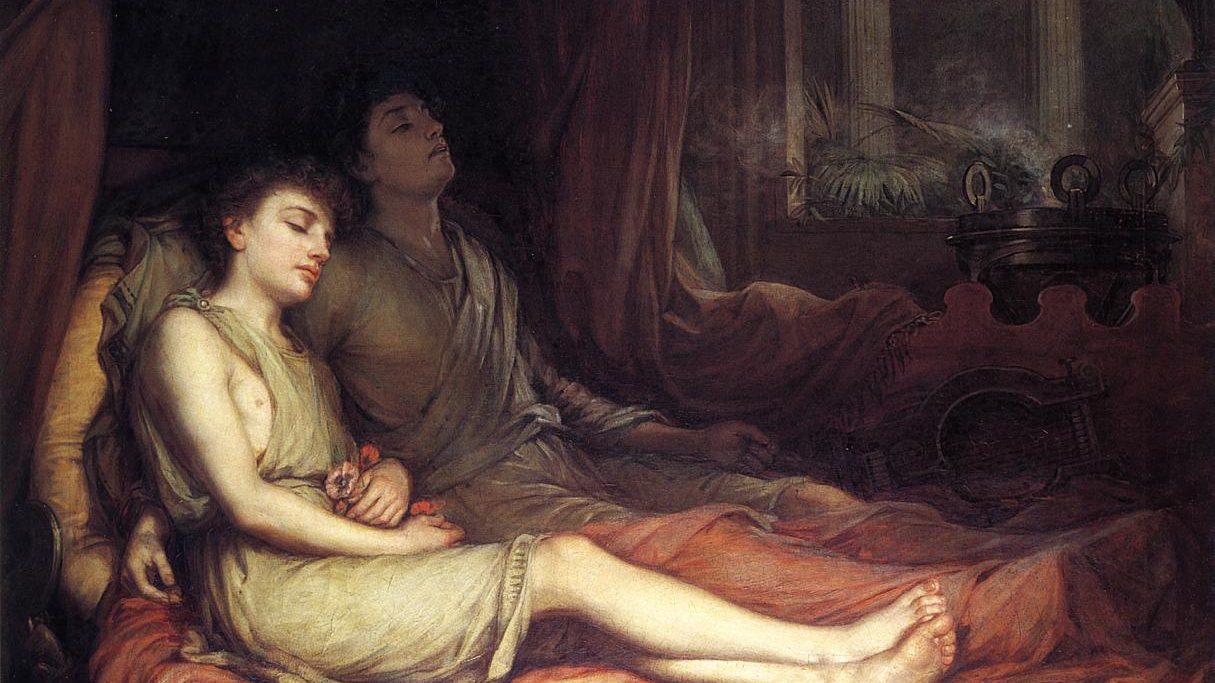
No surviving artwork can be identified as Pasithea with confidence, either. Classicists have proposed a small number of possible depictions, and none holds up without a caveat: an inscribed red-figure vase in Geneva names a figure "Pasithea," but Hesiod's Theogony gives that same name to an unrelated sea-nymph, so which figure the vase painter intended is not recoverable from the inscription alone. Hypnos, whose job title actually is sleep, has a far richer artistic record by comparison, including John William Waterhouse's 1874 painting of Hypnos beside his brother Thanatos, pictured above.
A search result calling Pasithea "the Greek goddess of sleep" with no further context is repeating a modern shorthand, not an ancient title. What the actual sources describe is a minor Grace who became sleep-adjacent through a single transaction in a war story, kept almost no myths of her own outside that transaction, and left later poets more divided over her parents than over her supposed domain.