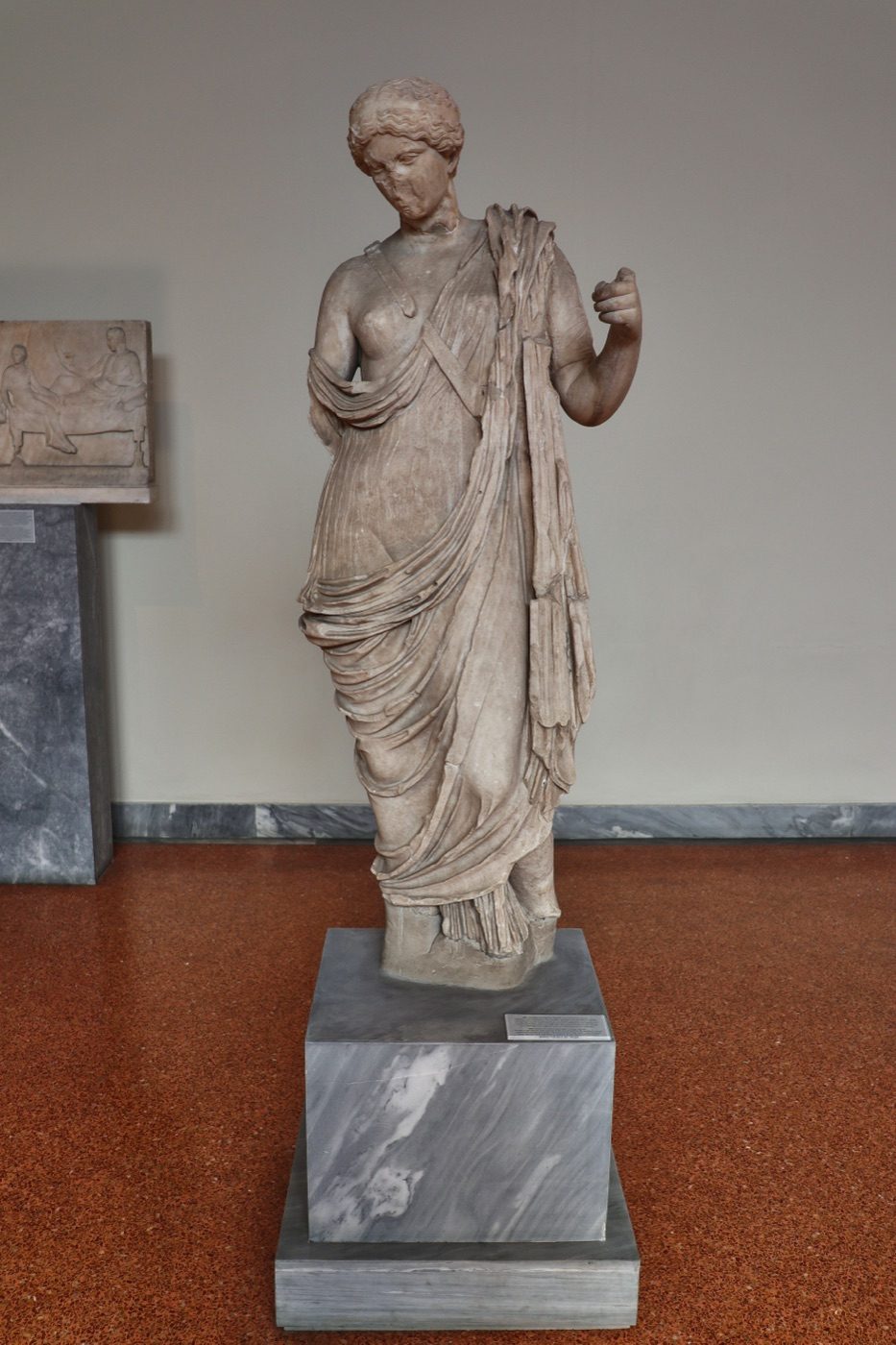
_in_the_National_Archaeological_Museum_on_2_July_2018.jpg)
The four-word power list undersells her
Search "aphrodite powers" and the answer that comes back is short: love, beauty, desire, sometimes procreation or eternal youth tacked on at the end. Some lists add a magic belt that makes people fall for whoever wears it. That short list is roughly how Aphrodite shows up in most surveys of the Greek goddesses, and all of it is accurate. None of it explains why a visitor touring Sparta, Cythera, or the summit of Acrocorinth around AD 175 would have found Aphrodite standing there fully armed.
Pausanias, the geographer whose Description of Greece is the fullest surviving record of what actual ancient sanctuaries looked like, recorded an armed cult statue of Aphrodite at three of her most important Greek sites, not one. He also left his own account of where the goddess's worship came from in the first place, and it starts nowhere near Greece.
Cythera: the oldest sanctuary in Greece armed her
Cythera, a small island off the southern Peloponnese, held what Pausanias considered Aphrodite's single most important sanctuary: "The sanctuary of Aphrodite Urania (the Heavenly) is most holy, and it is the most ancient of all the sanctuaries of Aphrodite among the Greeks. The goddess herself is represented by an armed image of wood" (Description of Greece 3.23.1). Not a minor shrine, not a regional variant. The oldest Aphrodite sanctuary Pausanias knew of held a wooden statue carrying weapons.
The same island shows up in an older, unrelated tradition too. Hesiod's Theogony has Aphrodite drift ashore at Cythera first, then Cyprus, after rising from sea foam gathered around Uranus's severed flesh, a birth story this site covers in full in the Greek family tree's two conflicting accounts of her origin. That is a myth about how she was born. Pausanias's claim is a separate, historical one about how her worship traveled centuries later, and it is the second story, not the first, that ends with a weapon in her hand.
Sparta: armed on the ground floor, chained on the floor above
Sparta's temple to Aphrodite Areia, "the Warlike," was unusual even by Pausanias's own account: "A little farther on is a small hill, on which is an ancient temple with a wooden image of Aphrodite armed. This is the only temple I know that has an upper storey built upon it" (Description of Greece 3.15.10). The ground floor held the armed goddess. The upper floor held something stranger.
"It is a sanctuary of Morpho, a surname of Aphrodite, who sits wearing a veil and with fetters on her feet. The story is that the fetters were put on her by Tyndareus, who symbolized by the bonds the faithfulness of wives to their husbands" (3.15.11). Pausanias records a second, harsher explanation, that Tyndareus chained the goddess to punish her for the scandal his own daughters caused, and rejects it outright: "it were surely altogether silly to expect to punish the goddess by making a cedar figure and naming it Aphrodite." Eighteen centuries before modern classicists started arguing about what her cult statues meant, a visitor to the temple was already correcting the record on the spot.
Corinth: she used her lover's shield as a mirror
At the summit of Acrocorinth, overlooking Corinth from the same rock that later held the city's fortress, Pausanias found a third armed Aphrodite sharing a temple with two other deities: "On the summit of the Acrocorinthus is a temple of Aphrodite. The images are Aphrodite armed, Helius, and Eros with a bow" (2.5.1). The temple itself was gone by the time modern archaeologists could examine it directly, but it appears on multiple Roman-era Corinthian coins, and those coins preserve a detail Pausanias's own text does not spell out: the statue holds up a shield in front of her body and uses it as a mirror.
A goddess of love checking her reflection in a shield, rather than a hand mirror or still water, is not a small stylistic choice. It puts a weapon at the center of her most personal, vain moment, in the same temple where Pausanias records her standing armed alongside Helius and Eros. Her marriage to Hephaestus, the god she is repeatedly caught betraying with Ares in Homer's Odyssey, only sharpens how much war imagery keeps turning up around her, even in scenes that have nothing to do with battle.
Where the armor came from, in Pausanias's own account
Pausanias did not think Aphrodite's cult started in Greece at all. Describing a separate sanctuary of the Heavenly Aphrodite in Athens, he traces the whole chain of transmission: "the first men to establish her cult were the Assyrians, after the Assyrians the Paphians of Cyprus and the Phoenicians who live at Ascalon in Palestine; the Phoenicians taught her worship to the people of Cythera" (1.14.7). By his own account, the sanctuary he elsewhere calls Greece's oldest and holiest was itself an import, several stops removed from its actual origin.
Modern classicists studying the wave of Near Eastern influence on early Greek religion, an era scholarship since Walter Burkert's 1984 work generally calls the Orientalizing period, have connected that transmission chain to Ishtar and Astarte, Mesopotamian and Levantine goddesses whose portfolios combined love with war rather than separating them. The Getty Villa's 2012 exhibition on Aphrodite's origins put it plainly: those Near Eastern deities "were associated with power, fertility, and war," a combination the later, softer Greek image of Aphrodite mostly dropped. Not every classicist accepts a clean, direct line from one goddess to the other. Stephanie Budin's essay "Aphrodite Enoplion," in the 2010 Brill's Companion to Aphrodite, argues specifically that the evidence for a straightforward one-to-one transfer from Ishtar or Astarte to Aphrodite is weaker than the tidy version of the story usually suggests, even as she treats Aphrodite's own martial imagery as real and worth explaining on its own terms.
The power everyone already knows about does something rougher than romance
The one Aphrodite power that does show up reliably in modern summaries is her embroidered girdle, the kestos himas she lends Hera in Iliad Book 14 so Hera can distract Zeus while the Greeks gain ground at Troy. Homer describes exactly what is woven into it: "loosed from her bosom the broidered zone, curiously-wrought, wherein are fashioned all manner of allurements; therein is love, therein desire, therein dalliance, beguilement that steals the wits even of the wise" (Iliad 14.214-217, trans. A.T. Murray).
That is not a description of mutual affection. It is a device built to override judgment, deployed in the middle of a war, by a goddess whose oldest and most important sanctuaries already showed her carrying a weapon of her own. The girdle and the armor are not two separate, contradictory sides of Aphrodite. In the sources Pausanias and Homer actually left behind, they read as the same power described twice.