,_part_2.JPG)
The Bronze Age tablets that put him first
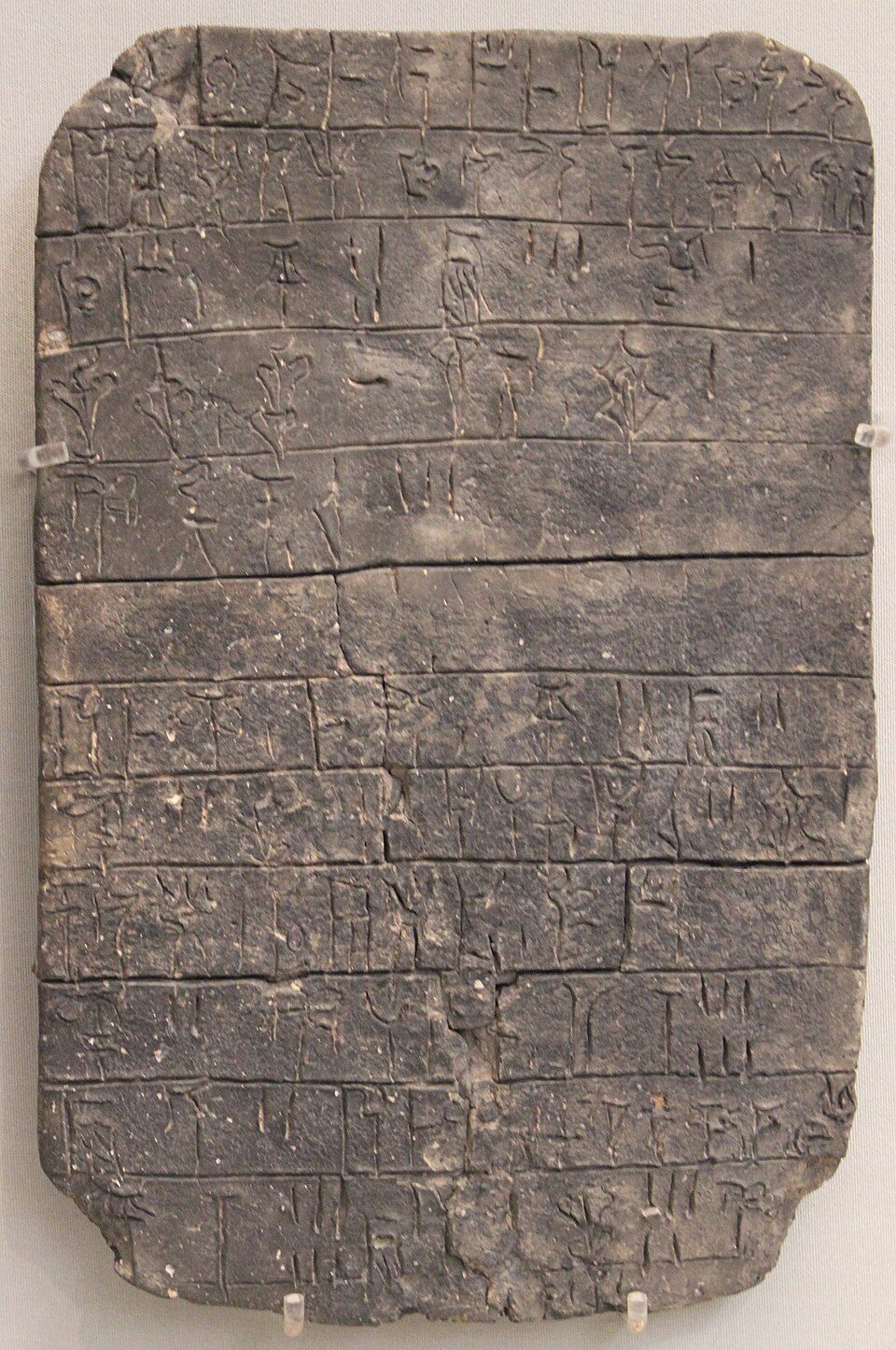
Ask most people to place Poseidon in the Greek pantheon and he lands in second position: the brother, handed the sea because Zeus had already taken the sky. The oldest written evidence for Greek religion does not support that ordering. It comes from clay tablets written in Linear B, the syllabic script the Mycenaean palaces used for accounting, and the richest surviving archive from the Greek mainland was baked hard by the fire that destroyed the palace at Pylos, in the southwest Peloponnese, around 1200 BC. Roughly 1,026 tablets survive from that one building. Only Knossos, over on Crete, has yielded more, about 4,158, out of some 6,058 known Linear B inscriptions in total.
Poseidon appears in the Pylos archive as po-se-da-o and po-se-da-o-ne, and he appears constantly. Jeremy B. Rutter, professor of classics at Dartmouth College, sums up the situation in his Aegean prehistory course notes: Poseidon was "evidently the most important deity at Pylos, to judge from the frequency with which he is mentioned in the texts there." Zeus is in the same archive, as di-we and di-wi-je-u, but he is not where the accounting centres.
The offerings logged for Poseidon were not token gestures either. Pylos texts record cattle, sheep and pigs sacrificed to him, plus specially perfumed oil, which sets the mainland practice apart from the bloodless offerings recorded at Knossos. One heavily argued tablet, Tn 316, lists gold vessels together with men and women assigned to a run of divinities. Most readings take that as people being consecrated to a deity's service, though the alternative, that they were human sacrifices made as the palace faced destruction, has never quite gone away.
None of this proves that Poseidon was once king of the gods in any tidy narrative sense. A palace archive records what one administration paid for in one region, not a theology. What it does show is that the pantheon most people carry around, with Zeus fixed at the top and Poseidon managing the water, is a later arrangement. In the earliest documents we have from Greek speakers, the god who ended up on top is not the one the scribes wrote down most often.

The version everyone already has
It is worth laying out the familiar Poseidon first, since the rest of this argues with him. He is one of the twelve Olympians, brother to Zeus and Hades, god of the sea, and the Romans identified him with their Neptune. His consort is Amphitrite. His son Triton is the horn-blowing merman, and the Cyclops Polyphemus, blinded by Odysseus in the Odyssey, is also his, which is why the sea spends ten years working against that particular sailor. His emblem is the trident, and the dolphin, the bull and the horse all belong to him as well.
That last item is the loose thread. Everything else on the list is maritime or dynastic, and then there is a horse, sitting in the middle of it without explanation. Pull on it and a lot of Bronze Age evidence comes away with it.
Earth-shaker first, sea god later
The titles attached to Poseidon in early Greek poetry are the clearest sign that his portfolio was not originally maritime. Homer calls him enosichthon and ennosigaios, both of which mean earth-shaker, and gaieochos, holder or embracer of the earth. Across Arcadia he was worshipped as Poseidon Hippios, Poseidon of horses. None of those words has anything to do with water. The Linear B material also preserves the title e-ne-si-da-o-ne, Earth-shaker, generally read as his, which puts the earthquake function on him already in the Bronze Age.
The short Homeric Hymn to Poseidon (Hymn 22) keeps the two halves in view and treats them as matching grants rather than a day job and a sideline. In Hugh G. Evelyn-White's 1914 translation it opens: "I begin to sing about Poseidon, the great god, mover of the earth and fruitless sea, god of the deep who is also lord of Helicon and wide Aegae. A two-fold office the gods allotted you, O Shaker of the Earth, to be a tamer of horses and a saviour of ships!"
The Swedish historian of religion Martin P. Nilsson read the pattern geographically. On his account Poseidon started as an inland god of the Achaeans, tied to horses and to earthquakes, and only became primarily a god of the sea once Greek speakers migrated to Ionia and built their livelihoods around shipping. Walter Burkert approached it from another direction and connected the horse cult to the arrival of the horse and the war chariot in Greece from Anatolia around 1600 BC.
There is also an argument from silence in the tablets. Mycenaean Greece was a sea-dependent culture with a sea-dependent economy, and the Linear B material still gives no firm evidence tying Poseidon to the sea at all. In the one place where we can read what people actually asked of him, nobody is asking for calm water.
The stallion in Arcadia
Arcadia, the landlocked mountain country in the middle of the Peloponnese, held on to the horse version of Poseidon longest, and its local myths are blunt about what that meant. Pausanias, touring Greece in the second century AD and writing down what local guides told him, recorded the version kept at Thelpusa, on the river Ladon.
While Demeter was searching for her abducted daughter, Poseidon pursued her. In the Loeb translation by W. H. S. Jones and H. A. Ormerod, she "turned, the story runs, into a mare, and grazed with the mares of Oncius; realizing that he was outwitted, Poseidon too changed into a stallion and enjoyed Demeter" (Description of Greece 8.25.5). The Thelpusians told Pausanias the union produced two offspring: a daughter whose name they would not give to the uninitiated, and a horse called Areion. Then comes the line that matters most here. It was for that reason, they said, that they were the first Arcadians to call Poseidon Horse (8.25.7).
Demeter kept two local surnames out of the episode, and Pausanias is careful about what they mean. Fury, Erinys, he explains as an Arcadian idiom rather than a verdict on any single grievance: the goddess took it "because of her avenging anger, because the Arcadians call being wrathful 'being furious'", and she took the second, Bather, because she afterwards washed in the Ladon (8.25.6).
The story is unpleasant, and it was not told for entertainment. Cult titles in Greek religion generally track what people did at an altar rather than what poets found diverting, so a Demeter worshipped as Fury standing beside a Poseidon in horse form is evidence about ritual practice. The horse aspect was not a metaphor invented later to dress up a sea god. It looks like an older stratum of the cult that later poetry never fully covered over.
The geography is the awkward part. Arcadia is about as far from open water as mainland Greece gets, and that is exactly where the horse god is strongest and where a community claims to have named him first.
How he lost Athens
The most famous Poseidon story of the classical period is a defeat. He and Athena both claimed Attica, and he came second.
Apollodorus gives the fullest account in the Library. In Sir James George Frazer's translation: "So Poseidon was the first that came to Attica, and with a blow of his trident on the middle of the acropolis, he produced a sea which they now call Erechtheis. After him came Athena, and, having called on Cecrops to witness her act of taking possession, she planted an olive tree, which is still shown in the Pandrosium." Zeus declined to rule on it himself and appointed the twelve gods as arbiters, explicitly not Cecrops, whose role was to give evidence. They found for Athena, because Cecrops testified that her olive had come first, after which Poseidon "in hot anger flooded the Thriasian plain and laid Attica under the sea" (Library 3.14.1).
What makes this story unusual is that fifth-century Athenians could walk up the hill and point at the evidence. Herodotus, describing the Persian sack of the Acropolis in 480 BC, writes that in the temple of Erechtheus "there is an olive-tree and a sea, which (according to the story told by the Athenians) Poseidon and Athene, when they contended for the land, set as witnesses of themselves." He then reports that the Athenians who had been "commanded by the king to offer sacrifice" went up the day after the fire and found a shoot about a cubit long already run up from the stock of the burnt tree (Histories 8.55, G. C. Macaulay's translation).
The losing god did not vacate the site. Poseidon kept a place on the Acropolis fused with the local hero Erechtheus, and the salt pool stayed on display next to the olive for centuries. He lost the city and kept an altar in it. That is a different kind of outcome from the way Athena arrived in the world, fully grown and already armed, with the city's name attached to hers.
A lot drawn, not a demotion handed down
Homer never presents the sea as a consolation prize. In Iliad 15, Zeus sends Iris to order Poseidon off the battlefield at Troy, and the reply is the sharpest statement of divine rank in Greek epic. In A. T. Murray's 1924 translation, Poseidon answers that Zeus "hath spoken overweeningly, if in sooth by force and in mine own despite he will restrain me that am of like honour with himself."
He then sets out the arrangement. Three brothers were born of Cronos and Rhea, Zeus, Poseidon and Hades, and lots were cast. Poseidon drew "the grey sea to be my habitation for ever," Hades drew "the murky darkness," Zeus drew "the broad heaven amid the air and the clouds," and earth and Olympus were left common to all three.
That last clause is what the speech turns on, and it usually gets dropped from retellings. Poseidon is not sulking about a smaller share. He is making a jurisdictional argument: the ground at Troy belongs to no one's allotment, so Zeus has no standing to give orders on it. He does back down when Iris presses him, but grudgingly. He names Athena, Hera, Hermes and Hephaestus as parties to the same grievance, and warns that if Troy is spared the resentment between himself and Zeus will never be settled.
For anyone reading later versions in which Poseidon is simply Zeus's subordinate, that scene is where the tidy hierarchy comes apart. In the oldest Greek poem we have, he denies it to Zeus's own messenger, out loud, and is talked round rather than overruled.
A name that will not translate
Part of the reason Poseidon's early history stays murky is that his name refuses to decode. Etymonline records the Greek Poseidon alongside the Doric form Poteidan and calls it, flatly, "a name of uncertain origin."
The best-known attempt splits it into posis, husband or lord, plus da, taken as an old word for earth, producing "lord of earth" and lining up neatly with the earth-shaker epithets. It is an attractive reading. It is also unproven: Burkert judged the husband-of-Earth interpretation quite impossible to prove, and Robert Beekes' Etymological Dictionary of Greek notes there is no indication that da means earth at all. Beekes suggests the name is probably Pre-Greek, inherited from whoever occupied the Aegean before Greek speakers arrived. A rival proposal reads the second element as dawon, water, which would make him master of waters instead.
Set that against his brother. Zeus's name runs cleanly back to a reconstructed Indo-European sky father and resurfaces in Latin as Jupiter, so the pedigree is traceable across half a continent. Poseidon has no such line. If Beekes is right, the god the Pylos palace was slaughtering cattle for carried a name Greek speakers borrowed rather than brought, which would fit a deity whose oldest functions sit awkwardly beside the job everybody remembers him for.
Second place is a late verdict
The compressed Poseidon in circulation now, the bad-tempered sea god with a trident and a grudge against Odysseus, is faithful to the Odyssey and to most of what classical Athens wrote down. It is not faithful to the whole record. The palace accounts at Pylos put him at the centre of a Bronze Age kingdom's religious spending. The hymn splits his office evenly between horses and ships. Arcadia was still worshipping the stallion when Pausanias came through in the second century AD, and his name is old enough that Greek itself cannot parse it.
The later ranking shows up in odd corners. No temple of Poseidon appears on the Hellenistic list of the Seven Wonders of the Ancient World, while Zeus got the seated statue at Olympia. That list was tourist literature about buildings rather than a league table of gods, and Poseidon had major sanctuaries of his own at Sounion and at Isthmia, so on its own it proves nothing. Of those seven, only the pyramid raised for Khufu at Giza is still standing, and one entry, a garden nobody can place on a map, may never have existed in the city its name assigns to it.
Ranking Poseidon second is an old habit. It is just not as old as he is.