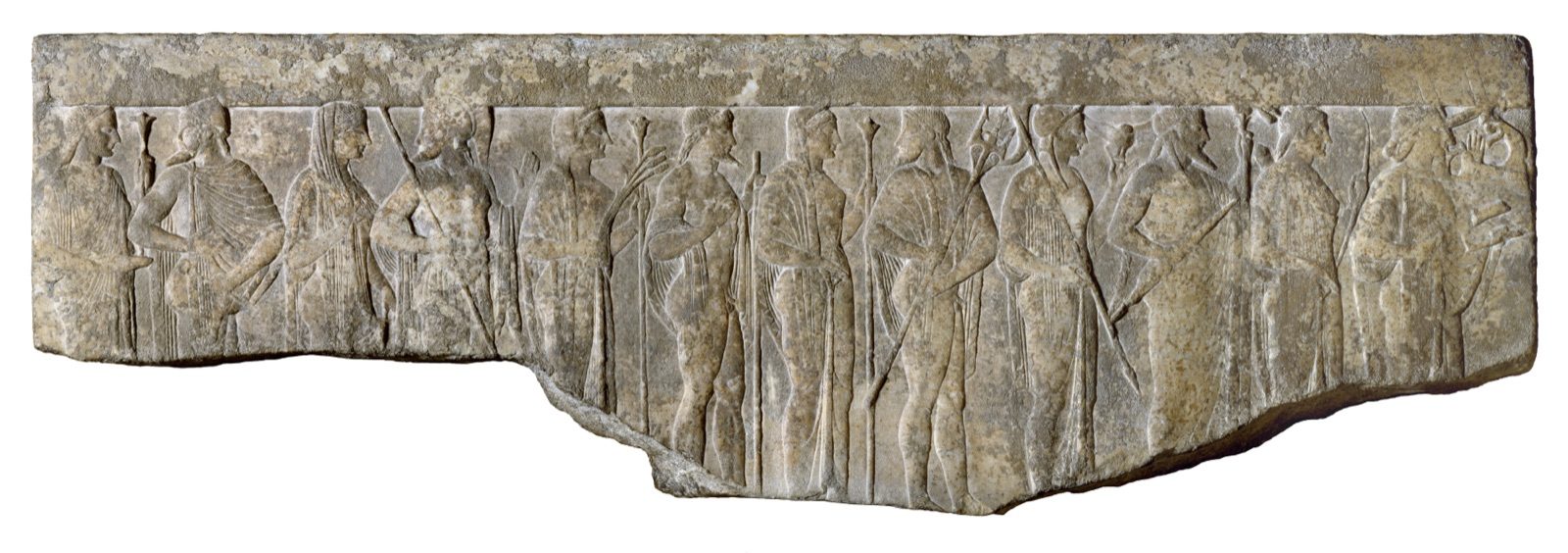

A list that looks more settled than it is
Search "greek gods" today and you get the same tidy package almost everywhere: a numbered list of twelve names, Zeus at the top, presented like a roster that was carved in stone once and never touched again. It reads like ancient consensus. It was not. The two most prominent public monuments Athens itself built to honor "the twelve gods" a century apart could not agree on who belonged in the group, and neither could the sanctuary at Olympia, which kept a tradition of its own that did not match Athens at all.
This is not a case of a single ancient author getting overruled by a later one, the way a scientific fact gets revised. Greek religion had no central authority handing down an official roster, no equivalent of a church council settling doctrine. Every city, every sanctuary, every generation of builders and poets worked out its own version of "the twelve gods" as a local, practical matter, and the surviving evidence for two of Greece's most important religious sites shows exactly how far those versions could drift from each other.
That disagreement is not a modern discovery. It was visible enough in antiquity that a classicist writing about Plato centuries later could point to it directly: at Athens, "there was a discrepancy in the list of the twelve chief gods, as to whether Hestia or Dionysus was included with the other eleven," as Kenneth Dorter put it, describing a gap the Greeks themselves lived with rather than resolved.
Two Athenian monuments, two different rosters
The earlier of the two is the Altar of the Twelve Gods, dedicated in the Athenian Agora around 522/1 BC by Pisistratus the Younger, grandson of the tyrant of the same name, during his year as archon. Thucydides records the dedication directly in Book 6 of his History of the Peloponnesian War. The altar quickly became more than a religious marker: from at least the 5th century BC on, it served as Athens's central milestone, the fixed point from which distances to the city were measured. A surviving marker from around 400 BC gives the distance to the harbor as "forty-five stades from the altar of the twelve gods," and Herodotus uses it the same way, as a shared reference point everyone in the city would recognize.
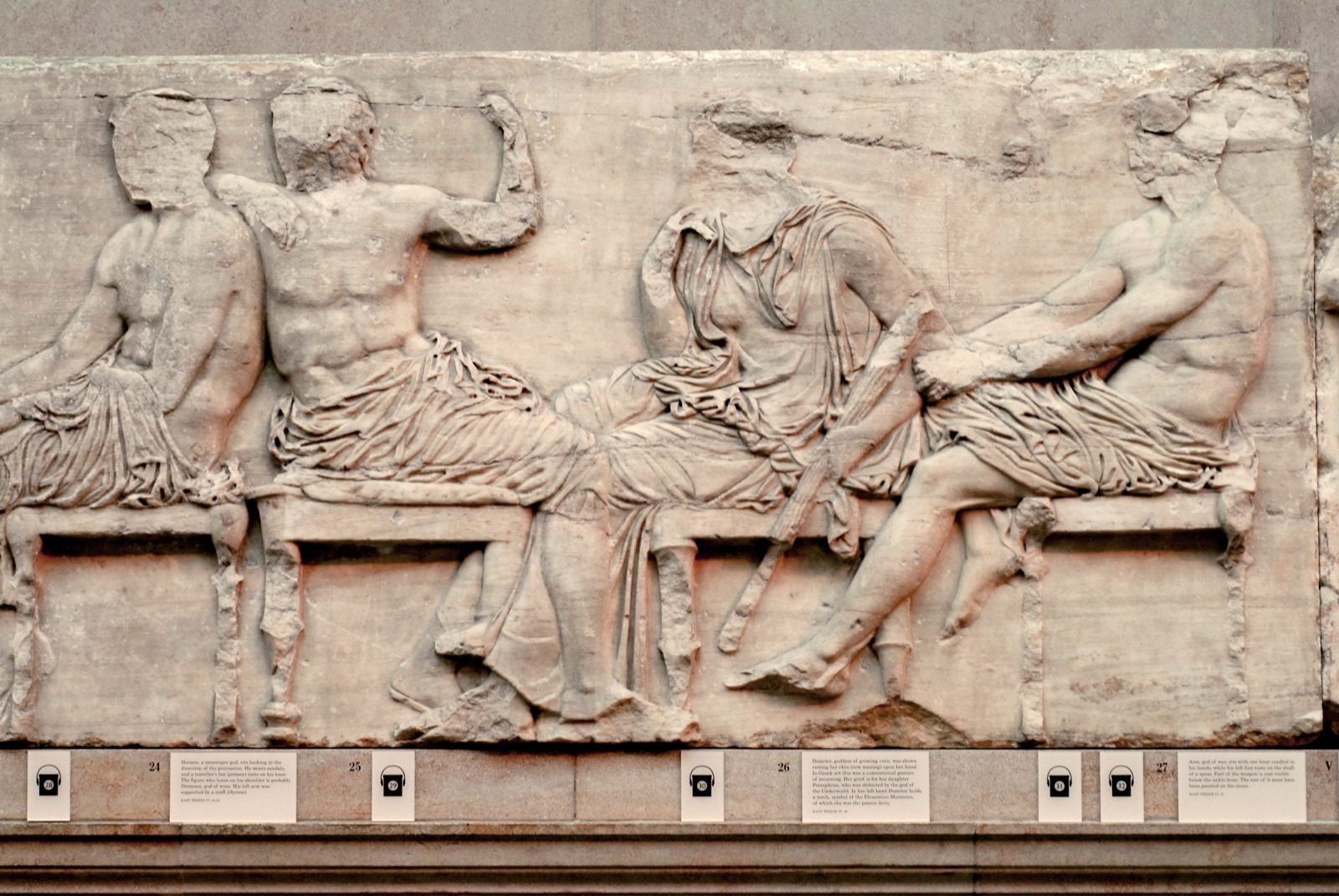
The exact twelve honored at that altar are not fully recorded, but ancient testimony ties it to Hestia rather than Dionysus. Roughly a century later, the Parthenon's east frieze, carved under Pheidias's direction between about 447 and 432 BC, depicted the same idea of "the twelve gods" for a different purpose: the culmination of the Panathenaic Procession, Athens's biggest religious festival. Pheidias is the same sculptor behind the seated Zeus at Olympia and the Athena Parthenos, so the frieze and those two statues came out of the same workshop tradition. On the frieze's Block IV, four seated gods sit in a row: Hermes, Demeter, Ares, and Dionysos, twisted around in his seat with an arm resting on Hermes's shoulder. Hestia is nowhere on the frieze at all.

Olympia kept a count of its own
Athens was not the only place running its own version of "the twelve gods," and the sanctuary at Olympia shows just how loosely the number was actually applied. Pindar, writing around 480 BC, describes Heracles sacrificing to "the twelve ruling gods" at Olympia in one of his Olympian odes, among the earliest literary references to any such group anywhere in Greek religion. But when the historian Herodorus of Heraclea, writing around 400 BC, listed out Olympia's twelve as six paired altars, the roster he gave was not a Greek pantheon in the way people now picture it: Zeus and Poseidon, Hera and Athena, Hermes and Apollo, the Graces and Dionysus, Artemis and the river-god Alpheus, and, closing the list, the Titans Cronus and Rhea, Zeus's own parents. A river god and two deposed Titans, standing alongside eight familiar Olympians, is not a lineup that maps cleanly onto anyone's modern top-twelve. "The twelve gods" at Olympia was a ritual structure, a set of paired altars for sacrifice, more than it was a fixed cast of characters.
That distinction matters more than it first sounds. A pantheon, in the sense most people mean the word today, is a settled cast: a defined set of named characters with fixed relationships, the kind of thing you could put on a family tree. Herodorus's six pairs were not built for that purpose. They were built for sacrifice, one altar and one offering per pair, and the local river feeding the sanctuary earned a place at that altar the same way a major god did, because the ritual needed twelve stops, not because Alpheus belonged in anyone's mythology textbook.
Where the graceful seat-swap story actually comes from
The Hestia-versus-Dionysus gap usually gets explained away with a tidy story: Hestia, goddess of the hearth and famously the mildest-tempered of the Olympians, voluntarily gave up her throne to the younger, rowdier Dionysus to avoid stirring up conflict among the gods. It is a satisfying explanation, in character for Hestia, and it shows up across a huge number of mythology sites and blogs, often presented as though it were simply how the ancient story went.
No surviving ancient source tells it. Not Hesiod, not the Homeric Hymns, not Pausanias's own description of the sanctuary at Olympia, not Herodorus's six paired altars. Wikipedia's own entry on Hestia does not tell this story either: discussing the same Dorter passage above, it notes that the hearth itself was immovable and states plainly that "there is no story of Hestia's ever having been removed from her fixed abode." What the ancient evidence actually shows is not a single mythological event with a winner and a loser. It is plainer and messier than that: different Greek communities, working a century or more apart, building different public monuments, and simply not agreeing on where the twelfth seat went. The tidy seat-swap story is a modern smoothing-over of a gap the Greeks themselves never bothered to close.
Who actually gets counted today
The version now treated as standard runs: Zeus, king of the gods and ruler of Olympus, profiled in detail in our own look at the god behind the name; Hera, his wife and queen; Poseidon, god of the sea, earthquakes, and horses, whose Bronze Age standing at Pylos actually outranked Zeus himself; Demeter, goddess of the harvest; Athena, goddess of strategic warfare and craft, born fully grown from Zeus's own head; Apollo, god of prophecy and music; Artemis, his twin, goddess of the hunt; Ares, god of war; Aphrodite, goddess of love; Hephaestus, god of the forge; Hermes, the messenger god; and, filling the contested twelfth seat, either Hestia, goddess of the hearth, or Dionysus, god of wine, depending on which ancient monument or modern textbook is doing the counting.
That asterisk on the twelfth name is not a footnote to the story. It is the story. Twelve was never a closed, agreed-upon guest list handed down from some single mythological founding moment. It was a number that different Greek cities, writing and building across several centuries, kept reaching for and kept filling in slightly differently, and the disagreement was ordinary enough that nobody in antiquity seems to have thought it needed explaining.