A god assigned to the river's source
Khnum ranks among the oldest attested deities in Egyptian religion, worshipped continuously from the First Dynasty, around 2925 to 2775 BCE, into the Roman period. His original chief cult center was Herwer, near modern Al-Ashmunayn in Middle Egypt. He only became the dominant god of Elephantine, the island at Egypt's First Cataract near Aswan, from the New Kingdom onward, roughly 1539 BCE, when he took the title of overseer of the cataract itself.
His job at Elephantine was specific: regulating the Nile's annual flood, which Egyptians believed emerged from caverns beneath the island, the home of Hapy, the deity embodying the inundation. The hieroglyphic root in his name, hnmt, meant "well" or "spring." Over time a related word, khnm, came to mean "to shape" or "to build," tracking his growing identity as the god who did the actual shaping of what the flood's silt made possible. At Elephantine he headed a triad with his consort Satis and her daughter Anuket, both Nubian goddesses folded into the local cult.
Khnum picked up a long list of working titles across his major cult sites: "Lord of the Cataract," "Lord of Life," "Lord of the Field," and, at his second major center in Esna south of Thebes, "Lord of Esna." Rams associated with his cult were mummified and buried with gold headgear in stone coffins on Elephantine itself, physical evidence that the animal was treated as sacred rather than symbolic only, a detail that matters for how the Elephantine conflict described further down actually played out.
Shaping bodies on a potter's wheel
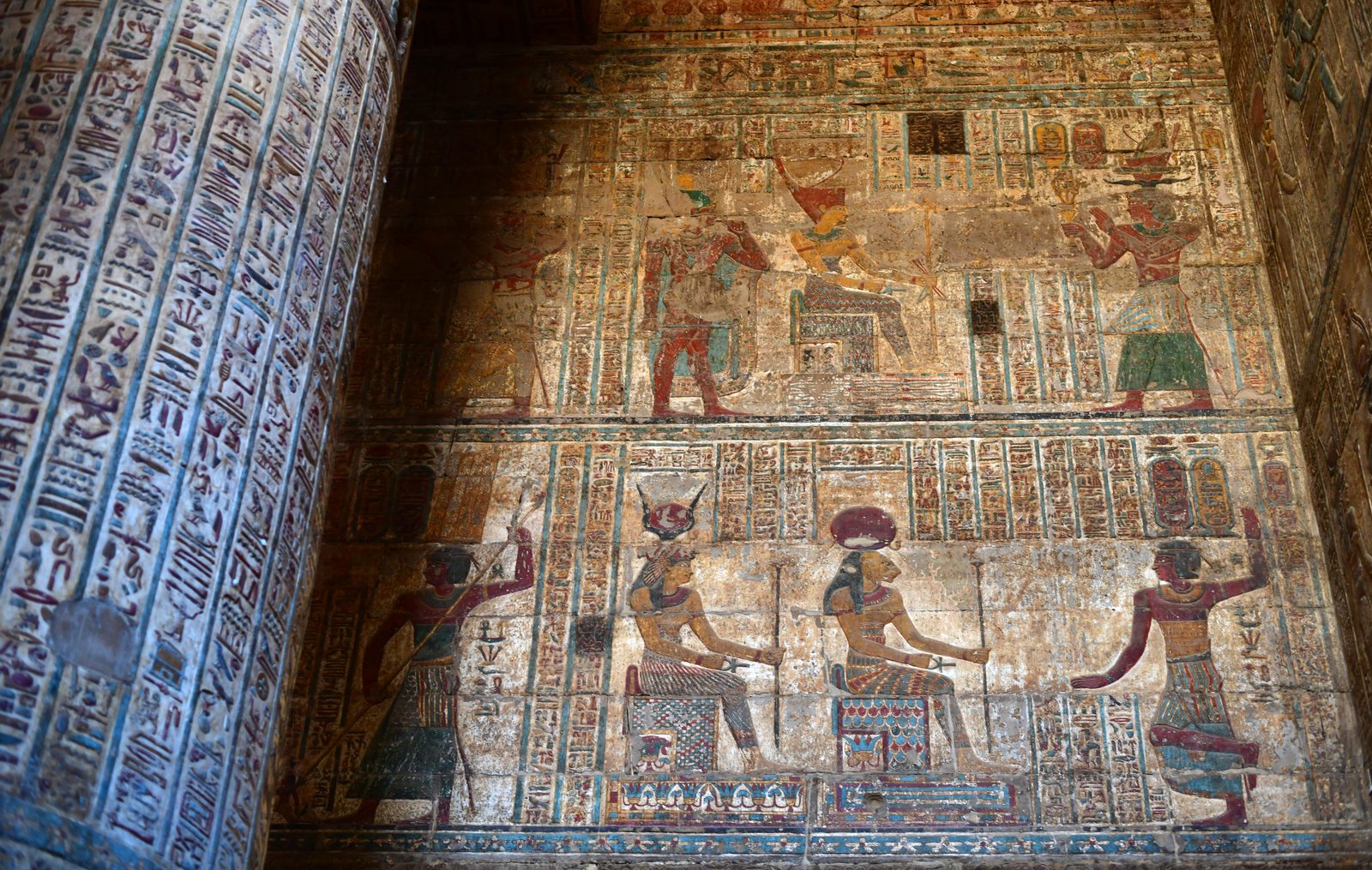
Khnum's central myth has him molding human bodies and their ka, or life force, out of Nile clay on a potter's wheel, then placing each one inside its mother's womb. The Great Hymn to Khnum, inscribed in his temple at Esna, credits him with fashioning gods, people, animals, and even the different languages spoken across Egypt's neighboring regions. Spell 214 of the Middle Kingdom Coffin Texts names him outright as the creator of humankind, and the Westcar Papyrus tells of the birth of three future kings to a woman named Ruddedet, where Khnum "infuses health" into each newborn and is paid a sack of barley for the service.
The same myth did real political work. Reliefs of Hatshepsut's divine birth at Deir el-Bahari, and of Amenhotep III's at Luxor Temple, both show Khnum forming the ruler's body and ka on his wheel, a claim that a pharaoh's fitness to rule was quite literally handworked by a god rather than only inherited by blood, one entry in the same rival Egyptian creation traditions that Heliopolis and Memphis were making on behalf of their own gods. Khufu's name carried the same devotion in a smaller form: his full name, Khnum-Khufwy, translates to "Khnum protects me," a dedication Egyptologists read as a sign of Khnum's rising religious importance in the Fourth Dynasty, during the reign of the king remembered today for the Great Pyramid of Giza.
Khnum rarely worked the wheel alone. Temple reliefs at Esna and the mammisi of Nectanebo II show him assisted by Heqet, a frog-headed goddess of fertility and childbirth, who tends the forming body while Khnum shapes it, and the pair are shown molding the god Ihy together at the Dendera Temple. The division of labor mattered to the theology: Khnum supplied the craft, but a newborn still needed Heqet's separate blessing to actually draw breath.
A face that changed with an extinction
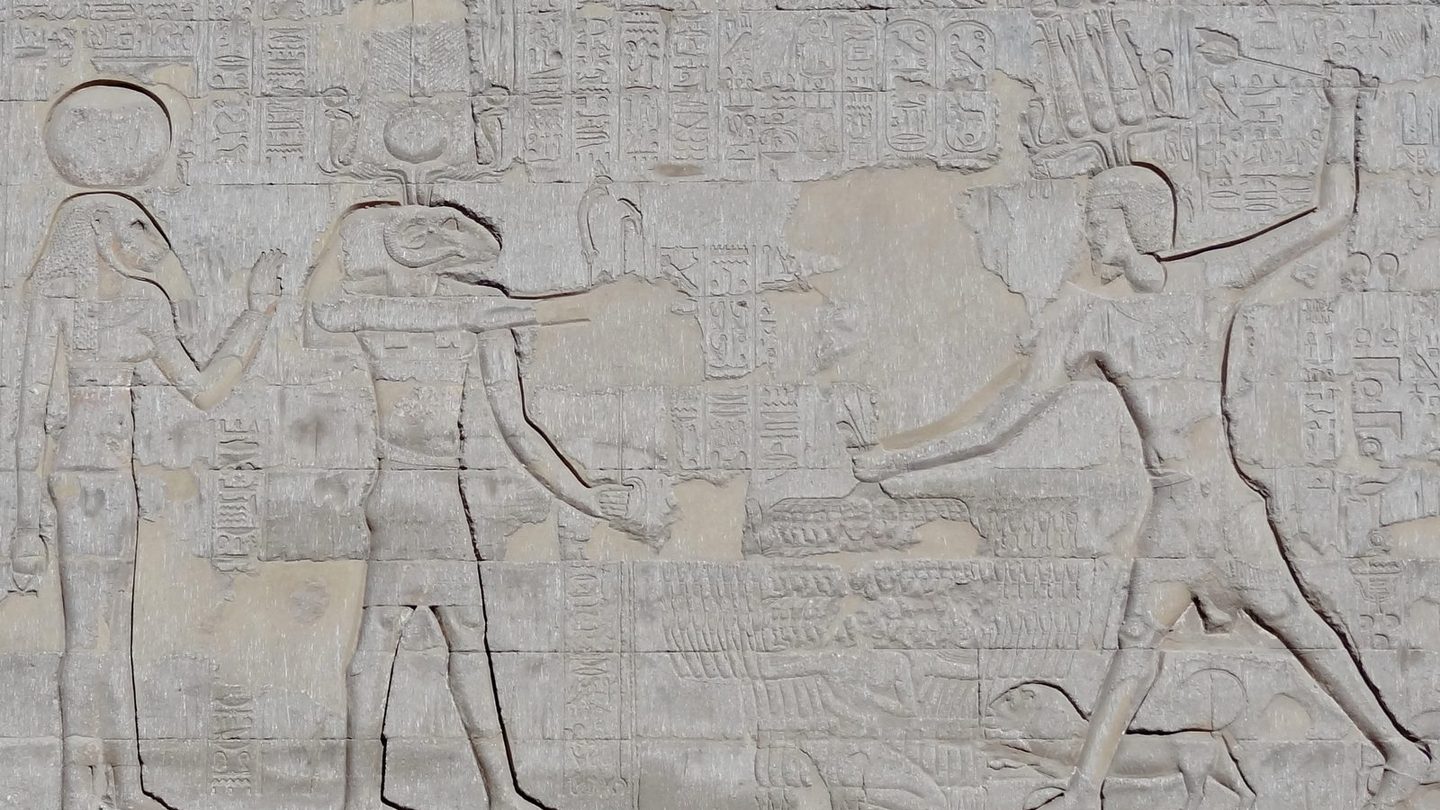
Khnum's ram horns are not a fixed detail. Early depictions give him horizontally spiraling, corkscrew-shaped horns, modeled on a real domesticated breed, the Ancient Egyptian corkscrew-horned sheep (Ovis longipes palaeoaegyptiacus), the earliest sheep breed raised in Egypt. That subspecies died out sometime during the New Kingdom. Egyptian artists responded by shifting Khnum's standard image to the downturned "horns of Ammon" style instead, modeled on a different, later breed, Ovis platyra palaeoaegyptiacus.
That is not stylistic drift. It is religious art tracking a real agricultural extinction: the god's face changed because the living animal artists had been using as his model disappeared from Egypt's flocks, and a new breed took its place as the culturally dominant sheep.
A famine stela that served the temple's interests
A rock inscription on Sehel Island, just south of Elephantine and squarely inside Khnum's territory, tells of a seven-year drought under King Djoser of the Third Dynasty, who reigned roughly 2686 to 2648 BCE. In the text, Djoser receives a vision of Khnum, who promises to end the famine if the king builds him a temple and dedicates a tenth of the region's revenue to it. Djoser complies, issues the decree, and the famine ends.
The inscription itself, though, was carved during the Ptolemaic Period, tentatively dated to around Year 18 of Ptolemy V, roughly 187 BCE, close to 2,500 years after Djoser's actual reign. Egyptologists Miriam Lichtheim and Werner Vycichl have both proposed that Khnum's priesthood likely composed the text, borrowing a revered Old Kingdom pharaoh's name to retroactively justify the temple's long-standing claim to that tithe. Real Egyptian temples did this routinely, attaching a famous ancient king's name to a much later institutional privilege. The Famine Stela is a documented case of the pattern, not a contemporary Old Kingdom record of Djoser's reign.
When Khnum's priests faced a temple next door
During the Persian period, a garrison of Jewish soldiers stationed at Elephantine maintained a temple to their own god, positioned close to Khnum's temple precinct. Their religious practice is documented mainly through the Elephantine papyri, a cache of Aramaic documents that first surfaced in the early 1900s. Tradition holds that the garrison's sacrifice of sheep, an animal sacred to Khnum, is what set the two temple communities against each other, though the evidence that such sacrifices actually took place there turns out to be thinner than the story built on top of it.
In 410 BCE, Khnum's priests destroyed the Jewish temple and looted its gold and silver. A petition the Jewish community sent to Bagohi, the Persian governor of Judah, dated November 25, 407 BCE, describes how "the priests of Khnub, in agreement with Vidranga," the Persian official in charge of the region, "decided to remove the Temple of YHW from Elephantine." A 2025 study by Gad Barnea in the Journal of the American Oriental Society goes further, finding no clear evidence that the garrison ever sacrificed animals at all, and tying the destruction instead to a political persecution campaign entangled with a man named Hananiah, likely a scion of Samaria's ruling Sanballat family, whose arrival in Egypt around 419 BCE Barnea connects to the unraveling that followed. Three years after the destruction, the Persian governor granted permission to rebuild, on condition that animal sacrifice never resume there. The rebuilt temple was abandoned sometime after 400 BCE. Wikipedia's summary of Khnum's life gestures only vaguely at "tensions" between the two temples; the fuller, still-contested account, including the named Persian official and the surviving petition text, comes from Elephantine-specific scholarship rather than any standard god-profile source.