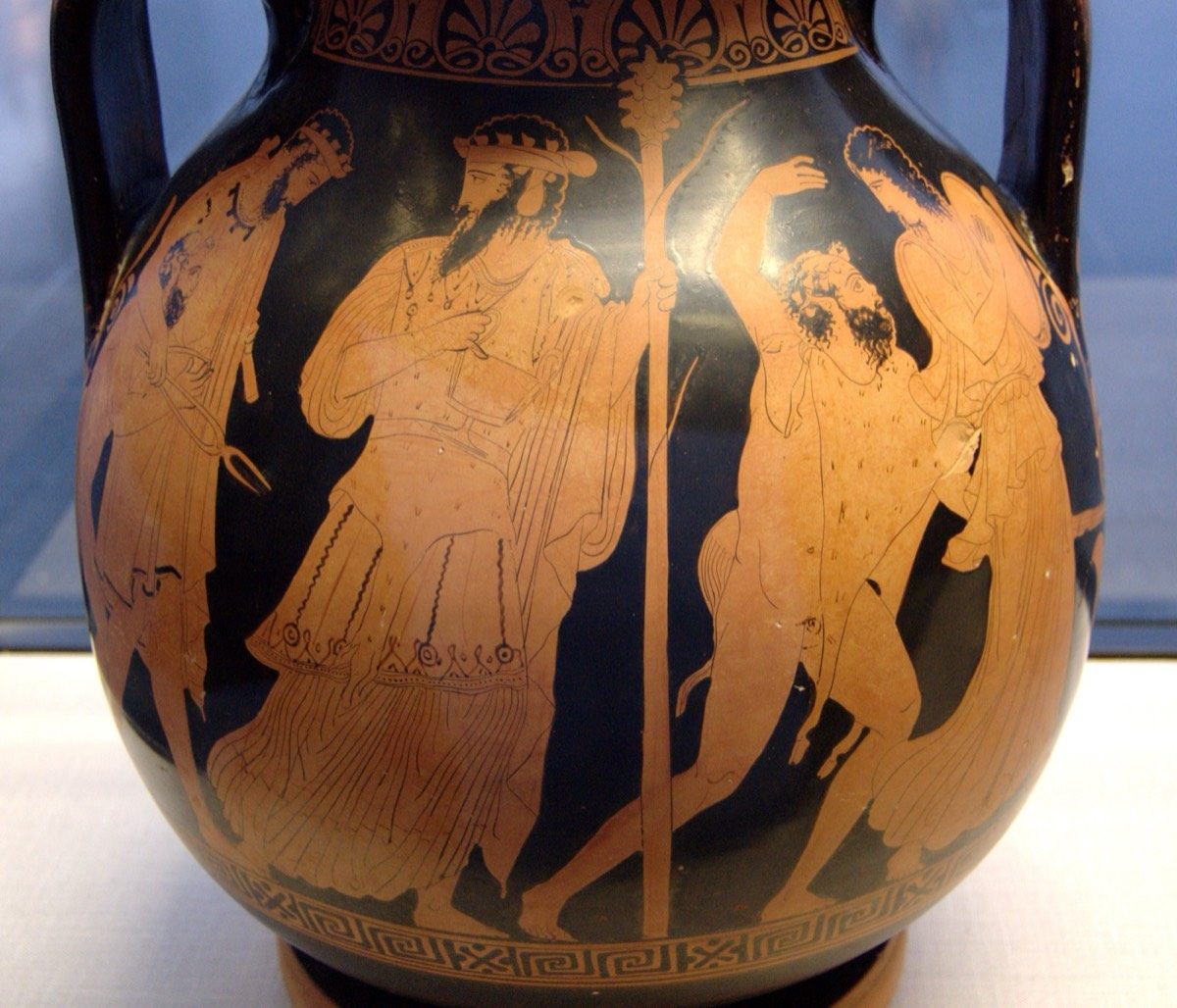

The one-line bio everyone gives him
Search "hephaestus god" and the results are unusually clean for a Greek mythology query: Wikipedia, Britannica, theoi.com, and reference sites like EBSCO's Research Starters dominate the page, with only a stray Percy Jackson fan wiki breaking the pattern. The consensus capsule bio that comes back is just as consistent: god of fire, metalworking, and craftsmen, the only Olympian with a physical disability, married off to Aphrodite, the butt of more jokes than any other god on the mountain. All of that is accurate. None of it explains why classicists keep writing papers and magazine essays about him with titles like "The Robots Are Winning!"
What that capsule bio leaves out is the strangest line on his résumé. According to Homer, writing around the 8th century BC, Hephaestus built machines that could think. Not decorative statues, not clever metaphors: Homer describes attendants with intelligence, speech, and strength, plus furniture that drove itself, in enough mechanical detail that Daniel Mendelsohn, writing in the New York Review of Books in 2015, could use the scene to open an essay about the entire modern genre of robot fiction, arguing Homer had already split machine stories into "two categories of science-fiction narrative that have persisted to the present day."
Golden women with minds of their own
The passage sits in Book 18 of the Iliad, when the sea nymph Thetis visits Hephaestus's workshop to ask for new armor for her son Achilles. Homer does not rush past the visit. He stops to describe the god's household staff: "handmaidens wrought of gold in the semblance of living maids. In them is understanding in their hearts, and in them speech and strength, and they know cunning handiwork by gift of the immortal gods" (Iliad 18.417-420, A.T. Murray's translation). Three separate faculties get named, not one: understanding, speech, and physical strength, all attributed to figures Homer is explicit are made of gold rather than born.
The same workshop scene opens on an even stranger detail before the handmaidens ever appear. Hephaestus has just finished twenty tripods for his hall, fitted with "golden wheels beneath the base of each that of themselves they might enter the gathering of the gods at his wish and again return to his house" (Iliad 18.373-379). A hundred lines later, once he actually starts forging, Homer describes twenty bellows that blew on the furnace "sending forth a ready blast of every force, now to further him as he laboured hard, and again in whatsoever way Hephaestus might wish" (18.469-472), tools that vary their own output on command, not just constant airflow.
None of this is confined to one scene. In the Odyssey, the palace of King Alcinous is guarded by gold and silver dogs Hephaestus forged, "immortal and unaging all their days" (Odyssey 7.91-94). And in a later telling by the mythographer Pseudo-Apollodorus (Bibliotheca 1.9.26), one of two competing origin stories credits Hephaestus with building Talos, the giant bronze automaton that patrolled Crete's coastline for King Minos, animated by a single vein running from neck to ankle and sealed at the bottom by a bronze nail. Kosmos Society, the classics-outreach project of Harvard's Center for Hellenic Studies, catalogues this whole set of automatons as a running theme across the epics rather than an isolated flourish, and Mendelsohn goes further, arguing the tripods and the handmaidens encode two distinct anxieties about automation that science fiction is still working through: machines that replace labor, and machines whose minds might rival their makers'.

Thrown from Olympus twice, by two different gods, for two different reasons
Hephaestus's own origin is where Homer stops being consistent with himself. In Iliad Book 18, Hephaestus is recounting his history to Thetis and says Hera threw him out of Olympus herself, ashamed of his lameness, and that he fell into the sea and was raised in secret for nine years by the nymphs Thetis and Eurynome (18.395-405), which is also, awkwardly for a description of one's own mother, why he owes Thetis a favor and drops everything to forge Achilles a new shield.
Book 1 of the same poem tells a different story. There, Hephaestus says Zeus was the one who hurled him down, gripping him by the foot and flinging him from the heavenly threshold for taking Hera's side in an argument between his parents; he says he fell for a full day before landing on the island of Lemnos, "and but little life was left in me," where the local Sintian people found him and nursed him back to health (Iliad 1.590-594).
Hesiod's Theogony, composed independently of Homer, complicates the parentage question further: it says Hera bore Hephaestus entirely on her own, without Zeus, specifically in retaliation for Zeus fathering Athena without her. The Odyssey, meanwhile, refers to Hephaestus as having two parents, implying joint descent from Zeus and Hera after all. None of these accounts was ever formally reconciled in antiquity; ancient audiences seem to have held two or three versions of Hephaestus's worst day in their heads at once, the same way they tolerated competing rosters of exactly who belonged among the Twelve Olympians.
A marriage nobody in the myths calls happy
Hephaestus's marriage gets treated, across nearly every ancient telling, as compensation rather than romance. He is paired with Aphrodite, and the mismatch is the whole story: the bard Demodocus's song in Odyssey Book 8 has Aphrodite carrying on an affair with Ares behind her husband's back, discovered when Helios, the sun god who sees everything, tips Hephaestus off. His response is not confrontation. He builds a trap, a net of chains fine enough that "not even one of the blessed gods" could see it, rigs it around his own marriage bed, then leaves for Lemnos and waits for word that Ares has taken the bait.
When the net springs, Hephaestus calls the rest of the Olympians in to witness the pair caught together, and the scene plays as public comedy rather than tragedy: several gods laugh at the display, and Poseidon eventually talks Hephaestus into releasing the couple by personally guaranteeing that Ares will pay compensation. Most retellings play the episode as slapstick at Ares and Aphrodite's expense, but the underlying arrangement, a craftsman god married to the goddess of beauty as a kind of consolation prize and forced to catch her in a trap rather than simply being loved back, is rarely played for laughs by Hephaestus himself in the ancient text.
The gear everyone else in the pantheon depended on
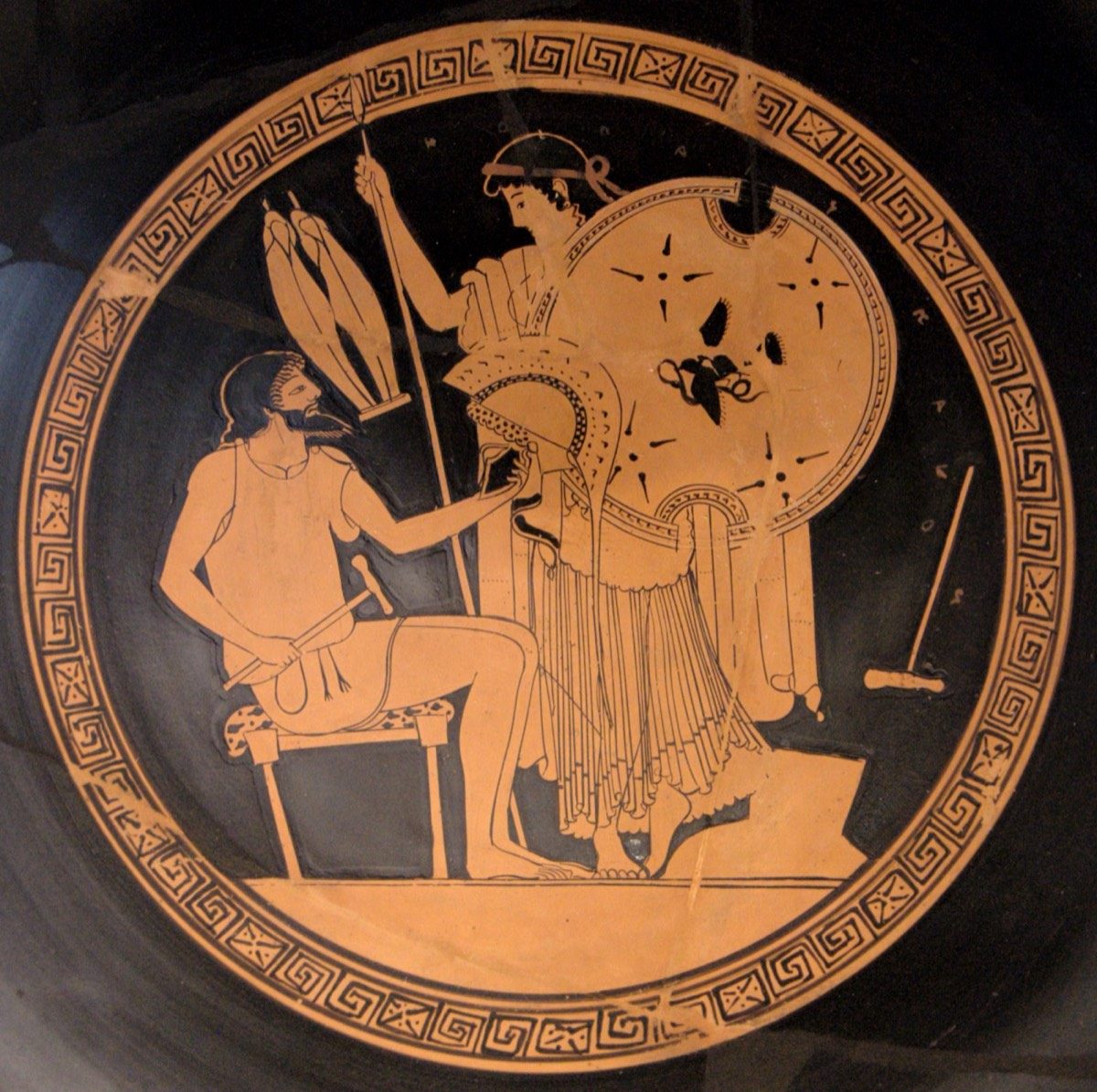
Outside his own household, Hephaestus functions as the pantheon's arms supplier, and Thetis's visit in Book 18 is only the most famous commission. The Foundry Painter's kylix, made in Athens around 490-480 BC and now in Berlin's Altes Museum, shows the moment directly, tongs and hammer still in the god's hands as he passes over the finished set. Wikipedia's summary of his broader portfolio also credits the same workshop with Zeus's thunderbolt, Poseidon's trident, and Hermes's winged sandals, plus, at Zeus's specific instruction in Hesiod's Works and Days, the first woman, Pandora, molded out of earth and water as a gift to humanity that came with unadvertised strings attached.
One popular image of Hephaestus's workshop does not actually belong to his original Greek myth: Cyclopes hammering away for him under Mount Etna is a Roman elaboration, staged most famously by Virgil in the Aeneid for Vulcan, Hephaestus's Roman counterpart, rather than a detail original to the Greek god. Greek tradition does connect Hephaestus to volcanic geography, through the epithet Aitnaios ("of Etna") and a cult presence on other active volcanic islands like Lipari and Hiera, but the specific picture of a Cyclops-staffed forge is a later Roman layer painted over an older Greek one, not a straight continuation of it.
Where people actually worshipped him
For a god this central to epic poetry, Hephaestus's cult footprint on the ground was oddly narrow. Wikipedia's overview of his worship describes him as having "almost no cults except in Athens," where the Hephaesteion, a Doric temple overlooking the ancient Agora, still stands today, one of the best-preserved temples anywhere in Greece precisely because it was later converted into a church rather than stripped for building material. His other real cult center was the island of Lemnos, which ancient sources treat as sacred to him specifically, home to an annual festival, the Hephaestia, and to the story of his landing there after Zeus threw him from Olympus.
That narrow footprint sits oddly against how much epic poetry leans on him, needed for the armor plot in the Iliad and for the household machinery in both epics, yet supplied with comparatively few altars of his own. It is a pattern that turns up elsewhere in this pantheon too: Poseidon was the most frequently invoked god in the Bronze Age palace archive at Pylos, centuries before Homer settled him into second place behind Zeus, proof that a god's narrative importance and a god's real-world cult footprint do not have to move together at all.