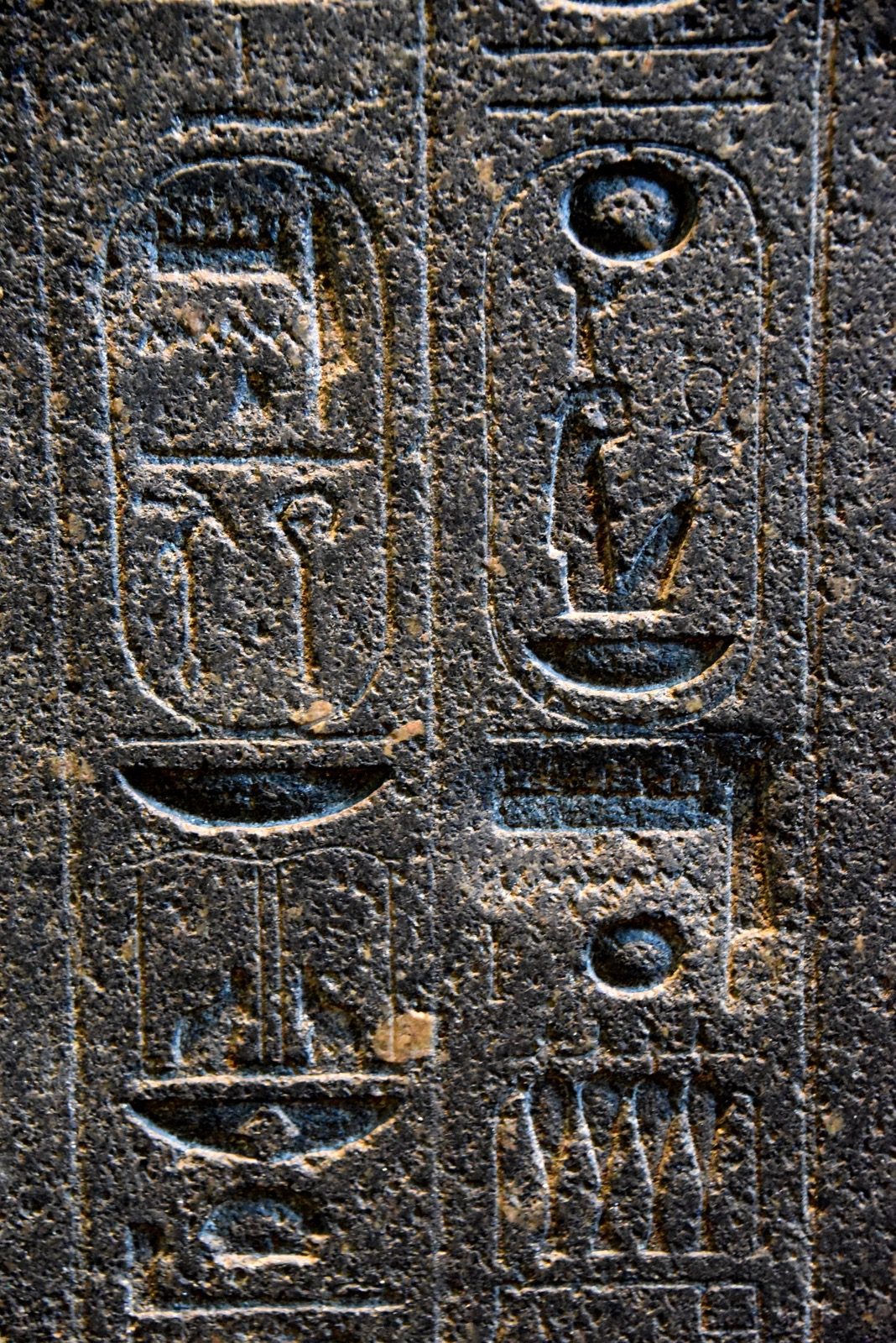
A list that looks more settled than it is
Search "Egyptian gods" today and the pattern is familiar: a tidy grid of ten or twelve names, Ra and Osiris and Isis near the top, presented like a finished roster. It reads like a settled pantheon with a fixed cast. It was never that simple, and the scale alone makes a single list impossible. Egyptologist James P. Allen has counted more than 1,400 distinct deities named in surviving Egyptian texts; his colleague Christian Leitz puts the real number at "thousands upon thousands," because plenty of texts name a god without describing what it did, and plenty of rituals describe a god's role without ever giving its name. Nobody, ancient or modern, has ever produced a complete list.
The bigger problem isn't the headcount. It's that Egypt never had one official story of how the gods, or the world, came to exist. Three of its most powerful religious centers, Heliopolis, Hermopolis, and Memphis, each ran a fully developed creation theology at the same time, taught by its own priesthood, carved into its own temple walls, and none of the three was ever declared correct at the others' expense. They simply ran in parallel for something like three thousand years.
Three cities, three different creators
At Heliopolis, the sun god Atum created himself out of the primeval waters, then produced Shu and Tefnut, whose children Geb and Nut in turn produced Osiris, Isis, Set, and Nephthys, nine gods in total known as the Great Ennead. This is the oldest of the three accounts to reach writing: it appears in the Pyramid Texts carved inside royal burial chambers of the Fifth and Sixth Dynasties, the same Old Kingdom period that raised the Great Pyramid at Giza, and Atum himself was already a major figure in those texts, sometimes merged with the sun god Ra as Ra-Atum.
Hermopolis rejected that starting point entirely. Its priesthood taught that before Atum or anyone else could act, eight primordial deities existed in four male-female pairs, representing the raw qualities of the pre-creation void: Nu and Naunet for the formless waters, Heh and Hauhet for their infinite extent, Kek and Kauket for the darkness inside them, Amun and Amaunet for their hidden, unknowable nature. Called the Ogdoad, the males were shown as frogs and the females as serpents, creatures that lived in the mud and murk the myth said they embodied. Long after Hermopolis lost political relevance, the hidden god Amun from this same Ogdoad would rise to become the state god of the New Kingdom. Other gods moved between roles without ever joining one of these official creator lineages at all: popular summaries assume Thoth judged the dead, but his actual job in the afterlife ceremony was narrower, recording a verdict that Anubis and Osiris were the ones who actually delivered.
Memphis rejected physical creation altogether. Its theology, centered on the god Ptah, held that Ptah created every other god, Atum included, not by any act of procreation but by conceiving each one in his heart and then speaking its name aloud with his tongue. Thought first, then speech, then existence. The clearest surviving statement of this idea is carved on the Shabaka Stone, a black granite slab now in the British Museum, commissioned by King Shabaka during Egypt's Twenty-fifth Dynasty.
The "ancient wisdom" on the Shabaka Stone might not be that ancient
The Shabaka Stone makes an extraordinary claim about its own origin. Its opening lines say the king found the Memphite theology written on a much older document and had it recopied because the original had decayed: it was, in the 1903 translation of Egyptologist James Henry Breasted, "a work of the ancestors, being eaten of worms; it was not legible from beginning to end." Breasted took that claim at face value. In that same paper he dated the underlying composition, in his own words, to a period "in or before the beginning of the New Kingdom (about 1600 B.C.)", centuries older than the stone itself, and called it the "oldest known formulation of a philosophical Weltanschauung" anywhere on record, a system of thought he believed had been fully worked out centuries before the first Greek philosopher was even born.
That dating hasn't held up unchallenged. Egyptologist Friedrich Junge and, later, R. S. Bianchi have argued that the stone's archaic grammar and its "ancient, worm-eaten original" framing were themselves a deliberate literary device: a Twenty-fifth Dynasty court, ruled by Kushite kings eager to present themselves as restorers of Egypt's true, ancient traditions, had every reason to dress up a newer composition as something rescued from the deep past. Under this reading, the Shabaka Stone is a text written close to when it was actually carved, roughly 700 BC, made to look far older than it is, not smuggled ancient philosophy at all. Which version is right remains an open argument among Egyptologists, not a settled fact either way, which is itself the point: even a single artifact that looks like hard proof of Egypt's oldest theology turns out to have its own unresolved dispute attached.
Merging gods instead of picking a winner
Egyptian religion had a standard tool for living with three unresolved creators, and it wasn't debate. It was syncretism: fusing rival gods into a single composite figure rather than declaring one version correct and discarding the others. When Thebes rose to political dominance during the Middle and New Kingdoms, its local god Amun, the same hidden Amun from Hermopolis's Ogdoad, didn't replace Heliopolis's sun god Ra. The two were merged into Amun-Ra, worshipped as one figure who was somehow still both. Ptah underwent the same treatment, absorbed into the composite Ptah-Sokar-Osiris, stitching the Memphite creator into the very Heliopolitan family line his own theology was supposed to have originated.
Egyptologist Erik Hornung, in Conceptions of God in Ancient Egypt: The One and the Many, treats this as the defining feature of how Egyptians actually thought about their gods: syncretism kept a scattered field of local deities from hardening into strict, separate polytheism, while also stopping the drift toward a single national god from ever completing itself, since "in Amun one apprehends and worships also Re," not Amun instead of Re. The divine stayed deliberately fluid rather than final. It's a different solution than Athens ever reached for its own contested twelfth Olympian seat: the Greeks argued over who belonged in one fixed group of twelve. Egyptian priesthoods mostly didn't bother forcing that kind of closure, which is also why a major death god like Anubis could operate for centuries outside Heliopolis's own nine-god Ennead without anyone treating that as a contradiction. That same cross-borrowing runs inside Anubis's own imagery too: the jackal and ritual emblem associated with him both turn out to be borrowed from elsewhere, the animal reclassified as a distinct African wolf lineage by a 2011 DNA study and the emblem originally tied to the Apis bull cult, not to Anubis.
The one pharaoh who tried to force a single answer
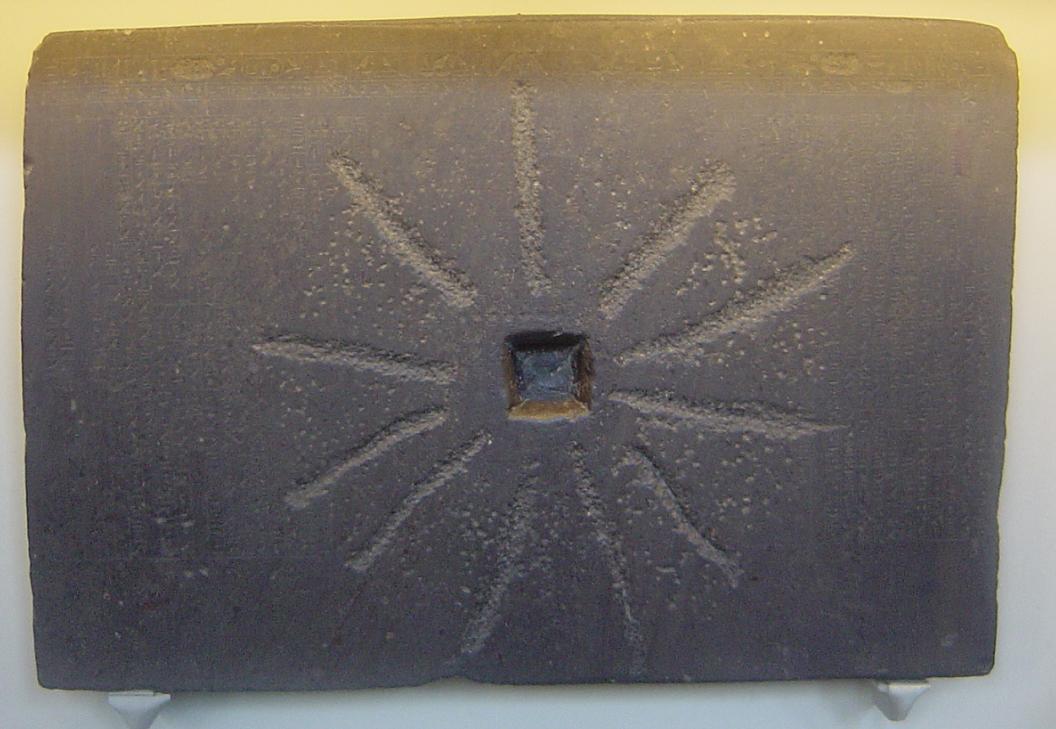
Exactly one ruler broke this pattern outright. Around 1353 BC, Akhenaten declared the Aten, the visible sun disc itself, the only god Egypt was permitted to worship, abandoning the old capital at Thebes for a new city, Akhetaten, founded around 1346 BC on a stretch of desert that had never belonged to any other god. He didn't stop at building a rival temple. He sent agents across Egypt to physically chisel the names of the old gods, above all Amun, out of temple walls, royal statues, and even small personal items like scarabs and cosmetic jars that ordinary Egyptians owned, on the theory that erasing a name could sever the god's presence from the object.
The reversal came almost as fast as the revolution had. Akhetaten was abandoned within roughly a decade of Akhenaten's death around 1336 BC, and his successors, Tutankhamun first and then Horemheb with far more force, restored the old gods and worked to erase Akhenaten the same way he had erased Amun: chiseling his cartouches out of monuments, reassigning temple lands and revenue back to Amun's priesthood, and folding the roughly twenty-five-year Amarna period out of Egypt's own official king lists entirely, so that later records ran straight from Amenhotep III to Horemheb as if the interruption had never happened. The one pharaoh who tried to collapse Egypt's competing creators into a single answer was erased by the very method he had used on everyone else, and the older, multi-answer system he tried to end kept running for well over a thousand years after him.