
A tomb built to outlast everyone who remembered it
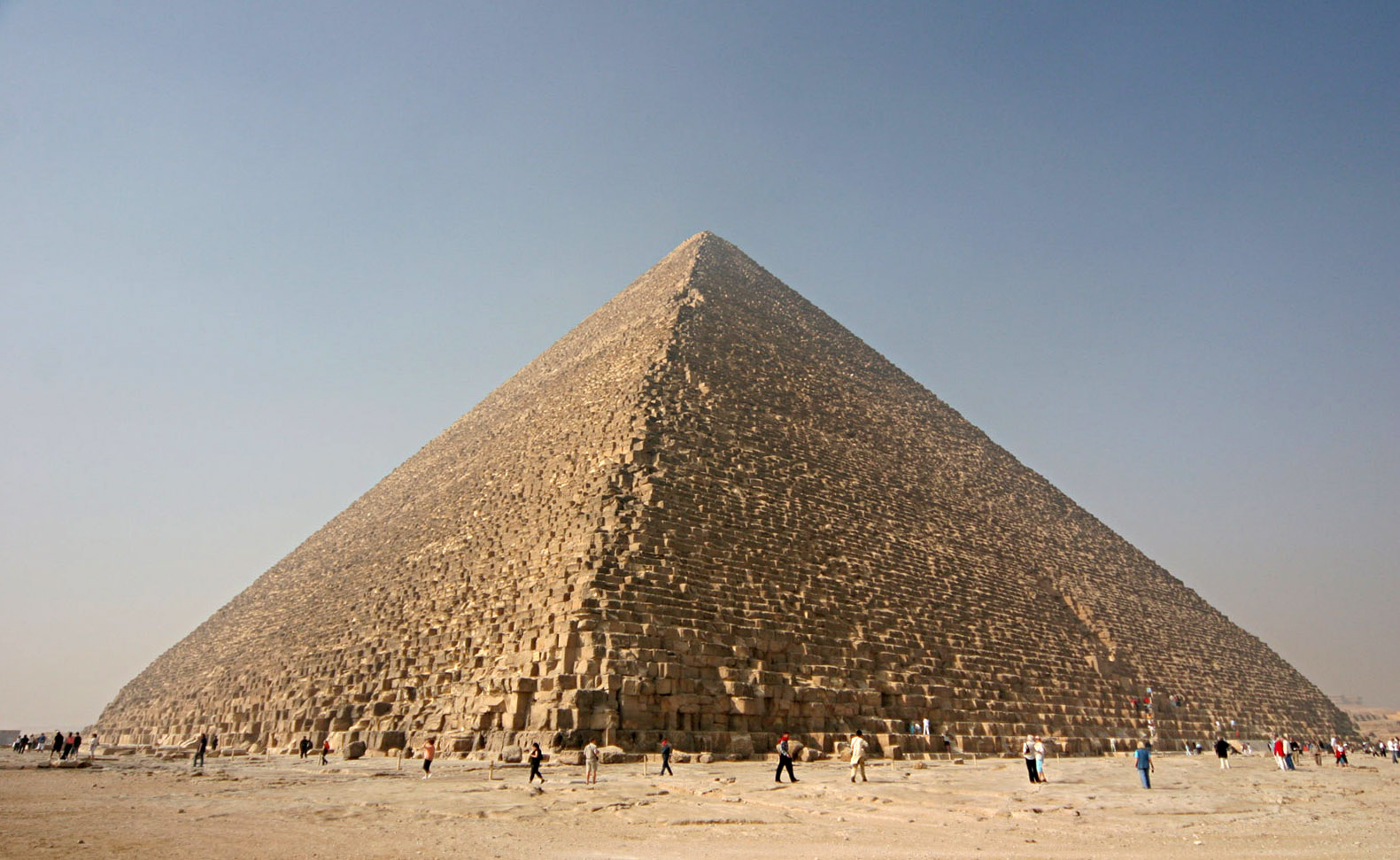
Around 2560 BCE, on a plateau just outside what is now Cairo, Egyptian workers finished the burial monument of Pharaoh Khufu, a ruler of Egypt's Fourth Dynasty. Ancient Greek writers later called him Cheops, a name that still turns up in some modern references to the pyramid. Construction is generally thought to have taken about 26 years. Radiocarbon testing on 46 samples of organic material recovered from the pyramid's own mortar calibrates to roughly 2871 to 2604 BCE, noticeably older than the traditional dates for Khufu's reign, an offset researchers attribute to the "old wood problem": the charcoal being dated can be centuries older than the fire that produced it. A later reanalysis that filtered out the oldest outlier samples narrowed that estimate to about 2620 to 2484 BCE, much closer to the conventional range. A separate radiocarbon-based chronology model built from hundreds of samples across the wider Old Kingdom, rather than a direct reading of this pyramid's own mortar, puts Khufu's reign specifically at roughly 2613 to 2577 BCE.
The scale of the thing is hard to picture even after you've read the numbers. At completion the pyramid stood 146.6 meters tall. It has lost about eight meters since then, mostly because the smooth white limestone casing that once covered it was quarried away centuries later to help build medieval Cairo, leaving the rougher core blocks exposed to the air for the first time in millennia. Each side of the square base runs 230.33 meters, and despite being laid out with nothing more advanced than sighting instruments and rope, the four sides differ in length by an average of just 58 millimeters. The corners come within 12 seconds of arc of a true right angle. A modern surveyor with a laser level would have a hard time beating that.
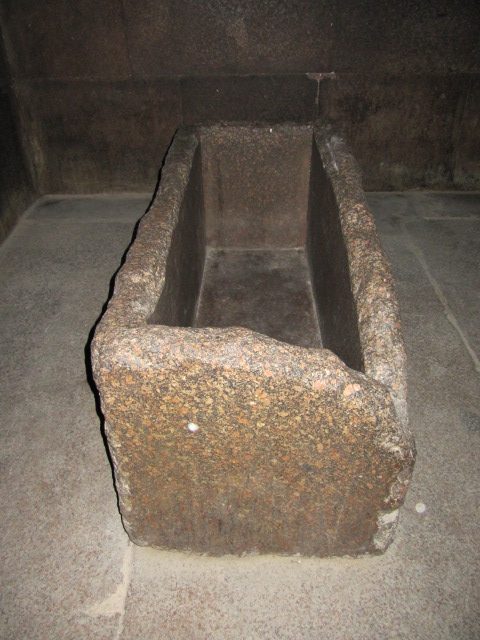
All of it is made from an estimated 2.3 million blocks, adding up to about 6 million tonnes of stone and mortar: about 5.5 million tonnes of limestone, 8,000 tonnes of granite hauled in from quarries far to the south for the interior chambers, and half a million tonnes of mortar holding it together. Inside sits the King's Chamber, lined in granite and holding an empty sarcophagus, along with the Queen's Chamber and a subterranean chamber cut into the bedrock below the pyramid's base. None of the three carries inscriptions or decoration, which was standard for Fourth Dynasty royal tombs, not a mystery in itself.

The record it held for almost 3,800 years
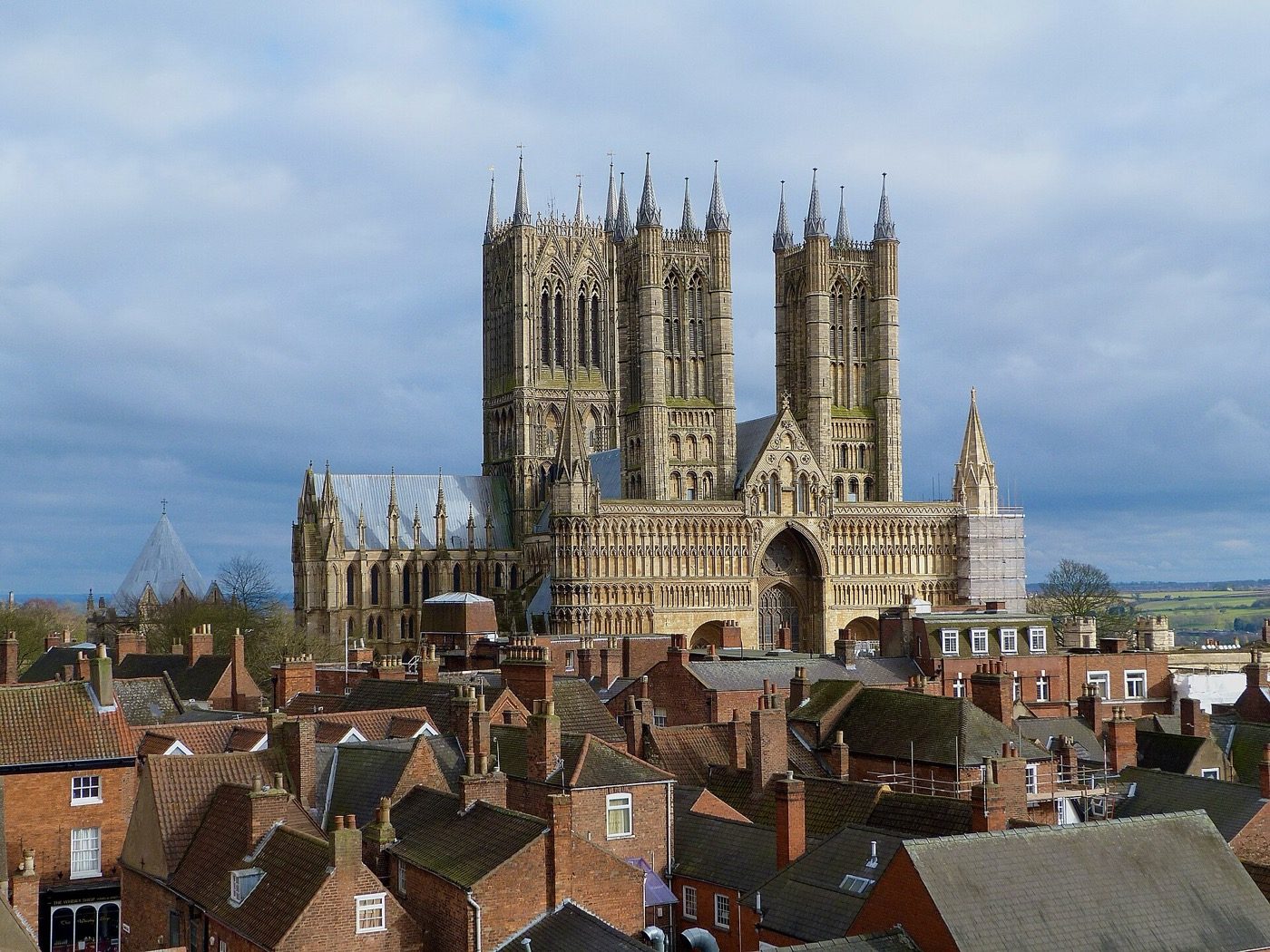
For most of recorded history, the Great Pyramid was the tallest structure any human being had built. It held that title from its completion until 1311 CE, when the central tower of Lincoln Cathedral in England was finished with a spire that pushed its total height to about 160 meters, some 13 meters taller than the pyramid's original peak. That's close to 3,800 years without a serious challenger, a run nothing else in architectural history has come close to matching. Lincoln Cathedral didn't keep the record forever either. A storm brought its spire down in 1548, ending the cathedral's own reign at around 237 years.
There's one honest wrinkle worth mentioning here, since it's exactly the kind of detail that gets smoothed out of trivia lists. Some historians credit Old St Paul's Cathedral in London, finished in the 13th century, with edging past the pyramid's height before Lincoln Cathedral made the outcome undeniable. The trouble is that Old St Paul's own spire height is disputed. Even Christopher Wren, who rebuilt the cathedral after the Great Fire of London decades later, questioned the figures that had been recorded for the original spire. So the safest version of the "almost 3,800 years" claim is that the pyramid unambiguously held the record into the 13th century, with its precise moment of being overtaken sitting in a decades-wide grey zone before Lincoln settled the question in 1311.

Nobody has proven how they actually did it
Here's the part that tends to surprise people: with everything Egyptologists know about who built the pyramid and roughly when, there's still no settled answer for exactly how 2.3 million blocks, some of them multi-ton granite slabs hauled from quarries hundreds of miles away, ended up stacked with that kind of precision. Ramps of some kind were almost certainly involved. Past that basic point, researchers disagree, and it's real, ongoing scholarship rather than a gap waiting for someone to look up the answer.
A straight ramp running directly up one face is the simplest idea and the one most documentaries default to, but most Egyptologists now consider it unworkable at full pyramid height. A ramp long and gradual enough to haul multi-ton blocks to a 146-meter summit would have required more material and labor than the pyramid itself, and no trace of one has ever turned up at Giza. Architect Uvo Hölscher proposed a zigzag ramp switching back across the pyramid's faces instead. Egyptologist Mark Lehner has floated a ramp spiraling around the exterior, starting down at the quarry and winding upward as the pyramid rose, though critics point out that wrapping a ramp around the outside would have buried the corners, making it hard for builders to keep checking the pyramid's geometry as they worked, which its famous precision suggests they were doing constantly.
French architect Jean-Pierre Houdin has argued for something stranger: a conventional external ramp for about the bottom third of the structure, followed by an internal ramp spiraling up through the pyramid's own core for the rest, essentially building a ramp inside the building. It's a striking idea and it has drawn a lot of media coverage, but it remains a minority position among specialists. Oxford Egyptologist John Baines has raised a common objection to explanations like this: he's skeptical of any theory built specifically to explain the Great Pyramid alone, since it didn't rise in isolation from the rest of Egyptian pyramid-building practice. The honest state of the field is that construction methods were probably never fully standardized in the first place. Builders likely adapted as they went, which is exactly the kind of process that leaves no clean archaeological trail for later researchers to reconstruct.
Who actually built it: not slaves, and not aliens
The idea of enslaved people, whip-driven and miserable, raising the pyramids has been part of popular imagination for a long time, but it doesn't match what archaeologists have dug up. In 1990, an American tourist's horse stumbled over a buried mud-brick wall southwest of the Giza plateau. That accident led Egyptian archaeologist Zahi Hawass to a cemetery of roughly 600 worker graves alongside 30 larger tombs belonging to overseers, dated to Egypt's Fourth and Fifth Dynasties. Hawass has summarized the finding bluntly: the builders were "peasants conscripted on a rotating part-time basis," not slaves, working under the supervision of skilled artisans and craftsmen.
The cemetery, together with the nearby settlement archaeologists excavated at the same time, points to organized labor crews rotating through the work rather than a mass of shackled captives. Skeletal remains show the labor was genuinely hard on the body: arthritis in the spine and knees was common among the buried workers, and most of the men died in their early thirties. But those same remains also show broken arm and leg bones that had been set with splints and healed properly, plus at least two documented cases of successful amputation, meaning these people had access to real medical treatment while they were alive. A papyrus known as the Diary of Merer, found in 2013 at a Red Sea harbor site, adds another layer to the picture. It's a work log kept by a mid-level official named Merer, whose crew of around 200 men spent months ferrying limestone by boat from quarries to Giza, reporting up to Ankhhaf, Khufu's own vizier. That's bureaucracy running the operation, not brutality.
The "aliens built it" theory doesn't hold up any better than the slave myth, for what it's worth. It has no supporting evidence behind it and mostly survives because the scale of the achievement feels implausible for Bronze Age tools. But Giza is one of the most thoroughly excavated sites on Earth, and everything that has come out of the ground points the same direction: quarry marks, worker graffiti naming specific crews, tools, bakeries, and now a literal paper trail in Merer's diary. If a simpler explanation existed, decades of digging would probably have surfaced it already.
Why the others fell and this one didn't
The Great Pyramid belongs to the traditional list of Seven Wonders of the Ancient World, and it's the only one still standing in anything close to its original form. The Statue of Zeus at Olympia left no physical trace at all beyond the excavated workshop where it was built. The Temple of Artemis at Ephesus and the Mausoleum at Halicarnassus survive only as scattered fragments, some of them sitting in the British Museum today. The Hanging Gardens of Babylon, one of the most famous of the seven, is such a thin case archaeologically that historians still debate whether it existed in the form ancient writers described, or even where it might have actually stood. The modern list has a labeling problem of its own: Christ the Redeemer is the wonder UNESCO never actually named.
Part of why the pyramid survived is almost boringly physical. It's an enormous solid mass of stone with no large open interior spaces that could collapse in an earthquake, unlike a temple or a hollow tower. Egypt's dry climate has also spared it the freeze-thaw weathering that breaks stone monuments down faster in wetter parts of the world. Its inland location kept it away from the coastal erosion and naval conflict that helped finish off wonders like the Lighthouse of Alexandria, which stood for around 1,500 years before earthquakes eventually toppled it. The pyramid lost its polished casing stones and some surrounding structures were dismantled for building material over the centuries, but the core has simply been too big and too solid to fully take apart.
There's something fitting in that. Of the seven wonders ancient travelers supposedly crossed the Mediterranean to see, six now exist mostly as descriptions from old writers, a few sketches, and scattered excavated fragments. The Great Pyramid is the one you can still walk up to and put your hand on, and that might be part of why it generates more live archaeological argument than any of the others. The evidence is sitting right there in the open, and researchers still haven't settled how it got that way.