
The short answer: no domain, and no altar
No surviving Old Norse text says Loki was the god of anything. Thor has thunder, Njörðr has the sea and wealth, and Odin collects several jobs, as the guide to what Odin was god of lays out. Loki gets a family tree, a list of misdeeds and a place in the end of the world, but no portfolio. The sources are the Poetic Edda, Snorri Sturluson's thirteenth-century Prose Edda, Heimskringla, skaldic verse and a Norwegian rune poem.
The absence goes further than the texts. Britannica's entry on Germanic religion says the medieval sources give no evidence of a cult for Loki, unlike other Norse deities, and that his name does not appear in place-names. Jens Peter Schjødt, summarising the written and archaeological evidence in 2020, concludes that Loki was never a much venerated god, if he was venerated at all, and that no sources describe rituals or cult acts that involve him. He is known only as a figure in stories. So the honest reply to 'what was Loki the god of' is that the sources leave the slot empty. The rest of this guide sorts out where the popular labels come from.
What Snorri and the poems actually call him
Snorri introduces Loki in Gylfaginning as one of the Æsir, and describes him as handsome, malicious and very changeable in behaviour. He gives him a list of epithets that includes 'originator of deceits' and 'the disgrace of all gods and men', and says he had cunning and tricks for every purpose, often getting the gods into trouble and then getting them out of it. Those are descriptions of a temperament. None of them is a sphere of the world that Loki looked after.
The poems make the same point through action. In Þrymskviða he goes to the giants beside Thor, dressed as a maid. In the Prose Edda he plays the part that produces Sleipnir: to help the gods cheat a giant builder, he takes the form of a mare, lures the builder's stallion Svaðilfari away, and later gives birth to the eight-legged horse. He is the father of the wolf Fenrir, the world serpent Jörmungandr and, in Snorri's account, Hel, and in Lokasenna he admits to Frigg that he is responsible for the death of her son Baldr. Völuspá has him bound in a grove of hot springs with his wife Sigyn beside him, then free again at Ragnarök, when he fights on the giants' side and he and Heimdallr are fated to kill each other.
The name Loptr, another of his names, is generally derived from Old Norse lopt, 'air'. It is an epithet, and as far as the surviving texts show, nothing gives him an air-god's job to go with it.
The blood-brother who mocks everyone
Lokasenna, 'Loki's flyting', is the best window on how the gods treated him. Loki crashes Ægir's feast after killing one of the servants, then trades insults with nearly every god present. In stanza 9 he reminds Odin of an old bond. In Benjamin Thorpe's translation he asks, 'dost thou remember when we in early days blended our blood together'. Odin does then have Víðarr pour him a drink, so the bond is honoured even here.
The scene shows a member of the group who is not treated as a full insider. He is welcomed by oath and attacked in verse. His mother Laufey and his father Fárbauti, a jötunn, place him among giants by birth, which is why the guide to the Norse gods describes him as a member of the Æsir by oath rather than by blood. Nothing in that arrangement needs him to preside over a subject.
Where 'god of fire' came from
The fire title has a traceable origin. In 1835 Jacob Grimm proposed that Loki was a 'god of fire', and the idea proved durable. Its two supports are the word logi, 'flame', which resembles his name, and a scene in Snorri's Útgarða-Loki story, where the Loki who travels with Thor loses an eating contest to a rival called Logi. Útgarða-Loki later explains that Logi was wildfire itself.
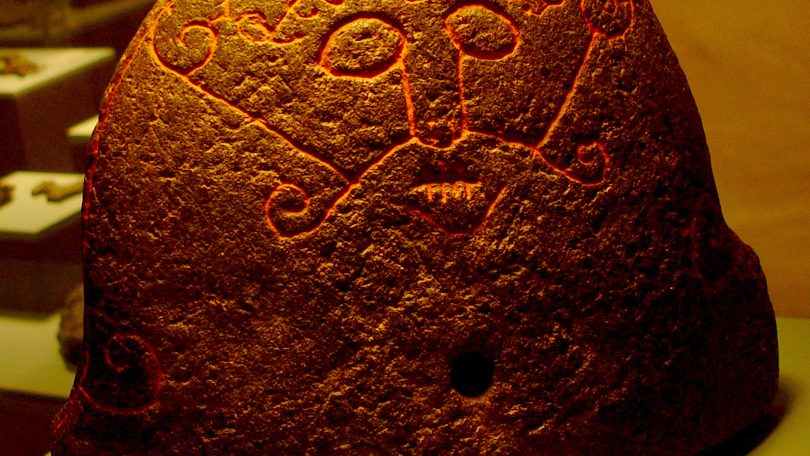
The name link does not hold up. Wikipedia's account of the scholarship says there does not seem to be a sound linguistic basis for tying Loki to logi. The later Scandinavian forms of his name, such as Danish Loke and Swedish Locke, point instead to a Germanic root *luk-, which has to do with loops, knots and closures, and words such as Swedish lockespindlar, 'Locke-spiders', and Faroese lokkanet, 'cobweb', preserve it. Eldar Heide reads the evidence as showing that Loki was thought of as a maker or embodiment of tangles. The best surviving physical clue is the Snaptun Stone, found in Denmark in 1950 and carved around the year 1000. It shows a face with stitched-up lips, read as Loki from a story in Skáldskaparmál, and it is a hearth stone that once shielded a bellows. That may hint at a link to smithing and flame, but it is one object, and it shows a myth motif rather than a worshipped fire god.
Loki does not sit in one scholarly box, and the answer to 'what was Loki the god of' depends on which scholar you ask. Folke Ström argued in 1956 that Loki was a hypostasis of Odin. In 1959 Jan de Vries called him a typical trickster figure. Anna Birgitta Rooth concluded in 1961 that he began as a spider, and Anne Holtsmark declared in 1962 that no conclusion could be reached. When the specialists split four ways, a single-word title for the god is out of reach.
Where 'god of mischief' came from
'Trickster' is a scholar's category, and it is applied to Loki with caution. The popular 'god of mischief' label is much younger, and its most direct source is comics. A version of Loki first appeared at Marvel's predecessor Timely in Venus #6 (August 1949), where he is a member of the Olympian gods under Jupiter. The version that shaped modern pop culture, the adoptive brother and enemy of Thor, debuted in Journey into Mystery #85 (October 1962), created by Stan Lee, Larry Lieber and Jack Kirby. Marvel's comic-book Loki is described as the Asgardian God of Mischief. Tom Hiddleston's version of the character reached film in Thor (2011).
Earlier centuries pulled him in other directions. Nineteenth-century writers could not agree on him. Some cast him as a hostile outsider among the Æsir, others as a Nordic Prometheus, a heroic bearer of culture. Britannica notes the Prometheus comparison in its own entry, which also says he has been considered a god of fire. Wagner's Loge in the Ring cycle plays on the Old Norse word for fire, so the fire reading has a musical afterlife too. The plain answer from the sources is that Loki has no domain, only a part in the stories: he complicates things for the gods and, at the end, stands against them.