
The tyrant streaming platforms built, and the administrator the sagas describe
Cate Blanchett's Hela strides into 2017's Thor: Ragnarok as Odin's exiled firstborn, a conqueror who crushes Mjolnir with one hand and announces she intends to retake the throne by force. It is a memorable performance, and it is also, by the entertainment press's own account, a deliberate rewrite. Marvel's comics had already kept Hela close to her mythological source, a daughter of Loki. The film discarded that lineage and made her Odin's own child instead, turning the plot from an outsider trying to steal a throne into an heir reclaiming one. Add a few years of God of War games sending players to fight their way through Helheim, and the modern search for "Hel norse mythology" mostly turns up a monster built to be defeated.
The Prose Edda, compiled around 1220 by the Icelandic chieftain and scholar Snorri Sturluson, describes someone considerably less dramatic. Hel is Loki's daughter, not Odin's. She was never exiled from a throne because she never held one. Odin appointed her to a post, ruler of the realm that receives everyone who dies of sickness or old age. That covers the overwhelming majority of the human dead; only the smaller number who fall gloriously in battle go to Valhalla or Freyja's field Folkvangr instead. Everything known about that arrangement comes from the same author, Snorri Sturluson, whose own prologue to the rest of the Norse pantheon he wrote down frames Odin and Thor as historical men later mistaken for gods. Unlike Hades and Persephone, who share rule over the Greek underworld between them, Hel administers hers alone, and nothing in Snorri's account frames the appointment as villainy. It reads more like a civil service posting than an origin story for a conqueror.
Loki's third child, and why Odin acted before she had done anything
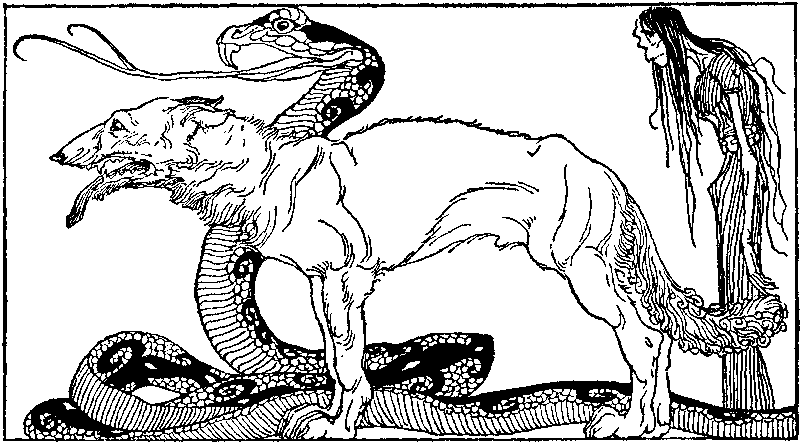
Snorri lays out Hel's family in the same breath as her two more famous brothers. In Arthur Gilchrist Brodeur's 1916 translation of the Gylfaginning, the relevant chapter opens plainly: "Angrboda was the name of a certain giantess in Jotunheim, with whom Loki gat three children: one was Fenris-Wolf, the second Jormungandr, that is the Midgard Serpent, the third is Hel." The gods learn where this brood is being raised and, through prophecy, learn that "great misfortune should befall them" on account of it, so Allfather Odin sends gods to Jotunheim to collect all three children and bring them before him.
What happens next is a sorting, not a trial. The serpent goes into the sea, where Snorri says he grew until he "lies in the midst of the ocean encompassing all the land, and bites upon his own tail," the Midgard Serpent of later Ragnarok prophecy. Fenrir stays among the Aesir, growing under their watch until his strength forces them to bind him with the enchanted fetter Gleipnir, an act of active restraint the gods have to keep negotiating and eventually deceive him into accepting. Hel gets neither the ocean nor a chain. Brodeur's translation puts it directly: "Hel he cast into Niflheim, and gave to her power over nine worlds, to apportion all abodes among those that were sent to her." She is not imprisoned. She is put in charge of something. Fenrir, Jormungandr, and Hel get filed together online as a monstrous trio, but that label obscures something simpler: they're family, not a separate monster species, Loki's own children and in-laws rather than members of some distinct category of Norse beast.
The distinction matters because nothing in the text says Hel did anything to deserve special treatment, good or bad. The fear driving Odin's decision is about the family line's prophesied role in Ragnarok, not about any individual child's conduct, and Fenrir's story shows what actual punishment or containment looked like to the Aesir when they judged it necessary. Handing someone administrative authority over nine worlds is a different kind of response, whatever else it says about how the gods viewed her.

A hall furnished out of scarcity, not fire
Snorri's description of Hel herself is specific and strange rather than monstrous: "She is half blue-black and half flesh-colour (by which she is easily recognized), and very lowering and fierce." No fangs, no flame, no wings. What she looks like is a body caught mid-transition between living and dead, which is more or less the population she is administering.
Her hall gets the same treatment, and this is where the household inventory does more work than any monster description could. Brodeur's translation lists it out: "Her hall is called Sleet-Cold; her dish, Hunger; Famine is her knife; Idler, her thrall; Sloven, her maidservant; Pit of Stumbling, her threshold, by which one enters; Disease, her bed; Gleaming Bale, her bed-hangings." The hall's Old Norse name, Eljudnir, is usually glossed as something close to "sprayed with sleet." Every object in the list names a small, ordinary hardship: an empty plate, a bad bed, a servant too slow to help you. None of it reads as an instrument of active torture. It is the furniture of deprivation, not punishment, and that distinction is easy to miss if the only version of Hel a reader already knows is a villain with an army.
The one myth where she has to make a call: Baldr's funeral
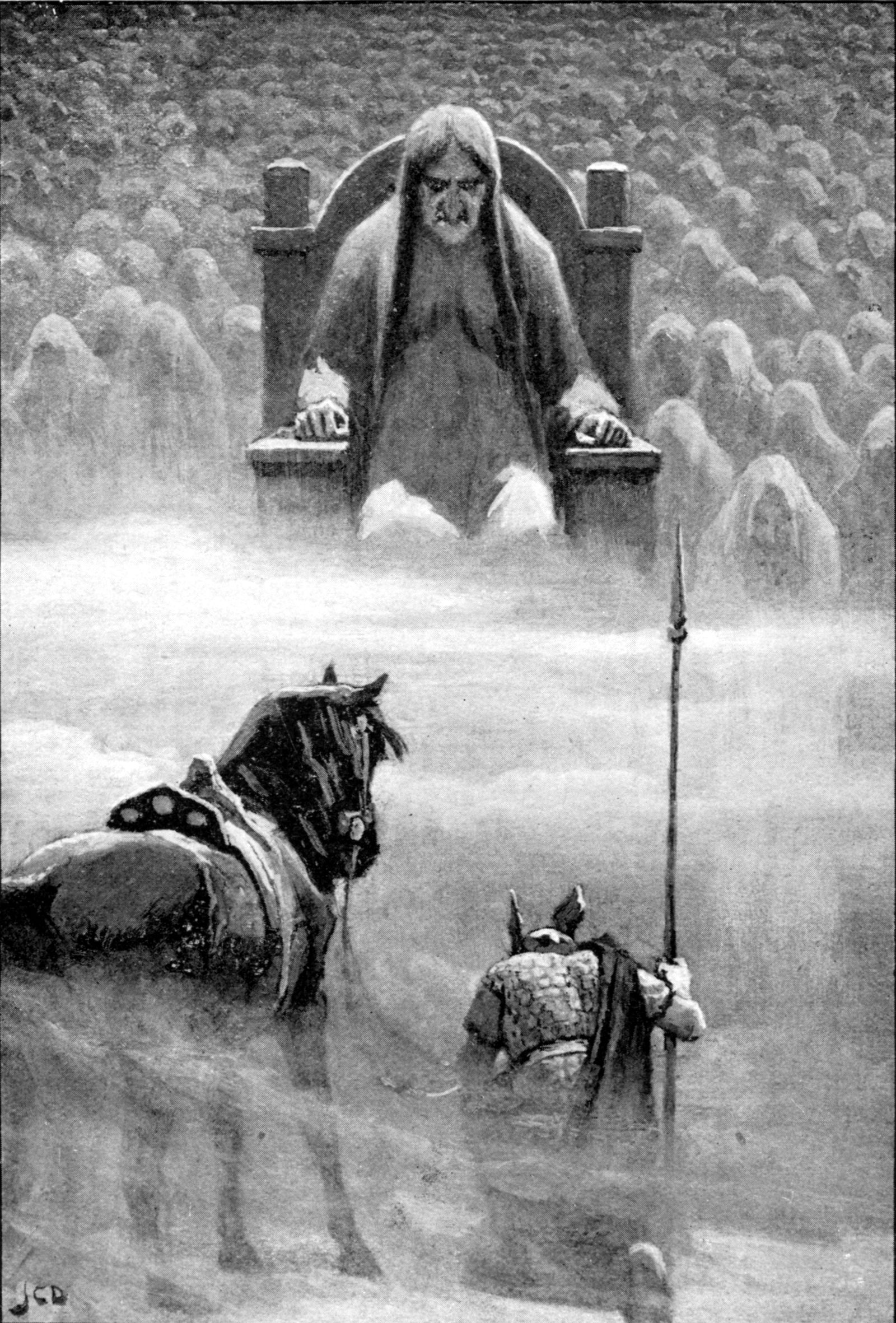
In the surviving mythology, Hel gets exactly one scene that calls for judgment, not just administration, and it comes after the god Baldr is killed. Frigg asks who among the Aesir will ride to Hel and offer a ransom for Baldr's return, and Odin's son Hermodr volunteers, taking Odin's own horse Sleipnir for the nine-night ride "through dark dales and deep" to the river Gjoll.
At the golden bridge over that river, the maiden Modgudr, who guards the crossing, stops him with a detail worth pausing on: she tells him that five companies of the dead had ridden over the bridge the day before, making less noise than Hermodr alone, and adds, "thou hast not the color of dead men." She can tell he is still alive just by looking at him, a small piece of world-building that treats Hel's road as a physically continuous place a living person could actually ride down, not an abstraction. Hermodr rides on to Hel's gate and spurs his horse so hard it leaps clean over without ever touching it, then finds Baldr seated in the hall's place of honor.
When Hermodr makes his request the next morning, Hel does not simply refuse or grant it. She sets a condition: "if all things in the world, quick and dead, weep for him, then he shall go back to the Aesir; but he shall remain with Hel if any gainsay it or will not weep." It is, on its face, a fair and almost bureaucratic test, the kind of process someone running an underworld might reasonably impose. Everything does weep, animals and stones and metals included, until the messengers reach one giantess sitting in a cave, who refuses. Snorri identifies her as Loki in disguise. Baldr stays with Hel not because she was cruel or arbitrary, but because the one being with a motive to sabotage the test was working against it from outside her hall entirely.
Why "Hel" and "hell" really are the same word, and why that isn't the whole story
The link between the goddess's name and the English word for the Christian afterlife of punishment is not a coincidence dreamed up by later writers. Both descend from the reconstructed Proto-Germanic noun *haljo, meaning "concealed place, the underworld," itself built from a verb root meaning "to cover" or "to hide." That root produced a whole family of related words across the old Germanic languages: Old English hel, Old Frisian helle, Old Saxon hellia, Old High German hella, Gothic halja. When Christian missionaries needed a word for the fiery place of eternal punishment described in scripture, they reused the native term their audiences already had for the general concept of an underworld. No one imported a new word for the occasion. The Online Etymology Dictionary, citing the linguist Robert K. Barnhart, describes this as "a transfer of a pagan concept to Christian theology and its vocabulary." The word survived the conversion. What it described did not.
That transfer produced a small, telling error that has outlived it. Even the same etymology entry describes Hel as the one who "ruled over the evil dead in Niflheim," and that phrase does not match Snorri's own text, which specifies people who died of sickness or old age as her subjects, with no mention of moral character at all. Valhalla and Folkvangr sorted the war dead; Hel took everyone else, honest and dishonest alike. If a widely used etymology reference can quietly import the word "evil" into a summary of Hel's realm, it is a fair sign of how thoroughly the later Christian meaning of "hell," a place for sinners, has bled backward into how people describe the pre-Christian word it was built from. Norse religious life never had a professional priesthood to formalize a single afterlife doctrine. Local chieftains performed what religious ritual there was in their own halls, with no clergy dedicated to the job, which is part of why Snorri's household inventory for Hel survives as essentially the only detailed version anyone wrote down.