
Search "kraken mythology" and the timeline is centuries too old
Most people picture the kraken as a Viking-age legend: an octopus the size of an island, arms wrapping around a longship's hull, a story passed down from the same culture that gave the world Thor and Odin. None of that survives contact with the actual written record. The word itself is a relatively late addition to European folklore, the famous grabbing arms come from a specific 18th-century book rather than any saga, and the sea monster medieval Norse writers really did describe behaved nothing like the creature in that mental picture.
Untangling those layers means tracing three separate things that got fused together long after the fact: a word, an image, and a much older story that the word and image eventually attached themselves to.
The word doesn't go back nearly as far as the legend
The earliest documented use of the word sits in a Norwegian dialect glossary compiled by Christen Jensøn in 1646, already applying it to a sea creature. The specific spelling "kraken" settles into wider circulation by 1755, the year an English translation of a Danish bishop's natural history book carried it into the broader European imagination. Even the root word has nothing to do with the sea. Norwegian dictionaries trace "krake" back to Old Norse "kraki", meaning a gnarled or crooked tree trunk, related to "krókr", a hook; the same root gave Norwegian and Swedish fishermen their word for a simple grapnel anchor made from a bent spruce branch weighted with a stone.
The Icelandic philologist Finnur Jónsson proposed in 1920 that the name stuck to a sea monster because a crooked, branching piece of driftwood conjures roughly the same silhouette as a many-armed animal. If that reading holds, the word now used for a tentacled leviathan started out meaning something closer to "crooked stick."
The tentacles come from a bishop's book, not a saga
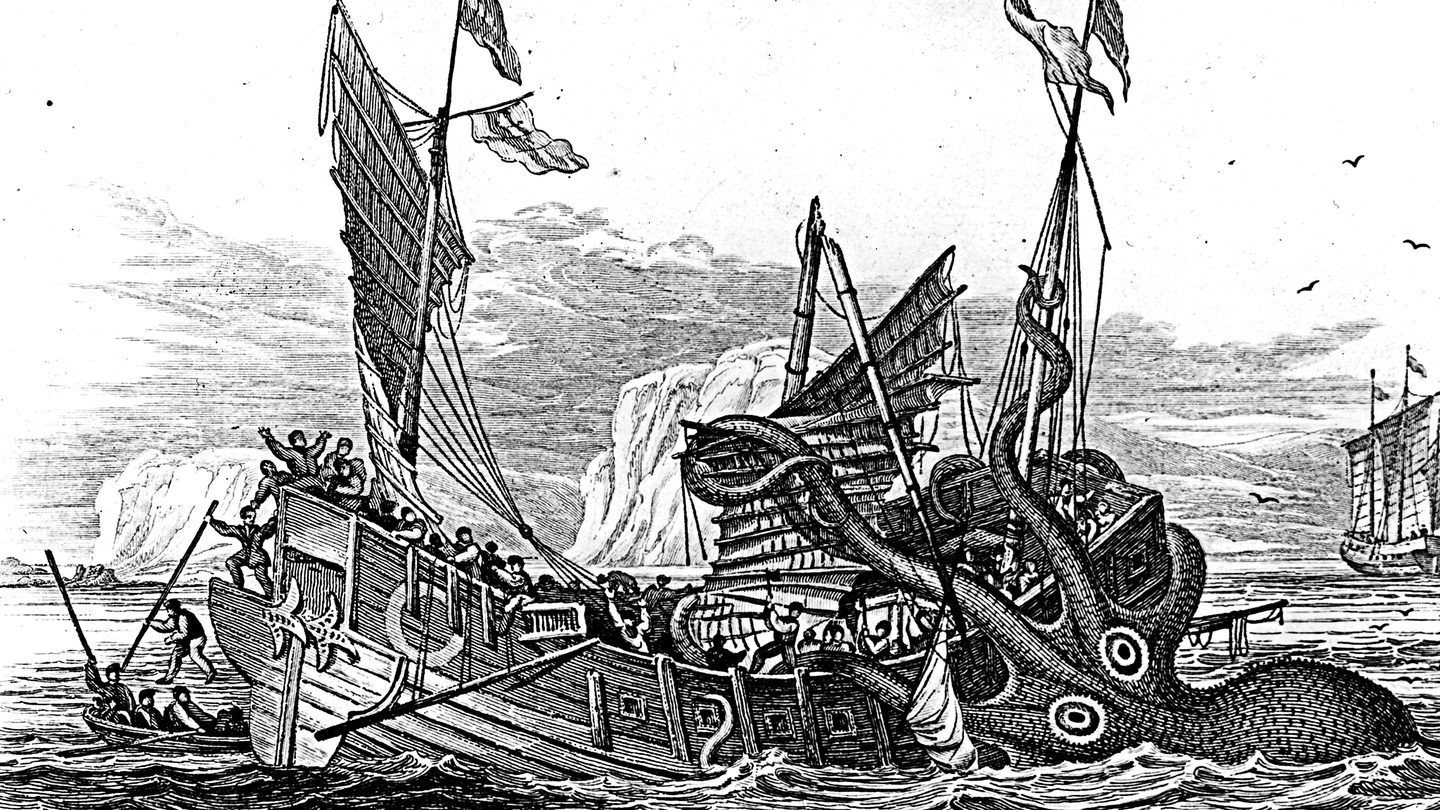
The image most searches actually want, a many-armed beast broad enough to pass for an island and strong enough to seize a ship, has a specific author and a specific publication date. Erik Pontoppidan, the Lutheran bishop of Bergen, described it at length in Forsøg til Norges Naturlige Historie, published in Copenhagen in 1752 and 1753. English readers met the passage through an 1755 London translation, which renders the animal as "round, flat and full of arms," with "horns" tall enough to stand "as high and as large as the masts of middle-siz'd vessels." The creature does not chase ships so much as ambush them from below: it "opens his arms, or horns, seizes and swallows his welcome guests," and Pontoppidan blames most drownings on the whirlpool it leaves behind when it dives back under, not on a direct attack.
Pontoppidan did not invent the name from nothing. Eighteen years earlier, in 1734, the Dano-Norwegian missionary Hans Egede had already written about the "kraken" of Norwegian waters and equated it with a much older figure from Icelandic tradition, the hafgufa, covered in the next section. What Pontoppidan supplied was the vivid, widely translated physical description, arms and all, that illustrators and novelists later ran with; Victor Hugo folded it into his 1866 novel Toilers of the Sea, and Jules Verne gave it a starring role in Twenty Thousand Leagues Under the Seas. None of them were working from a saga.
The medieval sea monster had no arms at all
Go back another five centuries into the actual Old Norse and Old Norwegian textual record, and the tentacles disappear entirely. The mid-13th-century Norwegian instructional text Konungs skuggsjá, the King's Mirror, has a father describe to his son a creature called the hafgufa: a fish so enormous that sailors mistake it for an island, seen so rarely that the King reasons only two of them can exist in the world, since the seas would otherwise be full of their young. Its hunting method is not grabbing. The King's Mirror says it belches out a cloud of bait that draws every fish nearby toward its open mouth, then closes its jaws and swallows the whole crowd at once.
A related creature, the lyngbakr, or "heather-back," appears in the Icelandic Örvar-Odds saga. The saga's oldest form is usually dated to the late 13th century, and the fullest surviving account of the hafgufa and lyngbakr episode comes from a longer 14th-century redaction, in which Örvar-Oddr's crew sail their ship between what they take for two rocky reefs, only to learn afterward that they had sailed straight through the monster's jaws and nostrils. No arms, no attack on the hull, no shipwreck by force. The danger in the medieval version is mistaking a living animal for land. This is the same Icelandic manuscript culture, working generations after Christianization, that also wrote down the Aesir and Vanir gods most people picture when they hear "Norse mythology" at all.
The island monster may not even be native to Norway
There's a further complication: the island-shaped hafgufa may not be a purely Norse invention to begin with. The Icelandic scholar Halldór Hermannsson traced its closest ancestor to the aspidochelone, a giant turtle-island from the Physiologus, a Greek-origin Christian bestiary that circulated across medieval Europe and reached Iceland in translation reworked as a whale rather than a turtle, luring prey with a sweet scent before swallowing it. Two 17th-century scholars went further and merged the traditions outright. The Danish physician Thomas Bartholin, writing in 1657, declared the hafgufa and lyngbakr to be a single beast and identified it with the giant fish of the Irish Voyage of St. Brendan, on whose back the traveling monks were said to have celebrated Mass before the "island" sank beneath them; the Icelandic writer Jón Guðmundsson made the identical connection in his own Natural History of Iceland.
If that reading holds, the half of this story that genuinely predates Pontoppidan by five hundred years did not originate as pagan Viking folklore at all. It reached Iceland through Christian bestiary literature written in Greek, centuries before any bishop added arms to it, arriving on the same wave of Christian institutions that took over the island's religious life after Iceland's formal conversion around 1000 CE.
A 2023 whale study revived one detail nobody expected
One piece of the King's Mirror account turned out to be less fantastical than seven centuries of readers assumed. In 2023, a team led by maritime archaeologist John McCarthy published a study in Marine Mammal Science comparing historical sea-monster accounts against a real, only recently documented whale behavior called trap feeding, in which a whale floats near-motionless at the surface with its mouth open, letting fish swim in before it snaps shut, sometimes after releasing a plume of bubbles or vomit that concentrates the prey first. Of every historical account the team surveyed, the hafgufa passage in the King's Mirror was the closest documented match to that behavior, a description written roughly 770 years before marine biologists formally described the strategy in living whales.
The bait-and-swallow detail that medieval Norwegian scribes filed under monster lore may be a genuine, if unlabeled, whale-watching record. It just took modern researchers until 2023 to notice.