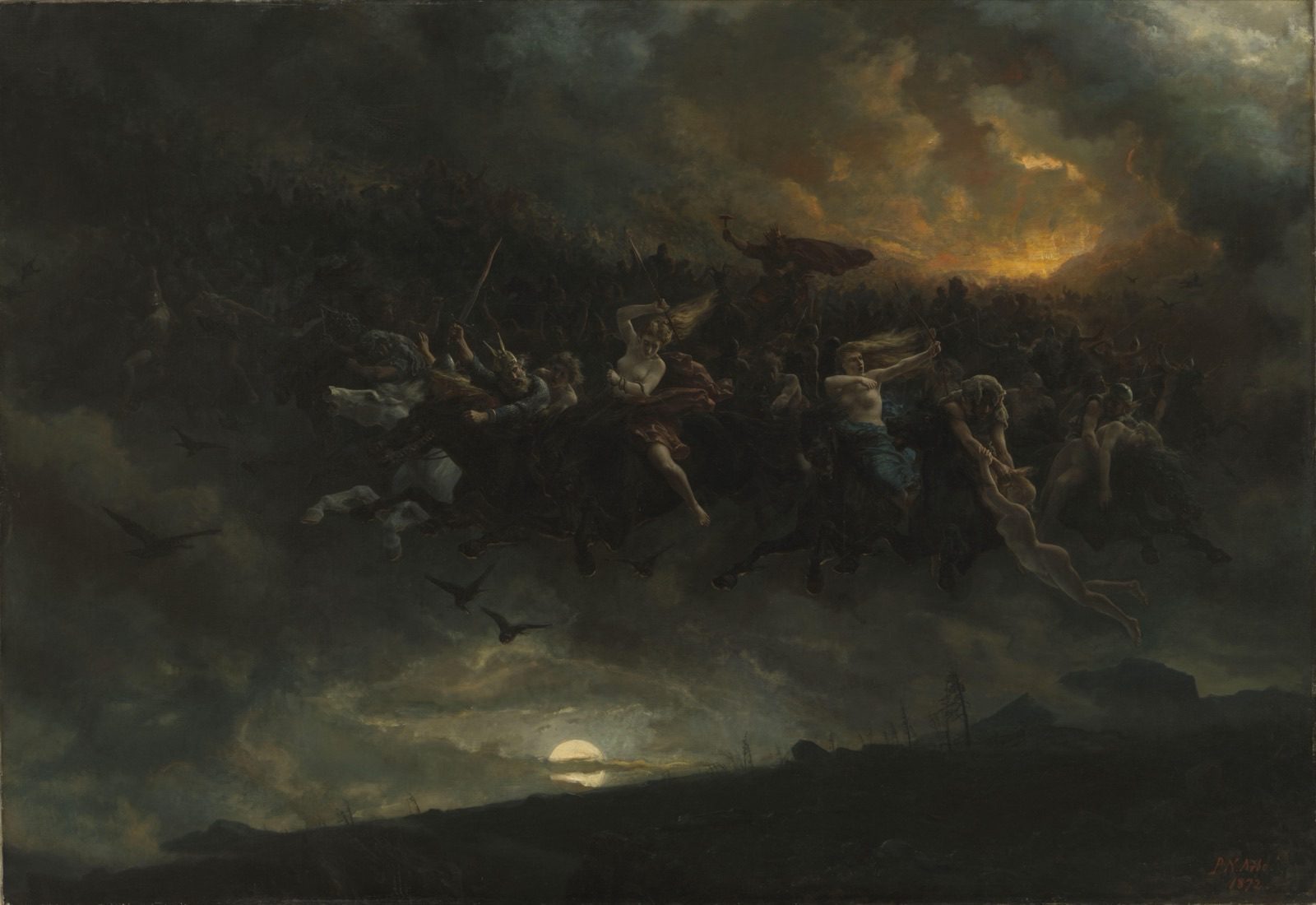

The gods almost nobody wrote down while they still had worshippers
Search "Norse mythology gods" and the results settle into a familiar shape: Odin, Thor, Loki, Freyja, laid out like a fixed cast of characters from a religion that ran continuously from the first Viking raids to the present. That framing skips over a real gap in the record. Iceland, the source of almost everything we know about this pantheon in narrative detail, adopted Christianity as its official religion by a vote of the Althing around 999 or 1000 CE, according to the standard scholarly dating. The two texts that carry nearly all of the connected mythological storytelling, the Prose Edda and the Poetic Edda, were both compiled after that vote, not before it.
The Prose Edda is the more traceable of the two: an Old Norse handbook on poetry compiled around 1220-23 by Snorri Sturluson, an Icelandic chieftain, lawspeaker, and historian, roughly two centuries after Iceland's formal conversion. The Poetic Edda is stranger. Its most important manuscript, the Codex Regius, was copied down by an unknown scribe around 1270 from older poems, then vanishes from any historical record until 1643, when it turned up in the possession of Brynjólfur Sveinsson, Bishop of Skálholt. Genuine pre-Christian material does survive outside these two books, mainly in skaldic poetry composed for Viking Age kings and preserved orally until later scribes wrote it down, plus scattered runestones and place names. But the connected biographies, family trees, and creation-to-Ragnarok narrative arc that most modern lists draw on come to us almost entirely through Christian Icelandic hands, writing generations after the old religion had stopped being anyone's actual religion.
A Christian scholar's built-in disclaimer: these were never gods
Snorri does not present his material as a record of true religion, and he says so directly in his own prologue. He opens the Prose Edda with a strategy medieval Christian writers called euhemerism, borrowed conceptually from the 4th-century BCE Greek philosopher Euhemerus, who had argued that the gods of Greek religion began as ordinary human rulers whose deeds later got inflated into divinity. Snorri's version recasts the Aesir as human warriors and kings who fled the fall of Troy, descendants of King Priam, and migrated north into Scandinavia, where local peoples mistook them for gods because of their superior weapons, learning, and bearing. Odin himself becomes, in this telling, a historical war-chief whose real cleverness got exaggerated into supernatural wisdom over generations of retelling.
This isn't a hedge tucked into a footnote. It's the frame the rest of the book sits inside, and it's also the reason a 13th-century Christian scholar felt safe copying pagan material down at all: euhemerism let him preserve the stories as history and poetic reference material without endorsing them as real religion. Most modern retellings strip that frame back out and present the results as if they were a clean window onto pagan belief, when the person who actually wrote most of it down was explicit that he didn't think the beings in it were gods. The same mismatch between what a source actually says and what popular culture assumes shows up on the Greek side too: nothing in Homer's own text backs up the now-standard picture of the Sirens as fish-tailed, exclusively female temptresses, a detail added by artists and later writers centuries after the Odyssey was composed.
Odin's name has nothing to do with the sky
Zeus, king of the Greek gods, gets his name from a reconstructed Proto-Indo-European sky-father root, Dyeus, shared directly with the Roman Jupiter and the Vedic Dyaus Pita. Odin's name follows a completely different path. Óðinn and its cognates, Old English Wōden and Old High German Wuotan among them, trace back to the Proto-Germanic Wōðanaz, built on a root, *wōð-, meaning "fury" or "inspired frenzy," the same root behind Old Norse óðr, which covers both "mad, frantic" and "mind, spirit, poetic inspiration." Structurally, the name reads less like "sky father" and more like "master of frenzy."
That etymology matches how Odin actually behaves across the surviving texts. He is not a stable, weather-commanding patriarch in the Zeus mold. He is associated with ecstatic trance, battle-frenzy, prophecy, and an obsessive, self-harming pursuit of hidden knowledge, a personality profile the two source texts back up with specific, physically brutal episodes rather than a generic "father of gods and men" title. Greek mythology has its own case of a deity whose standard backstory doesn't hold up under scrutiny: ancient sources can't even agree on Selene's own parentage, naming at least four different combinations of parents across four separate texts.
The eye at the well, the nine nights on the tree
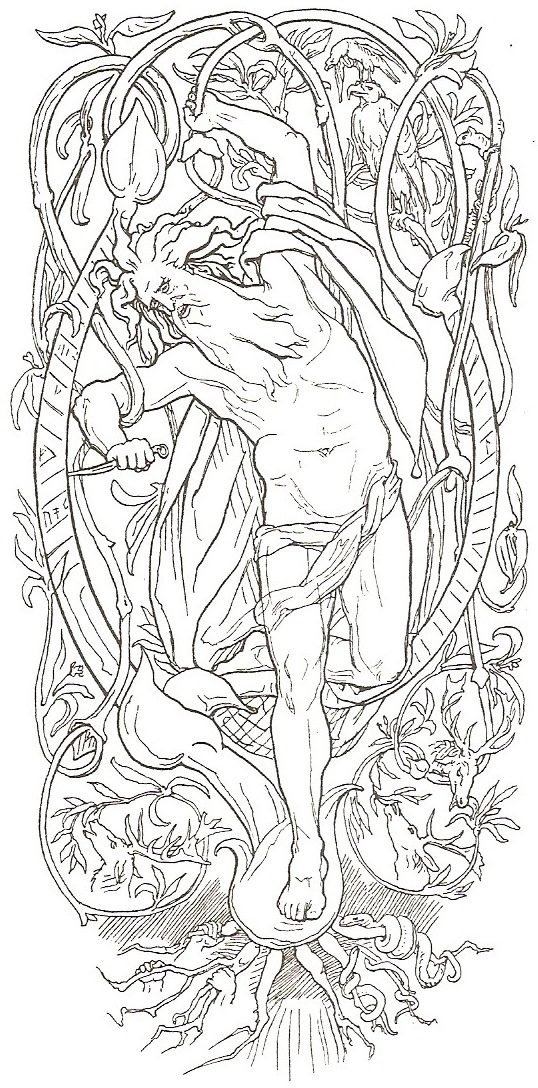
Two of those episodes account for most of Odin's defining imagery. To drink from Mimir's well, a source of hidden wisdom, Odin pays with one of his own eyes, the detail behind his standard depiction as one-eyed in later Norse art. Separately, in the Hávamál, a poem preserved in the Poetic Edda and framed as Odin's own first-person account, he describes hanging himself from a windswept tree, later commentators identify it with the world tree Yggdrasil, wounded by his own spear, for nine full nights, given, in his words, "myself to myself" (Hávamál, stanza 140 in Benjamin Thorpe's 1866 translation; later editions renumber the same passage as stanza 138). He takes no food or drink during the ordeal; only after it ends does he seize the runes and fall back down.
Within the mythology's own internal logic, that ordeal is the origin story for runic writing itself, not a decorative aside. It also sets the tone for Odin across the wider corpus: a god whose defining trait is wisdom bought through deliberate self-mutilation, closer to a shaman working through an initiatory trial than to a battle-commanding overlord.

Two families of gods, and a war nobody agrees on the meaning of
Norse mythology doesn't run on one unified family of gods. It runs on two: the Aesir, Odin, Thor, Frigg, Baldr, Tyr, and Heimdall among them, associated broadly with rulership and war, and the Vanir, led by Njord and his children Freyr and Freyja, associated with fertility, prosperity, and foresight. According to the myths, the two families went to war, and the conflict ends not with a clear winner but a negotiated peace sealed by an exchange of hostages: Njord, Freyr, and Freyja go to live among the Aesir, while other tellings send Hoenir and Mimir the other way.
What that war actually represents has been argued over for more than a century with no consensus reached. One reading treats it as folk memory of two distinct cult traditions merging into a single pantheon. A separate, Indo-European-focused reading casts the Aesir as incoming pastoralist newcomers and the Vanir as an older, indigenous agricultural tradition. A more skeptical camp argues the whole two-family structure could be Snorri's own literary organizing device rather than an inherited belief at all. None of the three has won out, which puts Norse mythology in company with Athens's own unresolved argument over who filled the final seat among its twelve Olympian gods, a dispute the ancient Greeks themselves never bothered to close either.
Loki was never one of them by blood
Modern retellings tend to slot Loki in as simply "the Norse god of mischief," one more member of the Aesir family alongside Thor or Baldr. The Prose Edda gives him a different genealogy: his father is the jötunn (giant) Fárbauti, and his mother is Laufey, a figure of ambiguous divine standing. Norse naming convention normally ran through the father's line, but Loki goes by Loki Laufeyjarson, "son of Laufey," a break from the pattern several scholars read as a sign his own parentage was considered irregular even inside the mythology's own internal logic.
He belongs to the Aesir by oath, not by birth. His bond to the ruling family runs through a personal blood-brotherhood pact with Odin, a debt Loki himself invokes directly in the poem Lokasenna, reminding Odin of the vow they swore together. That distinction, outsider absorbed by oath rather than insider born into the family, changes how his eventual betrayal at Ragnarok reads: less a family turning on itself, more the terms of an old bargain finally running out. That blurry line between monster and family member runs through the rest of Norse mythology too: most of the beings modern lists file under "Norse mythology creatures" turn out to be giants, dwarves, and Loki's own children, not a separate monster category at all.