
Three dates, and only one of them is the 1980s
Ask when dial-up internet was invented and you get three defensible answers, twenty-seven years apart. The modems came first, in the early 1960s. The dial-up services an ordinary person could buy came in 1979. Dial-up access to the actual internet arrived in 1989. The 1980s date most timelines settle on is accurate about one thing: that is the decade the equipment got cheap enough to be everywhere.
| Stage | Date | What it was |
|---|---|---|
| First commercial modem for computers | 1958 | Bell 101 Data Set, 110 bit/s, built for the SAGE air-defense network |
| First modem for a dialed phone line | 1962 | Bell 103A, 300 bit/s, full duplex over ordinary unconditioned lines |
| Equipment allowed onto the network | 1968 | Carterfone ruling, 13 F.C.C.2d 420, struck down AT&T's foreign-attachment tariff |
| First consumer dial-up service | 1979 | CompuServe MicroNET, 300 baud, sold through Radio Shack |
| First dial-up internet service | 1989 | The World, run by Software Tool & Die |
| Mass-market dial-up | 1990s | 14,400 to 56,000 bit/s, AOL on every desktop |
Nothing in that table happened in the 1980s. The Bell 103A was already twenty years old by then, and the ruling that let it onto the phone network was older still. What the 1980s added was price.
The first modem that could dial a number
The first commercial modem for computers was the Bell 101 Data Set, released by AT&T in 1958 for the SAGE air-defense system and offered commercially from 1959. It ran at 110 bits per second, and it was built for a private network of radar sites and command centers, not for anyone's telephone line.
The Bell 103A was the one that could dial. Introduced by AT&T in 1962, it used audio frequency-shift keying to push 300 bits per second over ordinary unconditioned telephone lines, both directions at once. The calling modem sent a 1,270 Hz tone for a mark and 1,070 Hz for a space; the answering modem used 2,225 and 2,025 Hz. Splitting the tones into two bands is what let each end filter out its own signal. Sources disagree by a year on the launch, with Time's gadget retrospective dating the Bell 103 to 1963 while other references say 1962. Either way, 300 bits per second stayed a working standard for roughly twenty years.
None of this was aimed at the internet, which would not exist in any consumer sense for another quarter century. These modems connected teleprinters and terminals to time-sharing mainframes over the network the telephone's own inventors had built, which is why the next obstacle turned out to be a tariff.
Why modems stayed off the phone network
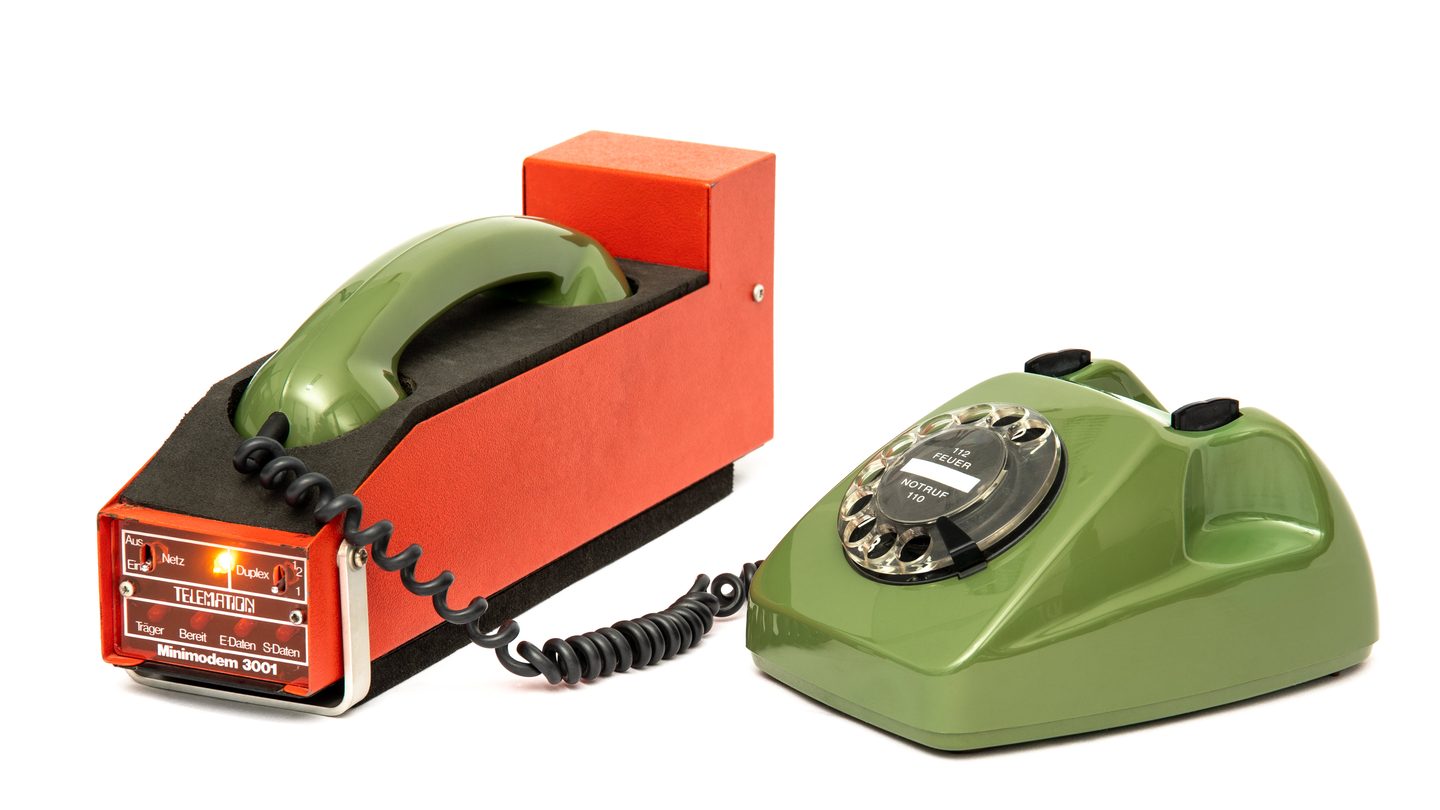
AT&T's foreign attachment tariff barred customers from connecting any equipment the phone company did not own. AT&T's modems came with Bell-supplied connecting arrangements and could attach directly; anything built by somebody else could not, which is why the modems those companies sold were acoustic couplers, with a telephone handset sitting in a foam cradle while the two machines talked in sound.
The first crack came in court. In 1956 the Hush-A-Phone case established that a customer may use a telephone "in ways which are privately beneficial without being publicly detrimental." Twelve years later the FCC went further. The Carterfone itself was a device that linked a two-way radio to the telephone system, acoustically, so somebody on a radio could speak to somebody on a phone. AT&T's tariff blocked it, and in the 1968 Carterfone decision (13 F.C.C.2d 420) the Commission found the tariff unreasonable and discriminatory, since identical equipment built by AT&T would have been allowed, and held that customers could attach devices that did not harm the network.
The effect took years to land. AT&T still insisted on its own connecting arrangements until the FCC adopted a registration program, codified as Part 68 in 1975, which let any manufacturer meeting technical standards sell equipment that plugged into a standard jack. The dial-up modem market, the fax machine and the answering machine all sit downstream of that decision. Once a technology is legal to build, the argument about who invented it becomes a separate question, which is the ground invention priority disputes cover.
Selling dial-up to households
CompuServe began in 1969 in Ohio as a time-sharing business, selling access to mainframes that sat idle overnight. On 24 September 1979 it opened MicroNET, the first dial-up online service aimed at consumers. It ran at 300 baud, the same speed the Bell 103A had reached seventeen years earlier, and it was sold through Radio Shack stores alongside Tandy's home computers. The Source launched the same year.
MicroNET was renamed the CompuServe Information Service in 1980. Subscribers got news, weather, stock quotes, file transfer, electronic mail and a chat system called the CB Simulator that soon accounted for about a fifth of the time used on the service. Those services ran on somebody else's mainframes, and you reached them by dialing a number. Access to the wider internet was a separate thing that arrived a decade later.
The box that made dialing automatic
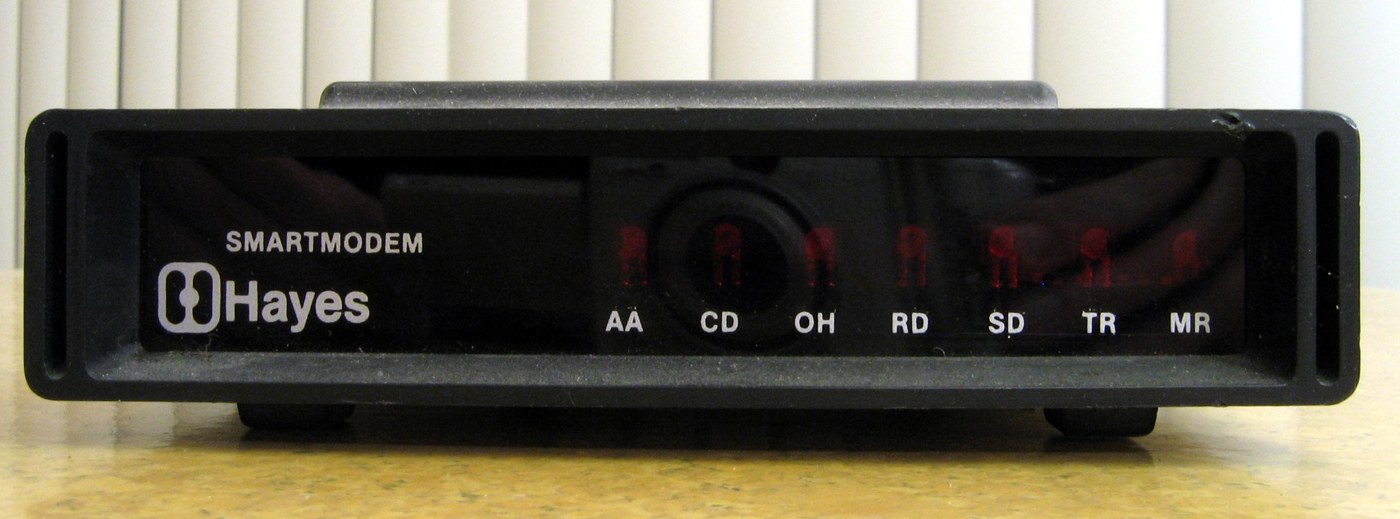
The Hayes Smartmodem, introduced in 1981, matched the speed of the modems already on the market, since it was a standard Bell 103A running at 300 bits per second. What it added was a command language, so the computer itself could tell the modem to dial, answer or hang up over the same RS-232 cable that carried the data. Auto-dialing had existed before, through a separate automatic calling unit; the Smartmodem put it in one box. The command set became a de facto standard, and the words Hayes-compatible sat on modem packaging for the next fifteen years.
The seven lights across that panel were the whole interface: AA for auto answer, CD for carrier detect, OH for off hook, RD and SD for the data moving each way, TR for terminal ready, MR for modem ready. Cheaper hardware followed quickly. Commodore's 1982 VicModem was the first modem sold for under $100 and the first to sell a million units, and bulletin board systems multiplied because owning a modem finally made sense.

How dial-up reached the internet
The first company to sell ordinary people dial-up access to the internet was Software Tool & Die, whose service The World opened in 1989. Speeds climbed steadily after that: 2,400 bits per second in 1984 with V.22bis, 14,400 around 1991, 28,800 with V.34 in 1994, 33,600 in 1996 and a nominal 56,000 with V.90 in 1998.
That figure was the ceiling the standard allowed. V.90 modems usually settled between 40 and 50 kbit/s in practice, because line noise and the age of the local wiring set the real limit, which is why the same computer could connect at different speeds on different days.
What the screech actually was
The noise people remember is two modems agreeing on terms. After the number was dialed, the calling modem announced itself in the 1,070 and 1,270 Hz band and the answering modem replied at 2,025 and 2,225 Hz, the same four frequencies the Bell 101 used in 1958. The wobbling and hissing that followed was both ends negotiating speed and error correction, and the final clunk was the connection locking in. A handshake that failed produced a different sound altogether and the words no carrier, because the carrier signal had never arrived.
When dial-up ended
Broadband began replacing dial-up commercially in the late 1990s but took years to win. Pew Research Center's surveys put dial-up at around 40 percent of American adults near 2000 and at about 3 percent by 2013. BT switched off its dial-up service in the United Kingdom in 2013, and Vodafone in New Zealand followed in 2021.
The largest remaining one closed on 30 September 2025, when AOL ended its dial-up service after 34 years, with an estimated 163,000 to 175,000 Americans still paying for it. A large share of them had told surveyors over the years that they stayed because broadband cost more, not because nothing else reached their street.