.jpg)
The two names everyone reaches for
Ask someone who invented electricity and the answer is usually one of two names: Benjamin Franklin, because of the kite and the key, or Thomas Edison, because of the light bulb. Both answers miss the same basic point: electricity is a force that already existed in nature, and people spent roughly 4,750 years of recorded history describing it, arguing about what caused it, and only very gradually learning to generate and control it. The same single-inventor shorthand gets applied to the telephone too, where Bell's hours-long lead over a rival turns out to hide a much longer list of competing claims.
Electricity had a name before it had a discoverer
The earliest known written reference to what we'd now call electricity has nothing to do with lightning or amber. It's a fish. Around 2750 BCE, Egyptian tomb carvings at Saqqara describe the electric catfish of the Nile in terms that translate roughly to "Thunderer of the Nile," recording that the fish could shock a fisherman through a wet net or boat pole hard enough to make him drop his catch. Nobody in that period claimed to have invented the shock; they just had a name for a fish that reliably delivered one, more than two thousand years before Thales of Miletus became linked to the story that would eventually give electricity its modern name.
That modern name traces back to Thales of Miletus, credited with observing, around 600 BCE, that amber rubbed with fur or wool attracts light objects like straw or feathers. The Greek word for amber, elektron, is the direct root of "electricity." But the Thales story is itself a layered myth. Nothing Thales wrote about it survives, and the claim reaches modern textbooks only through Diogenes Laertius, a biographer writing around the third century CE, roughly eight hundred years after Thales lived, reporting what Aristotle and Hippias had said about him. A 2012 study in the Journal of Electrostatics by Paul Iversen and Daniel Lacks concluded there's no real basis for treating Thales as having deliberately observed or experimented with static charge at all; in the surviving accounts, the amber comes up only as one incidental example inside a philosophical argument that inanimate objects have souls. It's the same gap MythCairn's invented traditions index was built to catalog: a story repeated as settled fact while the actual paper trail behind it runs far thinner than assumed.
The actual word "electricity" is much younger than the phenomenon it names. English physician William Gilbert coined the Latin adjective electricus, meaning "amber-like," in his 1600 book De Magnete, to describe any material that behaved the way rubbed amber did. It took physician and writer Sir Thomas Browne, in his 1646 Pseudodoxia Epidemica, to turn that into the English noun "electricity." Humanity had been living with recorded observations of the phenomenon for roughly 2,200 years before it had a name that's recognizable today.
Franklin's kite, and the vocabulary he actually left behind
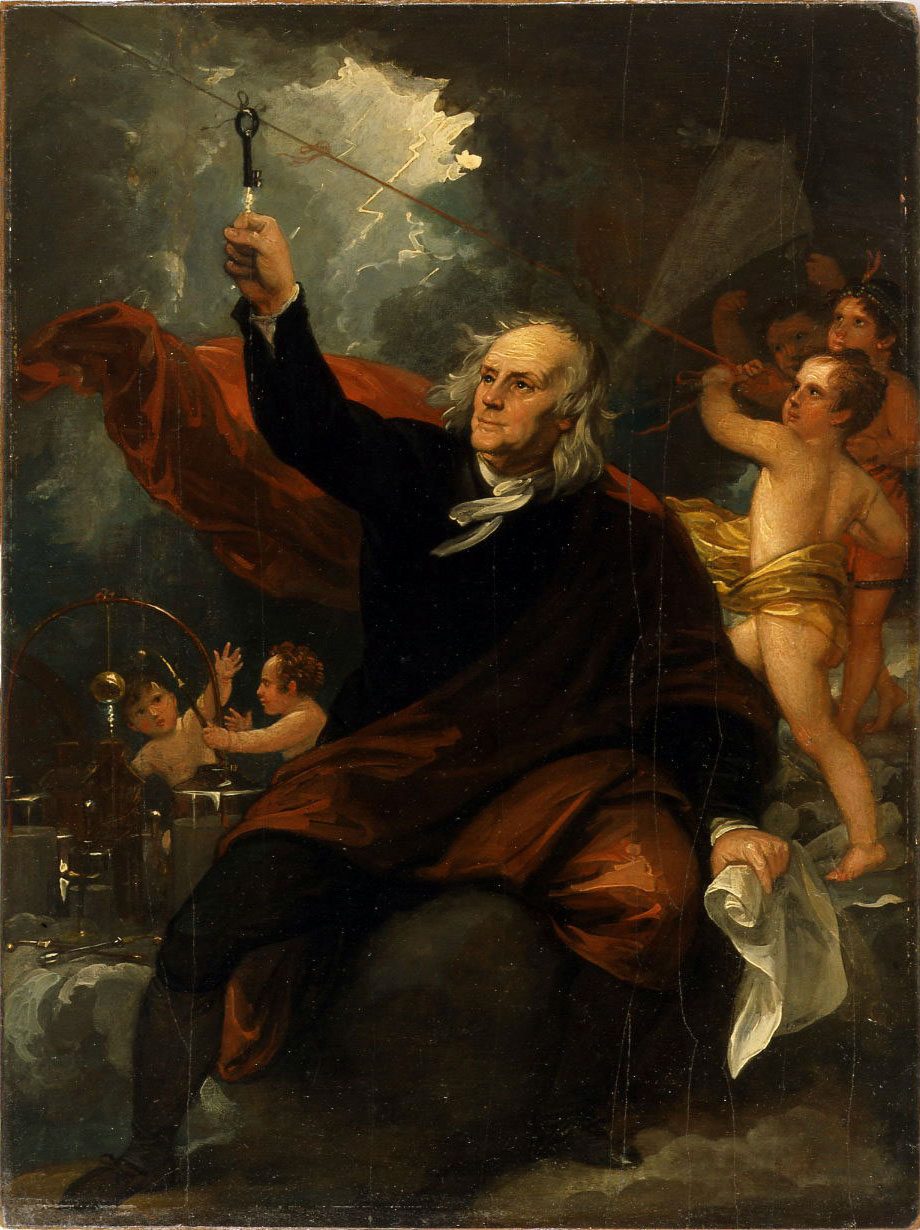
Benjamin Franklin gets closer to a legitimate claim than most people given credit, though not for the reason most assume. By the time of his famous kite flight, Franklin had already spent about five years experimenting with electricity, including the newly arrived Leyden jar, and he'd personally coined much of the vocabulary still used to describe electricity today: battery, charge, conductor, condenser, and the labels positive and negative for the two kinds of charge. That last pair came with a catch that's stuck around for over 270 years. Franklin guessed the direction his hypothesized "electrical fluid" flowed and called the surplus side positive, and he guessed wrong: when J.J. Thomson identified the electron in 1897, it turned out electrons flow the opposite way. Engineers kept Franklin's convention anyway, so the "conventional current" direction taught in physics classes today still runs backward from how electrons actually move, a quirk directly inherited from an 18th-century guess.
The kite experiment itself, from June 1752, is where the story gets shakier. Franklin's own published account, which ran in the Pennsylvania Gazette on October 19, 1752, opens by noting "the Success of the Philadelphia Experiment for drawing the Electric Fire from Clouds," and is written as a general set of instructions for how "any one may try" it, rather than as a first-person claim that he personally flew the kite on a specific day. He never filed a formal report, never gave an exact date, and the one person present, his son William, left no independent account of his own. In 2003, historian Tom Tucker argued in his book Bolt of Fate that the popular version of the experiment may not have happened as told, suggesting Franklin, in the middle of a scientific rivalry with researchers in Britain and France, made a public claim without necessarily performing the dramatic version later generations pictured. Other Franklin scholars reject that conclusion, pointing to a 1767 account by Franklin's friend Joseph Priestley that describes the experiment as real. The dispute has never been fully settled either way, which makes the most famous single moment in the popular history of electricity one that historians still can't fully verify.
A battery born from an argument, not a discovery
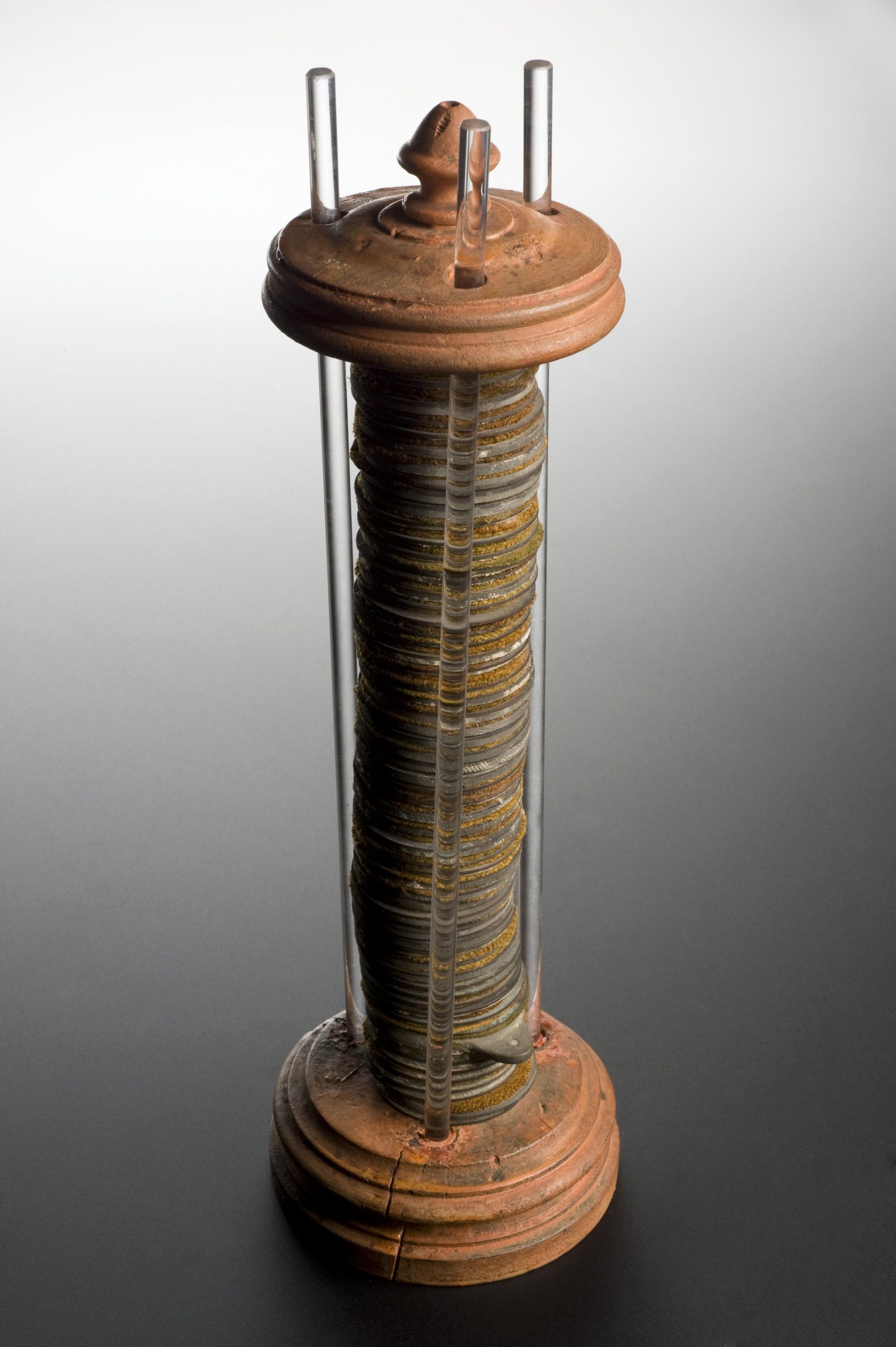
The next leap came out of a scientific feud, not a lone insight. In the 1780s, Bologna physician Luigi Galvani noticed that dissected frog legs twitched when touched by two different metals at once, and concluded the animal's own tissue contained a form of electricity, which he called animal electricity. Alessandro Volta, a physicist at the University of Pavia, disagreed. He argued the frog leg was acting only as a sensitive detector, and that the real source of the current was the contact between the two different metals themselves, with the moist tissue simply completing the circuit.
To prove his point without needing an animal at all, Volta built a stack of alternating zinc and copper discs separated by brine-soaked cardboard, the voltaic pile, the first device to produce a steady, continuous electric current on demand. He announced it in a letter to Sir Joseph Banks, president of the Royal Society, dated March 20, 1800; the letter was read to the Society that June. Neither man ended up entirely right or entirely wrong: later research into bioelectricity confirmed that nerves and muscles really do generate their own electrical signals, meaning Galvani's animal electricity was real too, just not the whole explanation for what he'd observed.

Newborn babies, and other things Faraday probably never said
Three decades later, in 1831, English scientist Michael Faraday wound two coils of wire around opposite sides of an iron ring and found that switching on current in one coil induced a brief current in the other, even though the two coils weren't physically connected. That effect, electromagnetic induction, is the direct ancestor of every electric generator and transformer running today. Faraday is often quoted as replying, when asked what practical use his demonstration had, "of what use is a newborn baby?" It's a good line, and it's also almost certainly not something he actually said: researchers tracing the quote have found no version of it in Faraday's own writing or in any account by his contemporaries, and consider it apocryphal, stitched together well after his death from vaguer, separate anecdotes. Even the story of how electricity got harnessed comes wrapped in a legend that isn't true.
Edison didn't invent electricity, he lost the argument over how to deliver it
The modern version of the invention myth usually lands on Thomas Edison, and it's worth being precise about what he actually did. Electricity was already thousands of years old by the time Edison was born; what he actually built was a commercially practical incandescent light bulb, and in 1882 he opened the Pearl Street Station in New York, a direct-current (DC) power plant designed to deliver electricity to that bulb across a city. DC power had a real limitation: it couldn't travel far from the generating plant without heavy losses.
Nikola Tesla, who had briefly worked for Edison, developed an alternating-current (AC) system that solved that problem using transformers, and sold the rights to industrialist George Westinghouse. Edison and Westinghouse spent the early 1890s locked in what's remembered as the War of Currents. Westinghouse won the decisive early rounds: he underbid Edison's General Electric to power the 1893 World's Columbian Exposition in Chicago with AC, $399,000 against GE's $554,000 DC bid, and that same year won the contract to harness Niagara Falls. AC became the standard for long-distance power transmission still used worldwide. The person most casually credited with "inventing electricity" is, by that measure, the one whose electrical distribution system lost within his own lifetime.
Electricity's real history is more interesting than the myth: a natural force named by Egyptians describing a fish, credited to a philosopher on the strength of an eight-hundred-year-old secondhand report, supposedly proven by a kite flight that even historians can't confirm, and finally delivered to homes by the loser of a business war. Long before any of that, cultures had already explained the same phenomenon their own way, lightning as Zeus's thunderbolt rather than a natural charge with a name borrowed from tree resin. It's the same gap between a tidy story and a messier truth that turned Carver into the credited inventor of peanut butter he never claimed to invent, and that still has historians arguing over what visitors to the oracle at Delphi actually experienced underground.