
Why this database exists
MythCairn's Invented History section has already found that no one person invented electricity and that Bell's telephone patent beat a rival by hours, not by being first to actually build a working device. This page collects that same pattern, one textbook "X invented Y" claim per row, and checks it against the patent filings, lawsuits, and court rulings that actually happened. It's the direct sibling of our Invented Traditions Index, which runs the same forensic check on customs and stories, not inventions: that page asks how old a tradition really is, this one asks who a credited breakthrough actually beat, and by how much.
Of the five disputes checked so far, the gap between the credited date and a real, documented earlier or simultaneous claim ranges from hours (the telephone, decided by which attorney reached the patent office first) to at least 22 years (smallpox vaccination, where a Dorset farmer's unpublicized 1774 case predates Edward Jenner's celebrated 1796 trial). None of the five was settled the way people usually assume: one patent held up under repeated legal attack, one was resolved by a corporate merger and not by a verdict, one still has no single ruling at all, and one produced a Supreme Court decision that's regularly summarized online in a way the actual text of the ruling doesn't support. The Invented History section also checks origin dates, not only credited names, and the dial-up timeline is the clearest recent case: a technology most timelines place in the 1980s was already running over dialed phone lines in 1962.
The five disputes
| Invention | Textbook credit | Real rival(s) and date | How it was actually resolved | Verdict / source |
|---|---|---|---|---|
| Telephone | Alexander Graham Bell, 1876 | Elisha Gray filed a rival caveat for a similar design the same morning, hours after Bell’s application (Feb 14, 1876); Philipp Reis had a working voice-transmitting device in 1861, 15 years earlier | Bell’s patent (No. 174,465, granted March 7, 1876) survived roughly 600 lawsuits; a 1886 bribery accusation against the examiner was found unsupported by a 2020 forensic review | Patent held MythCairn |
| Incandescent lightbulb | Thomas Edison, 1879 | British inventor Joseph Swan publicly demonstrated a working lamp and patented it in Britain in 1878, a year before Edison’s US patent | Swan sued Edison in Britain and won; the US side never reached a verdict, because the two companies merged in 1883, with Swan’s side getting more shares than Edison’s | Settled by merger Wikipedia: Edison and Swan Electric Light Company |
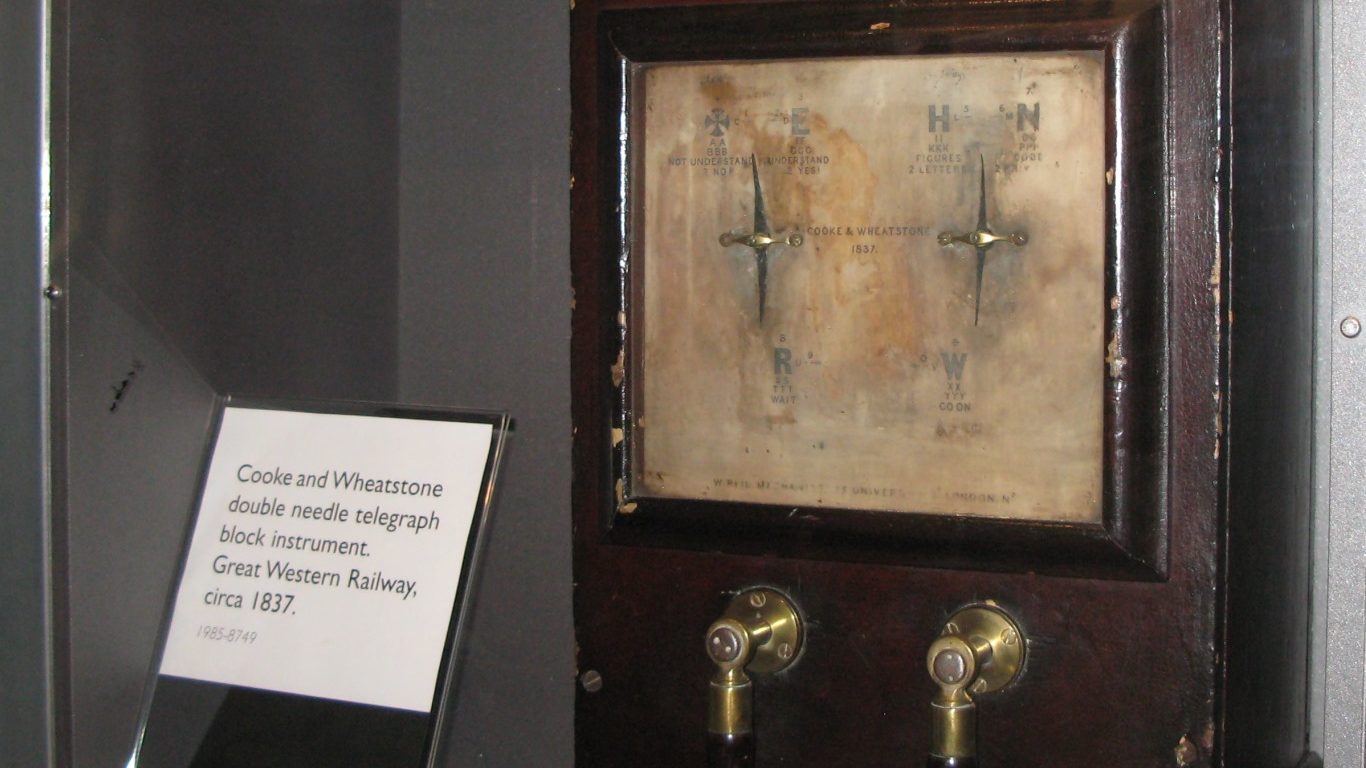
| Electric telegraph | Samuel Morse | Britain’s Cooke and Wheatstone patented and commercially deployed their own telegraph in 1837, the same year as Morse; Joseph Henry’s 1831 electromagnet research, passed to Morse, enabled Morse’s design but earned Henry no patent credit | No single ruling settled it; Cooke-Wheatstone became Britain’s standard, Morse’s simpler design won out in the US and most of the world | Parallel invention Smithsonian Institution Archives |
| Radio | Guglielmo Marconi, later “corrected” to Nikola Tesla by a 1943 Supreme Court ruling | The 1943 opinion examined earlier work by Nikola Tesla, Oliver Lodge, and John Stone Stone; its result concerned specific Marconi patent claims, not a declaration of one inventor of radio | Marconi Wireless Tel. Co. v. United States, 320 U.S. 1, decided June 21, 1943, six years after Marconi’s death, invalidated specific claims and set wartime compensation; it never crowned Tesla | Widely misreported ruling Justia: 320 U.S. 1 (1943) |
| Smallpox vaccination | Edward Jenner, 1796 | Dorset farmer Benjamin Jesty inoculated his own family with cowpox in 1774, 22 years earlier, but never published it; variolation with smallpox itself had already circulated for generations across the Ottoman Empire, Africa, and Asia | No patent dispute: Jenner deliberately never patented the method; his published 1798 paper, not the 1796 trial, is what spread internationally and built his lasting credit | 22 years late, unpublished rival Wikipedia: Benjamin Jesty |
Cite this
MythCairn Editorial, “Who Really Invented It? Invention Priority Disputes,” MythCairn, published September 29, 2026, https://mythcairn.com/who-really-invented-it/.
How a dispute earns a row here
A row earns a place here only when a named rival's competing claim has a specific, checkable date attached, sourced to a patent filing, a court record, a museum, or a peer-reviewed history-of-science paper, not to another list of "forgotten inventors" repeating a secondhand claim. Where the popular retelling of a legal outcome doesn't match what the ruling actually says, as with the 1943 radio case, the table gives the real text of the outcome rather than the version that circulates online.
This table will grow alongside MythCairn's Invented History section the same way the Invented Traditions Index has: each new "who invented X" article that turns up a documented, dated rival claim adds a row, and any dispute we can't pin to a specific filing or ruling gets left out rather than padded in with an approximate date.