
The short answer: no single year
Most answers to this question give a single year, and the year is usually 1349. Something dramatic did happen then, but 1349 is the date of the last big collapse, not the date of a destruction. The building was never knocked down in one event, and it was never abandoned in one either.
What actually happened is closer to a slow dismantling with two separate causes running alongside each other. Earthquakes damaged the structure at long intervals. In between, and for far longer, the Colosseum served as a working stone quarry for the city that had once filled it. History.com puts it bluntly: "a combination of weather, natural disasters, neglect and vandalism had destroyed nearly two-thirds of the original Colosseum, including all of the arena's marble seats and its decorative elements."
The dates that survive are uneven, because the record is uneven. Fire damage is described by ancient writers. Earthquake repairs are recorded in inscriptions and in the church's own paperwork. The quarrying is documented mostly through what the stone was used for, since nobody thought to write down the removal of a ruin they expected to keep removing. A single year is also the wrong shape of answer for much older buildings. The question of whether Stonehenge is older than the pyramids has no single answer for the same reason: the result depends on which phase of the monument you date.
| Year | What the record shows |
|---|---|
| 217 | Fire, attributed by Dio Cassius to lightning, destroys the wooden upper levels of the interior |
| 443, 484, 508 | Restoration work recorded, including an inscription crediting repairs under Theodosius II and Valentinian III |
| c. 1200 | The Frangipani family fortifies the building and uses it as a castle |
| 1349 | A major earthquake brings down the outer wall on the south side |
| 1439 to 1455 | Stone repairs the tribune of St John Lateran; 2,522 cartloads leave in 1452 alone; Pius II builds a wagon to carry material to Palazzo Venezia |
| 1703 | An earthquake drops three arches of the second ring on the south-west side; the travertine goes into the porto di Ripetta |
| 1749 | Benedict XIV forbids further quarrying and consecrates the building to the Passion of Christ |
What the 1349 earthquake actually did
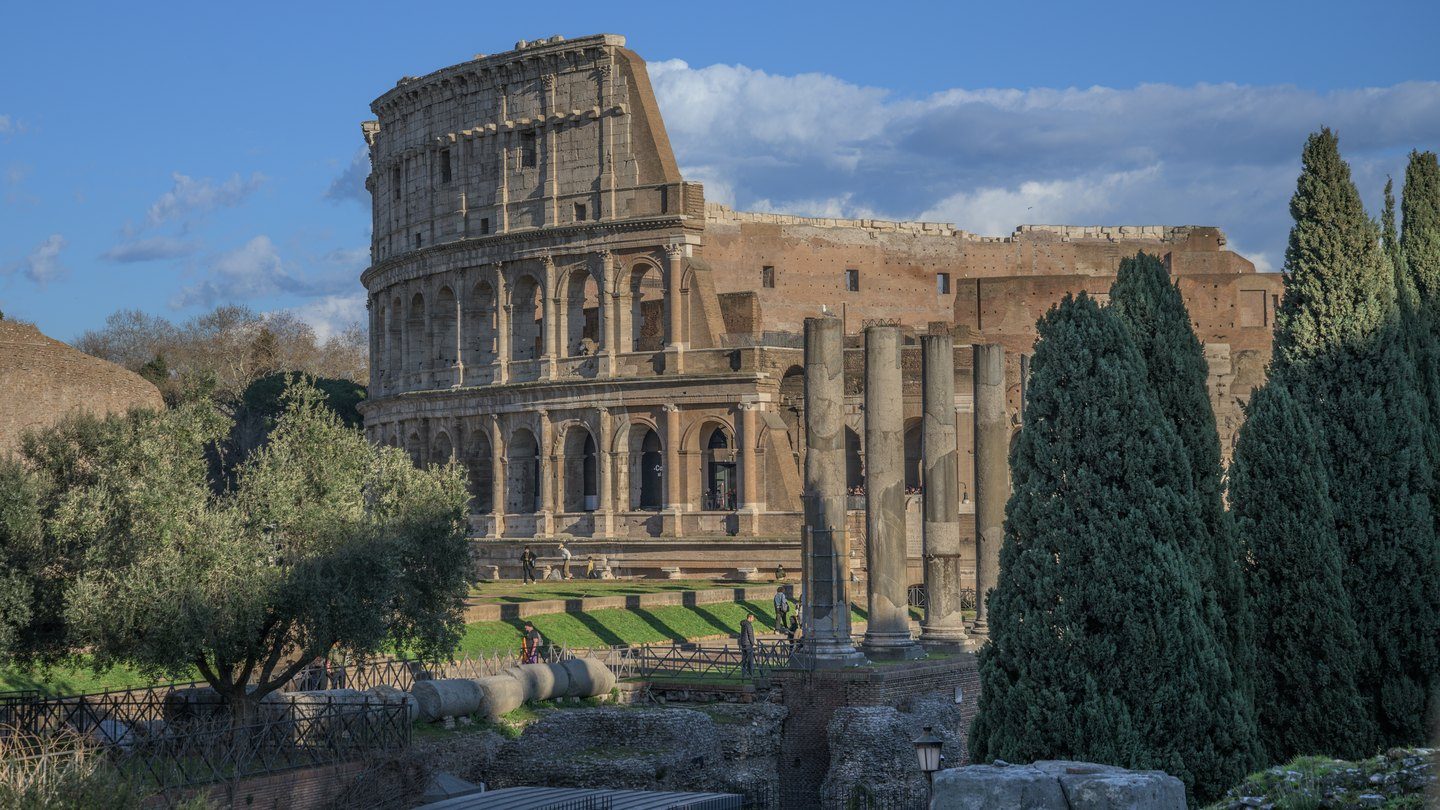
The earthquake is the closest thing to a destruction date, so it is worth being precise about its effect. It brought down the outer wall on the south side of the building. That section had been built over less stable alluvial ground, which is why the damage concentrated there and left the famous lopsided profile. One side of the ring fell; the rest of the amphitheatre did not.
Wikipedia (checked 13 October 2026) states the effect in one sentence: "Severe damage was inflicted on the Colosseum by the great earthquake in 1349, causing the outer south side, lying on a less stable alluvial terrain, to collapse." One history of the site puts the magnitude near 6.7 to 7, with shaking felt across Lazio, Molise and Abruzzo, and the city of L'Aquila almost entirely destroyed. Rome sits far enough from the epicentre that it does not experience the worst of Italian seismicity directly, but soft ground under the city can amplify waves arriving from a long way off, which is how a quake centred in the Apennines could still bring down a Roman wall in the middle of Rome.
This is why the south side of the Colosseum is the part that is gone. It is also why the rubble from that collapse was available to be carted away, and it was, for centuries afterward.
The damage that came before
Long before the earthquake, fire had already taken the top of the building. In 217 a blaze that Dio Cassius attributes to lightning destroyed the wooden upper levels of the interior. The repair was not quick: the Colosseum was not fully restored until about 240, with further work in 250 or 252 and again in 320.
Earthquake repairs follow in the fifth century. An inscription records restoration under Theodosius II and Valentinian III, possibly to make good damage from a quake in 443, and more work is recorded in 484 and 508. Each of these was a repair, not a demolition, which is the pattern that holds for most of the building's long decline: the structure was maintained by people who still wanted it standing.
What ended the maintenance was the end of the shows. Honorius banned gladiatorial combat in 399 and again in 404. The last mention of gladiators is around 435. Animal hunts ran until at least 523, when Anicius Maximus marked his consulship with a set of them and was criticized by Theodoric the Great for the expense. After that the building had no audience, and without an audience it had no budget.
The quarry years
Once the shows stopped, the Colosseum became a source of ready-cut stone in a city that was constantly building. This is the part of the story that the 1349 answer hides, because nobody treated it as a disaster. The removal was an industry, and popes licensed it for a fee.
The specialist Colosseum archive the-colosseum.net documents the trade in detail. Permission to take stone was granted by popes, for a fee, at the same time as those same popes were issuing edicts about protecting ancient monuments. In 1439 material went to repair the tribune of St John Lateran. In 1452 alone, 2,522 cartloads were carried off by a contractor from Como. Ten years later travertine from the site was used for the Scala Santa and for the square and the Loggia of the Blessings at St Peter's. Pius II had a wagon purpose-built to move Colosseum stone to Palazzo Venezia.
The list of buildings that consumed the amphitheatre runs across three centuries: Palazzo della Cancelleria and Palazzo Farnese in the sixteenth, the Palazzo Senatorio and the Palazzo dei Conservatori on the Capitoline, the Ponte Emilio in 1574, and Palazzo Barberini in the seventeenth. Not all of this came from standing walls. Much of it came from the pile of rubble left by the 1349 collapse, which was worked as a quarry into the 1700s.
The surface of the ruin still shows how the material went. The marble facade was burned to make quicklime, which destroys the stone entirely and leaves nothing to identify. The iron clamps that held the travertine blocks together were chiselled out and melted down, one account putting the total at over 300 tonnes of iron. Removing the clamps did not merely take the metal; it left the blocks beside each hole unbound, and the pockmarks on the outer wall are the sockets those clamps came out of.
Why one side survived
The north facade was kept on purpose. It stood where the religious procession to the Lateran passed, and it was preserved as a monumental backdrop for that route. Quarrying continued behind the facade, out of sight of the procession, while the outer wall itself was left standing. Even the removal of the metal clamps is much lighter on that side than elsewhere on the building.
The south side had no such protection. It stood on weaker ground, came down in 1349, and its fallen stone was then quarried for travertine into the eighteenth century. So the outline of the Colosseum as it exists now is the product of two different forces acting on two different halves: deliberate preservation on one side, geology plus the stone trade on the other.

How the quarrying stopped
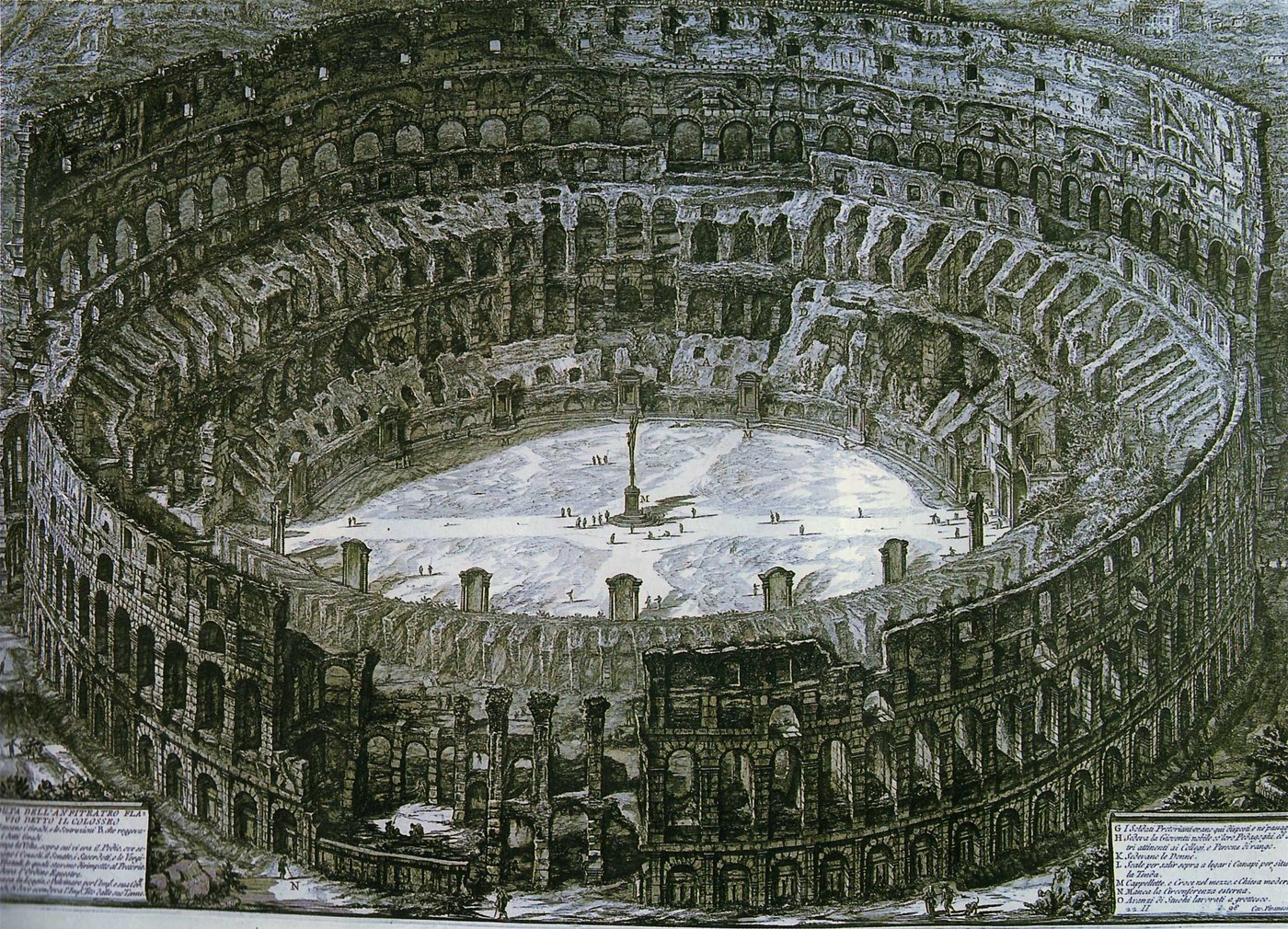
The quarrying ended in 1749, for a reason that had nothing to do with preservation. In that year Pope Benedict XIV endorsed the view that the Colosseum was a sacred site where early Christians had been killed, forbade its use as a quarry, consecrated the building to the Passion of Christ, and had the Stations of the Cross installed around the arena. That is the intervention that saved what was left.
The belief behind it has a documentary problem, and the same sources say so. Wikipedia (checked 13 October 2026) records that there is no historical evidence for the claim, and no sign that anyone before the sixteenth century suggested it, and it passes on the Catholic Encyclopedia's conclusion that there are no historical grounds for the supposition beyond the reasonable conjecture that some of the many people executed in the arena may have been Christian. The building was rescued by a tradition that cannot be traced back to the events it commemorates.
Earlier attempts to give the ruin a new job had all failed. Sixtus V wanted to turn it into a wool factory with machinery on the lower floors and workers housed above; the architect Domenico Fontana drew up the conversion, and the pope died in 1590 before the money was found. Clement X commissioned Gian Lorenzo Bernini to design a church to the martyrs in the middle of the arena, and nothing came of it. In 1700 Clement XI had the arches closed and the site used as a store for manure bound for a saltpetre works feeding a gunpowder factory nearby.
What is left, and who put it back
About a third of the original structure survives, if History.com's estimate of nearly two-thirds lost is right. Two buttresses hold the remaining outer arcades up, both nineteenth-century engineering rather than Roman work: Raffaele Stern completed one on the north-west side in 1820, and Giuseppe Valadier built a more visually matched one on the opposite side in 1826. A major restoration programme ran from 1993 to 2000.
The Colosseum's modern status has its own history. It entered the New7Wonders list in 2007 through a public vote, which is one of the two rival lists of Seven Wonders that the phrase can now mean. It had been attached to the idea of an eighth wonder much earlier, in a 1572 print series that paired it with the ancient seven, a trail followed in what the 8th wonder of the world actually is. Neither honour has anything to do with the years in which the building was taken apart.
Fire and earthquakes damaged the Colosseum, and a licensed building trade dismantled it over several centuries. The section still standing is the part that a procession route ran past. The Pantheon survives nearly whole, and it carries a dating problem that runs the other way: the inscription on its front belongs to a temple built about 150 years before the structure it is cut into.