
Two birthdays, 150 years apart
Search the question and one number usually comes back: about 1,900 years, completed under the emperor Hadrian, conventionally dated to around AD 126. That is the correct answer to the question as most people mean it. It is also only half of what the building says about itself.
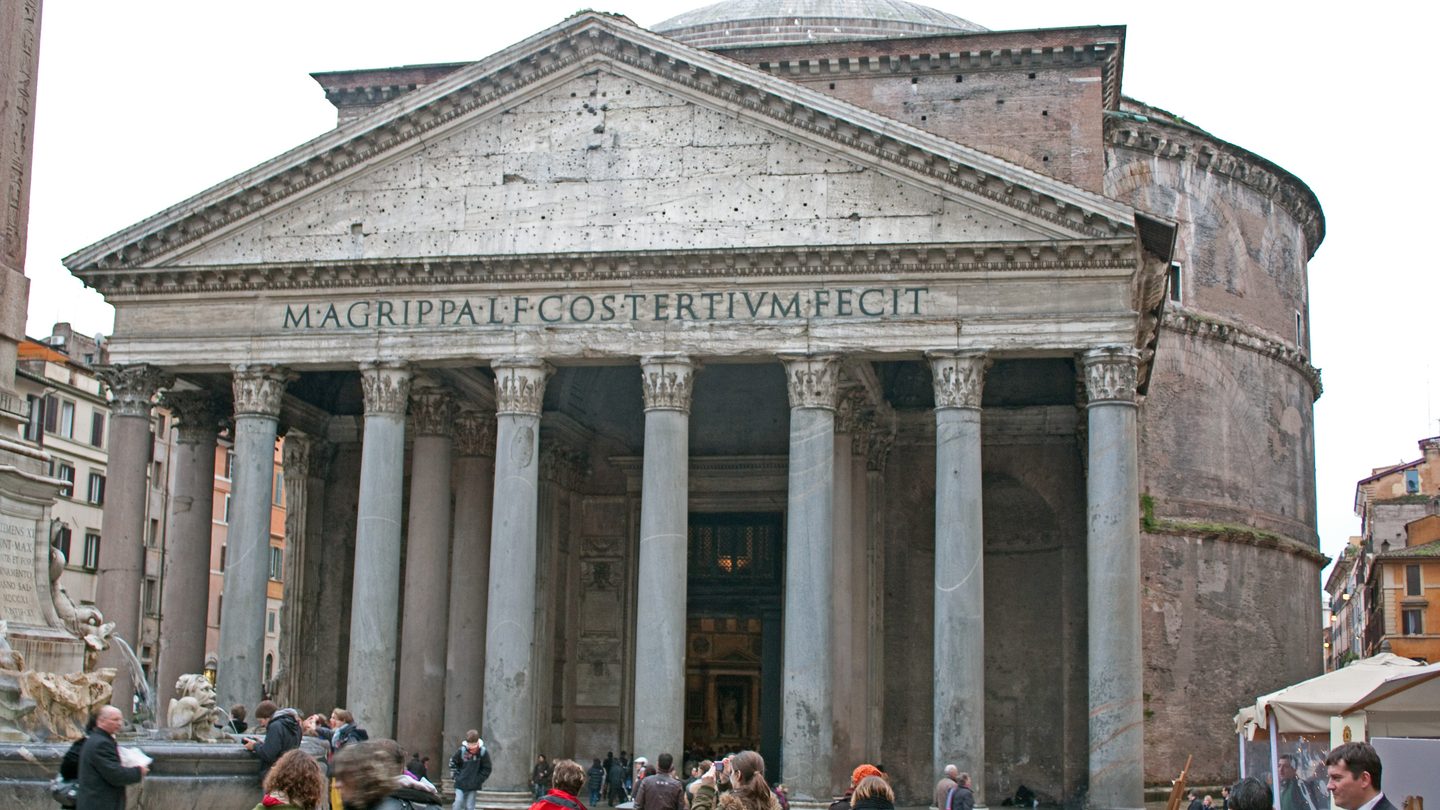
Cut into the frieze above the portico is a much older statement. It reads M·AGRIPPA·L·F·COS·TERTIVM·FECIT, which expands to Marcus Agrippa, son of Lucius, made this when he was consul for the third time. Agrippa held his third consulship in 27 BC, the year the consular lists give for him. Set that against a building of the 120s AD and the inscription advertises a structure roughly 150 years older than the walls it sits on.
Both dates are real. They belong to two different temples that stood on the same footprint, and the older one is the one named on the front.
Who Agrippa was, and what happened to his temple
Marcus Vipsanius Agrippa was Augustus's closest colleague, and after the Battle of Actium in 31 BC he spent heavily on Rome. Cassius Dio, the Roman senator who wrote his history in Greek, records the campaign building by building and gives the Pantheon its own line: "Also he completed the building called the Pantheon." Dio then offers two explanations for the name. It may come from the images of many gods inside it, "including Mars and Venus"; his own view is that "because of its vaulted roof, it resembles the heavens." The Pantheon, on this evidence, was never a temple to a defined list of twelve. It looked like the sky, or it held a crowd of statues, and either way the name described that.
Agrippa's Pantheon is not the building anyone visits. It burned in AD 80, in a fire that damaged several structures in the same district, and Domitian had it rebuilt. The replacement burned again in AD 110, during Trajan's reign. Two fires thirty years apart, and almost nothing of the first two versions survives above ground.
The Hadrianic date is the standard one, not the only one
The date normally attached to the present building comes from the bricks. Herbert Bloch's 1959 survey of the brick stamps in its walls placed the construction in Hadrian's reign, and that reading became the standard one. Wikipedia's article on the Pantheon, checked 16 October 2026, says the present building was "completed by the emperor Hadrian and probably dedicated c. AD 126," and adds that the date of construction is uncertain precisely because Hadrian re-inscribed the front with Agrippa's original wording. The Historia Augusta goes further and says Hadrian dedicated the building in the name of the man who had put up the first one.
Lise Hetland has argued for an earlier start. Her reading puts the beginning of construction at AD 114, under Trajan, four years after the second fire, and holds that Bloch's brick-stamp study should not have set aside the Trajanic-era bricks it turned up. Ancient Rome Live, which cites both studies, puts the present structure at "between 118 and 125 CE" and notes that some scholars think Trajan began the rebuilding and Hadrian finished it.
The result is a building whose age can honestly be given as 114, as 118 to 125, or as about 126, depending on which evidence is followed. Every one of those is a second-century date. None of them is 27 BC.
The Pantheon's dated history, from Agrippa to the melted bronze
Laid out in order, the dates attached to this building are the clearest answer to how old it is, because they show how many different things the question can be asking.
| Date | What is recorded | What the date rests on |
|---|---|---|
| 29 to 19 BC | Agrippa builds a complex on his own land in the Campus Martius: the Baths of Agrippa, the Basilica of Neptune, and the Pantheon | Cassius Dio 53.27 records the completion of the Pantheon; the 29 to 19 BC range for the whole complex is given in the sources below |
| 27 BC | Agrippa holds his third consulship, the office named on the inscription on the frieze | Consul lists for the year, as given in Cassius Dio; the inscription M·AGRIPPA·L·F·COS·TERTIVM·FECIT |
| AD 80 | Fire destroys the Augustan Pantheon; Domitian rebuilds it | Cassius Dio 66.24, which names the Pantheon among the buildings the fire consumed |
| AD 110 | The rebuilt temple burns a second time, under Trajan | Orosius 7.12, cited by Lise Hetland for the interval before the next rebuild (via the sources below) |
| AD 114 | Hetland’s date for the start of construction on the building that stands today | Brick stamps in the fabric, re-read against Herbert Bloch’s 1959 study (via the sources below) |
| AD 118 to 125, dedicated about 126 | The present structure is built under Hadrian and dedicated about 126, in the name of the original builder | Brick-stamp dating; Historia Augusta, Life of Hadrian 19.10 (via the sources below) |
| AD 202 | Severus and Caracalla restore the building, adding a second, smaller inscription below Agrippa’s | The Severan architrave inscription, now barely legible beneath Agrippa’s |
| 13 May 609 | Emperor Phocas hands the temple to Pope Boniface IV, who consecrates it as a church | The Liber Pontificalis, the papal record of the period, quoted in the sources below |
| July 663 | Emperor Constans II strips the roof and takes the bronze tiles to Constantinople | Paul the Deacon, quoted in full in the sources below |
| 731 to 741 | Pope Gregory III has the stripped roof relined with lead sheets, after about a century uncovered | Roof maintenance stamps and inscriptions on the fabric, recorded in the sources below |
| 1623 to 1644 | Urban VIII melts the bronze roof trusses of the portico; most of the metal becomes cannon for Castel Sant’Angelo | The pope’s accounts, read by the archaeologist Carlo Fea; a contemporary pasquinade |
What the later dates record
The 202 repair is the first date the building itself announces. Septimius Severus and his son Caracalla restored it, and their work is recorded in a second inscription on the architrave, smaller than Agrippa's and now barely legible: PANTHEVM VETVSTATE CORRVPTVM CVM OMNI CVLTV RESTITVERVNT, the Pantheon, damaged by age, they restored with all its embellishment. The wording matters. By 202 the building was already old enough to be described as decayed: 76 years after the latest of the three second-century dates given above, and 88 after the earliest of them.
In 609 the emperor Phocas handed the temple to Pope Boniface IV, who turned it into a church and consecrated it to St Mary and the Martyrs on 13 May 609. This is the reason the building is still standing at all. Wikipedia's article on the Pantheon, checked 16 October 2026, describes the consecration as saving it from "the abandonment, destruction, and the worst of the spoliation that befell the majority of ancient Rome's buildings during the Early Middle Ages." Ancient Rome Live states the same result more briefly, calling the Pantheon one of the best-preserved ancient buildings in Rome "largely because it was converted into a church in the seventh century." The bronze roof tiles did not survive the Middle Ages, though. Paul the Deacon records that when Constans II visited Rome in July 663 he stripped the church's roof and sent the tiles, along with everything else metal he could take, to Constantinople. The roof stayed open for about a century until Gregory III relined it with lead between 731 and 741.
The bronze, and the joke about the barbarians
The portico lost its bronze again in the seventeenth century. Urban VIII, elected in 1623, ordered the massive bronze trusses above the portico taken down and melted. Most of the metal went into cannon for the fortification of Castel Sant'Angelo, and the rest to other works under the Apostolic Camera. The popular version of the story says Bernini used the Pantheon's bronze for the baldachin over the high altar of St Peter's, and the papal accounts contradict it. The archaeologist Carlo Fea, working from those accounts, found that about 90 percent of the bronze went to the cannon and that the baldachin's bronze came from Venice. The line that did survive the episode is the joke. An anonymous Roman satirist posted a pasquinade on a statue in the city: quod non fecerunt barbari fecerunt Barberini, what the barbarians did not do, the Barberini did. Urban VIII was a Barberini.
So how old is the Pantheon?
There are three defensible answers and they are all correct in their own terms. The temple on this site is about 2,050 years old, if you date it from Agrippa's third consulship in 27 BC. The building standing there is about 1,900 years old, if you date it from the Hadrianic construction. The fabric in front of you, in the sense of what you photograph, is second-century work carrying an inscription cut for an earlier temple on the same ground.
That habit of attaching an older date to a newer object is not unique to the Pantheon, and it is the subject the site treats at How Old Is “Ancient”?, an index of buildings and traditions whose real age is younger than the one they advertise. The Pantheon belongs on it. The Colosseum's own end date is disputed in the same way, for related reasons: what looks like a single fixed date usually turns out to be a choice between several. Even the name Colosseum is later than the building, since the word reached the amphitheater only around the year 1000.