
No one has ever named an official eighth wonder
There isn't one. The only modern vote that tried to update the ancient list, the 2007 New7Wonders campaign, kept the number at seven, and nobody holds a registry of wonders, so "eighth" has no office to grant it. The Seven Wonders page covers how the list itself was assembled and why even the ancient version shifted between writers.
The phrase does have a paper trail, though. It turns up for four centuries on things with nothing in common except someone who wanted them noticed, so the useful question is who wanted the title and what they were selling.
The first print use was a joke at a traveller's expense
The earliest use that word historian Pascal Tréguer found is a title page. In 1613 the poet John Taylor published The eighth wonder of the world, or Coriats escape from his supposed drowning, a satirical pamphlet about the English travel writer Thomas Coryat (Tréguer, Word Histories). The "wonder" in the title was Coryat himself. So from the start the phrase could be a dig as easily as a compliment, and it still works that way when someone calls a self-satisfied person the eighth wonder of the world.
Taylor's title only works if readers already knew the seven. By 1613 the list was familiar enough that adding one to it was a punchline.
In the 1600s the title mostly belonged to a Spanish monastery
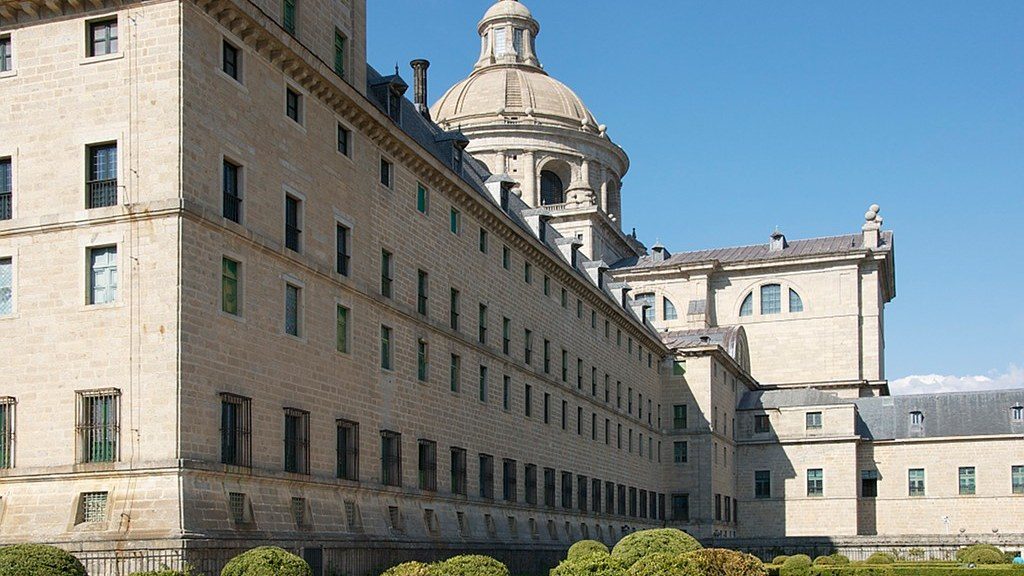
Once the phrase turned serious, it kept landing on the Escorial, the monastery and palace Philip II of Spain built near Madrid in the late 16th century. English-language writers between 1652 and 1696 used it that way again and again. The physician Walter Charleton, in 1652, called the monastery of St. Lawrence "for bravery and amplitude of architecture reputed the eighth wonder of the World." The Welsh historian James Howell, writing in 1655, told a correspondent that he had been to see it and that "considering the site of the place, the state of the thing, and the symmetry of the structure, with divers other rarities, it may be call'd so." A 1696 narrative of an English gentleman in Spain, by Philip Ayres, reports that "the Spaniards term this Magnificent Pile the Eighth Wonder of the World."
Howell's "it may be call'd so" is the telling bit. Even in 1655 the title was a judgment a visitor could grant or hold back, not a status the building held.
The label also traveled. A 1670 English translation of Arnoldus Montanus's account of Dutch embassies to Japan applies it to Osaka Castle, crediting the emperor Taicosama with spending so lavishly on it that the castle became "the eighth wonder of the World" (Atlas Japannensis, trans. John Gilby). Two buildings on opposite sides of the world, each called the eighth wonder by a European author in the same century. Nobody was keeping count.
A ledger of who has claimed the title, and what they were selling
Here are the documented claimants by date. Each row records a use of the phrase, not a verdict that the thing earned it.
| Year | Claimant | Who used the phrase |
|---|---|---|
| 1572 | The Colosseum | A print series by Philips Galle after Maarten van Heemskerck titled Octo Mundi Miracula, "Eight Wonders of the World" (see the Seven Wonders page) |
| 1613 | Thomas Coryat | John Taylor's satirical pamphlet title |
| 1652 to 1696 | The Escorial | Charleton, Howell, Ayres and others |
| 1670 | Osaka Castle | Montanus, in John Gilby's English translation |
| 1816 | The Wearmouth (Sunderland) bridge | A lottery advertisement to raise repair money, per Quote Investigator (Leeds Mercury, 26 October 1816) |
| 1883 | The Brooklyn Bridge | History.com says the bridge, opened 24 May 1883, was dubbed the eighth wonder of the world |
| 1925 | Compound interest | An Equity Savings and Loan Company advertisement in the Cleveland Plain Dealer, per Quote Investigator |
| 1931 (completed) | The Empire State Building | Credited by History.com to its height and its construction speed of one year and 45 days |
| 1965 | The Houston Astrodome | Described as the Eighth Wonder of the World by SABR and Mental Floss; neither says who coined it |
Read down the right-hand column. Lottery organizers, press at a bridge opening, a stadium's backers, a savings-and-loan copywriter. The phrase mostly shows up when someone wants a thing to have a reputation it doesn't yet have. No neutral authority adopting the phrase turned up in the sources checked.
The bridges and the dome: what the title meant when it was new
The Brooklyn Bridge opened on 24 May 1883 after fourteen years of construction, a fire in an underwater caisson, and the death of its designer John A. Roebling, and History.com says it was dubbed the eighth wonder of the world. The claim fit the facts available to a newspaper reader. History.com points to its unprecedented length and its two stately towers. It was also brand new.
The same logic applied to the Empire State Building, which History.com says earned the label for its height and above all its speed, rising in one year and 45 days. And it applied to the Astrodome, the Harris County Domed Stadium that opened in Houston on 9 April 1965 as the first enclosed, air-conditioned stadium for baseball and football. SABR says it was commonly called the Eighth Wonder of the World, and none of the sources checked says who coined the nickname.
Each was an engineering milestone, so the label wasn't empty. It was also a mark of novelty, handed out while the building was still the biggest of its kind and passed on to the next record-setter.
Einstein and compound interest: a quotation, not a wonder
Ask a search engine for the eighth wonder of the world and a large share of the answers are about money. The line goes that Einstein called compound interest the eighth wonder, and that those who understand it earn it while those who don't pay it. There is no good evidence he said any of it.
Quote Investigator, which traces quotations to their earliest documented appearance, reports that the earliest close match it located is a 1925 advertisement for The Equity Savings and Loan Company in the Cleveland Plain Dealer, with no attribution to anyone, and it suggests an unknown advertising copywriter wrote it. It also notes that the saying sits in a section titled "Probably Not By Einstein" in The Ultimate Quotable Einstein from Princeton University Press, and that the same line has been credited to financial figures such as Baron Rothschild and John D. Rockefeller.
It follows the Escorial and Astrodome pattern. Someone wanted compound interest to sound impressive, reached for the phrase, and the most famous name available got attached later.
How to check any eighth-wonder claim
Three questions sort most claims.
Who said it, and when? A travel site's "called the eighth wonder" is not a source. A dated newspaper line, advertisement or letter is.
What did the speaker gain? Lotteries, ticket sales and promotional campaigns account for much of the record above.
Did anyone with authority adopt it? So far, no. UNESCO lists World Heritage sites, and the 2007 New7Wonders campaign chose seven new monuments. The Great Pyramid of Giza is the only one of the original seven still standing, and its ancient list was never reopened to add an eighth.
If you want the monuments that did win a modern vote, Machu Picchu, the Taj Mahal and Christ the Redeemer are among them, and each has its own page here.