
The story everyone learns
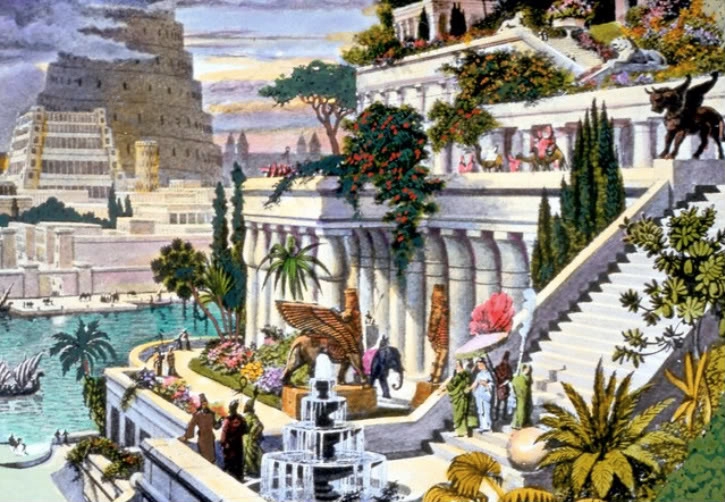
The traditional version goes like this. Sometime around 600 BCE, King Nebuchadnezzar II of Babylon built a spectacular garden, rising in tiered terraces high enough to be visible over the city walls, to comfort his wife Amytis of Media. She had grown up in the green hills of Media, in what is now western Iran, and found flat, sun-baked Babylon unbearable by comparison. So the story goes that Nebuchadnezzar built her a mountain, planted with trees and irrigated by a system clever enough to keep soil on a roof from drying out.
The earliest known version of this story comes from Berossus, a Babylonian priest writing around 290 BCE, whose original text is lost but survives in quotations by the Jewish historian Josephus centuries later. Berossus describes Nebuchadnezzar "planting what was called a pensile paradise, and replenishing it with all sorts of trees, he rendered the prospect an exact resemblance of a mountainous country." That's the version that eventually made it onto the standard list of Seven Wonders, alongside the Great Pyramid of Giza, the Statue of Zeus at Olympia, and the rest. The modern list carries its own mislabel: Christ the Redeemer is the wonder UNESCO never actually named.
It's a good story. The trouble is that almost nothing about it holds up under scrutiny, and there's a real chance the whole thing describes a garden that stood in a different city, built by a different king, for a different reason.
The problem: a king who documented everything, except this
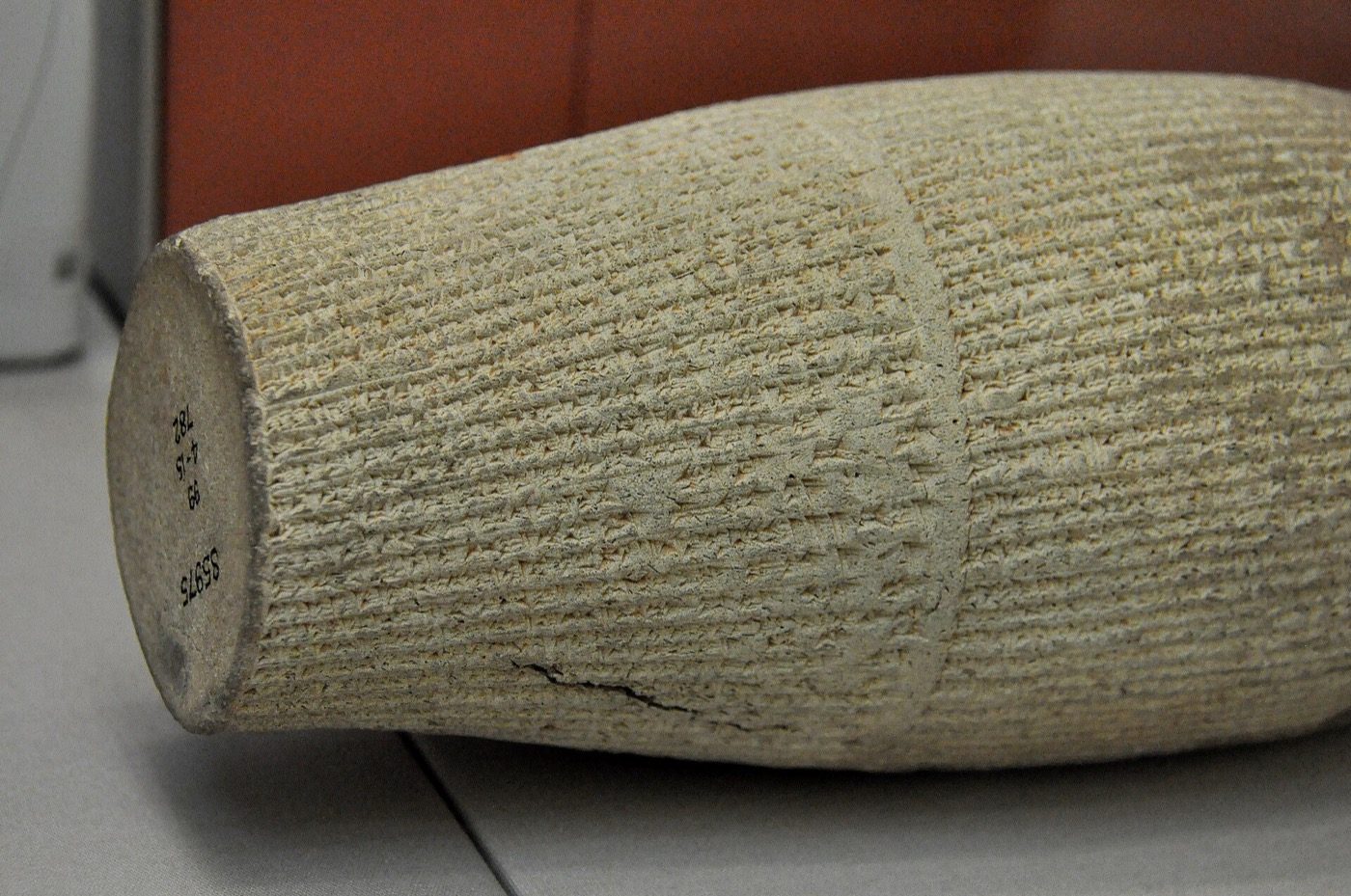
Nebuchadnezzar II was not a shy builder. He left behind hundreds of inscriptions boasting about his construction projects across Babylon: the Ishtar Gate, the ziggurat, temple restorations, city walls, palace additions. Mesopotamian kings of this era routinely inscribed detailed records of what they built and why, partly as propaganda and partly as a durable record for posterity. Given how much Nebuchadnezzar wrote about comparatively mundane infrastructure, the total silence on a garden famous enough to become a Wonder of the World is strange.
Archaeologists have been digging at the site of Babylon since 1899, when the German archaeologist Robert Koldewey began a major excavation. Koldewey found what he believed might be foundations for the gardens near the palace, including a room with unusual vaulted construction and what looked like an ancient well system. But the identification was never confirmed, and later scholars have pointed out that the structure he found more plausibly served as storage rooms or administrative space. No plant remains, no inscriptions describing a garden, nothing that settles the question either way. Complicating things further, the Euphrates River has shifted course since antiquity, and some archaeologists think any remains near the old riverbank could be waterlogged or simply unreachable given modern conditions in Iraq.
Then there's Herodotus. Writing around 440 BCE, only a century or so after Nebuchadnezzar's reign, Herodotus toured the region and wrote at length about Babylon: its walls, its temples, its customs. He is exactly the kind of source you'd expect to mention a garden famous enough to later become one of the Seven Wonders. He doesn't mention it at all.

None of the source writers ever saw it
This is worth sitting with, because it changes how much weight any version of the story deserves. Every detailed ancient description we have of the Hanging Gardens comes from Greek and Roman writers active centuries after Nebuchadnezzar died, and none of them claim to have seen the gardens themselves.
Diodorus Siculus, writing in the 1st century BCE, gives the most detailed physical description: a square garden about 400 feet on each side, terraces rising like an amphitheater to a height of about 20 meters, with brick walls over 20 feet thick to bear the weight of the soil and irrigation system. Strabo, writing around the same period, describes a screw mechanism drawing water up from the Euphrates to feed the terraces. Quintus Curtius Rufus, writing in the 1st century CE, describes gardens atop a citadel and, notably, attributes them not to Nebuchadnezzar but to an unnamed "Syrian king." Philo of Byzantium, in a much later text on the Seven Wonders, marvels at the engineering of the water-raising system without naming a builder at all.
These writers were working from earlier sources that are now lost to us, likely including accounts from officers and travelers in Alexander the Great's army, which passed through Babylon in 331 BCE. So the chain of transmission runs: unnamed eyewitness or near-eyewitness accounts from the 4th century BCE, filtered through now-lost intermediate texts, written down by authors working two to five centuries after the fact, none of whom had visited Babylon or Nineveh themselves. That's not a reason to dismiss the story outright, but it's a reason to treat specific details like the exact dimensions, the screw mechanism, or the queen's name rather loosely.
Stephanie Dalley's case for Nineveh
In 2013, after eighteen years of studying cuneiform texts, Oxford Assyriologist Stephanie Dalley published The Mystery of the Hanging Garden of Babylon: An Elusive World Wonder Traced, arguing that the gardens described by the Greek and Roman writers were real, but that they were never in Babylon at all. Dalley's candidate is a garden built by the Assyrian king Sennacherib at Nineveh, some 300 miles north of Babylon, sometime in the early 7th century BCE, about a century before Nebuchadnezzar's reign.
The evidence Dalley assembled is considerably more concrete than anything tying a garden to Babylon. One of Sennacherib's own inscriptions states plainly, "Over a great distance, I had a watercourse directed to the environs of Nineveh," describing an aqueduct spanning steep valleys, sluice gates, and canals stretching some 50 miles, built using what the same texts describe as over two million dressed stones. For lifting that water up into the terraces themselves, Dalley's reading of the technical passages describes a mechanism built from ropes, cables, and chains cast in bronze, mounted on tree trunks with large copper helicoids turning above the wells, essentially a screw pump. That would predate Archimedes, who is traditionally credited with inventing the screw pump about four centuries later, by a wide margin. Sennacherib calls his creation a palace and garden built to be "a wonder for all peoples," strikingly close to the language later Greek writers use for the Hanging Gardens.
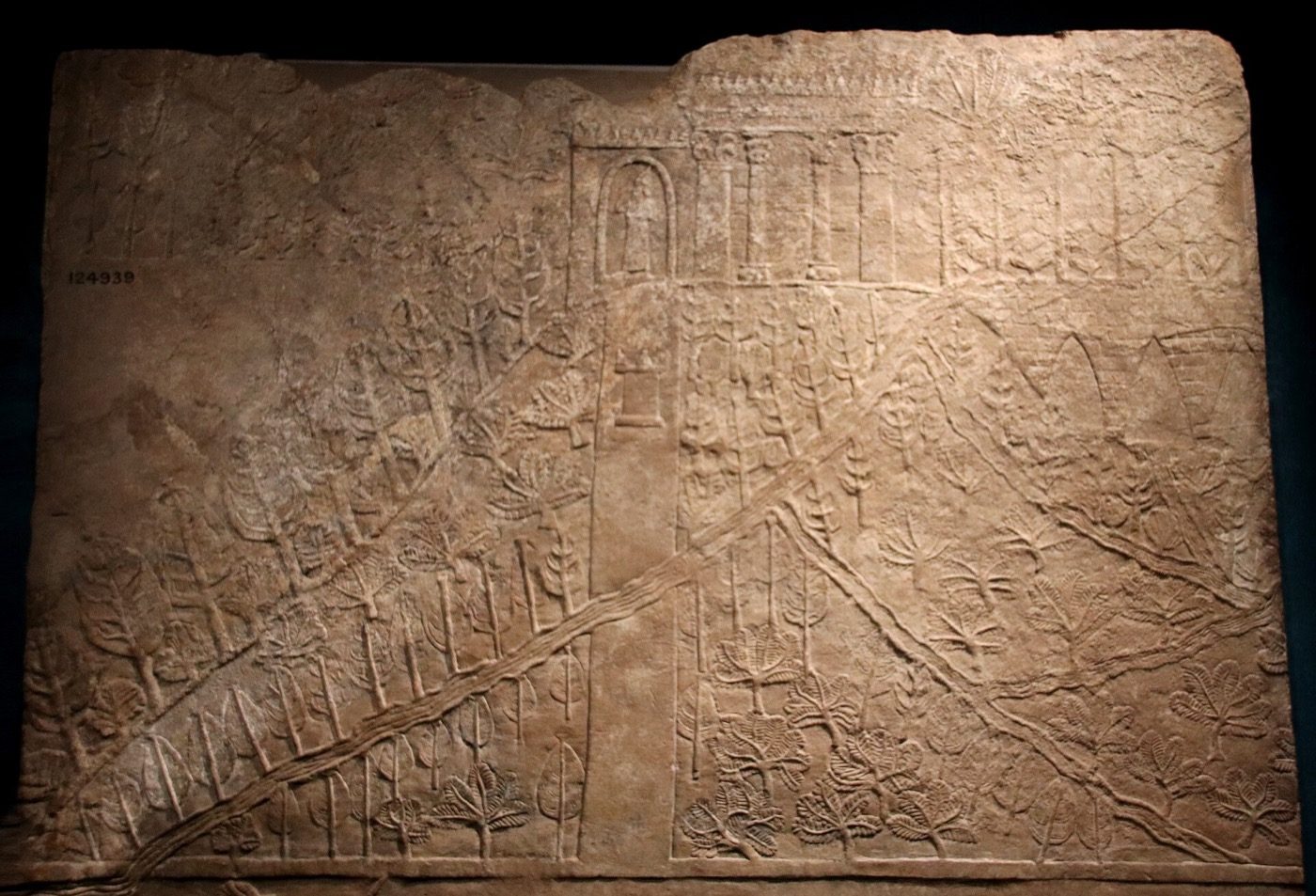
Two damaged stone reliefs recovered from Nineveh, one from Sennacherib's own palace and one from the palace of his grandson Ashurbanipal, depict a raised, terraced garden with trees growing on stone arches, watered by an aqueduct, with visitors apparently strolling and relaxing beneath a colonnaded walkway roofed by growing tree roots. It's a physical depiction of more or less exactly the kind of structure Diodorus and Strabo describe, centuries earlier than either of them wrote, and unlike anything found at Babylon.
Dalley also offers an explanation for how the mix-up could have happened. After Sennacherib's forces destroyed Babylon in 689 BCE, he rebuilt parts of Nineveh in a style that echoed the conquered city, reportedly renaming some of Nineveh's gates after Babylon's, and Nineveh came to be referred to in some later texts by the honorific "New Babylon." A garden built in a city sometimes called Babylon, centuries before, filtered through secondhand Greek retellings that were none too careful about which Mesopotamian capital was which, could plausibly have migrated onto Nebuchadnezzar's much more famous city in the retelling.

The best case against Nineveh
Dalley's evidence for a real garden at Nineveh is one thing. Explaining how Greek and Roman writers ended up attaching that garden to the wrong city centuries later is another, and that's where her theory meets its toughest critic. Timothy Potts, who holds a doctorate in Near Eastern archaeology from Oxford and has directed the Kimbell Art Museum, the Fitzwilliam Museum, and the J. Paul Getty Museum, reviewed Dalley's book for The New York Review of Books in 2013 and laid out a problem her account never fully closes.
Potts's first point is one of logic. Evidence that Sennacherib built an impressive garden at Nineveh isn't automatically evidence against Nebuchadnezzar building one at Babylon; both could simply be true. Earlier Babylonian kings had already boasted of splendid gardens of their own, even if none matched Sennacherib's mountain-style design, so the similarities Dalley documents could just as easily show Nebuchadnezzar copying an Assyrian idea he admired, not proof that his own garden never existed.
The harder problem is timing and geography. When Alexander the Great's army captured Babylon in 331 BCE, and again when Alexander returned there and died in Nebuchadnezzar's palace in 323 BCE, the city was still one of the most spectacular in the world, its walls, temples, and ziggurat toured and described firsthand by thousands of soldiers and court chroniclers. Nineveh, by contrast, had been rubble for nearly three centuries by the time Alexander's Greek chroniclers reached Mesopotamia. Potts's argument is that mixing up which of two obscure, long-vanished ruins held a garden is one kind of mistake. Deciding a garden belonged to a large, thoroughly toured megacity when it actually stood somewhere no one in Alexander's circle had ever set foot is a much bigger error to explain away.
Dalley's response to her biggest obstacle, Berossus, the earliest and most direct source, a Babylonian priest with access to the city's temple archives, is to treat his garden passage as a later addition to his text, not something Berossus wrote himself. Potts notes that specialists are split on whether that passage really is a later interpolation, which leaves Dalley's strongest and most inconvenient source only partly explained, not resolved. His verdict: Dalley proves Sennacherib built something wonder-worthy at Nineveh, without proving later writers ever moved it to Babylon.
So did the gardens exist?
Historians generally sort the possibilities into three camps. One: the gardens are essentially legendary, a romantic image that Greek and Roman writers built up around Babylon's genuine reputation for splendor, with no single real structure behind it. Two: the gardens were real and stood at Babylon as described, but were destroyed so thoroughly, and so long before Koldewey started digging, that no trace survived, or survived somewhere still unexcavated. Three, Dalley's position: the gardens were real, but the location and the builder both got mixed up, and the actual monument was Sennacherib's garden at Nineveh.
None of the three has been proven, and it's worth sitting with why that matters. The Hanging Gardens are the only one of the traditional Seven Wonders with no confirmed archaeological site at all. Compare that to the Great Pyramid of Giza, which has stood in full view on the same spot for over four thousand years, its builder never in any real doubt. That makes this an unusual kind of argument for archaeology to be having. Most debates over an ancient ruin are about how to interpret a structure everyone agrees is there. This one is about which of two Mesopotamian capitals held the structure in the first place. The same shape shows up far outside ancient Mesopotamia, too: George Washington Carver is remembered for inventing a food he never actually made, while the real, harder-to-summarize story of what he did accomplish got pushed aside for something tidier.