
Three claws, borrowed from four
A ryū, the word usually translated as "Japanese dragon," looks close to the Chinese lung it descends from but keeps one visible difference: three claws on each foot instead of four or five. In China, claw count once marked rank. Five-clawed dragons were reserved for the emperor, four-clawed dragons for princes and high officials, and three-clawed versions circulated more freely in decorative art, including the imagery that reached Japan through Buddhist temples and continental trade, a hierarchy documented both by Sotheby's overview of dragon symbolism in Chinese imperial art and separately by the Environmental Literacy Council's summary of the same claw-rank system. Japan kept the humbler three-clawed form. With no equivalent of China's imperial law to enforce it, that claw count applied to any dragon image, high-status or ordinary.
The bigger difference isn't cosmetic. Where the dragon of Western folklore hoards treasure and breathes fire, the ryū is a water spirit, a snake-like body without wings, tied to rivers, rain, and the sea rather than to caves and gold. Japan already had local water kami before continental contact, and the dragon form gave those older river and sea deities a shared visual language, the same way English speakers use one word, phoenix, for several unrelated fire-bird myths that never actually shared a single origin.
The serpent before the dragon
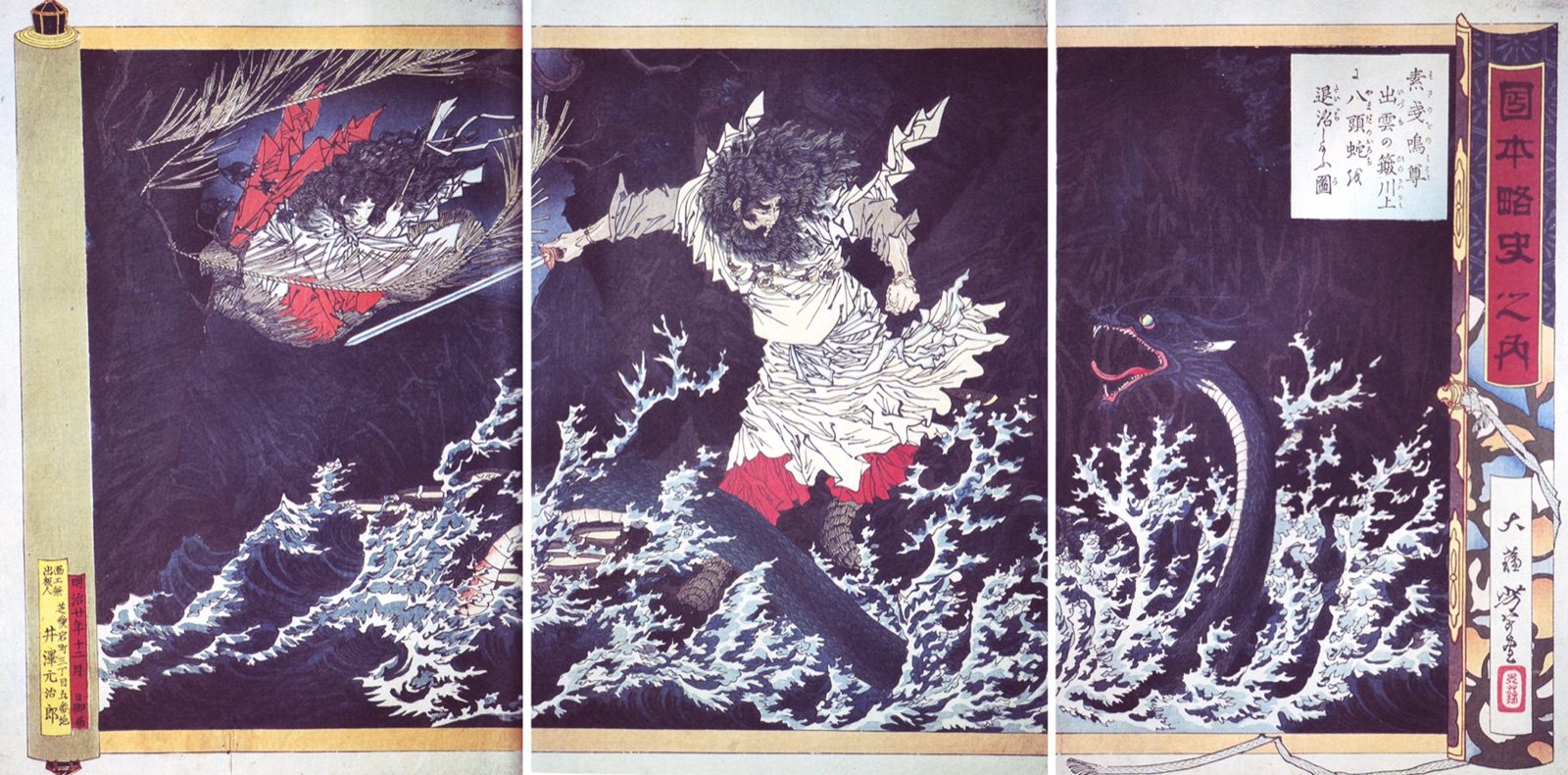
Japan's oldest recorded dragon story doesn't use the word dragon at all. In the Kojiki (712 CE) and the Nihon Shoki (720 CE), the country's two earliest chronicles, the storm god Susanoo is banished from heaven and lands in Izumo province, where an elderly couple tells him that a monster called Yamata no Orochi, eight heads and eight tails, has already devoured seven of their eight daughters, one a year, and is due to return for the last, Kushinada-hime. Basil Hall Chamberlain's 1882 English translation of the Kojiki renders the couple's description of the creature directly: "Its eyes are like akakagachi, it has one body with eight heads and eight tails... Its length extends over eight valleys and eight hills, and if one look at its belly, it is all constantly bloody and inflamed." Susanoo offers to kill it in exchange for the last daughter's hand in marriage.
His plan leans on sake, not swordplay first. Chamberlain's translation has him instruct the couple: "Do you distill some eight-fold refined liquor. Also make a fence round about, in that fence make eight gates, at each gate tie together eight platforms, on each platform put a liquor-vat, and into each vat pour the eight-fold refined liquor, and wait." The serpent duly "dipped a head into each vat, and drank the liquor," and, intoxicated, fell asleep. Only then does Susanoo draw his sword and cut it apart. One tail resists the blade; splitting it open, he finds another sword inside, sharp enough to become Kusanagi, later counted among Japan's three imperial regalia.
Every one of those quoted lines calls the creature orochi, a giant serpent, never ryū. English retellings translate it as "dragon" because an eight-headed monster slain for a bride fits the shape of dragon-slaying stories told elsewhere, but the 8th-century text keeps Yamata no Orochi and the water-deity dragons that appear later in the same chronicles as two separate kinds of animal, a distinction the Chamberlain translation preserves throughout: the word "dragon" never once appears in his rendering of this episode.
A sea god's daughter and an empire's ancestor
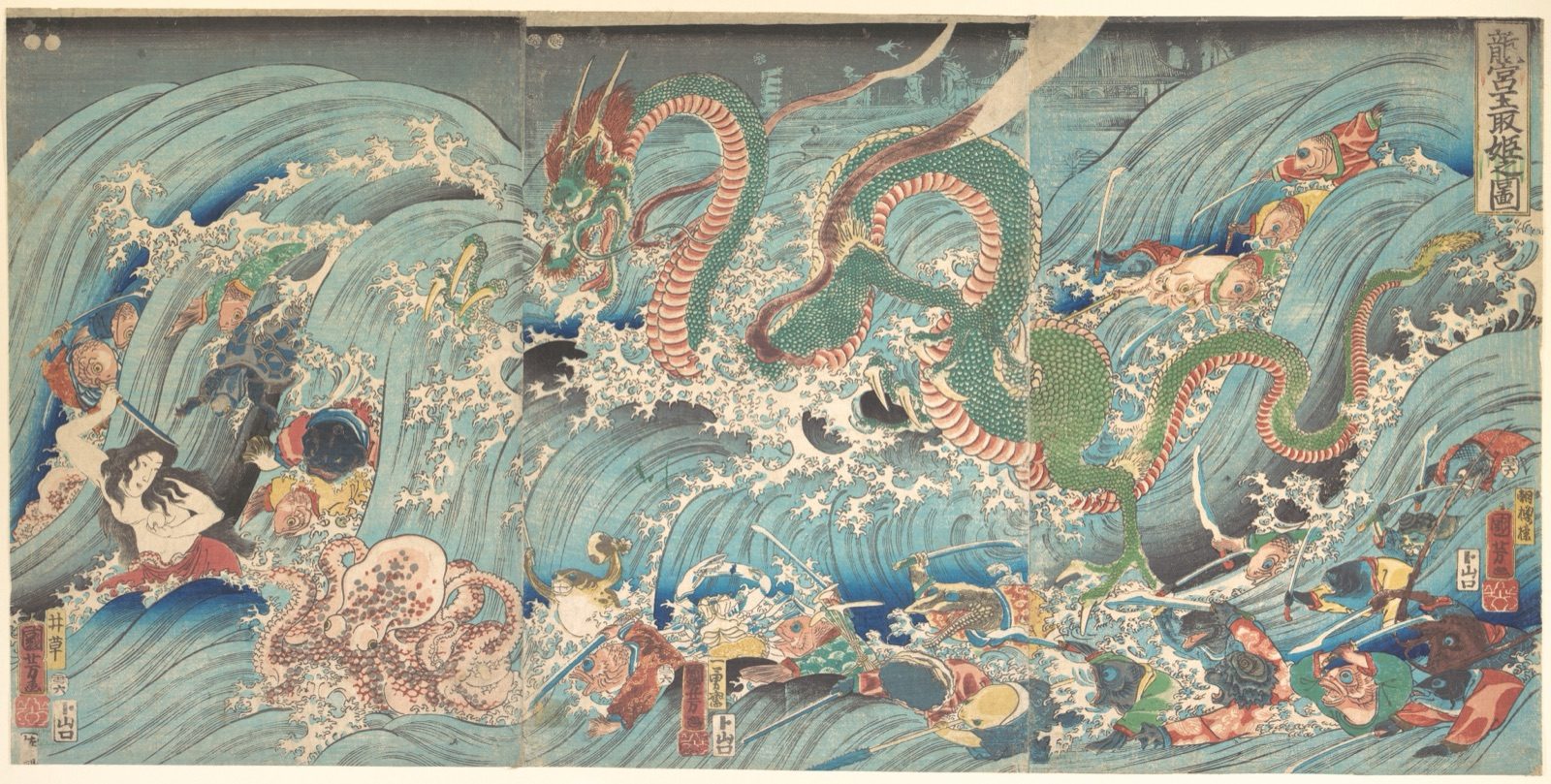
The dragon Japanese mythology actually calls ryū enters through Ryūjin, ruler of the sea and keeper of an undersea palace called Ryūgū-jō, where he commands the tides with a pair of magic jewels and is sometimes identified with an older water kami, Watatsumi, according to the World History Encyclopedia's entry on Ryūjin. His best-known story involves his daughter, Toyotama-hime, and Hoori, a descendant of the sun goddess Amaterasu who travels to the dragon king's palace to recover a lost fishhook and ends up marrying her instead.
When Toyotama-hime goes into labor, she asks Hoori not to watch, warning him that giving birth requires her to take her true form. He looks anyway and sees, per the Kojiki, a creature described as a wani, a term translators render as either a sea monster or a short dragon, eight fathoms long. Ashamed at being seen, she leaves the newborn on shore and returns to the sea, sealing the path between the two realms behind her. That child's son becomes Emperor Jimmu, the legendary first emperor of Japan in the same chronicles, which makes the dragon king's daughter an ancestor of the imperial line. A benevolent serpent or dragon figure holding that kind of central, non-monstrous status is not unique to Japan: Mesoamerica's Quetzalcoatl, the Feathered Serpent, was worshipped as a major deity of wind, learning, and creation at Teotihuacan more than a thousand years before the Aztecs adopted him, the same long head start Ryūjin's water-deity form had over the imported Chinese lung imagery layered onto it centuries later.
Ryūjin's undersea palace shows up again in an unrelated, later legend about a different woman entirely: Tamatori-hime, a pearl diver connected to the Fujiwara clan who dives into Ryūgū-jō to recover a jewel stolen from her husband's family, evading Ryūjin's dragon guards on the way out. Tamatori-hime and Toyotama-hime are separate figures with separate stories; what they share is only the palace itself, which turns up often enough in Japanese art and legend to function as a stock setting the way Olympus does in Greek myth.

A very different kind of dragon
Not every Japanese dragon story is about gods or emperors. The clearest counterexample is the tale now known by the names Kiyohime and Anchin: a woman falls for a traveling monk who evades her advances and flees toward the Dōjō-ji temple, and out of grief and rage she transforms into a fire-breathing dragon to kill him. The version with a living dragon transformation, not just death from heartbreak, appears in the early 12th-century Konjaku Monogatarishū, a collection of Buddhist parables compiled around 1120 CE, but in that telling neither the woman nor the monk has a name: she swims across a river in a fury and her body becomes a serpent, the monk hides under the temple's great bell, and she coils around it and kills him inside, her dragon body burning through the bronze in some tellings. A plainer version of the same core plot, an unnamed widow, an evasive monk, death by grief, and a serpent that emerges afterward to kill him at the same temple bell, but without the living transformation into a dragon, appears roughly eighty years earlier in the Dainihonkoku Hokekyō Genki (compiled around 1040 CE). The names now attached to the story came from later, separate texts: "Anchin" first appears in the Buddhist history Genkō Shakusho, compiled in 1322, and "Kiyohime" doesn't turn up until 1742, in the puppet play Dōjōji genzai uroko.
Unlike Yamata no Orochi, killed off as a threat to be removed, or Ryūjin, worshipped as a benevolent ancestor god, Kiyohime's transformation comes from human heartbreak, not divine nature, and the story works as a Buddhist warning about attachment rather than a myth about the sea or the imperial line. It became one of the most staged stories in Japanese theater, adapted into dozens of Noh and Kabuki scripts grouped under the umbrella term Dōjōji-mono.
Dragons as neighbors, not monsters
Outside these individual stories, dragons kept a working role in Japanese religious life. Ryūjin shinkō, dragon god worship, grew into a recognized strand of Shinto practice built around asking dragon deities for rain, and shrines dedicated to dragon gods for rainfall and drought still operate today. The calendar carries the same figure: the dragon, tatsu, is one of twelve animals in the zodiac system used across East Asia, including Japan, and Smithsonian Magazine's reporting on the zodiac notes it is the only one of the twelve that is not a real, living animal, sharing the cycle with the rat, ox, tiger, rabbit, snake, horse, sheep, monkey, rooster, dog, and pig.
Set the four stories side by side and water runs through all of them more consistently than menace does. Orochi is a monster defeated in single combat, and even that story ends with a sword pulled from its body, closer to a treasure recovered than one hoarded. Ryūjin and his daughter hold ancestor status. Kiyohime is the outlier: an ordinary woman transformed by grief, contrasting with the other three, who are dragons by nature. English-language pop culture built the dragon around fire and menace, but the ryū that actually appears in Japan's oldest texts spends most of its time governing rain, tides, and bloodlines. The gap between a term popularized in one language and what the original sources describe recurs with legendary animals translated across languages and centuries, the same slippage that turns up when tracing where the unicorn myth actually came from.