
A monster invented on every continent, with no shared source
The honest answer to "are dragons real" is short: no fire-breathing, treasure-hoarding reptile has ever left a fossil, a bone, or a genetic trace, because no such species existed. What makes the question worth asking anyway is a stranger fact. Serpentine or reptilian monsters show up independently in Chinese, European, Mesoamerican, and Middle Eastern mythology, cultures that had no meaningful contact with each other for most of the periods when these legends took shape. A creature this specific, a scaled predator too large and too dangerous for any hunter to reasonably claim to have killed, does not usually invent itself twice by coincidence.
Researchers chasing that pattern have not converged on one tidy answer. What they have built instead is three separate, evidence-backed explanations that do not cancel each other out: ancient people repeatedly finding and misreading fossilized bones, real living animals getting folded into a legend that in some cases predates them by centuries, and a competing argument that humans may be primed to imagine this specific shape of monster before they ever see a bone at all. None of the three requires the others to be wrong, and different regions likely arrived at their own version of the dragon through different combinations of all three.
China's dragon bones were real fossils, just not the ones popular science usually claims
The most repeated version of the fossil theory says ancient Chinese communities dug up dinosaur bones and mistook them for dragon remains. It is a tidy story, and it is also, according to paleontologist Mark Witton's 2021 review of the historical record, weaker evidence than the story people usually skip past in favor of it. Chinese medical texts reference long gu, or "dragon bones," in a documented, continuous tradition going back as far as the third century BCE, prescribed as remedies for ailments ranging from dysentery-like symptoms to epilepsy, anxiety, and forgetfulness. But according to Witton's analysis of historical pharmacy records and 20th-century fieldwork, the fossils actually sold under that name were overwhelmingly Ice Age mammal and invertebrate remains, not dinosaur bones. Teeth and bone fragments came from creatures like mastodons, ancient rhinos, and Gigantopithecus, the largest ape that ever lived, ground up and sold in pharmacies as a remedy for headaches, agitation, and dizziness.
The dinosaur version of the story is not baseless. Chinese fossil beds in regions like the Gobi Desert and the Sichuan Basin genuinely do preserve dinosaur remains that could plausibly have fed the same folklore, and researchers including Adrienne Mayor have documented specific dinosaur trackway sites in China tied to local dragon legends. But Witton's point is a matter of what is actually documented versus what is assumed: the mammal-fossil pharmacy trade has a paper trail running through 20th-century paleontologists who tracked specimens back to specific drugstores, while the dinosaur-bone version rests mostly on the coincidence that fossil-rich regions and dragon folklore overlap. The clearest proof of the trade's reach came in 1935, when paleontologist Ralph von Koenigswald, searching a Hong Kong drugstore for "dragon teeth" sold as medicine, found a molar unlike anything from a known living species. It turned out to belong to Gigantopithecus, an extinct ape twice the size of a gorilla, identified from a fossil that had been sitting in a jar meant for grinding into powder.
China's dragon, the lung, also became the template other regions built on; none of them invented the animal from scratch. The three-clawed water dragon that Japan developed into its own ryū, shaped by rivers and the sea, not caves and gold, descends directly from this same continental tradition, carried across through Buddhism and trade, not something that took shape on its own.
A European dragon built from a real skull, with a five-hundred-year paper trail
Europe has its own fossil-to-monster case, and unlike most fossil folklore theories, this one can be dated almost to the year. In 1335, workers quarrying stone outside Klagenfurt, in what is now southern Austria, uncovered a massive, strange skull. Local authorities declared it proof of the Lindwurm, a dragon-like beast said to have terrorized the area, and put the skull on public display, where it stayed for roughly two and a half centuries as physical evidence that the city's founding legend was true.
In 1590, sculptor Ulrich Vogelsang carved Klagenfurt's landmark Lindwurmbrunnen, or Dragon Fountain, using that skull as his direct reference for the statue's head. The result is now recognized as one of the earliest known reconstructions of an extinct animal built from real fossil evidence, made two and a half centuries before paleontology existed as a field. It took until 1840 for scientists to correctly identify the skull: it belonged to a woolly rhinoceros, a genuinely extinct Ice Age animal, just not the mythical one Klagenfurt had built a civic identity around. The statue still stands in the city's main square today, officially unchanged, an accurate sculpture of a fossil skull built to represent a monster nobody has ever found evidence actually existed.

A real animal that borrowed the dragon's name after the myth already existed
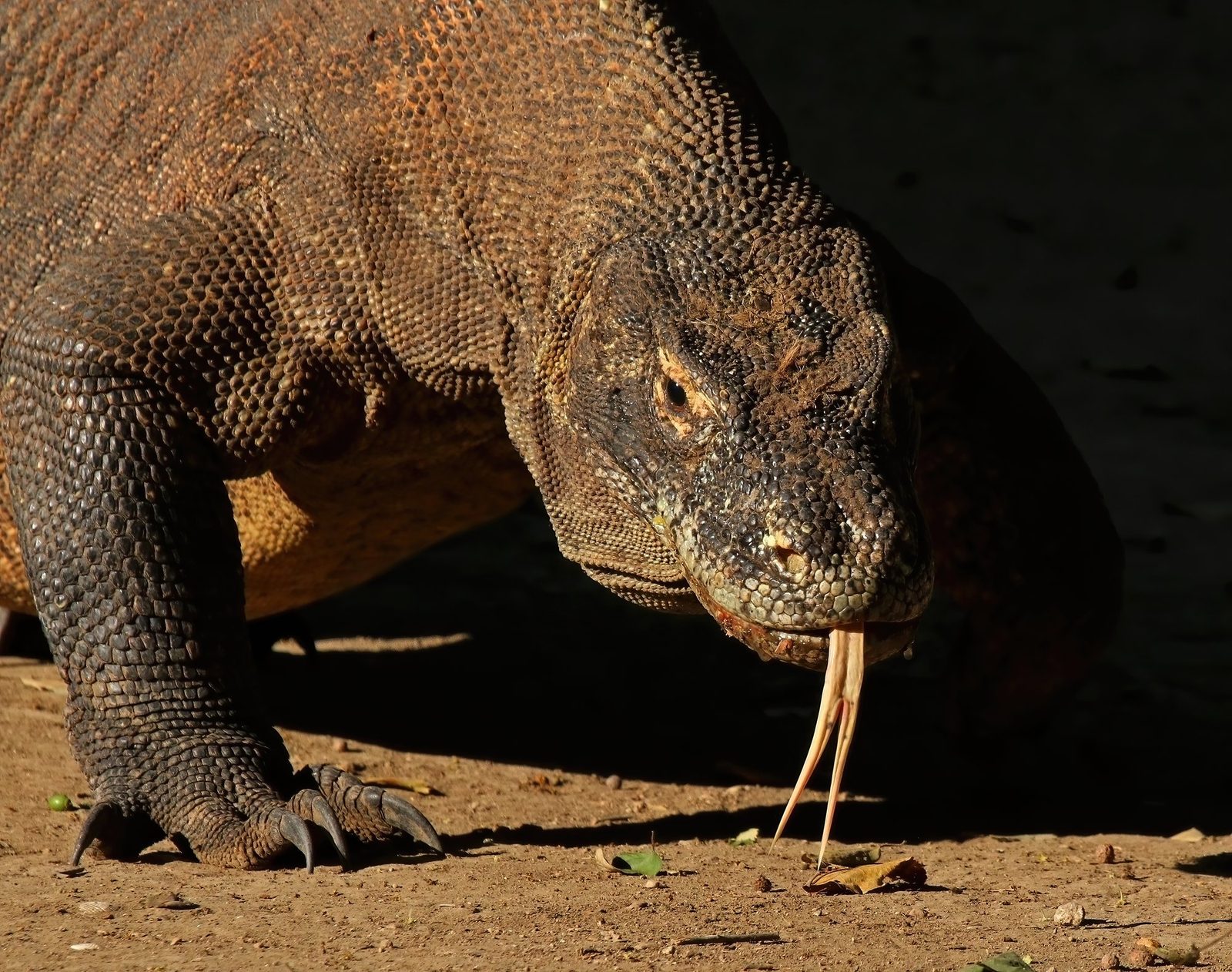
The Komodo dragon gets cited constantly as proof dragons are somehow real, and the timeline runs the opposite direction from what that claim implies. Local communities on Komodo Island had long known the giant lizard by the Manggarai name ora, but it only reached Western science after Dutch lieutenant Steyn van Hensbroek reported an encounter in 1910 and sent a skin to Peter Ouwens, director of the Bogor Zoology Museum in Java. Ouwens published the first formal scientific description in 1912, naming it Varanus komodoensis.
By 1912, European and Chinese dragon mythology already had well over a thousand years of continuous written tradition behind it: Hesiod's account of the gods, Shennong Bencaojing, and Klagenfurt's Lindwurm statue all predate the Komodo dragon's scientific description by centuries. The lizard did not inspire the legend. Western naturalists reached for an existing word, dragon, because it was the closest available label for a reptile larger and more dangerous than anything in the European bestiary, the same pattern of a real animal getting mapped onto a pre-existing myth that shows up in the rhinoceros and narwhal tusk repeatedly mistaken for unicorn evidence.
.jpg)
The competing theory: dragons as an inherited fear, not a fossil misread
Not every researcher working on this question thinks fossils and misidentified animals are doing the real explanatory work. In his 2000 book An Instinct for Dragons, anthropologist David E. Jones argued that the dragon's universality has a psychological rather than archaeological cause. His theory holds that early humans evolved an instinctive fear response to the three predators that most consistently threatened them: large cats, venomous snakes, and birds of prey. Over generations, Jones argued, those three inherited fears fused into a single composite image, a scaled, clawed, sometimes-winged predator that cultures kept independently reconstructing because the fear itself was already wired in, not because they were all looking at the same bones.
The theory has real academic pushback attached to it, not just popular acceptance. Folklorist Paul Jordan-Smith, reviewing the book in a 2002 issue of Western Folklore, argued that Jones never adequately ruled out the more mundane explanation that dragon myths simply spread between cultures through trade and contact rather than evolving independently in isolated human minds. That critique does not resolve the debate so much as leave two live explanations sitting next to the fossil evidence: bones and skulls that got misread as monster remains, and a possible inherited fear response that made humans quick to imagine a monster in the first place. Both can be true in different places, at different times, for different dragons. The Western dragon specifically is its own separate case study in assembly rather than origin: the fire-breathing, treasure-hoarding image most people picture today was assembled from unrelated medieval sources over more than 1,300 years, not inherited whole from any single ancient myth.