_1.jpg)
A ceremony invented in 1936, borrowing Rome's priestesses
Every two years, before a Summer or Winter Games opens, television crews broadcast a ceremony from the ruins of Olympia: women in white robes process past the Temple of Hera, kneel before a parabolic mirror, and use concentrated sunlight to kindle a flame that a relay of runners will carry to the host city. It reads as an unbroken link to antiquity. Most of it isn't. The ritual was designed in 1936 by Carl Diem, chairman of the organizing committee for that year's Berlin Games, and first performed at Olympia on 20 July 1936, a piece of stagecraft built for a Games widely documented as a platform for Nazi propaganda.
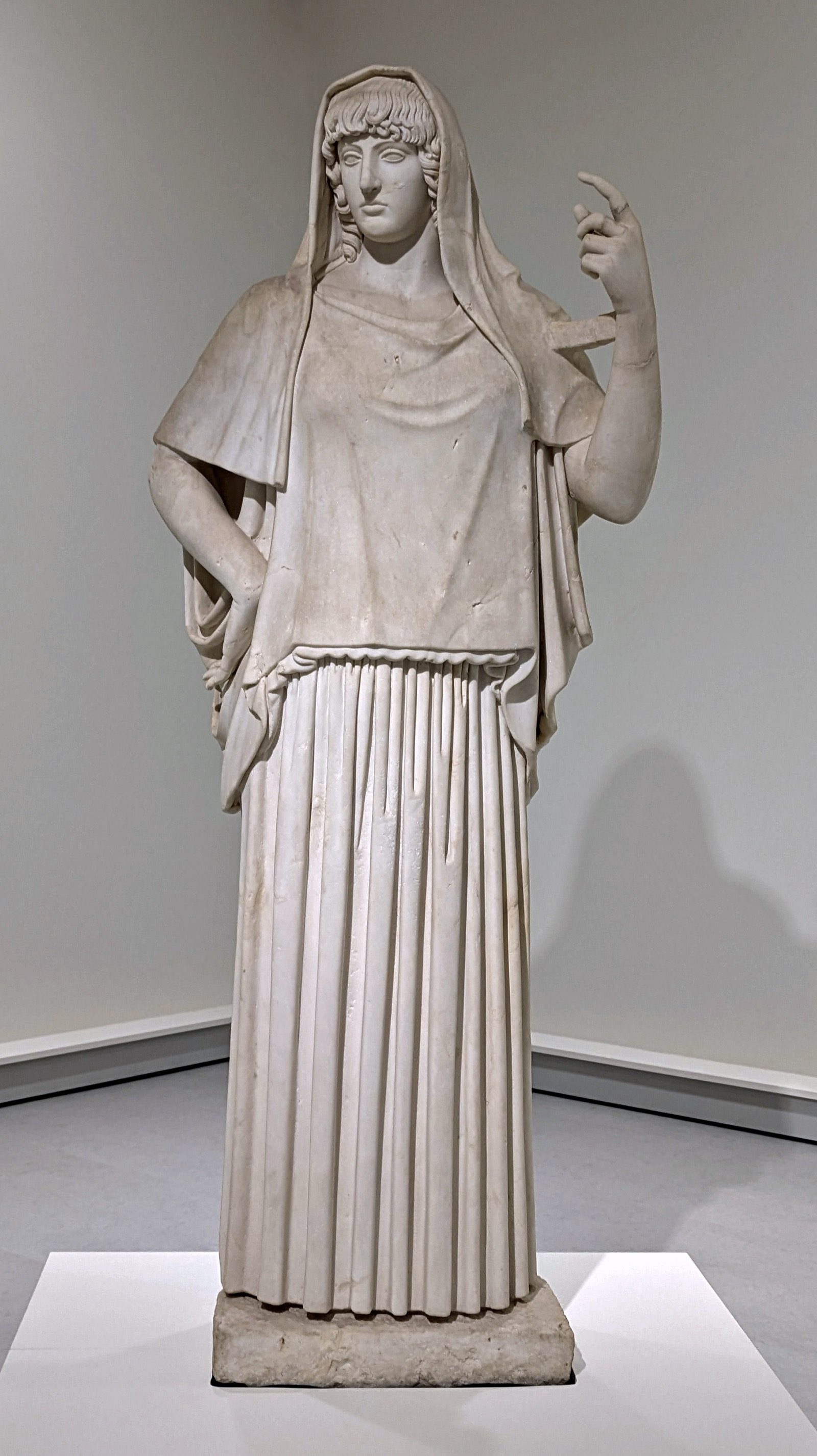
The actresses in that ceremony have never claimed to represent Hestia's own worshippers. Olympic organizers and the press that covers the ceremony describe them as playing the Vestal Virgins, the priesthood of Vesta, the Roman goddess conventionally paired with Hestia, not Hestia herself. One longtime performer in the role, Thalia Prokopiou, has been referred to in Olympic coverage since 2000 simply as "the Vestal Virgin of Olympia," a title that fuses a Greek place name to a Roman office the Greeks never actually created. Olympia is not the only place where a modern reconstruction stands in for a broken tradition; the sun festival of the Inca deities was rebuilt in 1944.
The fire under the ceremony was real
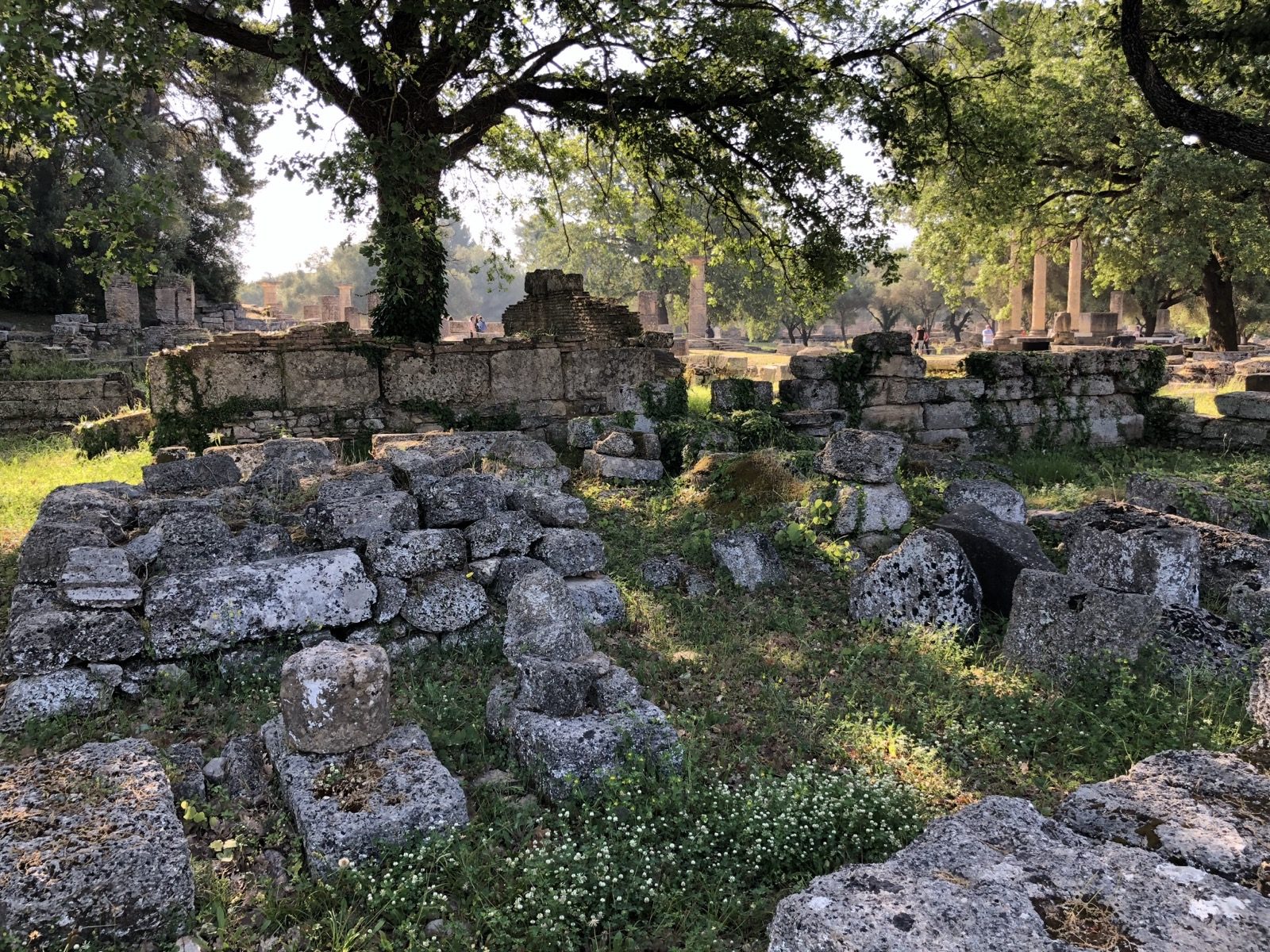
The confusion doesn't mean the underlying claim is invented. Pausanias, touring Olympia in the 2nd century AD, describes an actual perpetual fire kept in the sanctuary's Town Hall, the Prytaneion: "This hearth too is made of ashes, and on it fire burns every day and likewise every night." It wasn't purely ceremonial upkeep. Once a year, on the nineteenth day of the month Elaphius, Olympia's soothsayers carried ash from that hearth to the sanctuary's much larger Altar of Zeus, mixed it into a paste with water from the river Alpheius, and used it to build the altar up further, a ritual Pausanias says explains why the Alpheius was considered "of all rivers the dearest to Olympic Zeus."
Zeus's altar was consequently built, in a literal rather than symbolic sense, in part from Hestia's fire, one layer of ash at a time, every year the sanctuary functioned. Olympia was not unusual in keeping a fire like this. Every Greek city maintained a version of the same institution: a public hearth sacred to Hestia, tended in a building where magistrates ate their public meals, the civic counterpart to the household hearth every family kept in her name. Wikipedia's entries on Hestia and on the Prytaneion both describe cities founding new colonies by carrying a lit brand from the mother city's own public hearth to kindle the new settlement's, a way of declaring the colony a continuation of the same civic life rather than a fresh start.

At Olympia, Hestia went first, literally
Hestia's priority at Olympia wasn't just architectural. Pausanias also records the actual order in which the Eleans sacrificed at the sanctuary's altars, and it puts her ahead of everyone: "They sacrifice to Hestia first, secondly to Olympic Zeus, going to the altar within the temple, thirdly to Zeus Laoetas and to Poseidon Laoetas." At the site built to honor Zeus, in a sanctuary that housed one of the most famous statues of him ever made, ritual protocol still put Hestia first.
That precedence wasn't unique to Olympia. The Homeric Hymn to Hestia, likely already old by the time Pausanias was writing, states the same principle as a rule for sacrifice everywhere: "without you mortals hold no banquet, where one does not duly pour sweet wine in offering to Hestia both first and last." Two different sources, centuries apart, describing two different scales of the same custom, agree on the same detail: whatever else was on the ritual calendar, Hestia opened it and closed it.
The claim that she barely looked like a person doesn't survive her own sanctuary's art
None of that ritual centrality translated into much personal mythology, and it's that gap that produced Hestia's modern reputation. Plato's Phaedrus, describing Zeus leading a procession of the other Olympians through the heavens in eleven chariot squadrons, disposes of Hestia in a single line: "Hestia alone remains in the house of the gods." Walter Burkert's Greek Religion, the standard English-language reference on the subject since its 1985 translation, builds on that reading, describing Hestia as among the least anthropomorphic of the Olympians, more an abstraction of the hearth than a fully realized character.
Pausanias's own account of Olympia complicates that verdict before it was ever fully written. Describing the relief work on the pedestal supporting Pheidias's great gold-and-ivory statue of Zeus, built around 435 BC for the temple there, Pausanias lists the figures one by one: "Close to her comes Hermes, and close to Hermes Hestia." She stands as a specific, named figure among the gods flanking Zeus's own cult statue, in the very sanctuary where the least-anthropomorphic reading of her would later take hold.
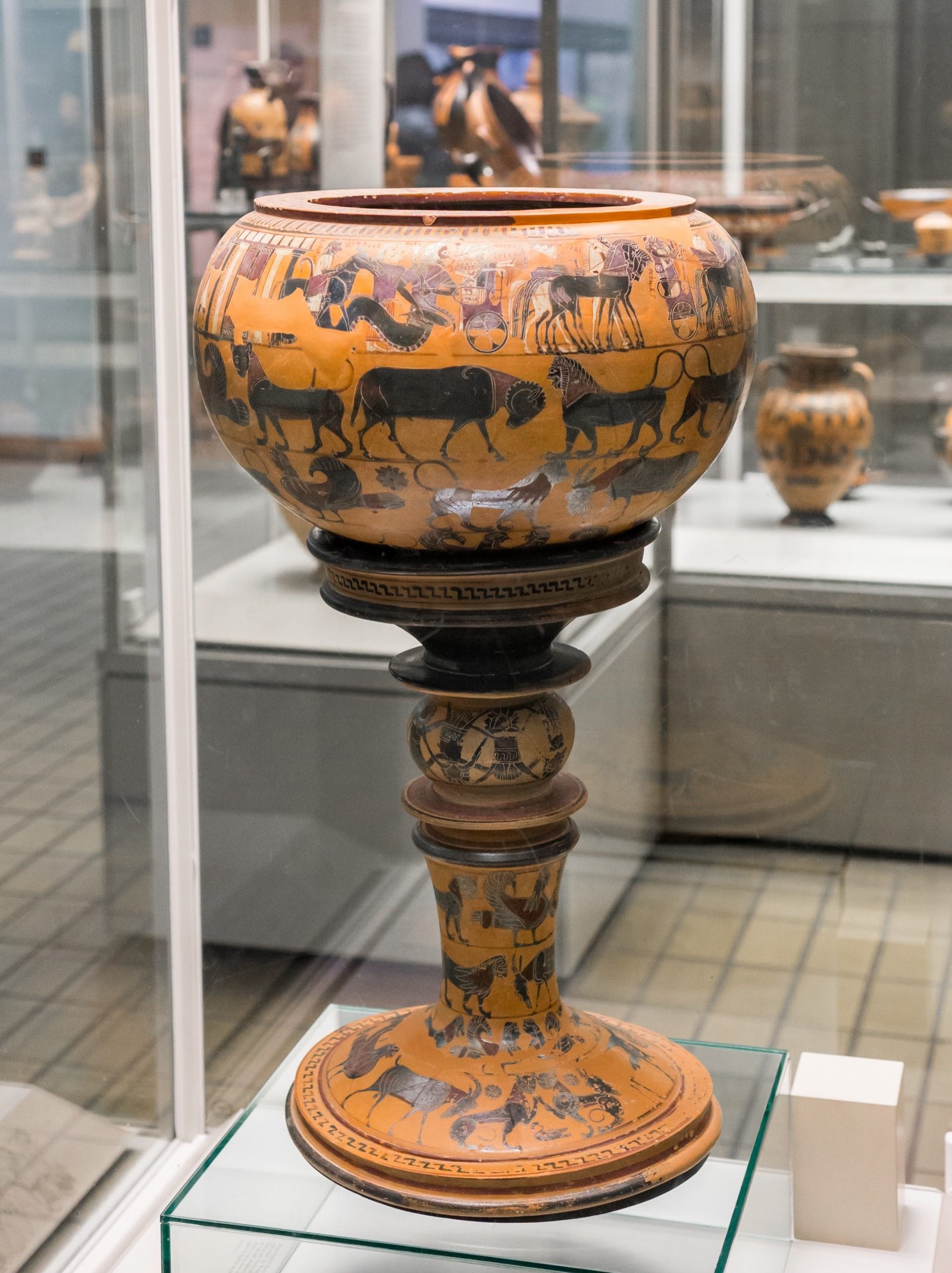
A 2024 paper in the Journal of Hellenic Studies, by classicist Aphrodite Alexandrakis, makes the same case more broadly, working back through Hesiod's Theogony and the Homeric Hymn to Aphrodite before turning to early vase evidence. The clearest example predates Plato's line by roughly two centuries: the Sophilos Dinos, a black-figure wine bowl signed by the Athenian potter Sophilos around 580 to 570 BC and now in the British Museum, shows the gods processing to the wedding of Peleus and Thetis, every figure individually labeled by inscribed name. Hestia is one of them, a specific guest at a specific event, not a placeholder for an idea.

No priesthood of her own
What isn't in dispute, across all of that, is whether Hestia ever had priestesses of her own in Greece. She didn't. Whatever else is unsettled about her, from whether she or Dionysus held the contested twelfth Olympian seat to how anthropomorphic her worshippers actually pictured her, Rome's Vesta had something Hestia never did: a state-appointed college of six Vestal Virgins, chosen before puberty and bound by thirty-year vows of chastity, tending her sacred fire in the Roman Forum as a formal, professional priesthood. Hestia's Greek worship stayed radically decentralized instead. Every household hearth was her shrine, tended not by a consecrated priestess but by whoever kept that particular home, and even the six familiar names anchoring most modern Greek goddesses lists rarely mention that Hestia is the one among them without an institution built in her name.
That is the specific gap the Olympic flame ceremony steps over every two years. It stages its ritual at Hestia's own sanctuary, using a fire-lighting method genuinely practiced there in antiquity, and then hands the job to actresses playing a Roman priesthood the goddess being honored never actually had.