
The peacock is the newest part of the story
Search for Hera's symbol and the answer arrives fast and short: peacock, pomegranate, crown. It is not wrong, but it flattens two traditions that come from different centuries and different cities into a single flat list. One tradition is archaic, tied to a documented cult statue that stood in Hera's own temple at Argos. The other is centuries younger and arrived by way of a bird that, going by the price it commanded in classical Athens, most Greeks of Homer's era had never laid eyes on.
Separating the two shows something more specific than a random assortment of attributes: a goddess whose oldest iconography was built around cattle and a temple choir of Seasons and Graces, centuries before anyone thought to attach her name to a bird from the other side of the Persian empire.
The cow-eyed goddess of Argos
Homer's epithet for Hera, used repeatedly across the Iliad, is boôpis: "ox-eyed" or "cow-eyed," built from bous, cow, and ops, eye or face. In archaic Greek, the phrase read as a compliment, describing large, dark eyes rather than anything bovine about her face, but the word choice was not arbitrary. Hera's central cult sat in the Argolid, at the sanctuary later called the Argive Heraion, between the old Mycenaean centers of Argos and Mycenae, and the boôpis title likely reflects an earlier layer of cattle worship bound up with that specific cult, older than the purely decorative reading later translations gave it.
That Argive identity runs through the rest of her early iconography too. When ancient sources describe Hera's original attributes, before any bird enters the picture, they describe a goddess anchored to one city's temple and one city's statue, not a set of symbols floating free of any particular sanctuary.
What the actual cult statue held
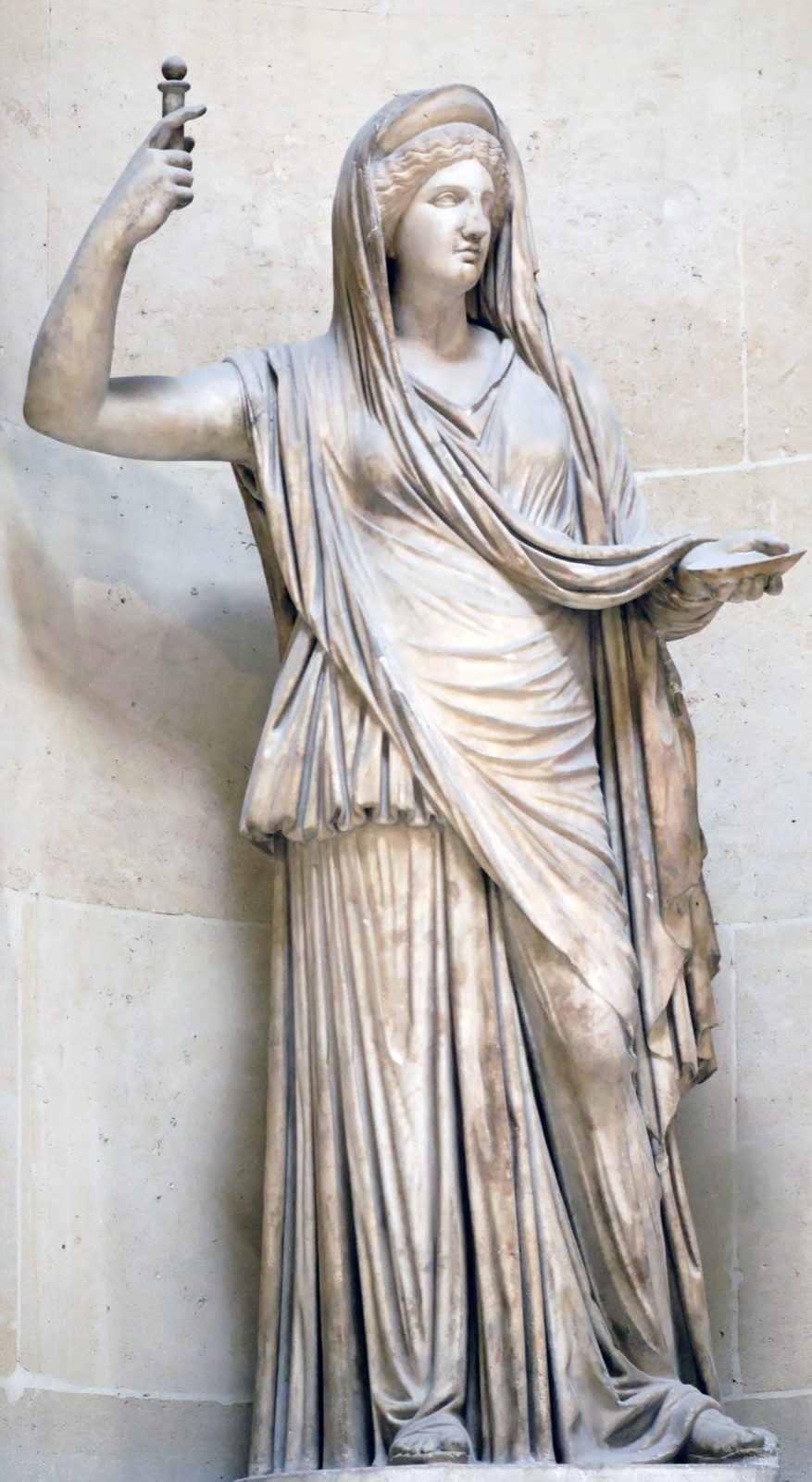
The most detailed ancient account of Hera's attributes comes from the traveler and geographer Pausanias, describing the cult statue inside the Argive Heraion in his Description of Greece, written around 175 AD. The statue itself, gold and ivory, seated on a throne, was the work of the sculptor Polykleitos and wore a crown carved in relief with figures of the Graces and the Seasons. In one hand it held a scepter; in the other, a pomegranate. Not every Olympian got a statue like that; Hestia's symbol was a real fire, and statues of her were rare.
Pausanias explains the scepter's detail, a cuckoo perched on top, by way of a courtship story: Zeus, still trying to win Hera over, took the shape of a bedraggled cuckoo, and Hera, out of pity, took the bird to her breast, at which point he resumed his own form. About the pomegranate, Pausanias is uncharacteristically tight-lipped for a writer who otherwise explains almost everything he sees. "About the pomegranate I must say nothing," he writes, "for its story is somewhat of a holy mystery." He closes his account of Hera's cult stories the way he closes many others in the same book, noting that he relates these tales without necessarily believing them himself, simply because they are the tales the sanctuary told.
The peacock is not as ancient as it looks
The popular version of the peacock story assumes the bird only reached Greece after Alexander the Great's campaigns into India in the 320s BC, and that his own famous astonishment at the birds is what put them on the map. Aristotle, Alexander's tutor, does call the peacock "the Persian bird" in his writing on animals, and later accounts describe Alexander threatening severe penalties against anyone who killed one after he encountered them in India. That framing skips over how much earlier peacocks had already reached Greek soil by other routes.
Peacocks were valued as exotic pets in Athens by the 5th century BC, generations before Alexander was born, arriving through trade and diplomatic contact with the Persian Empire; ancient sources put their price as high as 10,000 drachmas each, against roughly one drachma a day for a skilled laborer's wage, a cost so extreme it became shorthand in Athenian comedy for showy, corrupting wealth. Further east in the Aegean, the peacock's link to Hera specifically is attested even earlier and more concretely: the comic poet Antiphanes, writing in the 4th century BC, is quoted by the later compiler Athenaeus describing peacocks kept as Hera's sacred birds at her sanctuary on Samos, the Heraion, decades before Alexander ever set foot in India.
The eyes-in-the-tail story came later still
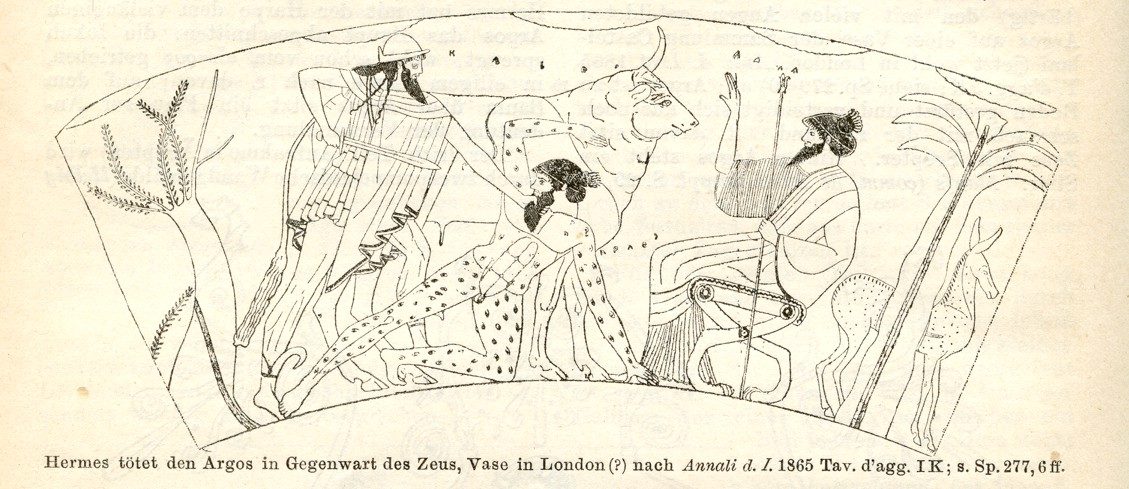
Even once the peacock was established as sacred to Hera at Samos, the explanation now attached to its tail feathers, that they carry the hundred eyes of the giant Argus, took longer to arrive in writing. Argus Panoptes and his death at the hands of Hermes were already dramatized in 5th-century BC Athenian tragedy, in Aeschylus's Suppliants, in the Prometheus Bound long transmitted under his name, and in Euripides's Phoenician Women, none of which connect the story to a peacock's tail at all. The detail that Hera specifically transferred Argus's hundred eyes onto the peacock is first attested roughly four centuries later, in Ovid's Metamorphoses, composed in the 1st century AD.
Ovid's telling, not the older Greek tragedies, is the version that stuck. The Metamorphoses became a core mythological sourcebook for medieval and Renaissance European art and literature, and it is Ovid's specific pairing, peacock feathers as Argus's preserved eyes, that later painters and mythographers kept repeating until it read as if it had always been the explanation. The bird had already been Hera's for centuries; the story of why took a Roman poet to fix in place.

Two sanctuaries, two different Heras
The split between Argos and Samos is not incidental to any of this. Argos gave Hera her oldest attested title, boôpis, and the cult statue Pausanias catalogued in careful, mostly-explained detail, a cow-associated, Peloponnesian Hera whose objects, the cuckoo scepter and the withheld story of the pomegranate, tie directly to her role as Zeus's wife and to a specific ritual courtship myth. Samos, across the Aegean, is where the exotic imported bird took root as her sacred animal generations before any Greek writer explained why, and where her own local birth myth placed her beneath a willow tree on the bank of the river Imbrasos.
Modern retellings collapse both sanctuaries into one tidy symbol set, but the ancient evidence keeps them apart, tied to two different cities and two different centuries. As one of the Twelve Olympians and mother to Hephaestus by her own account in Hesiod, Hera picked up her attributes from separate sanctuaries at separate times, not from one settled tradition handed down all at once. The same flattening happens to her fellow Olympian Ares: most lists just hand him the ♂ symbol without mentioning that its own origin story is still disputed between two competing, fully documented accounts.