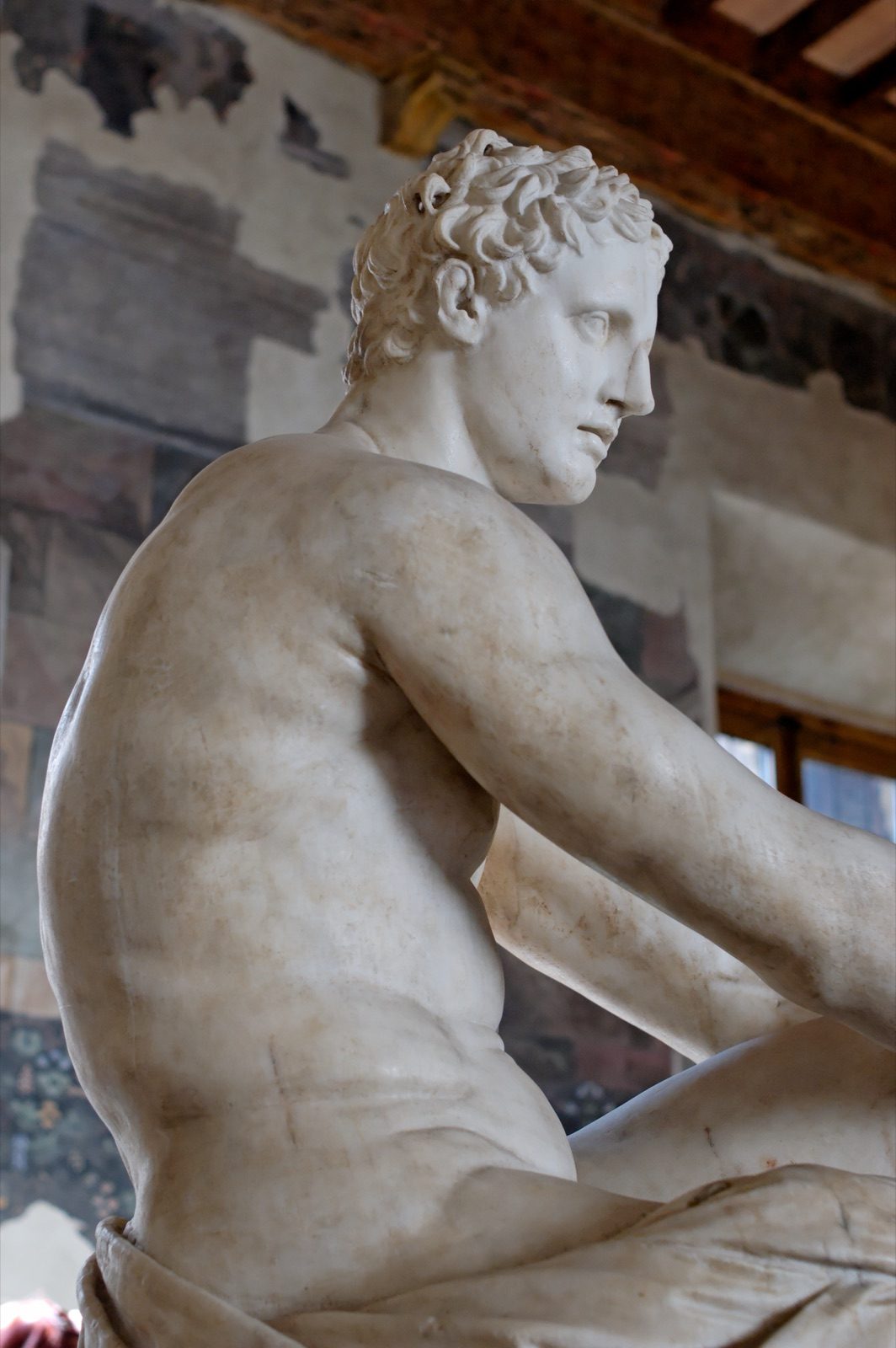

A symbol that outgrew the god
Ask what Ares' symbol is and most answers reach for the same explanation: the ♂ glyph, the sign now stamped on everything from the planet Mars to restroom doors, is a stylized picture of his spear crossing his shield. That explanation turns out to be more contested than the confident way it usually gets repeated. There is genuine, centuries-old artifact evidence for it, and there is a separate, equally well-documented account that traces the same shape through language rather than weaponry, and historians have not settled which one is correct.
The god the Greeks actually wrote about carried a more specific, less mythologized set of attributes than that glyph debate suggests, and the glyph's real backstory, whichever account turns out to be right, is stranger and better sourced than the single tidy answer most explainers give it.
What ancient sources actually gave him
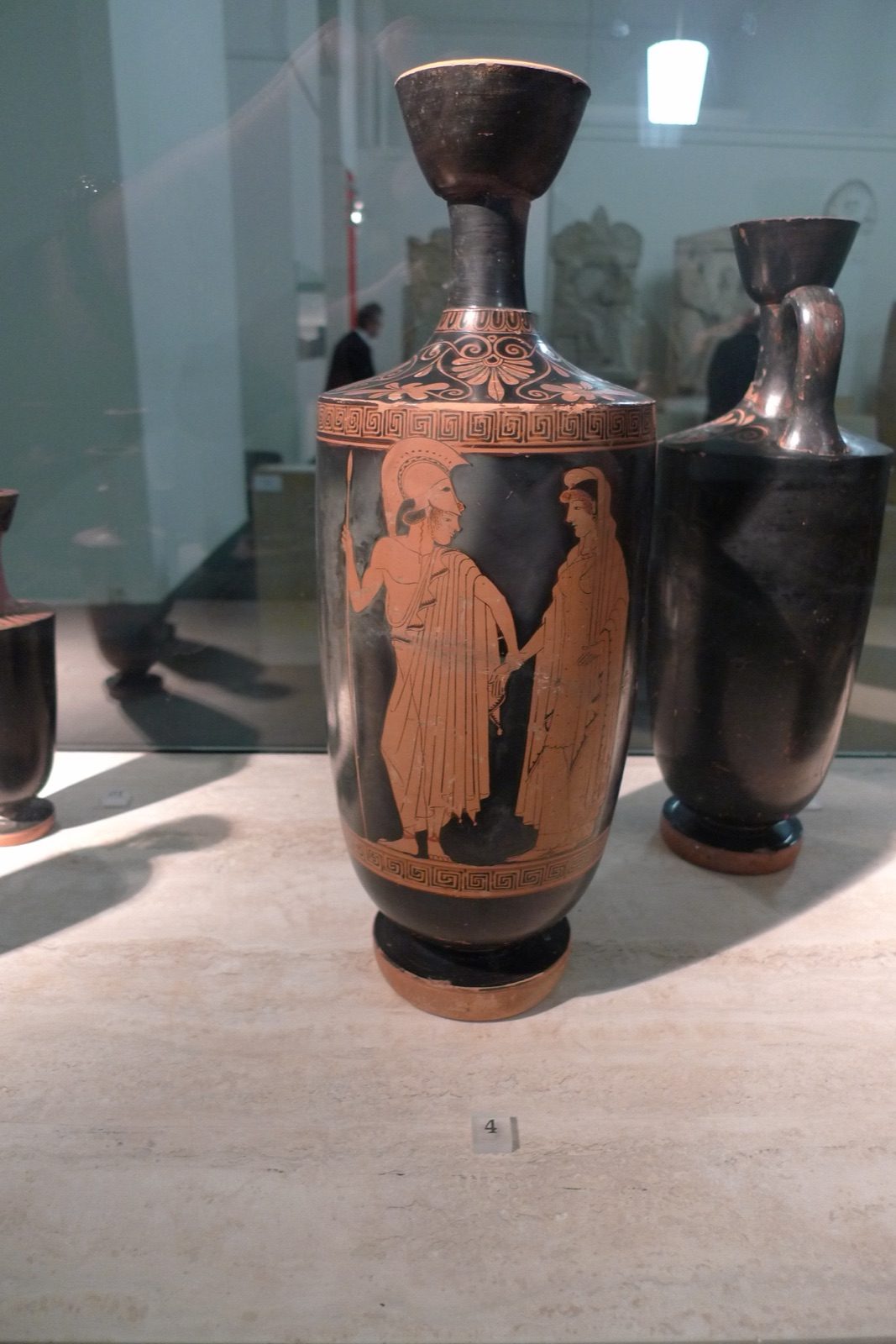
Homer's Iliad calls Ares thouros, "fierce" or "rushing," and elsewhere "man-slaying" and "insatiate of war," epithets that describe a warrior stripped of tactics, not a strategist. He appears armed with spear, helmet, and shield, the standard gear of a Greek hoplite rather than any object unique to him, and ancient vase painters depicted him accordingly: crested helmet, round shield, spear raised, often riding a four-horse chariot into or out of battle.
His sacred animals reinforce that battlefield register rather than adding anything symbolic beyond it. The dog and the vulture, both scavengers of the dead, are the two most consistently attested across ancient sources, drawn to a corpse the way Ares was drawn to the fighting that produced it. Some later sources add the boar to the list, though it appears far less consistently than the dog and vulture across the ancient record. None of this is subtle imagery. It is a war god dressed and escorted like the war itself: violent, unglamorous, and cleaned up afterward by scavengers rather than mourners.

A temple that used to belong to someone else
Even Ares' most concrete claim to space in Athens turns out to be borrowed. The building historians and tourist guides now call the Temple of Ares, standing in the ancient Agora, was not built for him. Archaeological work, including excavation of its original foundations at Pallene in central Attica between 1994 and 1997, shows the temple went up there around 440 to 425 BC as a shrine to Athena Pallenis, and possibly also to Apollo.
During the reign of Augustus, Roman masons dismantled the entire structure block by block, carried the pieces to the Agora, and reassembled it on new foundations, a relocation confirmed by masons' marks still visible on the stone. Only after that move did it become associated with Ares. The likely motive was not devotion to the Greek war god at all: Mars was Augustus's personal patron as Mars Ultor, "the Avenger," honored for the defeat of Julius Caesar's assassins, and rededicating a temple to Ares in the heart of Athens let Rome plant that same cult association on Greek soil. The version of Ares people visit in the Agora today is, structurally and historically, a repurposed building dedicated to somebody else.
The ♂ symbol has two rival origin stories, not one
The shield-and-spear explanation is not, as it turns out, folklore invented after the fact. A 12th-century Byzantine manuscript, the Compendium of Astrology by Johannes Kamateros, diagrams the planets with Mars represented by a round shield crossed by a diagonal spear, and a similar arrow-through-a-circle form for the symbol is attested as early as the 11th century. That is a real, dated artifact showing the weapon reading in actual medieval use, not a modern rationalization retrofitted onto an old symbol.
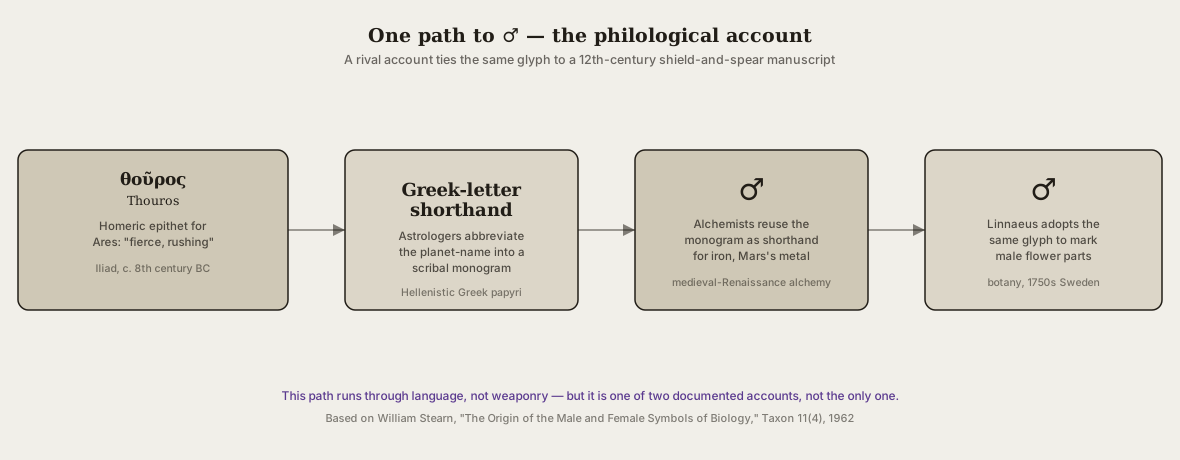
A separate, rival account traces the same glyph through language rather than imagery. Ares' Homeric epithet thouros, "fierce" or "rushing," was carried into Hellenistic astrology as an abbreviation for the planet named after him. The 17th-century French classical scholar Claude de Saumaise argued that scribes copying these abbreviated Greek planet-names, across centuries of astrological and alchemical texts, gradually simplified the lettering into shapes close to the modern glyphs, a derivation the botanist and bibliographer William Stearn laid out in detail, evidence included, in a 1962 paper in the journal Taxon. Stearn traces the same logic through the separate symbols for Jupiter, Saturn, and Mercury, and follows the resulting shapes into medieval alchemy, where they were reused as shorthand for the metals linked to each planet, iron for Mars among them. Carl Linnaeus, who had learned these planetary symbols as a schoolboy in Växjö, Sweden, in the 1720s, later adopted them in his own botanical writing to mark male, female, and hermaphroditic flower parts, the specific use that turned ♂ and ♀ into general sex symbols.
Neither account has won out. The Kamateros manuscript is genuine 12th-century evidence for the weapon reading itself, not a later story about it, while Stearn's philological derivation has the advantage of explaining several other planetary symbols with the same underlying logic. What the two accounts agree on is that the confident, single-sentence version usually repeated online, that the glyph is simply a doodle of a spear and shield with no deeper history, undersells both real explanations rather than representing either one accurately.
Same god, opposite reputation
Ares' low standing in Greek religion is well attested and stands in sharp contrast to how Rome treated Mars. In the Iliad, Zeus tells Ares outright that he is the god he hates most among the Olympians, and Greek cult worship of him was comparatively thin next to figures like Athena, his half-sister and battlefield opposite, who represented disciplined tactics against his raw bloodlust. Rome inverted that ranking. Mars ranked second only to Jupiter in the Roman state pantheon, credited as the legendary father of Romulus and treated as a guardian of the city itself, a status reflected in Augustus building him a major temple in his own Forum of Augustus under the Mars Ultor title, the same cult identity later exported onto the relocated temple in Athens.
Ares was born to Zeus and Hera as one of the Twelve Olympians, and his most famous ancient story does not even center on his own actions: it is Hephaestus's trap, catching Ares in an affair with Aphrodite and exposing the pair before the assembled gods, detailed on our page about the smith god. Even his family's best-known myth about him treats Ares less as a protagonist than as a warning about what happens when he stops fighting and starts pursuing something else.