
One word, two family trees
English lumps every serpentine deity from China to Cambodia under one label, dragon, as if a single creature just picked up regional costumes along the way. Genealogically, that's wrong. China's long spread outward through what historians call the Sinosphere, the belt of states that shared Chinese writing, Confucian court culture, and trade routes, and became Korea's yong and Vietnam's rồng, close relatives of the three-clawed water dragon Japan turned into its own ryū. Cross into Thailand, Laos, or Cambodia, though, and the water-spirit locals call a dragon in English isn't a descendant of China's long at all. It's a naga, a serpent deity that arrived from the opposite direction: Hindu and Buddhist religious networks radiating out of South Asia, the Indosphere rather than the Sinosphere. Nagas appear in Sanskrit texts including the Mahabharata and the Puranas, and rituals devoted to them have continued across South Asia for roughly 2,000 years. Two unrelated origin stories, arriving from opposite points of the compass, both got flattened into the same English word, the same translation problem behind why phoenix gets applied to several fire-bird myths that never shared a common origin.
Korea's yong: a dragon you have to earn
Korean folklore treats the dragon as a rank to work toward rather than a species to be born into. Most yong start out as an imugi, a giant serpent-like proto-dragon, and by the most common account an imugi has to survive one thousand years before completing the transformation. A faster but riskier version of the story exists too: an imugi that manages to catch a yeouiju, a luminous orb said to fall from heaven, becomes a full yong immediately. Korean tradition treats the yeouiju as the local name for the Cintamani, the wish-granting jewel of wider Buddhist and Hindu belief, and holds that only four-toed dragons, the ones with thumbs, are wise and powerful enough to actually wield it, leaving three-toed dragons without that same standing.
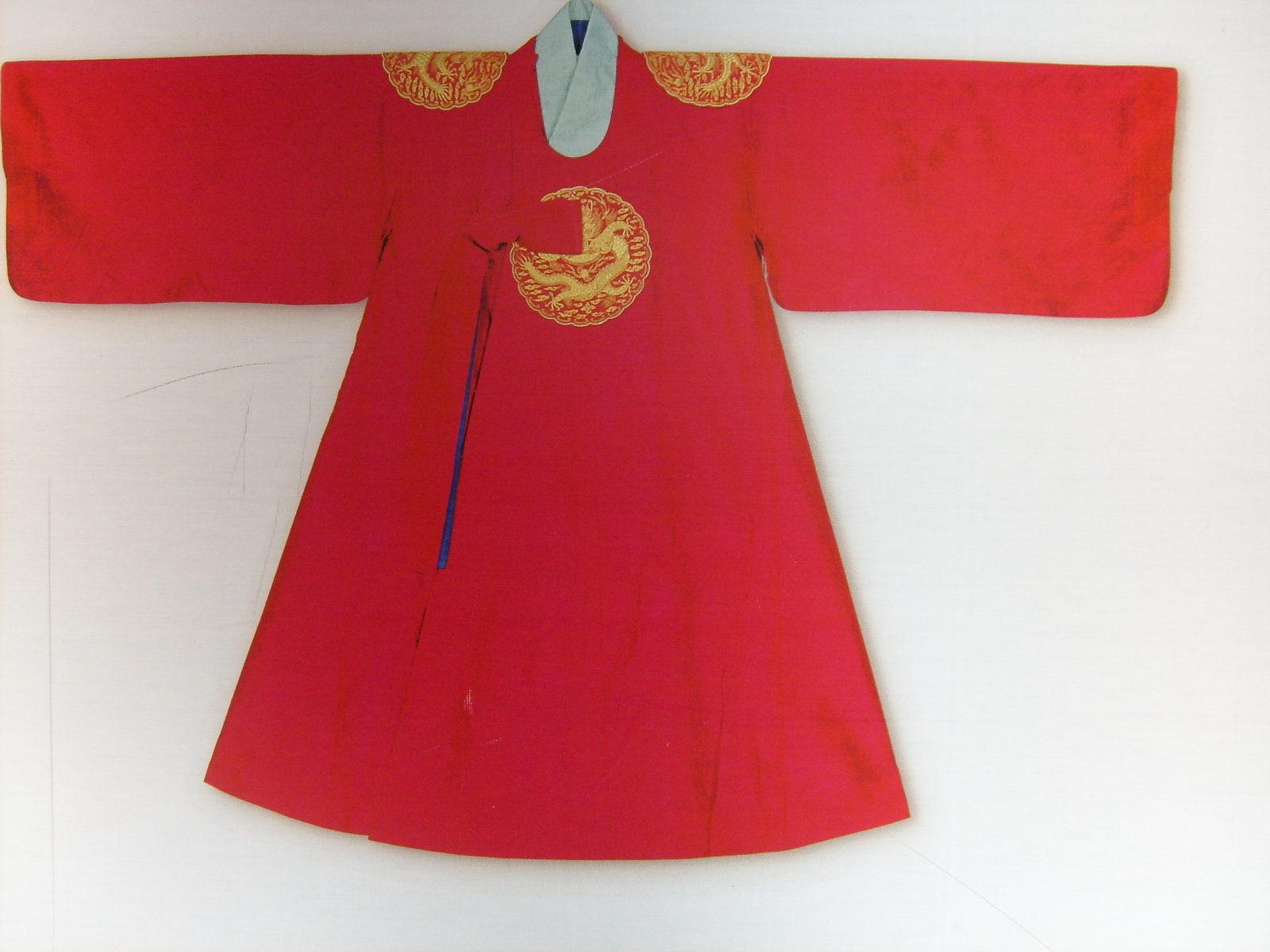
What a completed yong is supposed to do for its country shows up clearly in the legend of King Munmu, a 7th-century Silla ruler who reportedly asked on his deathbed to become "a great dragon of the East Sea" so he could go on protecting his kingdom after he died. The job description is guardianship, not menace, tied to water the same way China's long and Japan's ryū are. Korean dragons are said to carry 81 scales on their backs, nine rows of nine, since nine carries the same auspicious weight in Korean numerology it does across the wider Sinosphere. That symbolism became a matter of state dress under the Joseon dynasty, when kings and crown princes wore the gonryongpo, a robe embroidered with five dragons that stood for the wearer's authority over the natural and cosmic order alike.
Vietnam's rồng: the dragon that founded a nation
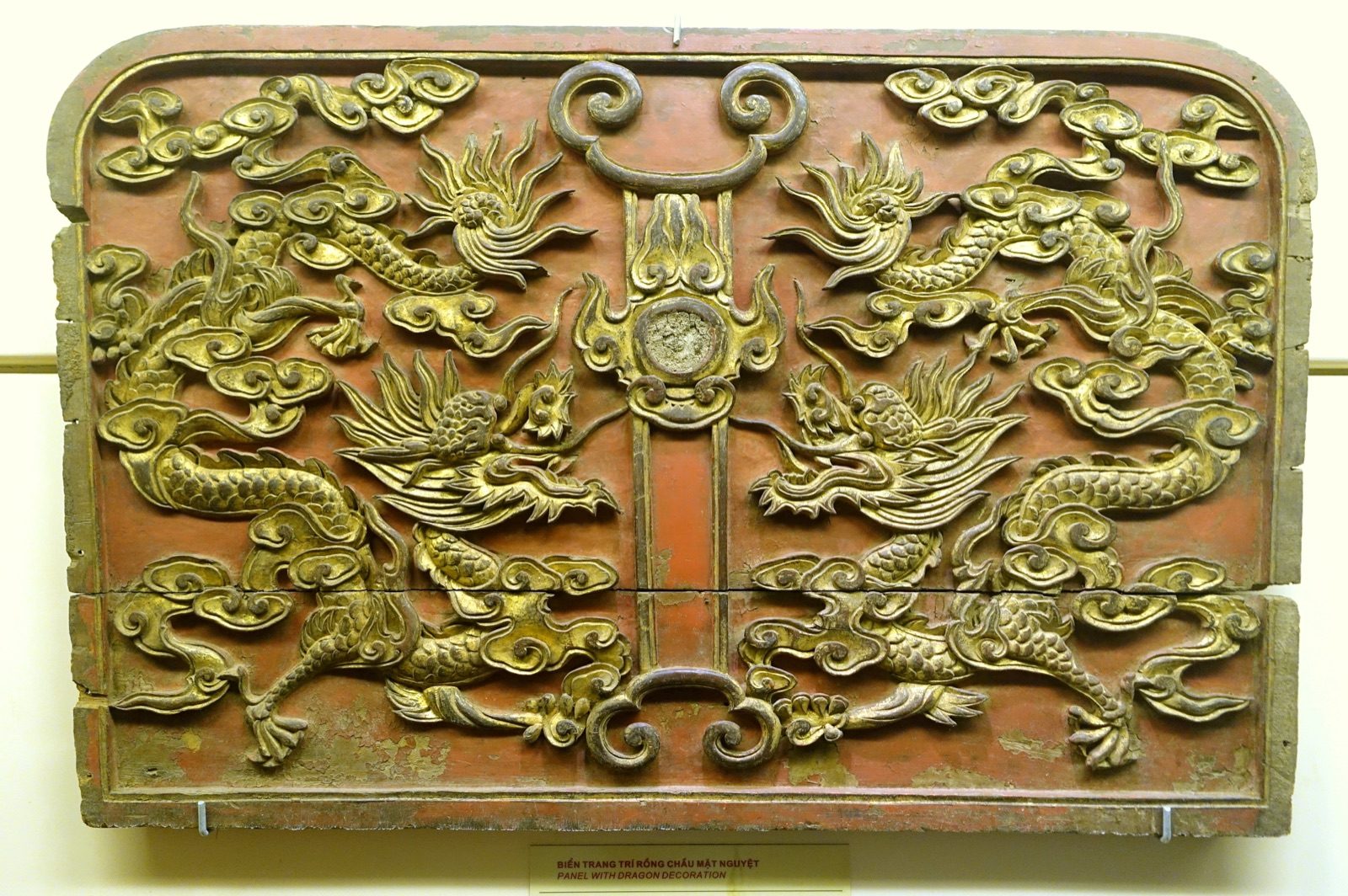
Vietnam's national origin story makes the dragon a literal ancestor rather than a guardian summoned after death. According to a mythical genealogy compiled in the 16th century, the Hùng Vương sự tích ngọc phả cổ truyền, the dragon lord Lạc Long Quân married Âu Cơ, a fairy princess from an entirely separate lineage. Âu Cơ gave birth to a sac of one hundred eggs that hatched into one hundred sons. Lạc Long Quân then told her plainly that a dragon and a fairy couldn't stay together, that water and fire don't share a household, and the couple split their children: fifty followed their mother into the mountains, fifty followed their father toward the sea. The eldest son who stayed with Âu Cơ became the first Hùng King. Vietnamese people still describe themselves today as con Rồng cháu Tiên, children of the Dragon and grandchildren of the Fairy, tracing an unbroken line back to that division. The Hồng Bàng dynasty's traditional reign dates for Lạc Long Quân, placed in the third millennium BCE by that same genealogy, belong to legendary chronology rather than to any archaeologically verified record.
The dragon reappears again, this time in recorded history rather than legend, as a founding omen for the country's capital. In 1010, Lý Thái Tổ moved his court to the old citadel of Đại La and, according to the account preserved in Vietnamese chronicles, described the site as a place where "the coiling dragon and the crouching tiger lie." When his boat docked there, a dragon reportedly soared above his head, and he renamed the site Thăng Long, "ascending dragon." The name held for roughly eight centuries before the city became Hanoi, and the old citadel at its center, Hoàng Thành Thăng Long, still carries the dragon's name today as a UNESCO World Heritage Site.

Southeast Asia's naga: a different animal wearing the same translation
Cross from Vietnam into Thailand, Laos, or Cambodia and the dragon lineage changes entirely, even though English keeps reaching for the same word. The naga is a divine, half-human, half-serpent being from Sanskrit religious literature, described in Hindu tradition as a child of the sage Kashyapa and his wife Kadru, worshipped in South Asia for roughly two thousand years before Buddhism carried the belief into Southeast Asia. Once there, it merged into existing local water-spirit worship rather than replacing it. In Laos, Mon-Khmer communities were already worshipping water spirits in serpent, dragon, and crocodile form as early as 2000 BCE, according to naga researcher Stéphane Rennesson of the Laboratory of Ethnology and Comparative Sociology in Paris; when Buddhism became the country's dominant religion in the 14th century, the naga was folded in as the religion's protector rather than displaced by it, and young Lao men entering the monkhood are still called nak in the naga's honor today.
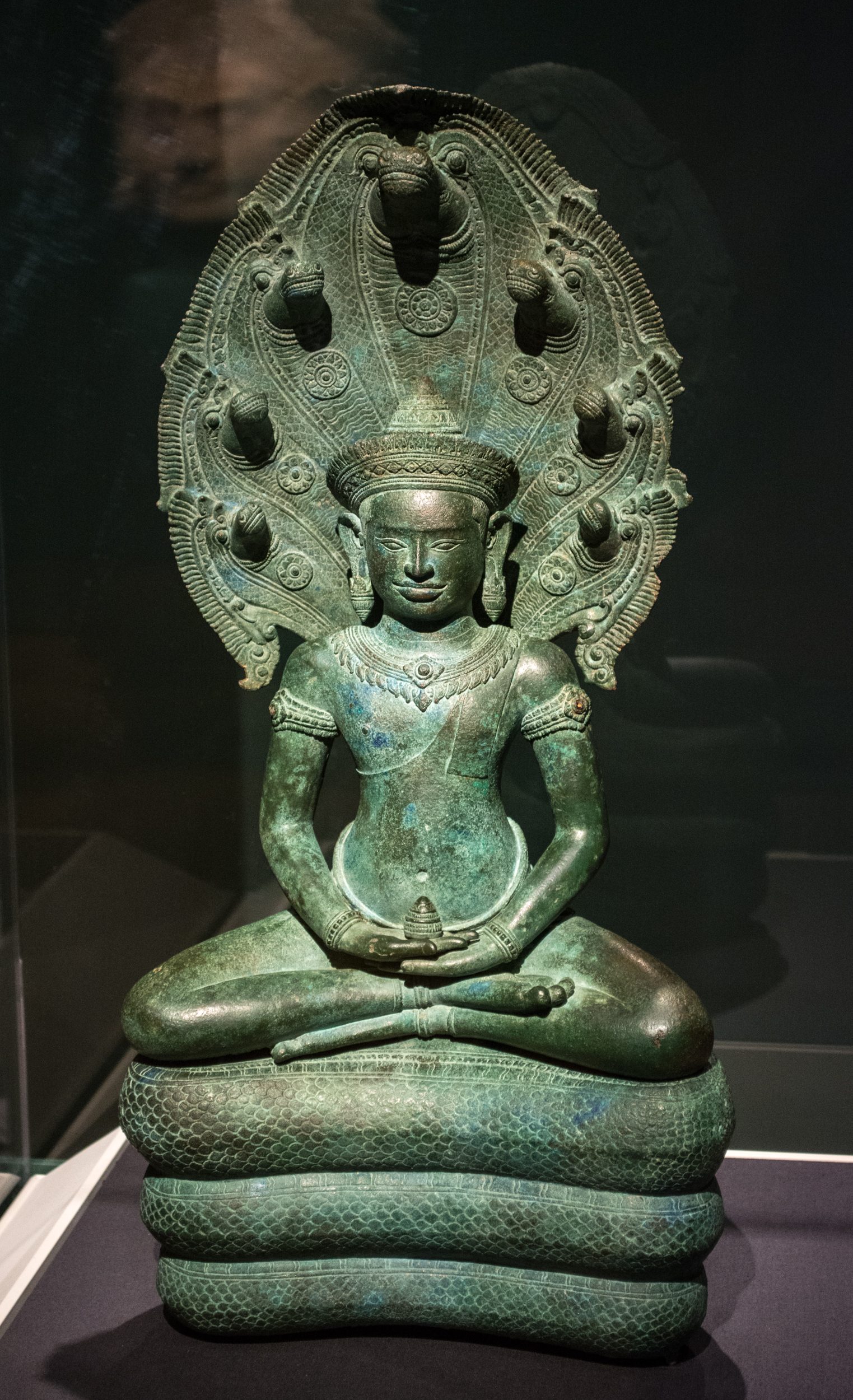
The naga's best-known Buddhist story places it beside the Buddha at his most vulnerable moment. According to accounts recorded in the Pali Canon's Vinaya and Udana texts, during the Buddha's third week of meditation after his enlightenment at Uruvelā, a violent storm broke for seven days, and the naga king Mucalinda rose from the earth, coiled around the Buddha's body, and spread his hood overhead as shelter until the sky cleared. That episode is why naga-enthroned Buddha statues, a multi-headed naga fanned out behind the seated figure, became one of the standard images across Cambodian, Thai, and Laotian Buddhist art, visually distinct from anything in Chinese, Korean, or Vietnamese dragon iconography. That visual distinctness cuts the other way too: the image most Westerners picture by default, four legs, bat-like wings, fire breath, has no equivalent in any of the Sinosphere or Indosphere traditions described above; it was assembled from entirely separate medieval European sources instead.
The naga hasn't faded into old temple carvings. Louangphabang, the former royal capital of Laos, is said to be guarded by fifteen nagas, part of the case Lao officials and weavers built into a UNESCO application centered on naga-patterned textile traditions. In November 2022, Thailand's cabinet went further and formally declared the naga a national mythological symbol, tasking the country's Fine Arts Department with drawing up standard reference images of the four traditional types: the golden naga, the green naga, the rainbow naga, and the black naga.
.jpg)
The Mekong's fireballs: an old belief with a very recent name
The naga's most visible modern moment happens every year on the Mekong River, where reddish balls of light, ranging from small sparks to basketball-sized orbs, rise a couple hundred meters out of the water and vanish, most often on the night marking the end of Buddhist Lent in late October. Reports describe anywhere from tens to thousands of fireballs in a single night, concentrated along roughly 250 kilometers of river centered near Phon Phisai in northeastern Thailand. Locals attribute them to phaya nak, the naga said to live beneath the river. The lights themselves are old, but the branding isn't: residents called them "ghost lights" until local officials renamed them "phaya nak lights" only in the mid-1980s, a gap one 2018 observer noted directly, pointing out that the phenomenon itself was "hundreds of years old" even though its naga-branded name was only about 35.
The explanations on offer don't agree with each other, and neither side has closed the case. A 2002 Thai television documentary filmed Lao soldiers firing tracer rounds across the river during the festival, and a Thai biologist who later analyzed footage of a fireball event concluded flare guns fired from the opposite bank were the real source. Skeptic Brian Dunning pushed back on physical grounds, arguing that gunfire from across a half-mile-wide river would take roughly 2.5 seconds to reach spectators as sound, by which point the crowd would already be cheering at the light itself and drown it out. Then in 2021, Lao authorities investigated the phenomenon during a strict COVID-19 lockdown and curfew and concluded it was "extremely unlikely" anyone could have fired weapons or flares undetected that night, given the heavy police presence in place. The natural-gas and plasma explanations proposed as alternatives don't hold up cleanly either, according to Dunning's review of the physics involved. What's left is the same unresolved gap that runs through most searches for a real, physical dragon: real observations, several competing explanations, and no single one that accounts for everything reported.