
No priesthood, no temples, according to the people who dig for them
Type "Norse religion" into a search bar and the results assume a religion in the institutional sense: a belief system with its own clergy, its own buildings, its own body of teaching. The archaeological and historical record from Viking Age Scandinavia does not support that picture. The National Museum of Denmark, summarizing decades of excavation, states it plainly: despite regular sacrifices, there appears to have been no regular priesthood and no single-purpose temples. The men who led each community performed the ceremonies themselves, in their own homes, and excavations of the great estates that hosted them show these were simultaneously political, economic, and religious centers, not separate sacred sites set apart from ordinary life.
That absence of a dedicated religious class is one of the clearest structural differences between what most people picture when they hear "ancient religion" and what the sources for pre-Christian Scandinavia describe. Nobody trained for a religious vocation the way a monk trained for holy orders, and nothing like a church hierarchy existed in Scandinavia until Christian missionaries brought their own institutions with them. Ancient Egypt ran the opposite system: three rival priesthoods at Heliopolis, Hermopolis, and Memphis each maintained their own temples and taught their own creation theology side by side for roughly three thousand years. Norse religion never developed anything close to that kind of vocational structure.
The chieftain who spoke for the gods
In Iceland, the closest thing to a religious office was the goði (plural goðar), a title that literally translates to "speaker for the gods." A goði was a chieftain first: the sagas and later legal texts describe him as maintaining the communal hall, or hof, where feasts and sacrifices took place, while also holding secular authority over his district. The Old Norse sources use goði and höfðingi, the general word for chieftain, almost interchangeably, because in practice the two roles were the same job.
Iceland's early legal system formalized this arrangement rather than separating it out. After a period of competing, informally organized goðorð (chieftaincies), a constitutional reform fixed their number at 39 around 965 CE, according to historian Jesse Byock's research on early medieval Icelandic governance. Each goði held religious, judicial, and political authority over his followers at once. When Iceland's assembly, the Althing, formally adopted Christianity by vote around 999 or 1000 CE, the goðar's religious duties transferred to the new church, but many of the same men kept their political power, since the office had never depended on the old gods to begin with.
Sacrifice in a farmhouse, not a sanctuary
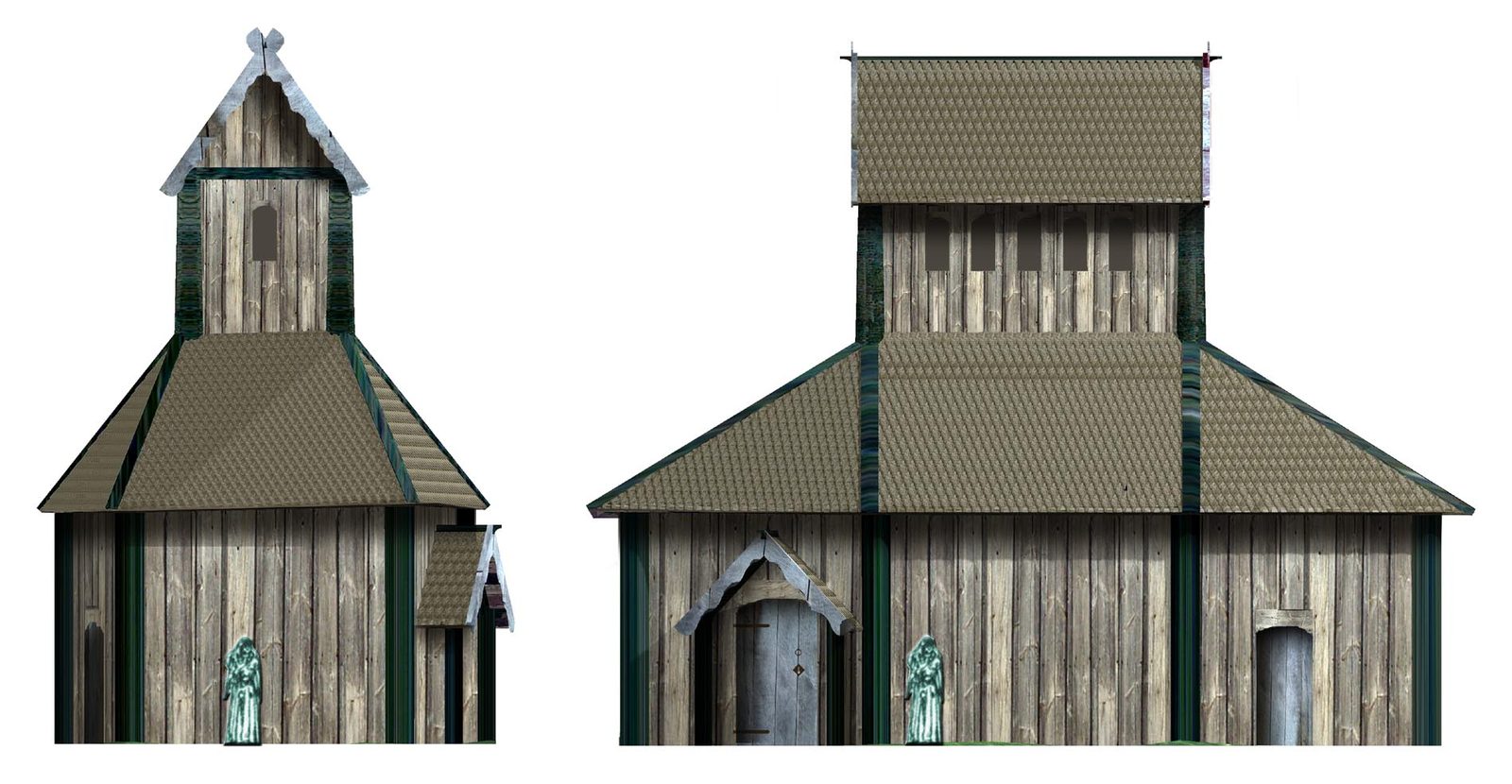
The blót, the central sacrificial ritual of Norse religion, mostly happened at exactly the kind of hall a goði already controlled, not in a purpose-built shrine. Written sources and the archaeological record agree that animals, particularly pigs and horses, were the main offerings. At Hofstaðir, a documented temple-hall site in northern Iceland, archaeologists have found evidence that oxen were decapitated in seasonal rituals over an extended period, with the skulls displayed on the building's walls afterward. The scale model shown above, built by Sven Rosborn for the Museum of Foteviken, reconstructs a cult house excavated at Uppåkra in Sweden by Lund University archaeologists Lars Larsson and Birgitta Hårdh. According to Larsson's 2007 excavation report in the journal Antiquity, the building was first erected in the 3rd century AD and rebuilt on the same spot six more times over roughly 700 years, with the last version still standing into the early Viking Age. Its tall timber structure and rich array of ornamented finds led Larsson to describe it as the first Scandinavian building for which the word 'temple' can fairly be used. Even so, it stood next to an ordinary hall as part of a larger settlement, not a freestanding complex set apart from daily life.
Human sacrifice, described in a handful of Christian-era sources, remains one of the most contested claims in the whole field. Accounts from writers like Thietmar of Merseburg and Adam of Bremen describing mass sacrifices at pagan sites have long been treated with suspicion by historians, who point out that both writers had reason to portray the pre-Christian religion as brutal and that neither had firsthand access to the rituals they described.
The one detailed 'grand temple' account nobody fully trusts
If there is a single passage responsible for the popular image of Norse religion as an organized cult with a central sanctuary, it is Adam of Bremen's description of the temple at Uppsala, written in his history of the archbishops of Hamburg-Bremen around 1075. Adam, a German cleric who never visited Uppsala himself, described a gold-covered building housing statues of Thor, Odin, and Freyr, along with a nine-year sacrificial festival involving both animals and men.
Historians have picked that account apart for over a century. Adam was working from secondhand reports, not eyewitness testimony, and the philologist Rudolf Simek notes that his sources "are of extremely varying reliability," though he adds that the existence of some temple at Uppsala is not itself in dispute. Simek and others have also pointed out that details of Adam's description echo the Old Testament's account of Solomon's Temple, and that he may have filled gaps in his information with that biblical template. The scholar Andy Orchard put it bluntly: "it is unclear to what extent Adam's description has a basis in historical fact rather than lurid fiction." Adam's version is a hostile outsider's secondhand composite, patched with guesswork where his sources ran thin, and it is the main reason many popular summaries of Norse religion describe temples and priesthoods that the archaeological record mostly doesn't back up.
No scripture from anyone who actually believed it
Even the stories now packaged as "Norse mythology," the closest thing to religious teaching that survives, did not come from practicing believers writing down their own faith. As covered in more detail in MythCairn's piece on where the Norse gods come from, the two texts carrying nearly all of the connected narrative material, the Prose Edda and the Poetic Edda, were both compiled roughly two centuries after Iceland's official conversion, by Christian Icelanders working from oral tradition that had already passed through generations of a Christianized society. Snorri Sturluson, author of the Prose Edda, frames the old gods in his own prologue as historical human kings later mistaken for divinities, a technique called euhemerism, rather than presenting them as objects of real belief.
That leaves modern readers with a strange asymmetry: a religion is best documented through the writings of people who no longer practiced it and, in some cases, were actively working to discredit it. Greek religion had a milder version of the same authority gap: no central council ever settled a single fixed roster of the Twelve Olympians, and Athens's own two major public monuments to the twelve gods, built roughly a century apart, didn't agree with each other about who belonged.
The version practiced openly today is a 20th-century revival
Norse religion does have living practitioners, but the organized version most people could join is far younger than the Viking Age. Ásatrúarfélagið, Iceland's Norse pagan fellowship, was founded on the first day of summer in 1972 by the poet and farmer Sveinbjörn Beinteinsson, who became its first allsherjargoði, or high priest. The Icelandic government granted it official religious status in 1973. According to the organization's own history, Beinteinsson led its first public blót in nearly a thousand years that August, at his farm.
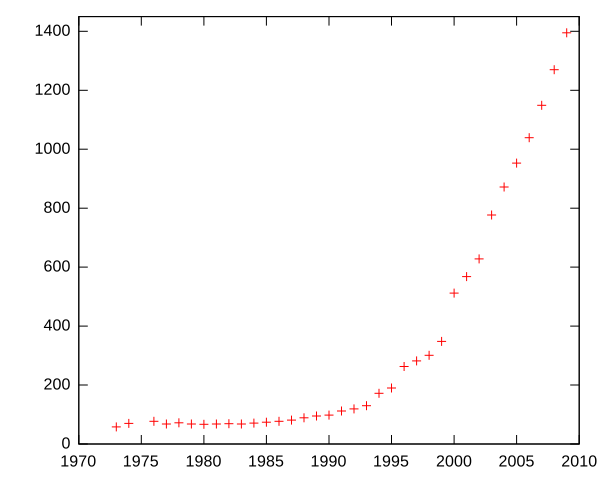
Growth since then has been steady but small in absolute terms. Statistics Iceland, the government statistics agency, counted 58 registered members in 1973; by September 2024 that figure had grown to roughly 5,435, about 1.5% of Iceland's population, with the organization's own count reaching around 6,250 members in 2025, making it comfortably the largest non-Christian religious body in the country. The chain back to the Viking Age was never unbroken to begin with. Ásatrú is a deliberate 20th-century reconstruction, built from the same fragmentary, Christian-filtered sources discussed above, roughly a millennium after Iceland's conversion cut off any direct line of practice.