_by_M%C3%A5rten_Eskil_Winge.jpg)
"Norse mythology creatures" is a search-engine category. The Eddas never used it.
Every list that comes up for "Norse mythology creatures" runs the same beings together: giants, dwarves, elves, a wolf, a serpent, an assortment of the restless dead, all filed under one heading as if medieval Icelandic sources treated them as a single class of thing to be afraid of. They didn't. Snorri Sturluson's 13th-century Prose Edda and the older poems collected in the Poetic Edda keep these groups apart by lineage, by role, and by how closely each one sits to the gods themselves, and the differences matter more than the resemblances a modern list flattens away.
Three of those differences carry the most weight. The jotnar, usually translated "giants," are not an enemy species so much as an extended family that keeps marrying into the gods' own line, one that includes the mother of Odin himself. The dvergar, or dwarves, picked up their reputation for shortness centuries after the Eddas were written, not from them. And the handful of named figures most people actually mean when they say "Norse monster," the wolf Fenrir, the serpent Jormungandr, and the goddess of the dead Hel, are three siblings from one household, not evidence of some wider monstrous order.
The giants aren't the gods' enemies. One of them is Odin's mother.
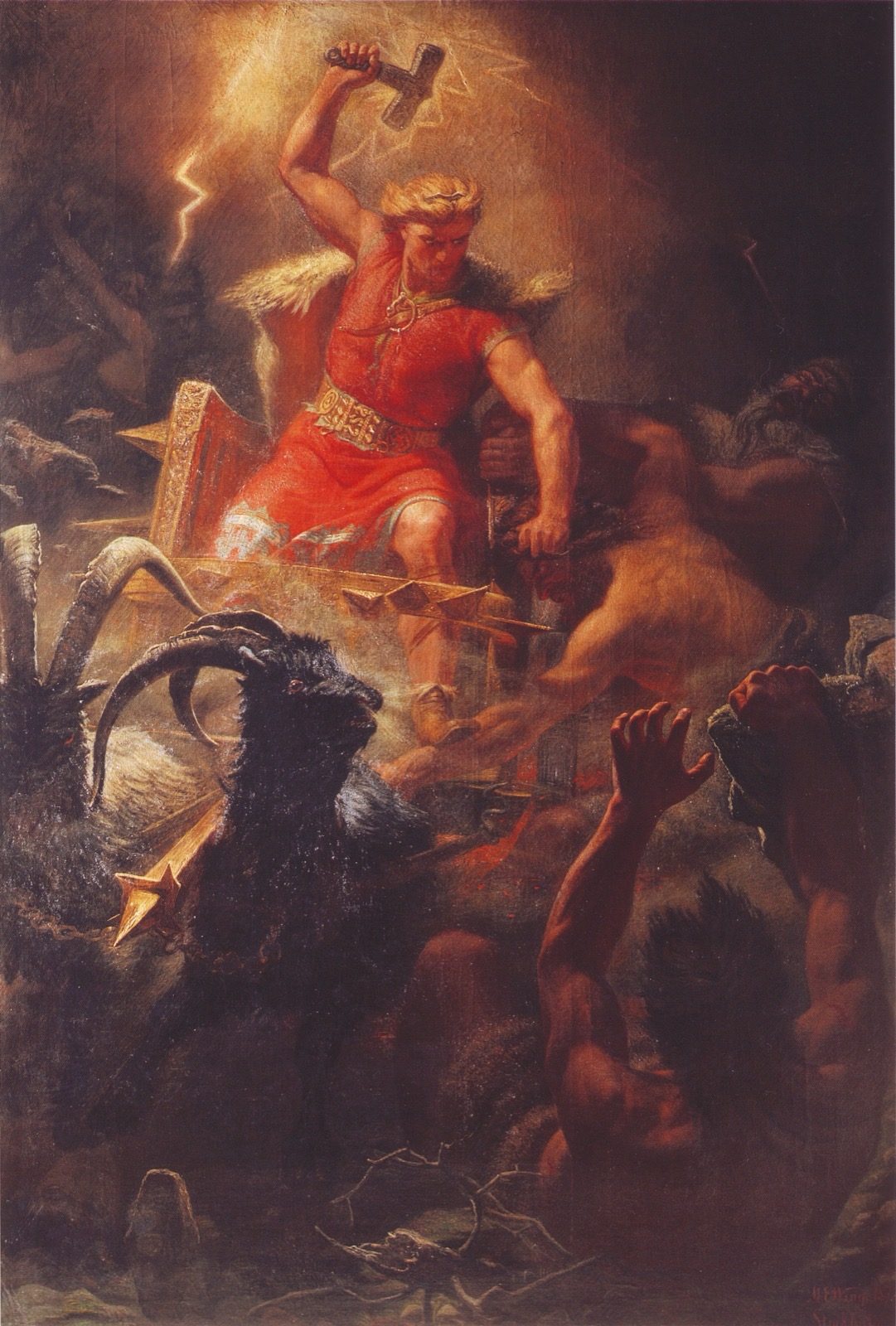
Norse cosmology starts with a giant, not a war against one. According to Gylfaginning, the section of Snorri's Prose Edda that lays out creation, the first being to exist is Ymir, a jotunn who forms out of melting frost, and the world itself is built from his corpse after Odin and his brothers kill him: his flesh becomes the earth, his blood the sea, his skull the sky. That skull is held up at its four corners by four dwarves, Nordri, Sudri, Austri, and Vestri, whose names are simply the four compass directions, north, south, east, and west. The gods' own family tree runs directly through this supposedly hostile species: Bestla, Odin's mother, is herself a jotunn, daughter of the giant Bolthorn, which makes the king of the Aesir gods half-giant by blood before the story of the Aesir has properly started.
That mixing does not stop with one generation. Njord, a Vanir god of the sea, marries the giantess Skadi as a settlement after the Aesir kill her father, though the marriage falls apart once neither god can stand the other's home, Njord hating the wolves that howl around her mountain hall and Skadi hating the seabirds that cry along his coast. Freyr's marriage to the giantess Gerdr goes further and costs more. Per the Eddic poem Skirnismal, Freyr sees Gerdr from Odin's high seat, Hlidskjalf, and is overtaken by longing badly enough that he sends his servant Skirnir to win her on his behalf, arming Skirnir with his own magical sword to make the trip. Gerdr refuses every gift Skirnir offers and only agrees to the marriage after he threatens her with a curse of loneliness and monstrous suitors, a considerably rougher courtship than modern retellings that stop at the wedding. Freyr never gets the sword back. Because he gave it away to secure a giant's hand, Snorri's Prose Edda has him facing the fire giant Surtr at Ragnarok with nothing but an antler, and losing.
Even Loki, the gods' most notorious troublemaker, is not fully one of them by blood. His father, Farbauti, is named a jotunn in Gylfaginning; only his mother, Laufey, gets counted among the goddesses. The one family everyone actually pictures when a list says "Norse monster" starts here, with a god's blood brother who is himself half-giant.
The dwarves were never described as small. That part got added later.
Ask for a mental picture of a Norse dwarf and most people reach for the same image: short, bearded, living underground, probably holding a hammer. The earliest Old Norse sources that mention dvergar don't support the "short" part of that picture. Wikipedia's summary of the scholarship is blunt about it: dwarfs are sometimes described as short in later legendary sagas, but this is "neither explicit, nor relevant to their roles" in the earliest Eddic material, and the linguist Anatoly Liberman has suggested the literal smallness attached to dwarfs only after Christianization reframed the old religion's beings as lesser.
The sky-bearing dwarves Nordri, Sudri, Austri, and Vestri, the same four holding up Ymir's skull from the section above, are the clearest argument against a small dwarf in the oldest sources: a being propping up the entire sky at one corner of the world is a strange thing to picture as short. Even the two surviving Prose Edda accounts of where dwarves come from disagree with each other. Snorri's Gylfaginning says they formed like maggots in Ymir's rotting flesh before the gods gave them human wit and human shape; the older poem Voluspa says instead that they were shaped from the earth, with no mention of Ymir at all. Two of the religion's foundational texts can't agree on dwarf biology, let alone their height.
What the sources agree on instead is craftsmanship. The dwarves Brokkr and Sindri forge Mjolnir, Thor's hammer, along with Odin's ring Draupnir and Freyr's boar Gullinbursti, in a contest against another pair of dwarven brothers, the sons of Ivaldi, who separately forge Odin's spear Gungnir and the golden hair that replaces the hair Loki cuts from Thor's wife Sif as a prank. Every object a modern reader would call an iconic god-weapon in Norse mythology, the hammer, the spear, the ring, came out of a dwarven forge, not divine hands. That is what the Eddas emphasize instead. Height never enters into it.
The "monster" most lists mean is one litter, not a category.
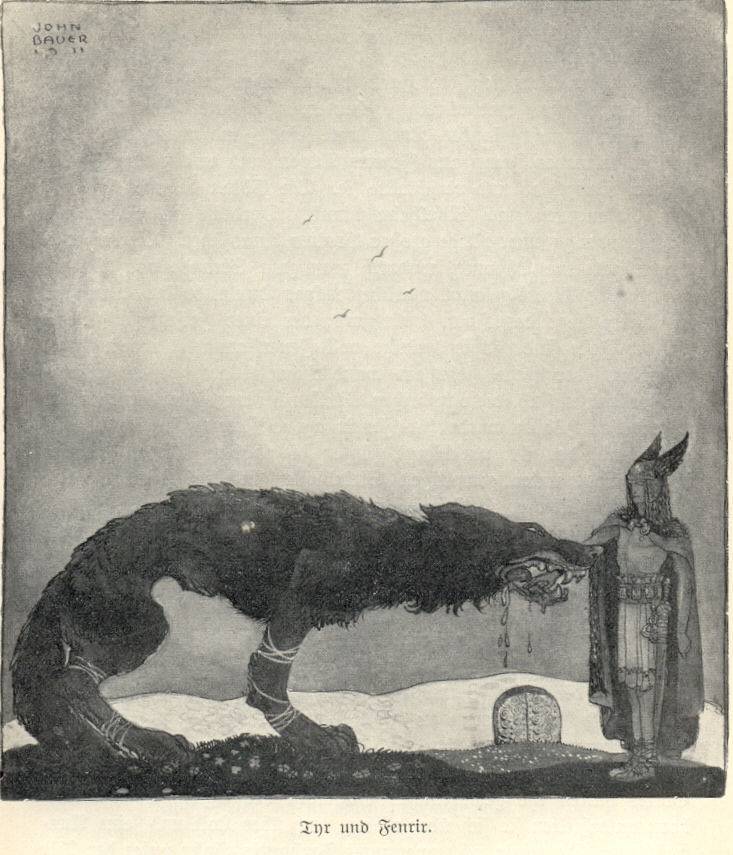
Strip out the giants who marry into the family and the dwarves who forge its weapons, and what's left of "Norse monster" narrows down fast to one specific household. According to Gylfaginning, Loki, the half-giant trickster from the section above, fathers three children with the giantess Angrboda in a place called Ironwood: the wolf Fenrir, the serpent Jormungandr, and a daughter, Hel. Prophecy warns the Aesir that this litter will bring them harm, and each child gets shipped off separately. Odin casts the infant Jormungandr into the ocean surrounding Midgard, where the serpent grows until it encircles the world and bites its own tail. Hel is sent down to rule over Niflheim and everyone who dies of sickness or old age, a role covered in full elsewhere on this site, since the job has almost nothing to do with punishment despite the name's later borrowing into English. Fenrir alone stays in Asgard, raised among the gods who fear him most, fed only by Tyr, the one god willing to go near him.
That decision to keep Fenrir close is what produces Norse mythology's most quoted monster story. Two ordinary fetters break the first time Fenrir strains against them, so the gods send Skirnir to a group of dwarves to have a third one made. Gylfaginning, in the Brodeur translation, describes it exactly: "It was made of six things: the noise a cat makes in foot-fall, the beard of a woman, the roots of a rock, the sinews of a bear, the breath of a fish, and the spittle of a bird." Fenrir grows suspicious of a chain that thin and agrees to be bound only if one god places a hand in his mouth as a pledge of good faith. Tyr is the only one willing to do it. When Fenrir realizes he has been tricked and cannot break free, he bites down, and Tyr loses the hand at what the text calls the wolf's joint. Every part of that story, the impossible ingredients, the demand for a hostage, the missing hand, comes from one family's specific myth. None of it generalizes to jotnar as a whole, who spend just as much of the source material marrying into the Aesir as fighting them.

The one creature in this story that's actually just a monster has no giant or god in its family tree.
If giants are mostly in-laws and the Fenrir household is one family's story, the clearest unrelated threat in Norse tradition comes from somewhere else: the draugr, an animated corpse with no jotunn or Aesir lineage attached to it at all. The 13th-century Grettis saga tells the best-known example, a herdsman named Glam who dies under strange circumstances and returns from his grave larger and stronger than he was alive. When the saga's hero, Grettir, finally confronts him, the text describes Glam stretching upright inside a doorway "enormously big and amazingly large-featured," his head nearly brushing the roof. He is simply a dead man who came back changed, with no jotunn or divine ancestor anywhere in the story.