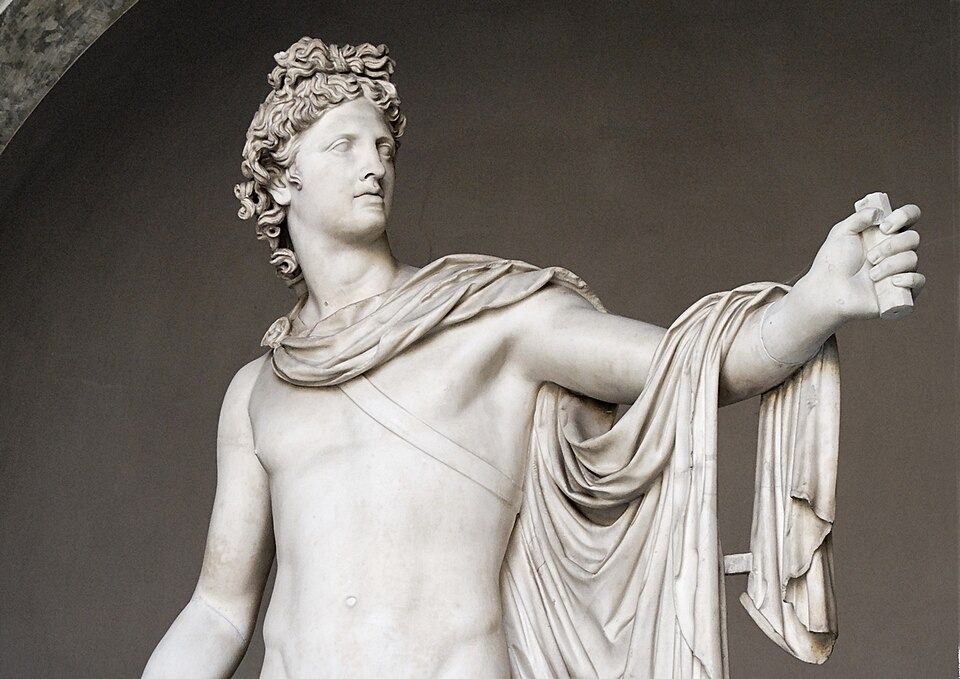

The sanctuary Apollo took, rather than founded
The Homeric Hymn to Apollo, one of the oldest surviving accounts of the god, does not describe Delphi as Apollo's from the start. The hymn places a nameless female serpent at the site before he ever arrives, guarding a spring on behalf of an older order: Gaia, the earth, who according to later mythographers had given a share of the oracle to the Titaness Themis, who ran it in turn. Apollo's arrival is a hostile takeover, not a founding. He shoots the serpent with an arrow, and the hymn lingers on her death: "she left her life, breathing it forth in blood," while Apollo stands over the body and boasts, "Now rot here upon the soil that feeds man."
The Greek verb for that rotting, pythesthai, is the hymn's own explanation for two names at once: the place became Pytho, and the god who killed the monster there took the byname Pythian. Later sources name the serpent Python and make the takeover a family dispute rather than a clean victory. Gaia, angered at how her daughter Themis had been pushed out, retaliated by sending Delphi's inhabitants prophetic dreams that bypassed Apollo's new shrine entirely, undermining his authority at the very sanctuary he had just claimed. The standoff was settled only when Zeus stepped in on his son's side, formally handing Apollo control of the oracle. The version of Delphi that survives in the historical record, Apollo's temple, Apollo's priestess, Apollo's fame, was the outcome of that intervention, not an uncontested inheritance.
The vapor scholars said couldn't be real
The two ancient writers with the best claim to know what actually happened at Delphi both describe a physical vapor rising from the ground. The geographer Strabo, writing in the first century BC or AD, says the oracle sat over "a cave that is hollowed out deep down in the earth, with a rather narrow mouth, from which arises breath that inspires a divine frenzy," and that the Pythia inhaled it while seated on a tripod placed over the opening. Plutarch, writing a century or so later, had unusually direct access to the question: he served for years as a priest of Apollo at Delphi and wrote an entire essay, On the Obsolescence of Oracles, partly devoted to the exhalation and why he thought its strength had weakened over time.
For most of the twentieth century, scholars treated both accounts as a myth dressed up as geography. Pierre Amandry, the French archaeologist who led excavations at Delphi and published the standard study of the oracle in 1950, argued that gas vents of the kind Strabo and Plutarch described belong to volcanic terrain, not the limestone of Mount Parnassus, and concluded the vapor was a literary invention. Later archaeologists and classicists, including Frederick Poulsen, E. R. Dodds, Joseph Fontenrose, and Saul Levin, followed his conclusion, and by the second half of the century, no vapor and no chasm was close to a scholarly consensus. None of them, however, were geologists, and no one with that training had examined the site.

What a 2001 geology study actually found
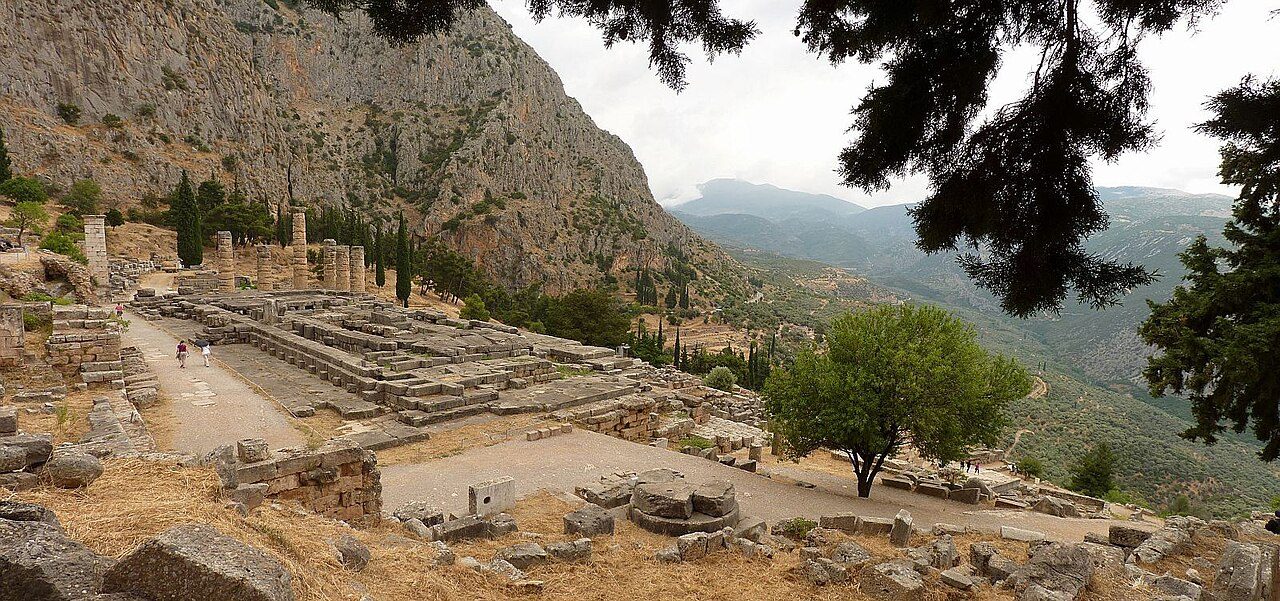
That consensus held until geologist Jelle de Boer, archaeologist John Hale, and geochemist Jeffrey Chanton published "New Evidence for the Geological Origins of the Ancient Delphic Oracle (Greece)" in the journal Geology in 2001. Their team mapped an intersection of two active faults, the Delphi Fault and the Kerna Fault, running directly beneath the temple ruins, and sampled spring water at the site that showed measurable ethylene, along with ethane and methane, seeping up from bituminous limestone deposits below. Amandry had been right that Delphi sits nowhere near a volcano; he had been wrong that a non-volcanic setting couldn't produce gas at all. Faulted limestone turned out to be its own kind of source.
That finding does not settle the older question of what the gas actually did to the Pythia. Ethylene in low doses is described in toxicology literature as capable of producing mild euphoria, and de Boer, Hale, and Chanton argued it as a plausible cause of her trance state. Toxicologists Jay Foster and Danny Lehoux pushed back in a 2007 paper in the journal Clinical Toxicology, arguing the ethylene concentrations documented at the site were far too low to intoxicate anyone standing above them, and other researchers have since proposed different combinations of gases and different locations for the vents. What survives the debate is narrower than the popular version of the story: geologists confirmed real faults and real gas emissions in the precise place ancient writers said a vapor rose from the ground, after fifty years of being told that was impossible. Whether that vapor was strong enough to alter a priestess's mind is still an open argument between toxicologists, not a settled fact.
A name older than Greek myth, and maybe older than Greece
Every other member of the Twelve Olympians picked up a different name in Rome. Zeus became Jupiter, Hera became Juno, Poseidon became Neptune, Ares became Mars, Aphrodite became Venus. Apollo is the one significant exception: the Romans imported his cult directly, kept the Greek name unchanged, and never gave him a native Latin identity of his own. Ancient sources treat him as a conscious import rather than an assimilated native god, which may be exactly why nobody bothered translating him: there was no old Italian sky-father or war-god whose name he could quietly slide into, the way Jupiter's own name already existed as a Proto-Italic word for "sky father" before Zeus was ever mapped onto it.
The reason may run deeper than Roman religious habit. Dutch linguist Robert S. P. Beekes, in a 2003 paper and later in his Etymological Dictionary of Greek, found no convincing Indo-European root for "Apollo" and argued the name is Pre-Greek, the same conclusion he reached for Hermes. But Apollo's case comes with a specific, datable clue that Hermes's does not. A Hittite treaty from around 1280 BC between the Hittite king Muwatalli II and Alaksandu, ruler of a western Anatolian city called Wilusa, lists a god named Appaliunas among the divine witnesses guaranteeing the agreement on Wilusa's side, a name specialists in Hittite and Greek read as an early form of Apollo's own. Wilusa is now widely identified with Troy, and some scholars connect Alaksandu himself to Alexandros, the birth name Homer gives Paris of Troy. Centuries later, in the Iliad, Apollo still fights on Troy's side against the Greeks and is credited with building the city's walls, a loyalty that lines up strikingly well with a god whose oldest known name belongs to a treaty protecting that very city, long before the Trojan War was ever written down as myth.