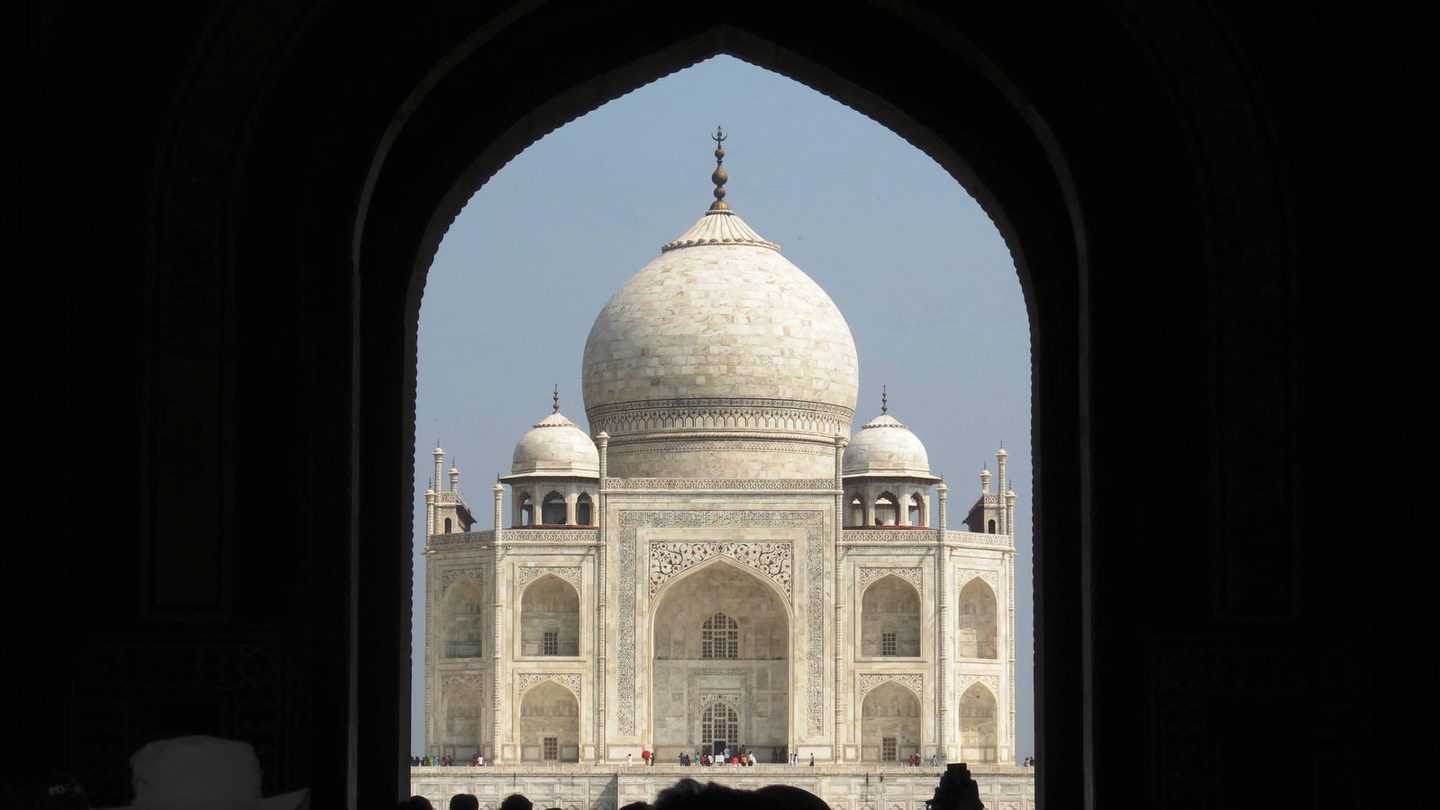

Yes, but the room you enter is the upper one
The short answer to whether you can go inside the Taj Mahal is yes. The mausoleum itself is open to visitors, and Wikipedia's (checked 13 October 2026) visiting section says the complex is open every day except Friday, from an hour before sunrise until 45 minutes before sunset. Step through the south door and you are in an octagonal chamber whose sides measure about 7.3 metres. The walls rise around 25 metres to a "false" interior dome decorated with a sun motif, and light comes in through pierced marble screens set into the walls.
At the center of that room, behind a carved marble screen, stand the two tombs everyone photographs. They are the tomb of Mumtaz Mahal and, beside it, the tomb of her husband Shah Jahan. They are also not where anyone is buried. Wikipedia's (checked 13 October 2026) description of the interior is blunt about it: the main chamber "houses the false sarcophagi" of the couple, "while the real ones are in the basement." Outlook Traveller, in an explainer on the restricted area, says the same and adds that the burial chamber was open to the public in earlier years and no longer is.
What the upper chamber holds, and what has been swapped out
The screen around the cenotaphs is made from eight marble panels, pierced and inlaid with semi-precious stones. It is not the first screen. According to Wikipedia, checked 13 October 2026, the cenotaphs were first covered by a gold screen installed for the second anniversary of Mumtaz Mahal's death in 1633, and a marble one replaced it in 1643.
Other fittings have also come and gone. Wikipedia (checked 13 October 2026) reports that in the 18th century the Jat rulers of Bharatpur, invading Agra, took away two chandeliers, one of agate and one of silver, that had hung over the main cenotaph, along with the gold and silver screen. The large lamp visitors see in the chamber today was commissioned by Lord Curzon, the British viceroy, whose restoration project finished in 1908. The inlay and the cenotaphs are 17th-century work, while some of what hangs and stands around them is later.
Wikipedia (checked 13 October 2026) says the epitaph on Mumtaz's cenotaph names her as Arjumand Bano Begam, titled Mumtaz Mahal, and gives 1631 as her year of death.
Where the real graves are
The actual burials are one level down. Wikipedia (checked 13 October 2026) describes a stairway from the southern entrance room leading to a rectangular lower chamber, walled in marble, with an undecorated coved ceiling. The original tombs there are largely bare, with the Ninety-Nine Names of God inscribed on the side, and the bodies are laid on their sides facing west toward Mecca. Wikipedia's (checked 13 October 2026) account puts Mumtaz's cenotaph at the exact center of that chamber and Shah Jahan's on a larger base to the west. Set beside the inlaid cenotaphs upstairs, it is a very different room.
For a normal ticket-holder that room stays shut. Outlook Traveller says the genuine tombs remain sealed to preserve the site's sanctity and protect the structure, and it wrote the piece after a video of the crypt went viral on Instagram in August 2025. The outlet does not name an official rule or order, so the reason for the closure is its own summary rather than a published ASI statement.
The one time the basement opens
There is an exception, and it comes once a year. Each year the death anniversary of Shah Jahan is marked with an Urs, a three-day commemoration at the tomb. In a PTI report carried by Daily Excelsior, ASI officials said the graves of Shah Jahan and Mumtaz Mahal are opened to the public only once a year, for the three days of the Urs, and that free entry runs alongside it. The most recent one I could confirm was the 371st, on 15, 16 and 17 January 2026, which the ASI schedule ties to the 26th, 27th and 28th days of the Islamic month of Rajab. Free entry began at 2 pm on the first two days and ran from sunrise to sunset on the last, per the same ASI order.
The year before, according to ETV Bharat's preview of the 370th Urs, the dates were 26, 27 and 28 January 2025, and visitors were promised the chance to see the original graves in the basement. That report lists a ghusl, a ceremonial washing of the graves, then prayers and floral offerings, followed on the second day by sandalwood paste, Quran recitation and qawwali, and a complete recitation of the Quran on the third.
Because the Urs follows the Islamic lunar calendar, its Gregorian dates slip earlier each year, so a given January slot is not fixed. Anyone planning around it has to check the ASI announcement for the year. On every other day, the basement door is shut.
Is the wife still buried there?
Yes, though she was not the first place she was laid to rest. Mumtaz Mahal died on 17 June 1631 while giving birth to her 14th child, during a campaign in the Deccan. Wikipedia's (checked 13 October 2026) biography says her body was temporarily buried at Burhanpur, in a walled garden called Zainabad on the bank of the Tapti River, and that it was disinterred in December 1631 and carried back to Agra, where it was interred in a small building on the bank of the Yamuna. The Taj Mahal article dates the mausoleum to a commission in 1631, construction from 1632 and completion in 1648, with the surrounding complex done five years later. She now lies in the basement chamber described above.
Shah Jahan joined her decades later. His son Aurangzeb deposed him in 1658 and held him under house arrest at Agra Fort, from where, Wikipedia (checked 13 October 2026) notes, he could see the Taj Mahal. When Shah Jahan died in 1666, Aurangzeb buried him in the mausoleum next to his wife. The Taj is one of the seven winners of the 2007 New7Wonders vote, alongside Christ the Redeemer and Machu Picchu. The Colosseum, the third of those names, is not intact at all: about two-thirds of it has gone, and the record of when each part was lost separates the earthquake damage from the centuries of stone removal.
The "22 rooms" question
The claim that 22 hidden rooms are sealed inside the Taj Mahal has circulated for years, and in 2022 it reached a courtroom. On 12 May 2022, the Lucknow bench of the Allahabad High Court, made up of Justices D. K. Upadhyay and Subhash Vidyarthi, dismissed a petition asking that the Archaeological Survey of India open the locked doors. LiveLaw reported that the petitioner, Rajneesh Singh, who is media in charge of the BJP's Ayodhya unit, said false history about the monument was being taught and that he wanted to research the closed rooms. The bench's reply, quoted by LiveLaw, was that such debates are meant for the drawing room, not for a court of law. Free Press Journal added that the plea sought a fact-finding committee and an ASI report.
What is actually behind the doors is less dramatic than the framing. Outlook Traveller, citing reports, says these are not really rooms but a long arched corridor in the basement with a door, cleaned regularly by the ASI and locked for security. It adds that experts suggest they support the structure and are opened from time to time for restoration work. That is one outlet's summary and there is no published survey of the space, so it is worth treating as the best available answer instead of a settled one.
The record on the building itself is clear. The Taj Mahal was commissioned by Shah Jahan in 1631 as a tomb for Mumtaz Mahal, according to Wikipedia, checked 13 October 2026, and the bench declined to rule on the building's history. What lies behind the locked basement doors has not been opened to the public.