
The question assumes an answer that doesn't exist
Search "goddess of nature" and you won't land on one name, because no mythology, ancient or otherwise, actually assigned nature to a single deity. Nature was too large a job description for any one god to hold, so every tradition that survives in enough detail to check split it into pieces and handed each piece to a different specialist. That's not a gap in the historical record. It's how these religions were actually organized, visible in texts that are centuries or in some cases millennia old.
Greek mythology is the clearest example, because it's also the best documented. English-speakers reach for "nature goddess" as one category, but ancient Greek religion never worked that way. Three goddesses cover what a modern search collapses into a single term, and they are not interchangeable: worshippers didn't pray to Gaia for a good harvest, and farmers didn't invoke Artemis over their wheat fields. Each had her own job.
Greek mythology splits nature three ways
Gaia is the oldest of the three and the odd one out, because she isn't really "a" nature goddess so much as nature itself, personified. Hesiod's Theogony, written around 700 BC, opens with Chaos, then "wide-bosomed Earth," meaning Gaia, arriving before anything resembling a personality exists in the story. She produces Uranus, the sky, on her own, then bears the Titans with him, and only in the third generation of gods do Zeus and the Olympians show up at all. Gaia isn't a specialist within nature. She's the ground everything else, including the later, more specialized nature goddesses, stands on.
Demeter governs a much narrower and more specific slice: the growth of food crops, the harvest, and the fertility of tended, farmed land. She's a second-generation Olympian, sister to Zeus and Hades, and her myths center on agriculture, not the wilderness. When Persephone is taken to the underworld, it's Demeter's grief that stops crops from growing, not some general breakdown of "nature" in the abstract. Her domain is specifically the land people had already put to work.
Artemis covers the opposite territory. Britannica defines her precisely: she is "the goddess of wild animals, the hunt, and vegetation and of chastity and childbirth." Where Demeter's land is cultivated, Artemis's is untamed, the forests and wild country beyond the plough, along with the animals living in it. She protects the young of wild species even as she also presides over hunting them, an apparent contradiction that ancient sources treat as two sides of the same guardianship rather than a problem to resolve.
Put together, these three cover primordial earth, farmed land, and wild land as three separate portfolios, each with its own goddess, its own myths, and its own cult practices. Nothing in the ancient sources treats them as regional variants of one underlying "nature goddess." They're distinct figures doing distinct jobs.
Rome copied the split, then split it further
Roman religion kept the Greek pattern of dividing nature among specialists, and in some ways pushed that division even further, without folding it back into one figure. Terra, also called Tellus or Terra Mater, personified the earth as a whole, the rough equivalent of Gaia. Ceres, whose name is the direct root of the modern word "cereal," governed specifically the growth of food plants, and Britannica notes she was worshipped either alone or jointly with Tellus, since the two domains, earth and the crops grown from it, overlapped in practice even though Romans kept them as separate goddesses. Flora, meanwhile, held a narrower portfolio still: the flowering of plants and the arrival of spring, honored every year at the Floralia festival.
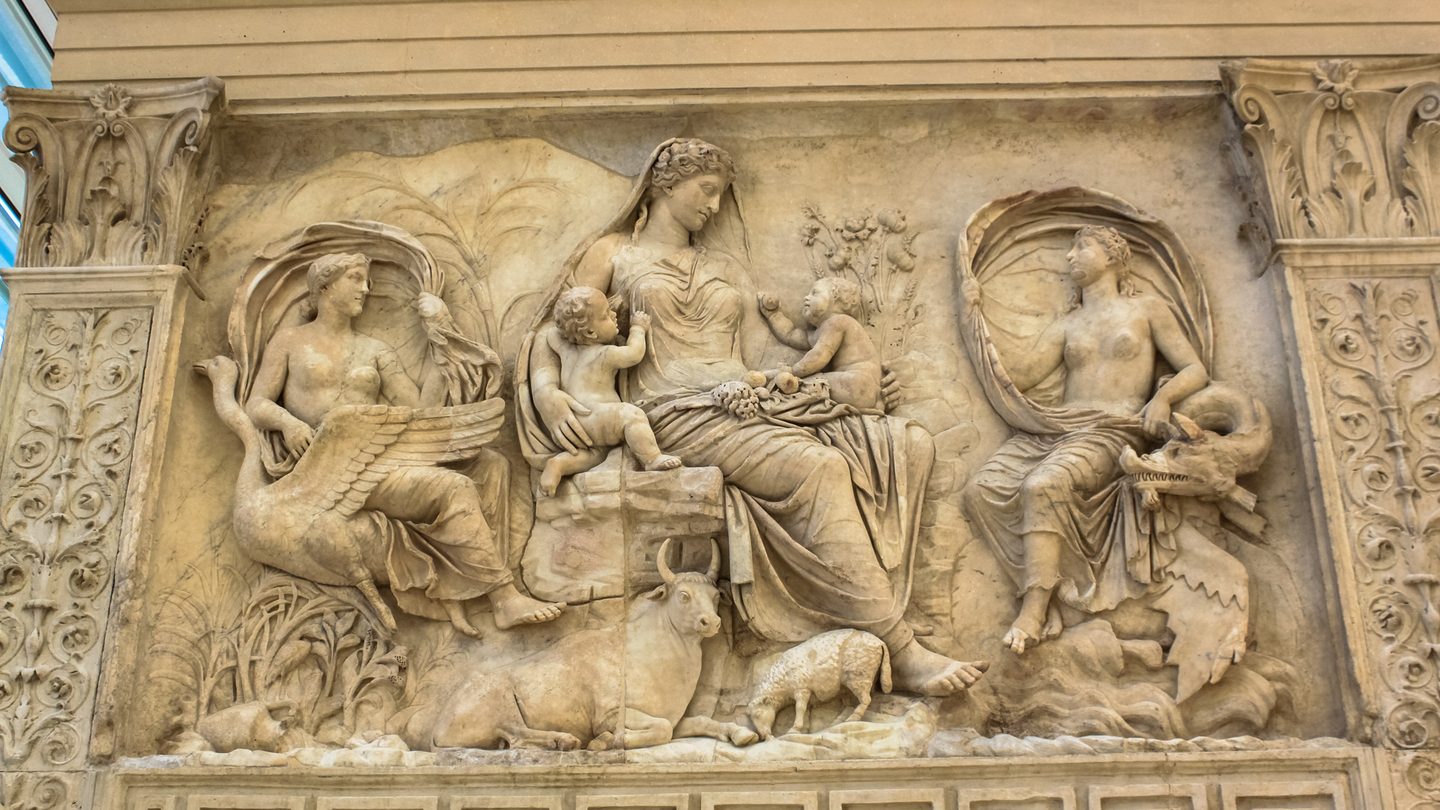
The Ara Pacis, an altar to Peace completed in Rome around 9 BC under Augustus, carries a famous relief panel usually identified as Tellus, seated with an abundance of fruit and grain in her lap and pairs of animals at her feet, flanked by personifications of Air and Water. It's one of the best-surviving visual statements of what Romans imagined "Earth" as a figure to look like, and even here she's shown alongside, not merged with, the other natural forces around her. The monument itself argues against collapsing these figures into one another: Earth, Air, and Water share the panel as distinct presences.
In January, Ceres and Tellus were honored jointly at the Sementivae, a sowing festival that treated the crop goddess and the earth goddess as partners, not as a single merged figure. That's consistent with the wider pattern: Roman religion, like Greek religion before it, kept its nature deities specialized and separate, right down to which festival belonged to which goddess.
The one female name in Kyiv's official pantheon
Slavic mythology answers the question with a single, specific figure, but her actual portfolio doesn't match "nature" in the wilderness sense the English phrase implies. The Primary Chronicle, compiled in the Kyiv area in the early 12th century, records that in 980 AD Prince Vladimir erected a pantheon of idols on a hill outside his hall: Perun, Khors, Dazhbog, Stribog, Simargl, and Mokosh. It's the only place an East Slavic ruler's official pantheon is written down, and Mokosh is the sole female name among the six.
Her domain, as Britannica and later Slavic folklore sources describe it, centers on moisture, the earth, and fate, tied to spinning and weaving rather than wild animals or untamed forest. She survived Christianization far longer than her five male counterparts, continuing in East Slavic folk belief as Mokosha or Mokusha long after the official pantheon was dismantled. She's a genuine, well-documented answer to "is there a goddess for nature," but her actual job description, damp earth and woven fate, is narrower and stranger than the generic English phrase suggests.
Norse mythology's earth goddess is named, literally, Earth
Norse tradition takes the most direct route of all: Jörð's name is simply the Old Norse word for "earth" or "ground," tracing back to the Proto-Germanic root erþō-. She's the personification of the earth, mother of the thunder god Thor, and, according to Britannica, a consort of Odin. She's attested across several sources spanning roughly a century: the 12th-century Latin history Gesta Danorum* by the Danish chronicler Saxo Grammaticus, and the 13th-century Poetic Edda and Prose Edda.
The detail that tends to surprise people is her actual status. Despite being Thor's mother, Jörð is a jötunn, a giantess, by lineage, not one of the Æsir gods proper. Norse mythology's most direct personification of the earth itself sits formally outside the main pantheon of gods, grouped instead among the giants Thor spends much of his mythology fighting. It's the same kind of detail the Greek and Roman material shows: the obvious assumption, in this case that the mother of a major god must herself be a major god, doesn't hold up against what the actual sources say.
The Celtic "nature goddess" that scholars walked back
Celtic mythology supplies the clearest case of the assumption running ahead of the evidence. Type "Celtic goddess of nature" into a search engine and Flidais comes up repeatedly, described as a woodland deity, a lady of the forest, an Irish counterpart to Artemis or Diana. Her own Wikipedia entry, checked 13 October 2026 and sourced to the medieval Irish texts themselves, tells a different story: that reputation rests on a folk etymology of her name as flid ois, "wetness of a faun," tied to a detail about her son Nia Segamain being able to milk wild deer as if they were cattle.
The actual surviving myths about Flidais focus almost entirely on cattle, not wilderness. She's the central figure in Táin Bó Flidhais, "The Driving-off of Flidais's Cattle," an Ulster Cycle tale in which her lover Fergus mac Róich carries her and her magical herd away from her husband, and it's in that same story that her prize cow, the Maol, is said to feed three hundred men from a single night's milking. In the separate, larger Táin Bó Cúailnge, she instead sleeps in the tent of Ailill mac Máta, king of Connacht, and her herd supplies milk for his entire army every seven days. Wikipedia's summary (checked 13 October 2026) is blunt about the mismatch: "Fliodhais' mythology overwhelmingly focuses only on domestic cattle and milking," and scholars now consider the woodland-goddess framing a mistaken modern reading rather than an authentic ancient tradition.
It's a useful check on the whole exercise of hunting for "the" nature goddess in any tradition. Sometimes the mismatch between the popular label and the actual myth isn't ancient religious complexity. It's a nineteenth or twentieth-century writer reaching for a tidy comparison to Artemis and getting the etymology wrong along the way.
Why there was never one Earth Mother behind all of this
Some twentieth-century popular writing treated figures like these as regional faces of a single prehistoric universal Mother Goddess, an idea that shows up constantly in pop-mythology books and shelves of feminist spirituality literature. Comparative-religion scholar Lotte Motz argued directly against that framing in The Faces of the Goddess (Oxford University Press, 1997), making the case that goddesses across cultures have distinct, non-interchangeable origins rather than descending from one archetype.
Her examples cut against the assumption from two directions. Sedna, the Inuit goddess whose severed fingers became the seals and fish that fed her people, has a myth about where sea mammals come from, not one about fertility or motherhood at all. And Cybele, the Anatolian goddess given the title Magna Mater, "Great Mother," doesn't herself give birth or aid women in childbirth in her own cult, according to Motz's account, undercutting the idea that even a goddess literally titled "Mother" was doing the job the label implies.
That's the actual answer to who the goddess of nature is: not a name, but a pattern. Every tradition detailed enough to check split nature into pieces, primordial earth, cultivated land, wild land, moisture and fate, and assigned each piece to its own specialist. The times it looks like one universal figure sits behind all of them are usually a modern retelling smoothing the differences away, not something the ancient worshippers themselves believed.