.jpg)
Five symbols, three different kinds of proof
Five items show up on nearly every "Demeter's symbols" page: wheat, torch, cornucopia, pig, poppy, usually listed as if they carry equal weight. A line from a 700 BC farming manual and a disputed Bronze Age figurine are not the same kind of evidence, and treating them that way flattens a much more interesting split. Two of the five go back to specific, quotable ancient texts. One belongs to a completely different myth and got reassigned to her later. One is the best-documented item of the group and still gets left off most lists. And one may not depict her at all.
Sorting them by the strength of the evidence behind each claim, rather than by how often a claim gets repeated, changes which symbol looks central and which looks borrowed.
The grain: hers from the start, no rival claimant
Of the five, the sheaf of wheat is the one nobody disputes, and it is also the one with the plainest textual backing. Hesiod's Works and Days, composed around 700 BC as a practical farming almanac rather than a mythological narrative, tells farmers to "set your slaves to winnow Demeter's holy grain... on a smooth threshing-floor in an airy place" (trans. Hugh G. Evelyn-White). That is not poetic flourish attached after the fact. It is an instruction manual using her name as the ordinary word for the crop itself, the way a modern recipe might casually invoke a saint's name for a regional dish.
The Homeric Hymn to Demeter, composed roughly a century later and the source ancient Eleusis treated as its own foundation story, reinforces the same identity: her anger over Persephone's abduction directly causes famine, and her reconciliation with the other gods directly restores the harvest. No competing deity claims the wheat sheaf as a signature attribute the way Amalthea's horn gets claimed by half a dozen figures, discussed below. It is Demeter's alone, in her oldest surviving literature, without qualification.
The torch was reenacted, not just painted
The Homeric Hymn gives the torch an equally specific origin. Searching for her abducted daughter, "for nine days queenly Deo wandered over the earth with flaming torches in her hands," refusing food and drink the entire time, until Hecate meets her on the tenth day "with a torch in her hands" and the two go together to question the sun-god Helios (trans. Evelyn-White). That is the scene vase painters and sculptors kept returning to for centuries: not a static attribute like a scepter, but a specific nine-day act of searching.
What separates this symbol from the others on the list is that Eleusis staged the search instead of merely depicting it. Initiates carried torches in the procession from Athens to Eleusis and held them through the following all-night vigil outside the sanctuary. Ancient sources describe a reenactment of Demeter's search with torches lit, followed by a celebratory casting-off of the torches once the search ended, marking Persephone's return. The office of Daduchos, literally "torch-bearer," ranked among the small handful of senior hereditary priesthoods that ran the Mysteries. A symbol that has its own named priestly office is not decorative in the way a cornucopia painted into a still life is decorative.
The cornucopia was never really hers
The horn of plenty most people picture beside Demeter did not start out as her attribute at all. Its origin story belongs to Amalthea, the goat, or in some versions the nymph who owned the goat, that nursed the infant Zeus in hiding on Crete. In the myth, Zeus accidentally snapped off one of her horns while playing and then blessed the broken horn with the power to refill itself endlessly with whatever its owner wished for. That is a story about Zeus's infancy, not about agriculture, and it predates any specific attachment to Demeter.
Because an inexhaustible horn of food is a useful visual shorthand for abundance in general, it drifted across several unrelated figures over time: Tyche and her Roman counterpart Fortuna, goddesses of luck rather than farming; Plutus, the personification of wealth; and Dionysus, god of wine. Demeter picked it up as one recipient among several, through the same general association with prosperity rather than through any myth of her own. Calling the cornucopia "Demeter's symbol," full stop, borrows a resolution that belongs to Zeus's own infancy on Crete, not hers.

The animal nobody lists is the best-documented one
Popular "Demeter's symbols" pages almost never mention the pig, despite it being the item with the strongest physical evidence behind it. During the earlier Skirophoria festival, women threw piglets into underground pits called megara, alongside cakes shaped like snakes and phalluses, and left them to decompose. Months later, at the autumn Thesmophoria, a women-only festival held across the Greek world in honor of Demeter and Persephone, women called antletriai, "Bailers," descended into the same pits, retrieved the decayed remains, and mixed them with seed grain that was placed on altars and later scattered on fields, a fertility rite linking the dead animal directly to the next harvest.
Unlike the cornucopia, this is not a literary attribute borrowed from another god's story. Excavations at multiple Demeter sanctuaries, including the Eleusinion in Athens, have turned up piglet bones and decayed organic deposits inside ritual pits matching this practice, giving the pig physical, dug-up confirmation that the poppy and the cornucopia both lack. It gets left off the symbol lists not because the evidence is weak, but because a decomposing sacrificial animal buried in a pit makes for a less appealing bullet point than a wheat sheaf or a horn of fruit.
The poppy might not even be her
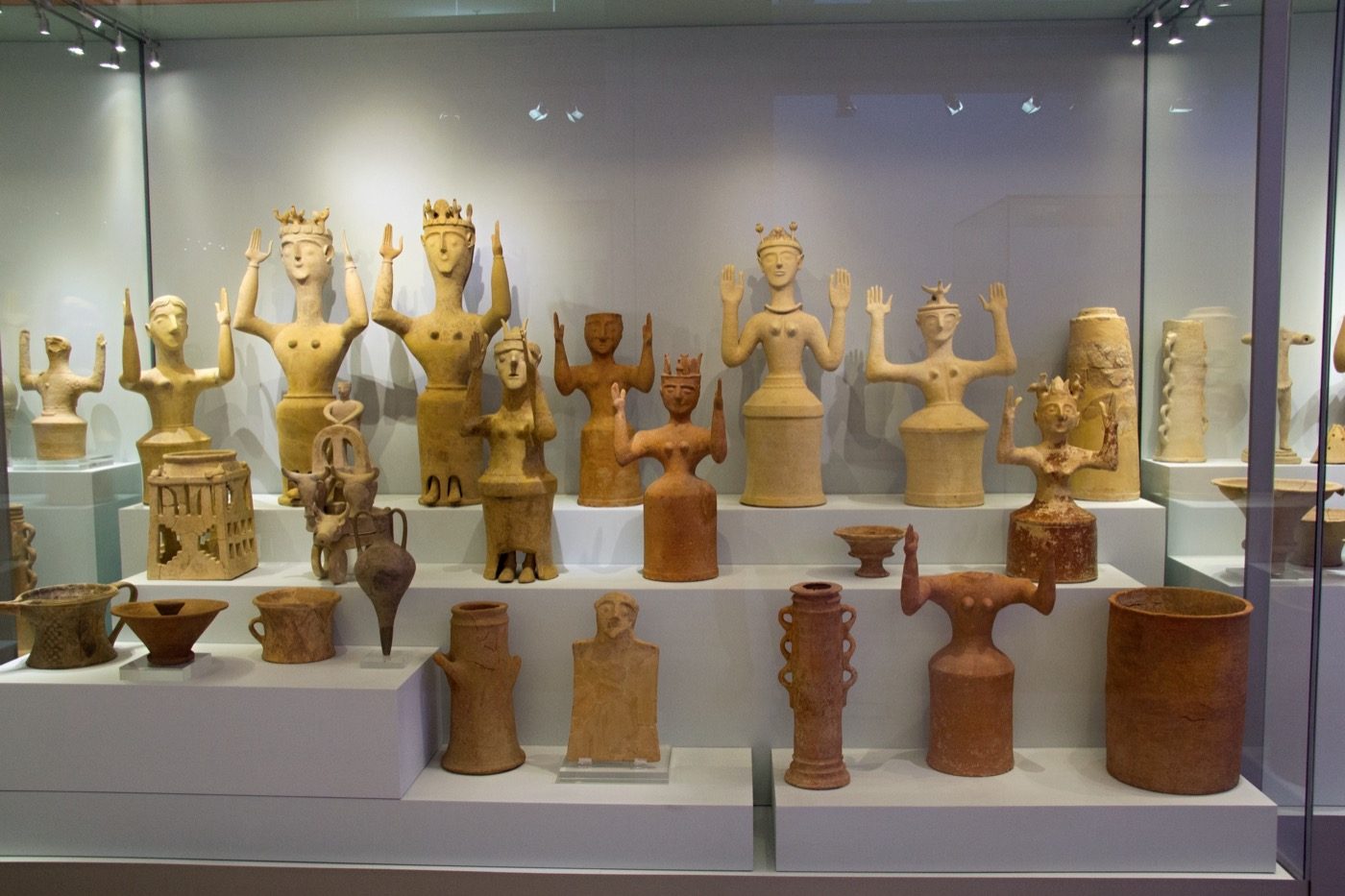
The weakest link in the standard five-item list is the poppy, and the reason is a single famous artifact rather than a body of literature. A terracotta figurine of a goddess with raised arms, roughly 79 centimeters tall and dated to the Late Bronze Age (about 1300-1100 BC), was excavated in 1937 by the Greek archaeologist Spyridon Marinatos at a shrine in Gazi, near Knossos on Crete. Three stylized poppy seed pods rise from the diadem on her head, which is why later scholarship nicknamed her the "Poppy Goddess," a modern label, not an ancient one attached to the object when it was made.
Two problems follow from that origin. First, the figurine is Minoan, from a religious culture that collapsed centuries before the Homeric Hymn to Demeter was composed, so treating her as an early portrait of the Greek Demeter requires bridging a large cultural and chronological gap that the archaeology itself does not confirm. Second, archaeologists disagree on what she represents even on her own terms: some read her as a goddess presiding over sleep and death, others as a figure tied to drug-induced forgetfulness, without settling on a single identification, let alone a link to Demeter specifically. The poppy does appear in the Eleusinian tradition later, paired with grain in some ancient descriptions of the goddess, so the association is not invented. But its most-cited piece of physical evidence, the Gazi figurine, is safer read as an open question than as an underappreciated fact. Mistaken-identity problems like this one aren't confined to pottery goddesses: the unicorn myth survived for roughly two thousand years for much the same reason, because the rhinos and narwhals behind the unicorn myth kept seeming to confirm a creature that never existed.
What the sorting shows
Ranked by evidence rather than repetition, the five items split unevenly: the grain and the torch rest on named, translatable ancient texts and, in the torch's case, an entire priestly office built around reenacting the scene. The pig rests on excavated archaeology that rarely gets cited in the popular version of the list at all. The cornucopia rests on a myth that was never hers to begin with, the same kind of late attachment that gave Hera her peacock centuries after her oldest cow iconography and decades after the cult statue that had already paired her with a cuckoo. And the poppy rests on a single disputed Bronze Age figurine from a civilization that predates the Greek goddess by hundreds of years. For a goddess whose symbol was the thing itself, see Hestia's symbol: the fire was real, and the statues rarely were.
The uneven mix is not unique to Demeter. The same nine-day search that put the torch in her hand also produced one of Greek myth's odder detours: while wandering for Persephone, she was pursued by Poseidon; she transformed into a mare to hide among a herd near Thelpousa, and he caught up to her by transforming into a stallion himself. Sorting a god's attributes by what the evidence supports, rather than by which version keeps getting recopied onto listicle pages, tends to surface this kind of unevenness across Greek religion generally, not only in Demeter's case.