.jpg)
A goddess Ephesus already had before the Greeks showed up
Long before Ionian Greek settlers arrived at Ephesus on the coast of what is now Turkey, the site already held a cult devoted to an Anatolian mother goddess, one of several fertility deities worshipped across the region alongside figures like Cybele. Ancient sources record her original name as Artimus, and when Greek colonists took over the sanctuary they did not replace her, they folded her into their own pantheon under the name Artemis instead. The result was a hybrid figure quite unlike the virgin huntress described in the Homeric Hymns: an all-encompassing fertility and mother goddess wrapped in the trappings of an older Anatolian cult, worshipped at the site for centuries before anyone called her Artemis at all.
By the time the Lydian king Croesus funded a rebuilding of her temple around 560 to 550 BCE, the sanctuary was already old. The historian Herodotus recorded that at Ephesus there were "the oxen of gold and the greater part of the pillars" that Croesus dedicated, and one of those pillars survives today: a marble column drum, now in the British Museum, inscribed in archaic Greek with the words "I belong to Croesus." The temple he helped fund eventually earned a spot among the Seven Wonders of the Ancient World, the same list that includes the Statue of Zeus at Olympia and the Hanging Gardens of Babylon, but almost nothing about the goddess worshipped inside it matched the Artemis described in Greek poetry.
Bull parts, bee eggs, or breasts, and no agreement in 47 years
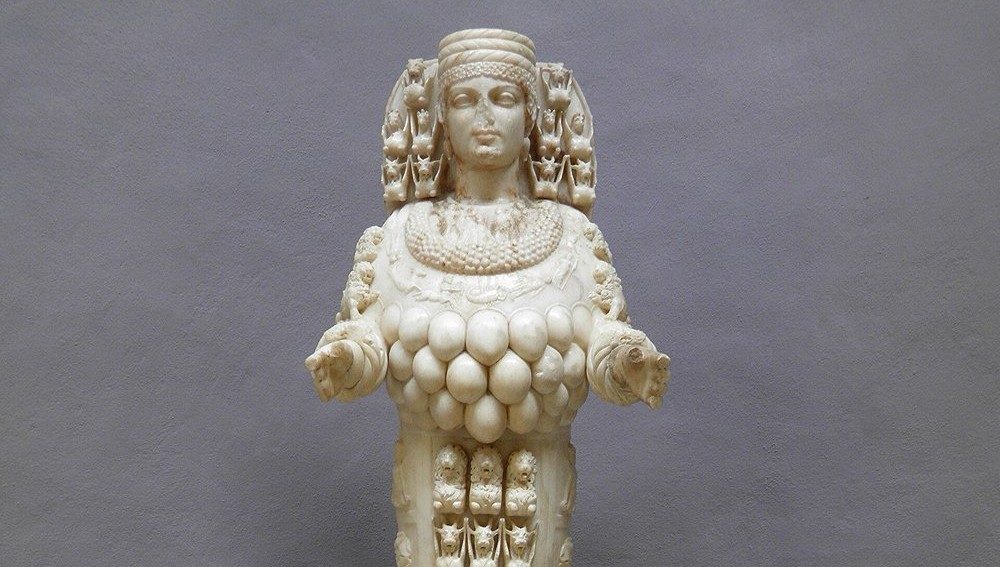
The most distinctive feature of the Ephesian cult statue is a row of smooth, egg-shaped protrusions covering the lower half of her chest, arranged in tight horizontal bands. For a long time the popular assumption was that these were breasts, a literal image of a many-breasted mother goddess. Scholars studying the surviving copies point to a problem with that reading: the shapes carry no anatomical detail at all, no nipples, no separation into individual forms consistent with breast anatomy, just uniform smooth ovals stacked in rows.
In 1979, the archaeologist Gerhard Seiterle proposed a different answer in the journal Antike Welt, after presenting the idea a year earlier at the International Congress for Classical Archaeology in London. He argued the ornaments were bull testicles, hung on the statue as fertility offerings, and built a physical model of the statue with real bull scrota attached to make his case. The theory caught on. Classicist Walter Burkert and archaeologist Brita Alroth both accepted it during the 1980s, and it has been repeated in popular accounts of the goddess ever since. Not every specialist agreed: archaeologist Robert Fleischer rejected Seiterle's reconstruction, and other scholars have proposed the objects were gourds or dates instead, plant-based fertility symbols known elsewhere in the ancient Mediterranean.
The most thorough academic pushback came in 1992, when Lynn LiDonnici published "The Images of Artemis Ephesia and Greco-Roman Worship: A Reconsideration" in the Harvard Theological Review. LiDonnici argued that Seiterle's bull-testicle theory rested on thinner evidence than its popularity suggested, and that the objects were likely not originally intended to represent any single, literal thing. Her research turned up a separate wrinkle: by the Roman period, Ephesians themselves appear to have started describing the ornaments as breasts, whatever the original sculptors intended centuries earlier. Even the people who lived alongside the statue for generations were not reading it the same way over time, and the scholarly debate over what she is wearing has not settled more than three decades after LiDonnici's paper.
Ephesus told Rome she wasn't even born on Delos
The Greek literary tradition is unanimous that Artemis and her twin brother Apollo were born on the island of Delos, delivered by their mother Leto beneath a palm tree. Ephesus disagreed, and made its case in the most consequential venue available: the Roman Senate. In 22 CE, the emperor Tiberius ordered cities across the Greek world that claimed asylum rights for their temples, meaning fugitives and debtors who reached the sanctuary could not be touched, to send envoys to Rome and justify those privileges before the Senate. The historian Tacitus recorded the proceedings in his Annals, and Ephesus went first.
According to Tacitus, the Ephesian envoys "declared that Diana and Apollo were not born at Delos, as was the vulgar belief. They had in their own country a river Cenchrius, a grove Ortygia, where Latona, as she leaned in the pangs of labour on an olive still standing, gave birth to those two deities." It was not an idle claim. Asylum rights were valuable and contested, and Ephesus was rewriting one of the best-known birth stories in Greek mythology, directly contradicting Delos's own version, in order to win a legal argument in front of Roman senators nearly eight centuries after Homer.
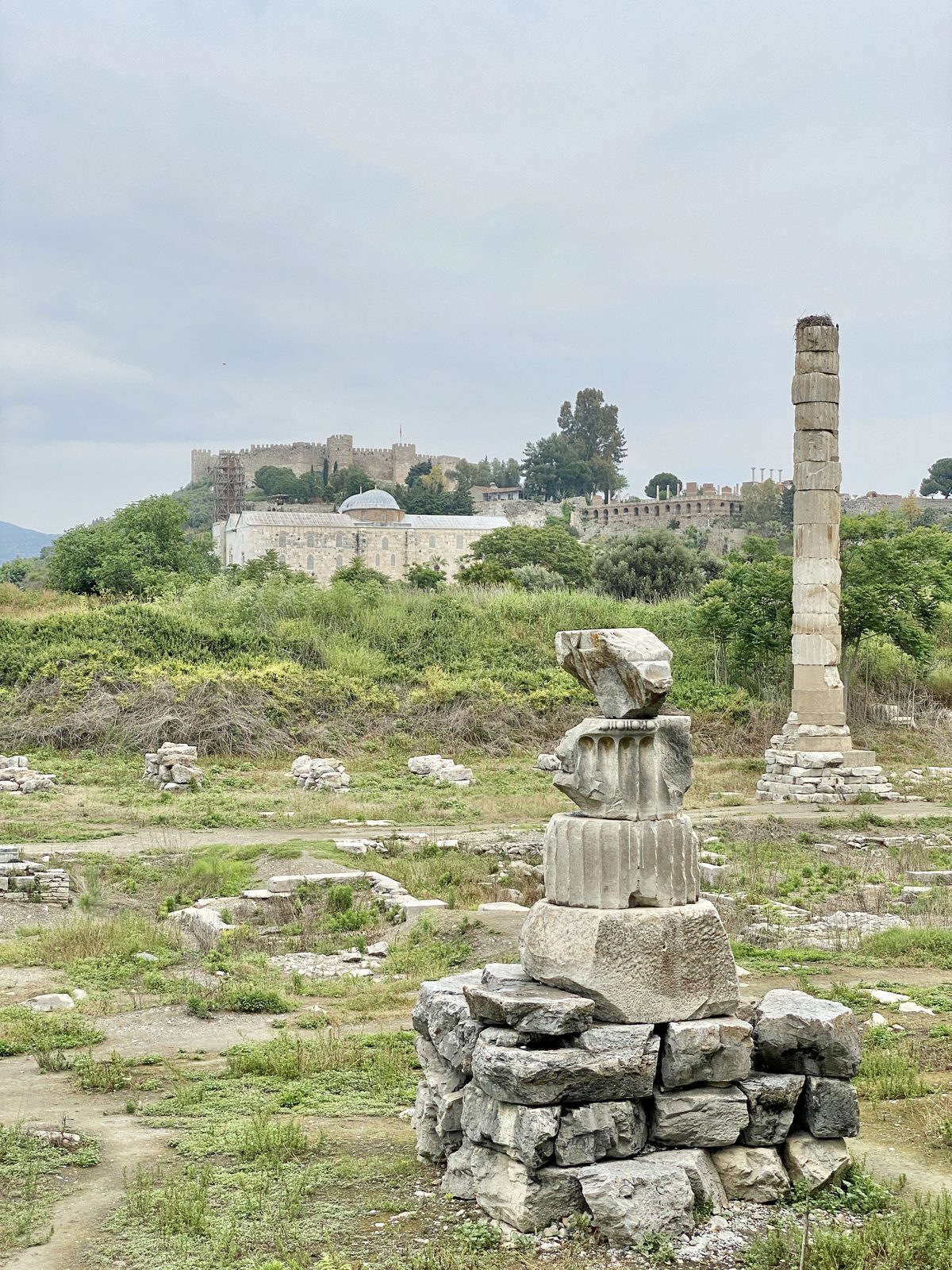
The temple whose sanctity Ephesus was defending that day did not survive antiquity. An earlier version burned down in 356 BCE, its rebuilt successor was sacked in a Gothic raid in 262 CE, and today the site holds a single reconstructed column standing over a marshy field of scattered stone, a startling comedown for a Wonder of the Ancient World whose birthplace claim Roman senators had once taken seriously enough to hear formally argued.
.jpg)
The huntress underneath the layers
Set the Ephesian cult aside and the Artemis of mainstream Greek myth is a more familiar figure: daughter of Zeus and the Titaness Leto, twin sister of Apollo, and goddess of the hunt, the wilderness, and wild animals. Ancient sources describe her as one of the virgin goddesses of Olympus, sworn never to marry, and closely tied to childbirth and the protection of young girls even while remaining unmarried herself. She appears consistently as one of the Twelve Olympians in a way some other seats on that roster did not, a rare point of ancient agreement about a goddess whose regional cults otherwise diverged as sharply as the one at Ephesus.
To the Romans she was Diana, a name that carried the same core attributes across the empire: hunting, the moon, and the protection of wild places. It is Diana, not Artemis, who appears in Tacitus's account of the Ephesian Senate hearing. The goddess Rome heard argued over in 22 CE and the goddess whose statue still puzzles archaeologists at Ephesus were, by that point, treated as the same figure by everyone involved, even though her Anatolian origins and her Olympian mythology never fully merged into one consistent story.