
Six endings, and nobody left to arbitrate
Search for what happened to Helen of Troy after the Trojan War and the summaries tend to converge on one tidy answer. She goes home to Sparta, Menelaus takes her back, and the war recedes into a story people tell at dinner. That answer is real. It is also one of six, and the other five are not fringe readings. They were written down across roughly nine centuries and they run from a quiet retirement to a hanging.
None of the six is a medieval invention or a novelist's flourish. Each is the recorded account of a named work, which is what makes the disagreement worth reading. Greek myth had no single scripture able to overrule a local version, and Helen, who was worshipped in more than one place, collected more than one ending.
| Ending | Source | Date | The decisive line |
|---|---|---|---|
| Home in Sparta as Menelaus's wife | Homer, Odyssey 4 | c. 750-700 BC | "for thou hast Helen to wife, and art in their eyes the husband of the daughter of Zeus" |
| Never sailed to Troy at all | Stesichorus' Palinode, quoted by Plato | 6th century BC | "That saying is not true; thou didst not go within the well-oared ships, nor didst thou come to the walls of Troy" |
| Spent the war in Egypt | Herodotus, Histories 2 | c. 430s BC | "I myself believe their story about Helen" |
| Made immortal, a goddess for sailors | Euripides, Orestes | 408 BC | "she, his child, must be immortal... a savior to mariners" |
| Hanged from a tree on Rhodes | Pausanias, Description of Greece 3.19 | 2nd century AD | "the Rhodians have a sanctuary of Helen of the Tree" |
| Alive on the White Isle, married to Achilles | Pausanias, Description of Greece 3.19 | 2nd century AD | "Helen was wedded to Achilles" |
The six are not unrelated guesses. Some descend from earlier ones and at least two are openly arguing with a predecessor. Taking them in the order they were written shows how the argument developed, and the physical evidence left behind in Sparta and Rhodes makes the split harder to explain away than a difference of literary taste.
The earliest surviving ending is the quietest
In the Odyssey, ten years after Troy fell, Telemachus arrives at Sparta hoping for news of his father. Helen walks out of her chamber "like Artemis of the golden arrows," her chair and rug and silver work-basket are brought out for her, and she sits down and "at once she questioned her husband on each matter" (Odyssey 4.120-145). The marriage has resumed. There is no scandal in the scene, no punishment and no trial, only a middle-aged couple hosting a guest.
The poem does more than restore the marriage. It grants the pair an unusually good afterlife. Menelaus, stranded in Egypt, extracts a prophecy from Proteus, who tells him he will not die in Argos but be carried to the Elysian plain, "for thou hast Helen to wife, and art in their eyes the husband of the daughter of Zeus" (Odyssey 4.561-569). In that line, being married to Helen is the reason for the reward.
This is the ending the search results summarize, and it has the best claim to being the earliest written down. It is also the least dramatic of the six, which may be exactly why later writers went looking for a better one. For a poem built on delayed homecomings, hers is already over by the time the narrative reaches Sparta: Odysseus himself is still missing and will spend a year with Circe before he gets home.
Stesichorus retracted the war itself
The first surviving writer to put Helen somewhere other than Troy was a sixth-century BC poet, and he did it as a correction. Plato, in the Phaedrus, has Socrates say he needs to purify himself, then explains: "for those who have sinned in matters of mythology there is an ancient purification, unknown to Homer, but known to Stesichorus. For when he was stricken with blindness for speaking ill of Helen, he was not, like Homer, ignorant of the reason, but since he was educated, he knew it and straightway he writes the poem." What follows is the retraction itself: "That saying is not true; thou didst not go within the well-oared ships, nor didst thou come to the walls of Troy" (Phaedrus 243a).
What survives of the retraction is brief, and the rest of the poem is lost. What it establishes is that by the sixth century BC a Greek poet could abandon the Iliad's premise and present the change of mind as a cure for blindness. Blaming Helen had cost him his sight; giving her an alibi restored it. From that point on, a version of the story in which she never reached Troy was available to anyone who wanted it.
Herodotus believed the Egyptian version
The Greek word for the story Herodotus reports is logos, and he is explicit that he got it from Egyptian priests rather than from a poet. In the second book of the Histories he sets out the version they gave him: Paris is driven off course to the Egyptian coast, his servants take refuge in a temple of Heracles and denounce him there, and the matter comes before the warden of the Nile mouth. "When I inquired of the priests, they told me that this was the story of Helen" (Histories 2.113).
What makes Herodotus unusual is that he does not merely record it. He endorses it, and his reasoning has nothing to do with divine intervention or a phantom. It is an argument from ordinary self-interest: had Helen really been inside the walls, the Trojans would have handed her over, because no king risks a city for one man's marriage. "I myself believe their story about Helen," he writes, "for I reason thus: had Helen been in Ilion, then with or without the will of Alexandrus she would have been given back to the Greeks" (Histories 2.120).
This is a different claim from the poet's retraction. Plato, in the Republic, refers to "the wraith of Helen" that Stesichorus said was fought over at Troy, which leaves the real Helen somewhere else while a substitute absorbs the war (Republic 586c). Herodotus has no wraith at all; he simply concludes that she was never there, and that the Iliad's plot is a mistake.
Euripides has her carried off, alive
In Euripides' Orestes, produced in 408 BC, Helen is not dead and not in Egypt. She is about to be murdered at Argos when Apollo arrives above the stage and stops it: "Helen, whom all your eagerness failed to destroy... is here as you see in the enfolding air, rescued from death and not slain by you. I saved her and snatched her from beneath your sword at the bidding of father Zeus, for she, his child, must be immortal, and take her seat with Castor and Polydeuces in the enfolding air, a savior to mariners" (Orestes 1625-1640).
Apollo calls her "his child" because Helen is a daughter of Zeus, a parentage the Odyssey had already leaned on when Proteus calls Menelaus the husband of the daughter of Zeus. Here it does new work, converting her into a constellation-adjacent figure installed beside her twin brothers, the Dioscuri, who were themselves patrons of sailors. She does not die, and she does not stay human.
The same playwright had staged the opposite alternative a few years earlier. His Helen, produced around 412 BC, dramatises the Egyptian version at length, with a phantom carrying the war for a decade while the real Helen waits in Egypt. Within a single career, Euripides tried both the escape and the disappearance.
At Rhodes she was hanged from a tree
Pausanias, traveling in the second century AD, reached Sparta and found the local story agreed with the Odyssey, at least about the burial. On the ridge at Therapne he records a temple of Menelaus and adds that the people there said the pair lay buried on the spot (3.19.9). Then he gives the other side, introduced simply as the account of the Rhodians.
In that version Menelaus is dead and Orestes is still wandering, which leaves Helen without protection. She is driven out by her stepsons Nicostratus and Megapenthes and sails to Rhodes, where she has an old friend, Polyxo, the widow of Tlepolemus and by then queen of the island. Polyxo blames Helen for her husband's death in the war, and she waits. Pausanias writes that she "sent against her when she was bathing handmaidens dressed up as Furies, who seized Helen and hanged her on a tree, and for this reason the Rhodians have a sanctuary of Helen of the Tree" (3.19.10).
The detail is oddly specific for a legend. Nicostratus and Megapenthes are named, Polyxo's motive is given, the setting is a bath, and the killing produces a named cult. A story shaped that precisely has the look of an aetiological tale, the kind a cult tells to explain a rite it already performs, which may mean the sanctuary came first and the hanging was invented to account for it.
On the White Isle she never died at all
A few lines later Pausanias reports a second Rhodians-adjacent tradition, this one centred not on her death but on her continued life. At the mouths of the Danube there was said to be an island sacred to Achilles, called White Island, twenty stades around, wooded and full of animals, with a temple and an image of Achilles on it. How that hero died is a further case of the record refusing to line up, as the competing accounts of Achilles' death set out. A general from Crotona named Leonymus, wounded in the breast in battle, was sent there by the Pythian priestess with the promise that Ajax would heal him.
He came back cured and reported what he had seen: Achilles, both Ajaxes, Patroclus and Antilochus, and Helen. "Helen was wedded to Achilles," Pausanias writes, "and had bidden him sail to Stesichorus at Himera, and announce that the loss of his sight was caused by her wrath" (3.19.13).
That last clause is the strange part. The White Isle account depends on the same story Plato tells, that a poet was blinded for how he wrote about Helen, and it supplies a different explanation for who lifted the punishment. Two traditions that look independent, one a poet's retraction in the sixth century BC and the other a healing miracle reported centuries later to a travel writer, are in fact talking about the same event. The variants are not all separate answers. Some of them are one answer wearing different clothes.
The two cults disagree as much as the poems
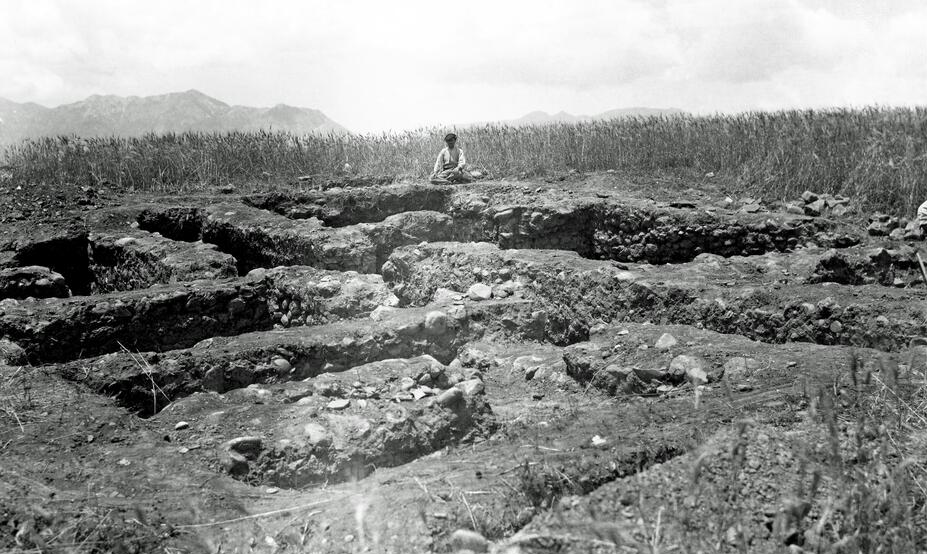
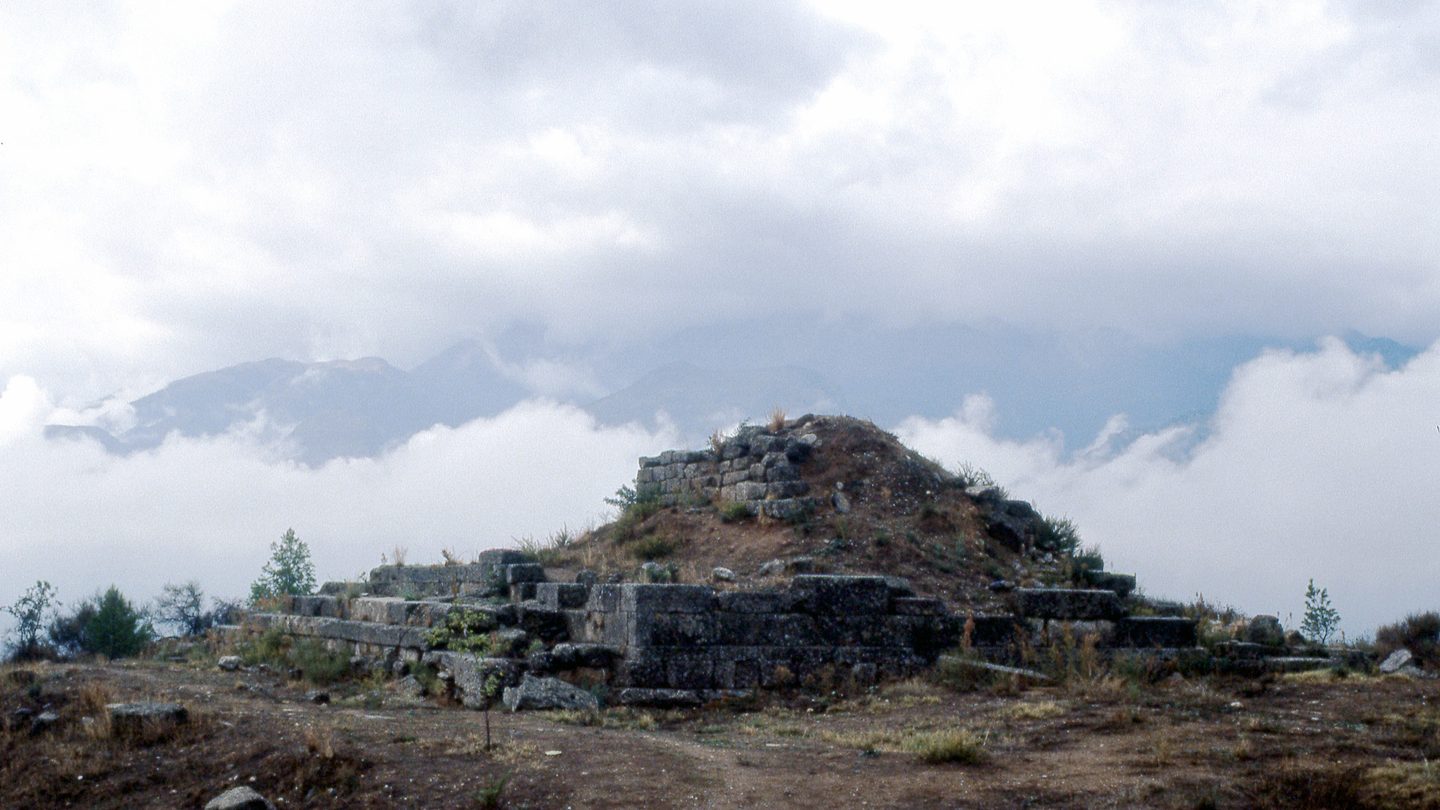
The strongest evidence for Helen's fate is not literary. It is what people actually built. About the eighth century BC, on the ridge at Therapne roughly five kilometres from Sparta, someone raised a monumental hero-shrine directly over the ruins of a Mycenaean settlement and dedicated it to Menelaus and Helen, honouring them as divine ancestors whose connection the Spartans could use to legitimise their hold on the region. Excavators have been digging there since Ludwig Ross opened the site in 1834; the British School at Athens followed in 1909 and 1910, with Hector Catling returning from 1973. Pausanias 3.19.9 is the ancient source for the cult itself, and the excavation reports are listed in the sources below.
At the other end of the Greek world, the Rhodians kept the sanctuary Pausanias heard about, the one named for the tree. One community treated Helen as an immortal ancestor with a shrine and a tomb. The other remembered her as a woman who was hanged.
That is the real shape of the question. It is not that the ancients had a version and the internet lost it. They had at least six, and two of them had buildings.