
Homer calls her a dread goddess, not a witch
Circe gets introduced only once in the Odyssey, and Homer spends that introduction on her rank, not her reputation. Book 10 places Odysseus's ships at "the isle of Aeaea, where dwelt fair-tressed Circe, a dread goddess of human speech, own sister to Aeetes of baneful mind; and both are sprung from Helius, who gives light to mortals, and from Perse, their mother, whom Oceanus begot" (Odyssey 10.133-139, A.T. Murray's translation). Theos, the Greek word Homer uses, is the same word applied to Zeus or Athena. Hesiod's Theogony backs up the parentage independently: "Perseis, the daughter of Ocean, bare to unwearying Helios Circe and Aeetes the king" (Theogony 956-957, Hugh G. Evelyn-White's translation). Two different poets, working in two different genres, agree on the same divine lineage.
Aeetes, Circe's brother, later fathers Medea, herself a byword for magical vengeance in Greek myth and, per the same Theogony passage, born to Aeetes and the Oceanid Idyia. Apollodorus's Library adds a third sibling on the same branch: Aeetes is described as "son of the Sun and of Perseis, and brother of Circe and Pasiphae, whom Minos married" (Library 1.9.1, J.G. Frazer's translation). Pasiphae is the queen who later gives birth to the Minotaur. Circe, Medea, and the mother of the Minotaur share the same set of grandparents in these two ancient sources: three myths about women who bend the natural order, all drawn from one family.
The men keep their human minds inside a pig's body
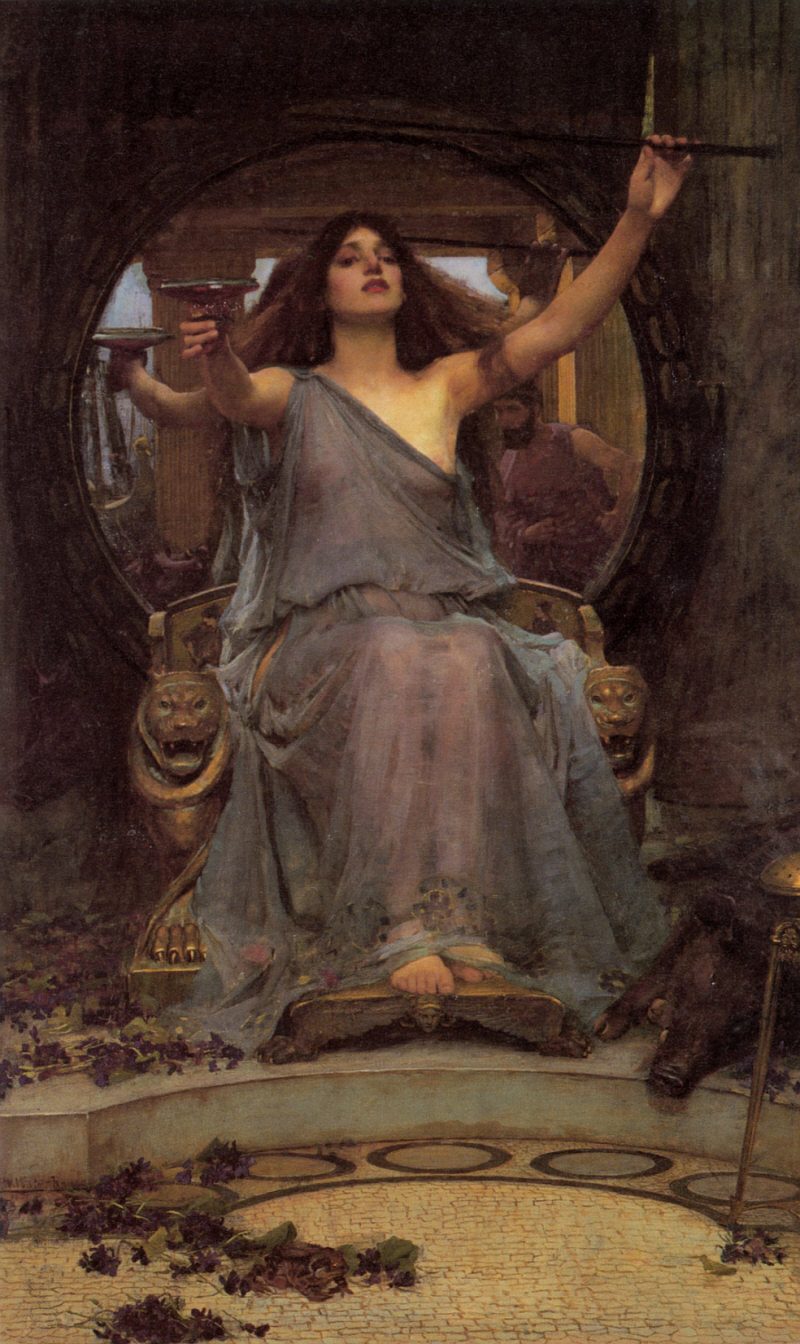
The transformation scene itself is shorter and colder than most retellings suggest. Eurylochus, leading half the crew to Circe's hall, hangs back at the door, "for he suspected that there was a snare." The rest go in, and Circe seats them, mixes a potion of cheese, barley meal, honey, and Pramnian wine laced with "baneful drugs, that they might utterly forget their native land," and once they drink it, "she presently smote them with her wand, and penned them in the sties." What Homer specifies next is the detail most summaries drop: "they had the heads, and voice, and bristles, and shape of swine, but their minds remained unchanged even as before" (Odyssey 10.230-240, A.T. Murray's translation). The men are not mindless animals. They are human minds locked inside pig bodies, aware enough to be described a few lines later as "penned there weeping."
Eurylochus survives only because he stayed outside, and his report back to the ship is nearly wordless: "Not a word could he utter, for all his desire, so stricken was his heart with great grief." Odysseus's response is to go alone, against his own crew's advice, armed with nothing yet but a sword and no plan for how a sword is supposed to help against a goddess.
Hermes' plant, and the oath that follows
The sword never gets the chance to matter, because Hermes intercepts Odysseus on the path and hands him the solution instead. He describes and produces a plant on the spot: "At the root it was black, but its flower was like milk. Moly the gods call it, and it is hard for mortal men to dig; but with the gods all things are possible" (Odyssey 10.302-306, A.T. Murray's translation). It comes with a script, not just a defense. Hermes tells Odysseus that when Circe strikes him with her wand as she struck the others, he should draw his sword and rush at her as though he means to kill her. She will lose her nerve and invite him to her bed. Only then, Hermes says, should he agree, and only after making her swear a binding oath first.
Odysseus follows the script almost line for line, and the text renders the negotiation as dialogue: demand, refusal, and a sworn condition. Circe, disarmed, asks him to sheathe his sword and come to bed. Odysseus refuses first: "how canst thou bid me be gentle to thee, who hast turned my comrades into swine in thy halls... Nay, verily, it is not I that shall be fain to go up into thy bed, unless thou, goddess, wilt consent to swear a mighty oath that thou wilt not plot against me any fresh mischief to my hurt" (Odyssey 10.337-345, A.T. Murray's translation). Circe swears it. Homer records the outcome in one clean line: "she straightway swore the oath to do me no harm, as I bade her." The sword gets drawn once and never swung; Circe's spoken oath is what actually ends the standoff.
What moly actually was is still an open pharmacology question in 2024
Homer's description of moly, a black root with a milk-white flower that only a god could dig up, has read like a riddle for centuries. One attempt to solve it, in 1983, used actual pharmacology to test the description against real toxicology. The neurologists Andrew Plaitakis and Roger Duvoisin published "Homer's Moly Identified as Galanthus nivalis L.: Physiologic Antidote to Stramonium Poisoning" in Clinical Neuropharmacology, proposing that moly was the common snowdrop. Snowdrop bulbs contain galantamine, a compound that blocks the enzyme acetylcholinesterase, and the authors argued this mechanism could counter poisoning by anticholinergic plants, which would make Homer's scene the oldest surviving record of that kind of antidote in use.
That identification has not held up unchallenged. A 2024 paper by Rafael Molina-Venegas and Rodrigo Verano, "The quest for Homer's moly: exploring the potential of an early ethnobotanical complex," published in the Journal of Ethnobiology and Ethnomedicine, revisits the snowdrop hypothesis directly and calls it, in the authors' own framing, questionable. Their alternative names a group of similar-looking Mediterranean species, including sea daffodils of the genus Pancratium, that ancient herbalists may have lumped together under one name because of their shared appearance and shared acetylcholinesterase-inhibiting properties. More than four decades after the first pharmacological hypothesis, researchers are still arguing over what moly actually was.
A year on Aeaea, then Circe sends him toward the underworld
Once the oath is sworn, the story stops being an escape narrative. Circe's handmaids bathe Odysseus, dress him, and set a feast, and he and his crew end up staying on Aeaea for a full year before the men, not Odysseus, are the ones who eventually press to leave. Homer has Odysseus recall it directly: "day after day for a full year we abode, feasting on abundant flesh and sweet wine. But when a year was gone and the seasons turned... my trusty comrades called me forth" and urged him to think of home (Odyssey 10.467-475, A.T. Murray's translation). When they do, Circe does not resist it or try to hold them. Instead she tells Odysseus that the route home runs somewhere no living sailor wants to go first: the house of Hades. She gives him the ritual he needs to summon the dead and question the blind prophet Tiresias about the rest of the voyage, including how to survive the wrath Poseidon has been carrying since the Cyclops Polyphemus was blinded.
The plant Hermes hands Odysseus early in Book 10 sets up everything that follows in the back half of the poem: without moly there is no oath, without the oath there is no year on Aeaea, and without that year there is no goddess willing to send Odysseus toward the underworld with real instructions instead of a warning to stay away. Circe reappears once more, in Book 12, with warnings specific enough to double as a survival manual.
She tells Odysseus the Sirens sit in a meadow ringed by "a great heap of bones of mouldering men," and instructs him to plug his crew's ears with wax and have himself bound to the mast if he wants to hear their song and live. She describes Scylla in the same breath: six necks, six heads, three rows of teeth apiece, and the warning that "with each head she carries off a man," one sailor per head, whichever way the ship is steered (Odyssey 12.85-100, A.T. Murray's translation). The crossing plays out exactly as she described it. Scylla seizes six of Odysseus's men, "the best in strength and in might," the same number Circe had already told him to expect.