
The Iliad never shows the death. It only warns about it, twice
Homer's Iliad ends with Hector's funeral. Achilles is still alive on the poem's last page, which means the most famous death in Greek myth happens entirely offstage, in a poem that never gets there. What the Iliad does instead is warn about it, twice, well before the end.
The first warning comes from Achilles himself, mid-battle, nearly drowned by the river god Scamander and furious that he might die a meaningless death by water rather than in glory. He cries out to Zeus, blaming his mother Thetis for a promise she made him: "None other of the heavenly gods do I blame so much, but only my dear mother, that beguiled me with false words, saying that beneath the wall of the mail-clad Trojans I should perish by the swift missiles of Apollo" (Iliad 21.275-278, A.T. Murray's translation). No mention of an arrow's landing spot. Just Apollo, and missiles, and the wall of Troy.
The second warning is more specific, and it comes from Hector, dying at Achilles's hands in Book 22 after Patroclus's death drove Achilles back into the fighting. With his last breath, Hector tells his killer what's coming: "Bethink thee now lest haply I bring the wrath of the gods upon thee on the day when Paris and Phoebus Apollo shall slay thee, valorous though thou art, at the Scaean gate" (Iliad 22.358-360, A.T. Murray's translation). This is the closest Homer gets to naming the manner of Achilles's death: two agents, Paris and Apollo together, and a location, the Scaean gate. Not a heel. Not even a wound. Just a prophecy the poem never lives to fulfill.
The oldest full account survives only because someone else summarized it
The scene Homer skipped was written down eventually, just not by Homer. It appeared in the Aethiopis, an epic attributed to Arctinus of Miletus and composed as part of the Epic Cycle, a set of poems that filled in the story of the Trojan War before and after the events of the Iliad. Scholars generally place its composition in the 7th century BC, a few generations after Homer. The poem itself is lost. Not a line of continuous text survives.
What survives instead is a summary, written centuries later by a figure usually identified as the grammarian Proclus, describing the plot poem by poem. According to that summary, after Achilles kills the Ethiopian king Memnon and routs the Trojans back toward their own walls, "Achilles routs the Trojans, and, rushing into the city with them, is killed by Paris and Apollo." That's the entire account of the moment: rushing into the city, and then killed by two named agents. No wound is described. No weapon beyond the implied arrow. The single most-cited early source for the death of Greek myth's greatest warrior is a two-line plot summary of a poem nobody today can read in full.
The most-cited English translation of the death scene says ankle
For an actual description of the wound, the earliest surviving text is Apollodorus's Library, or more precisely its surviving Epitome, a later summary-compilation usually dated to the 1st or 2nd century AD but drawing on much older material. J.G. Frazer's translation, still the standard English edition hosted by the Theoi Classical Texts Library, renders the line this way: "Having chased the Trojans also, Achilles was shot with an arrow in the ankle by Alexander and Apollo at the Scaean gate" (Epitome 5.3). Alexander is Paris's other name in Greek sources. The wound, in Frazer's own English, lands in the ankle.
Then, a few pages later, in his footnote explaining the same passage, Frazer writes that Achilles's mother Thetis made him invulnerable by dipping him in the Styx, all "but his heel, by which she held him." Two sentences, one translator, and the wound has already changed location between the main text and its own footnote. That inconsistency sits inside the single most commonly cited English edition of this story, which suggests the ankle-to-heel drift wasn't something later readers introduced. It was already happening within one scholar's own commentary.
Hyginus's Latin says the same thing, and modern translations still convert it
A second ancient source confirms the pattern. Hyginus's Fabulae, a Latin mythological handbook usually dated to the 1st or 2nd century AD, opens its account of the contest over Achilles's armor with a brief recap of his death: after Hector's burial, while Achilles is boasting around the walls of Troy that he alone conquered it, an angry Apollo disguises himself as Paris and strikes him down. The Latin is specific about where: "Apollo iratus Alexandrum Parin se simulans talum quem mortalem habuisse dicitur sagitta percussit et occidit" (Fabulae 107). Talum is the accusative of talus, the Latin word for the ankle bone, matching the Greek astragalos.
Widely used English translations of this same line, including the one hosted at Topostext, render talum as "heel." That's not a fringe mistake made by one amateur site. It's the standard rendering across most accessible English translations of Hyginus, which means a reader checking the Latin original and the English translation side by side will find the word for ankle quietly turned into a different body part somewhere in the process.
The Styx-dipping story doesn't show up for another seven centuries, and barely then
The detail everyone actually remembers, an infant Achilles dipped whole-body into the River Styx by his mother, invulnerable everywhere the water touched, vulnerable only at the one spot her hand covered, isn't Greek at all in its earliest surviving form. It comes from the Roman poet Statius, writing his unfinished epic the Achilleid around the last decade of the 1st century AD, roughly 750 to 800 years after the Iliad and the Aethiopis.
Even in Statius, the detail is barely there. The Achilleid never narrates the dipping as a scene. It surfaces once, obliquely, when Thetis is trying to talk her son into hiding from the coming war disguised as a girl on Scyros. Pleading with him, she says: "if at thy birth I fortified thee with the stern waters of Styx, ay, would I had wholly!" (Achilleid 1.242-273, H.R. Mozley's translation). That's the entire textual basis in Statius's own verse: a mother's regret that she hadn't dipped him completely. The poem doesn't say which body part stayed dry. The specific detail that it was the left heel, and that her grip on it was the reason, comes from ancient commentary written to explain that line, not from Statius's poem itself.
A 2026 classics paper argues even 'heel' is a mistranslation
A study published in June 2026 pushes the ankle argument one step further, into Statius himself. Barbara Carè, writing in the Bulletin of the Institute of Classical Studies, argues that the anatomical language of the Achilleid tradition points to the ankle, using the Latin talus, or the Greek astragalos, rather than the heel. Her case rests partly on how that Latin word changed over time. Talus meant ankle bone specifically, distinct from the heel bone, or calcaneus, in classical anatomical usage. But as Latin evolved into the Romance languages, talus's descendants drifted toward a different meaning: Italian tallone and French talon both now mean heel, not ankle. Carè's argument is that medieval and Renaissance readers and translators, working with a word whose meaning had already shifted under them, retrofitted "heel" onto ancient stories that had specified something else.
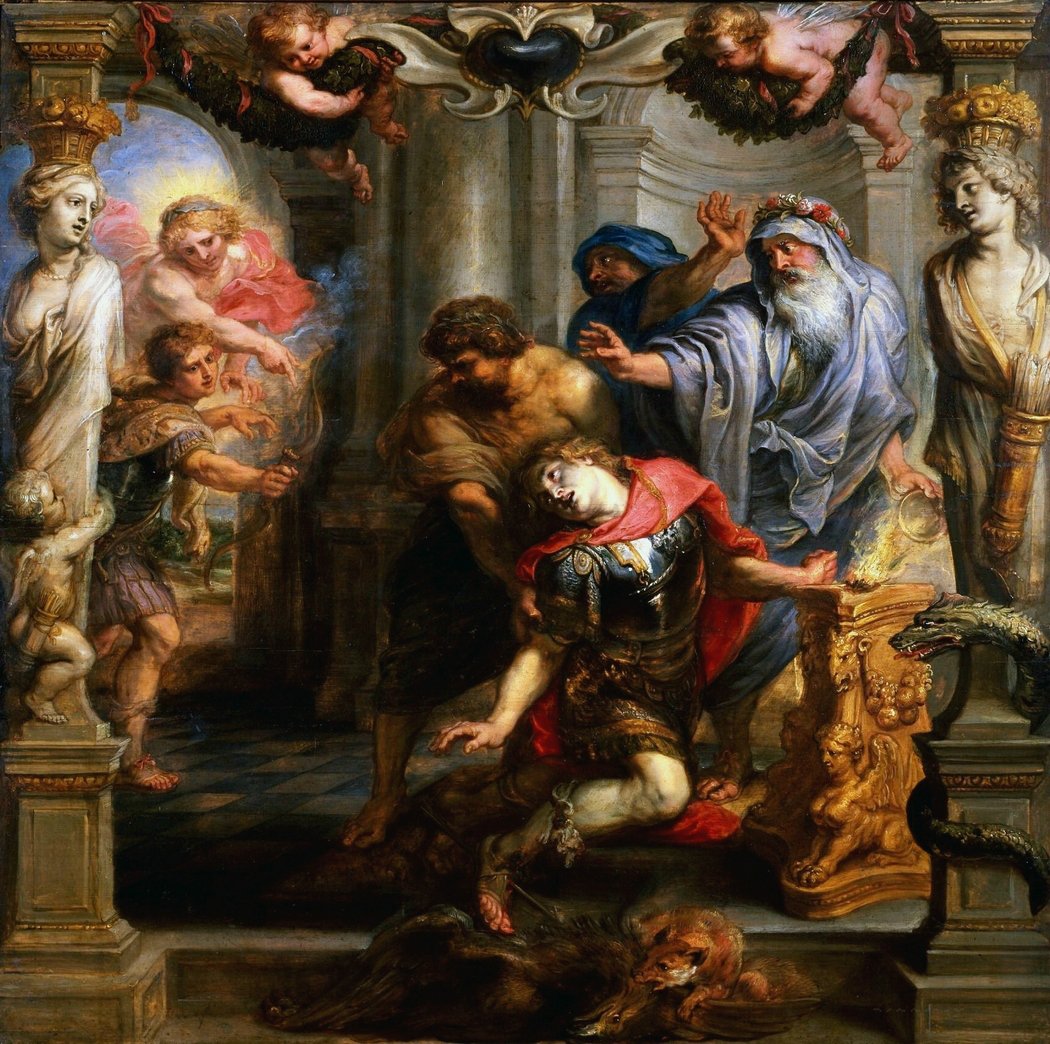
None of this makes the heel version fake, exactly. It has fifteen centuries of its own tradition behind it by now, plenty of ancient support once later Latin commentators started specifying it, and it's the version nearly every modern retelling, including Rubens's own 17th-century paintings of the scene, actually shows. What it does mean is that the popular image of Achilles's one weak spot rests on a body part that keeps shifting depending on which language, which century, and which translator's footnote you happen to be reading.
Ancient writers can't even agree on who did the killing
Strip away the wound question and a second disagreement is still there: who actually fired the arrow. The Aethiopis summary and Apollodorus both credit Paris and Apollo jointly, a killing with two named agents rather than one. Frazer's footnotes point out that other ancient writers went further and cut Paris out entirely. Reading one line in the Iliad, where Achilles blames only "the swift missiles of Apollo" with no mention of Paris at all, later authors including Aeschylus and Sophocles apparently told the story as Apollo acting alone, no human archer involved.
Still other sources swing the other way and drop Apollo from the kill itself. Euripides, in both Andromache and Hecuba, describes Paris as Achilles's slayer without crediting the god directly. And a separate tradition abandons the arrow altogether. According to the late antique writer Dictys Cretensis, echoed by Hyginus in a different fable and by the Roman-era Dares Phrygius, Achilles wasn't shot at all. In that version, Priam offers his daughter Polyxena's hand in marriage if the Greeks will lift the siege, Achilles goes unarmed to the Temple of Apollo to finalize the deal, and Paris stabs him with a sword while Deiphobus holds him in a fake embrace of welcome. No arrow, no ankle, no heel: a betrayal at an altar instead. Four separate traditions, and none of them fully agree with any of the others about how, exactly, the war's greatest warrior actually died.