
Sold as a charm, born as a weapon
Search for "Eye of Ra" online and most of what comes back is jewelry: pendants, tattoos, rings, described in listing copy as a general-purpose protection symbol, sometimes stretched into vague claims about intuition or a third eye borrowed from an entirely different religious tradition. None of that framing is what an ancient Egyptian scribe would have recognized. The fullest surviving account of what the Eye of Ra actually is and does describes something far more volatile than a passive charm anyone would want dangling from their neck for luck: an independent, furious goddess who once came close to ending the human race, one Ra himself could not simply switch off once he had sent her out.
That myth comes from the Book of the Heavenly Cow, and its premise carries through every later version of the story: the eye has a will of its own, capable of running further than the god who sent it out ever intended.
An eye that became a goddess
According to the Eye of Ra entry on Wikipedia, Egyptian religion personified the eye as a fully separate deity, one who could act, travel, and disobey independently of the god she belonged to, and across different periods and cult centers she was equated with a long list of goddesses: Hathor, Sekhmet, Bastet, Wadjet, Mut, Tefnut, Menhit, Neith, and others. Each name carried a different register of the same underlying power. Sekhmet embodied the eye's rage, Hathor its joy and affection, Bastet its protective side, Wadjet its authority over kingship, Tefnut its control of moisture and rain. That independent streak is not something the Book of the Heavenly Cow invented: Middle Kingdom Coffin Texts, composed centuries earlier, already allude to a myth in which the eye storms off after finding herself replaced and has to be coaxed back, the same basic shape as the Sekhmet story told below. That kind of drift, one symbol absorbing several registers of meaning over time, isn't unique to Egyptian religion either: yaoguai started as a dynastic omen, not a monster, and only picked up its modern "demon" translation much later.
That list only makes sense inside a religion where the same divine force could legitimately wear several names depending on which temple was telling the story, a pattern that recurs across the broader Egyptian pantheon and reaches well beyond this one symbol. What makes the Eye of Ra distinctive even by that standard is that the different names read as different moods of one goddess, not regional dialects for the same being, with the myths built specifically around the question of what happens when the wrong mood gets loose. That same impulse to fold many distinct goddesses into one simplified label shows up again in the modern "fertility goddess" category, a 19th-century invention now applied to goddesses whose own earliest sources describe them running wars and empires more than harvests.
The myth: Ra sends his eye to destroy mankind
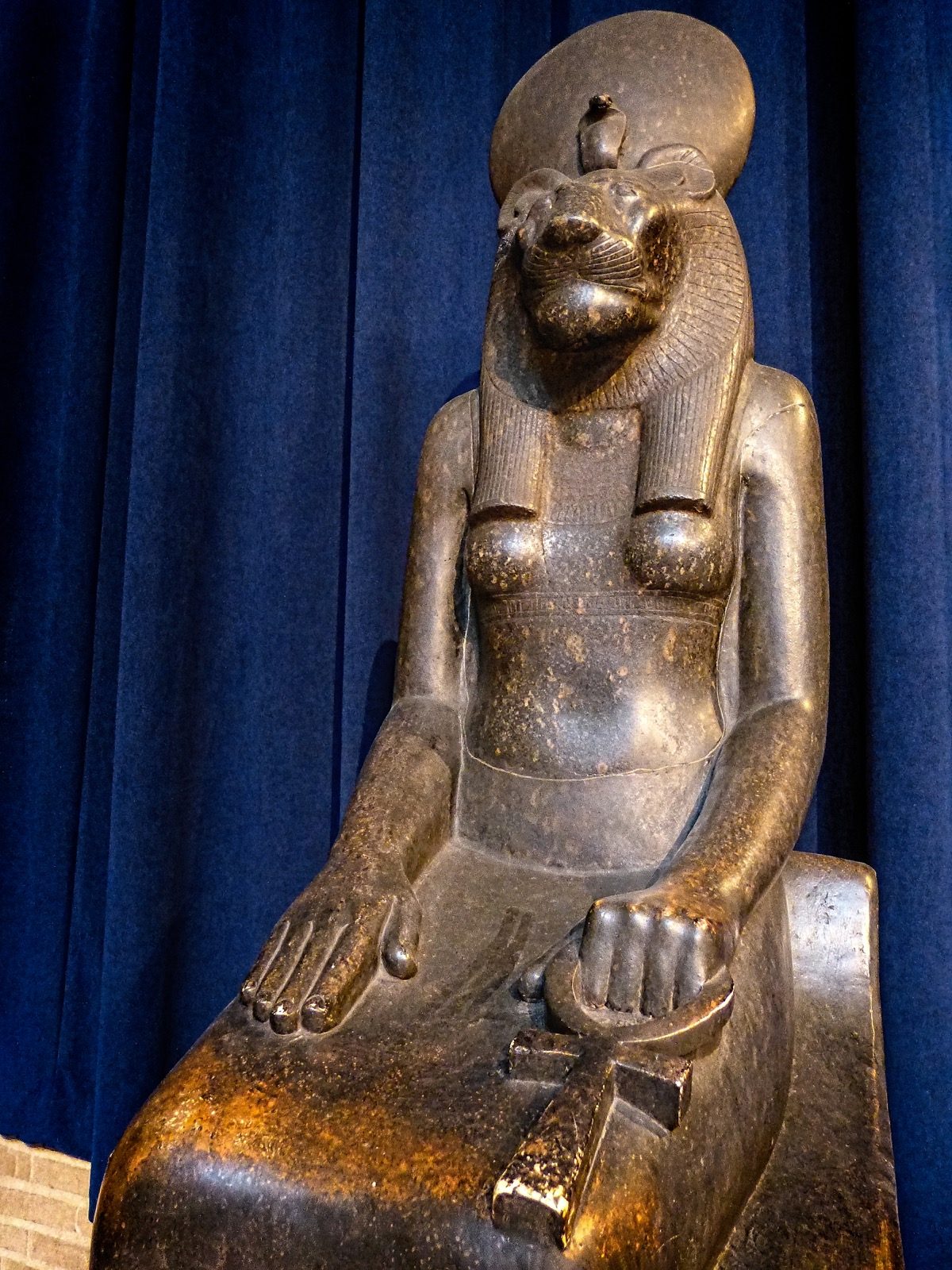
The fullest version of the story is preserved in the Book of the Heavenly Cow, a New Kingdom funerary text. According to the World History Encyclopedia's entry on the text, Ra, grown old, learns that humanity has stopped upholding ma'at, the principle of order and justice, and is plotting against him. He convenes the older gods, including Nun, and settles on punishment. He sends out his Eye, in the form of Hathor, to deal with the rebellion, and Hathor transforms into the lioness Sekhmet to carry it out.
Sekhmet does not hold back. She massacres the rebels in the desert with a thoroughness that alarms even Ra, and by the time he decides mercy is in order, he discovers he cannot simply recall her. Her bloodlust keeps running once it starts, threatening to finish off the entire species rather than the guilty portion of it. Ra's actual solution is a trick, not an order: he has an enormous quantity of beer brewed, dyed red with ochre to resemble blood, and, per the World History Encyclopedia's account, has it carried to Dendera and poured out to flood the plain, 7,000 jars of it. Sekhmet finds it, mistakes it for the blood of the people she has already killed, drinks it, and passes out drunk. She wakes up calm, reverting to the gentler Hathor, and the killing stops because the goddess forgot what she was doing, not because anyone ordered her to stop.
The story is thought to have circulated in some form as early as the First Intermediate Period, roughly 2181 to 2040 BC, and to have been composed in writing during the Middle Kingdom, but no copy from either period survives. Every physical copy that exists comes from the New Kingdom. The earliest known copy is carved into the interior of Tutankhamun's outermost gilded shrine in his tomb, KV62, and complete versions were later cut into subsidiary chambers built specifically to hold the text in the tombs of Seti I, Ramesses II, and Ramesses III. Primary theology like this, copied straight off New Kingdom tomb and shrine walls, is exactly the kind of source material modern Kemetic revivalists work from today, particularly since Kemetism itself covers three separately founded movements rather than one continuous tradition.
_Egypt_Penn_Museum_02.jpg)
The archaeology behind the hangover
Egyptians appear to have reenacted this story's ending once a year, and there is physical, excavated evidence of the ritual, not only a text describing it. Since 2001, the Johns Hopkins Egyptologist Betsy Bryan has led excavations at the Precinct of Mut, part of the Karnak temple complex at Thebes, and uncovered what her team identified as a "Porch of Drunkenness," a structure built under Hatshepsut and dated to around 1470 BC, later dismantled with its columns reused as foundation material for a larger temple.
Reporting on Bryan's work, NBC News described inscriptions at the site linking the structure to a Festival of Drunkenness, during which Egyptians drank deliberately to the point of intoxication, framed as a ritual reenactment of Sekhmet's beer-induced collapse and the moment humanity was spared. The same coverage notes graffito at the site interpreted as referring to sex, tied to a phrase translated as "traveling through the marshes." Bryan's excavation gives the Sekhmet myth something most Egyptian religious stories do not have: a dated, physical structure built under Hatshepsut specifically to reenact it, not only a text copied onto tomb walls generations later.
The eye that ran away: Tefnut and the origin of the crown cobra
A second, separate myth involving the Eye of Ra explains a different piece of Egyptian iconography: the cobra worn on the front of nearly every pharaoh's crown. In this version, the Eye, often identified with the goddess Tefnut, grows angry at Ra and leaves Egypt entirely, retreating into the deserts of Nubia in the form of a fierce lioness. Her absence carries a practical cost beyond the emotional rupture: Tefnut governed moisture, and with her gone, the myth holds that Egypt loses its rain and dew along with her.
To bring her back, Ra sends either her twin brother Shu or the god Thoth, who tracks her into Nubia and talks her down rather than forcing her, using flattery, music, and, in the version preserved on a Demotic papyrus known as the Myth of the Sun's Eye, a string of animal fables told specifically to win her over. When she finally returns to Ra, she finds he has grown a replacement eye in her absence, and her fury flares up again on the spot. Ra's fix mirrors his earlier trick with Sekhmet in spirit, not in mechanism: he does not trick her into calming down; he gives her status instead. He mounts her on his own forehead as the uraeus, the rearing cobra, making her the most visible feature on the head of the king of the gods rather than a subordinate he happened to grow a spare of.
That single placement is why every surviving pharaoh's crown carries a cobra at the front. The uraeus was understood as the pacified, still-dangerous Eye, believed capable of spitting fire and venom at any enemy who threatened the king wearing it, functioning simultaneously as royal regalia and as a live weapon left over from a goddess who had to be talked out of destroying the world twice.
Eye of Ra vs. Eye of Horus: the tidy rule, and the messier reality
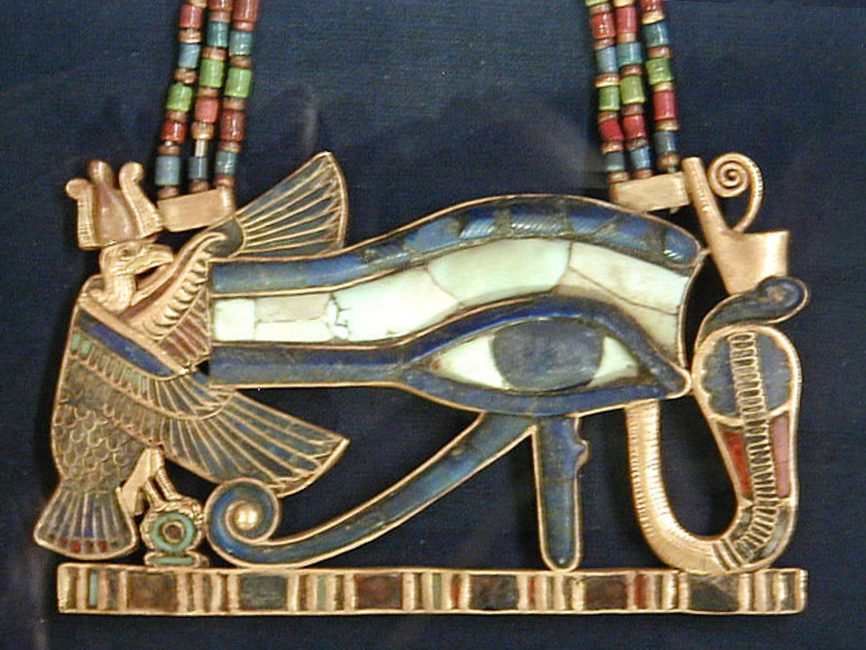
Modern explainers usually flatten Egyptian eye symbolism into a clean pair: the Eye of Ra is the right eye, solar, associated with power and wrath, while the Eye of Horus is the left eye, lunar, associated with healing. The Horus half of that story has its own myth attached, in which Horus's eye is torn out or damaged by Set during their conflict over the throne of Egypt and later restored, usually credited to Thoth. That restoration is where the word wedjat comes from, meaning roughly "whole" or "sound," describing a wound made complete again rather than the eye that started it.
The split is real, but ancient sources apply it far less consistently than modern summaries suggest. The word wedjat itself was used for the eyes of more than one god depending on the text and period, the sun-eye and moon-eye were sometimes described as a matched pair belonging to a single sky deity, not two separate ones, and the same eye that a text calls the Eye of Ra in one line can turn up called the Eye of Horus in another, occasionally even the Eye of Osiris. The right-eye, left-eye division that gets repeated as settled fact today is a later simplification of a symbol that ancient Egyptians themselves moved between gods depending on which one the particular ritual or temple needed to invoke, not a fixed rule anyone in antiquity was working from. Heliopolis's other resident solar symbol, the self-renewing Bennu bird, went through a comparable kind of drift as later Greek, Roman, and Christian writers each reinterpreted what it stood for, which suggests this kind of fluidity was closer to how Egyptian religious symbols traveled than an exception limited to the eye.