
A description written by a man who never went to India
The earliest written account of anything resembling a unicorn comes from Ctesias, a Greek physician who served at the Persian court under Artaxerxes II and wrote a book called Indica around 400 BCE, the first work in Greek devoted to India, Tibet, and the Himalayas. Ctesias never traveled to India himself. He compiled his book from what Persian officials and traders told him, and it shows: alongside the unicorn, Indica describes dog-headed men and a fountain that turns objects to stone, the kind of secondhand geography that collects at the edge of an empire's maps.
His description of the animal itself, preserved through a later summary by the Byzantine scholar Photius, is oddly specific for something he never saw: "In India there are wild asses as large as horses, or even larger. Their body is white, their head dark red, their eyes bluish, and they have a horn in their forehead about a cubit in length. The lower part of the horn, for about two palms distance from the forehead, is quite white, the middle is black, the upper part, which terminates in a point, is a very flaming red." Ctesias didn't stop at description. He added that cups carved from the horn protected whoever drank from them against convulsions, epilepsy, and even poison, so long as wine or water was drunk from the same cup before or after. That claim would resurface, essentially unchanged, more than a thousand years later on a different continent.
Modern historians reading the passage generally land on the same animal: the Indian rhinoceros, the only land mammal in the region with a single prominent horn, likely described by someone who had never seen one closely either, or who was combining a rhinoceros with a horse from separate reports. Ctesias never claimed to have witnessed it firsthand, which makes the passage less a fabrication than a translation error that hardened into zoology.
A horn nobody in Europe could trace back to its source
For most of the Middle Ages, Ctesias's poison-proof horn had a real, physical supply chain behind it, just not the one anyone in Europe suspected. Norse traders, working routes that ran through the Baltic and North Atlantic, sold narwhal tusks across the continent as unicorn horn, and the market never seriously doubted them, because almost no one in medieval Europe had ever seen a live narwhal, an Arctic whale that spends its life under pack ice far from any port a merchant would visit. A single spiraled tusk, several feet of dense ivory, looked enough like a legendary horn that nobody had reason to ask where the source animal lived.
The prices tracked the belief. Queen Elizabeth I received a carved, jewel-encrusted narwhal tusk valued at the price of a castle, something in the range of four to five million pounds in modern terms. When Lorenzo de' Medici died in 1492, the "unicorn horn" in his personal collection was appraised at 6,000 florins. Cups turned from shavings of the horn were sold on the specific promise Ctesias had described nearly two thousand years earlier: that they neutralized poison placed in a drink. Nobody selling or buying those cups knew they were repeating a claim about an animal from India, made about a whale from the Arctic.
The trade held together as long as it did because the two ends of it never met: the Norse hunters who knew exactly what a narwhal was had no reason to correct a European market that was paying gold-weight prices for the story, and the buyers had no way to check.
The capture story that turned a rumor into Christian art
The unicorn's most famous story, that it can only be caught by a virgin, doesn't come from Ctesias at all. It first appears in the Physiologus, a Greek text compiled around the 2nd century CE that draws moral lessons from real and legendary animals: the unicorn, too fierce and fast to be hunted down, will walk calmly into the lap of a virgin placed in its path and allow itself to be led away tame. French writer Pierre de Beauvais retold the same capture scene in his own bestiary around 1218, one of many medieval writers who copied and elaborated on the Physiologus rather than inventing their own version.
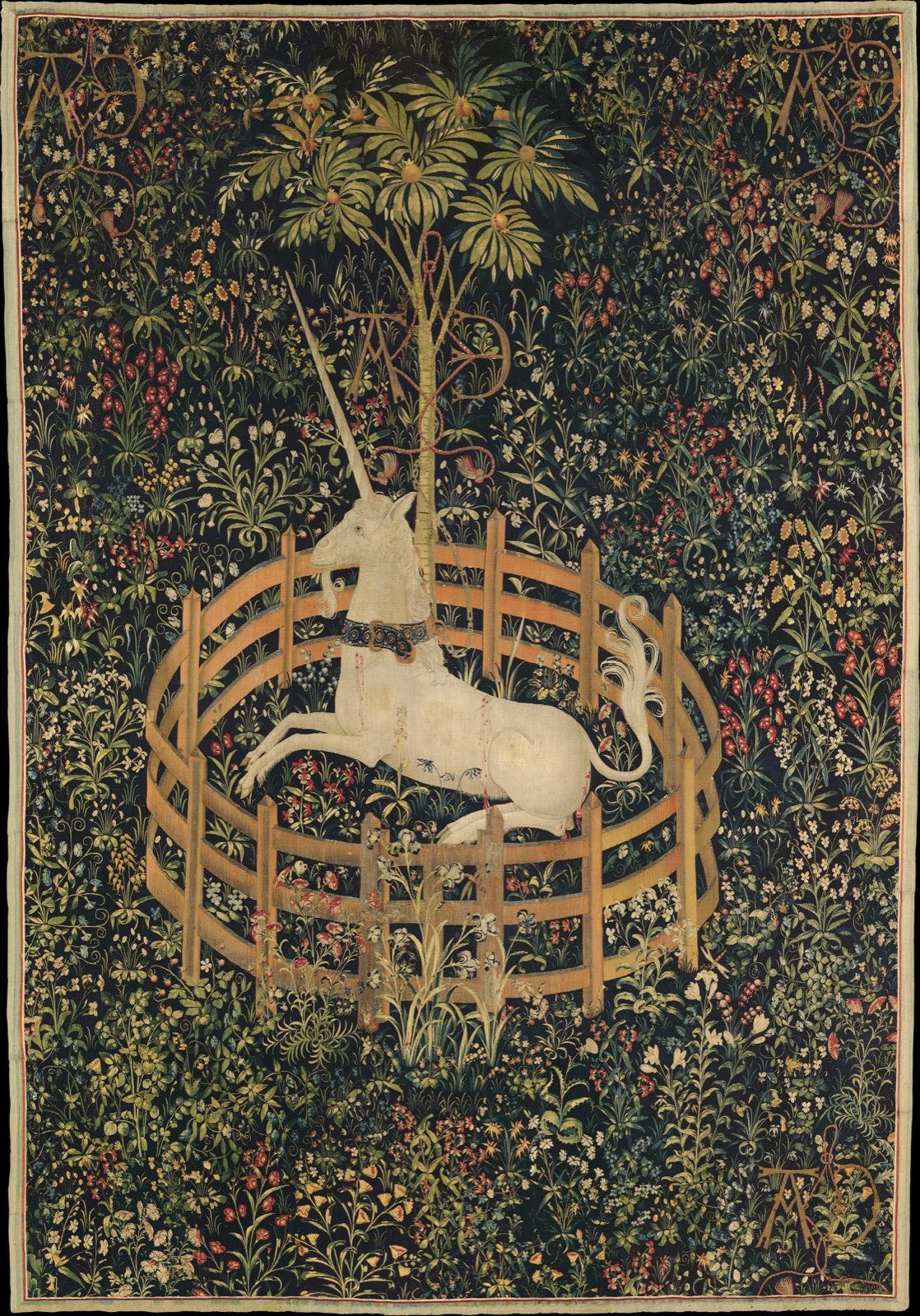
Christian writers read the scene as an allegory almost immediately: the untamable unicorn as Christ, the virgin who alone can approach it as Mary, the capture itself standing in for the Incarnation. That reading is what turned a foreign traveler's report about an Indian animal into a recurring subject in European religious art for over the next thirteen centuries, culminating in works like the seven-panel Hunt of the Unicorn tapestries, woven in the Southern Netherlands around 1495 to 1505 and now held at the Met Cloisters in New York. In the final panel, the unicorn is alive and tamed rather than dead, resting inside a low, easily cleared fence, loosely chained to a pomegranate tree with fruit staining its flank red, the image the whole capture legend had been building toward.
The explorer who finally found one, and hated it
The gap between the legend and the animal behind it became impossible to ignore once someone with a European audience reached the region Ctesias had only heard about secondhand. Marco Polo, traveling through the kingdom of Basma in Sumatra around 1292, wrote that he had found unicorns there, and made no attempt to hide his disappointment. In Henry Yule's translation of his account, Polo describes the animal as having "hair like that of a buffalo, feet like those of an elephant, and a horn in the middle of the forehead," with a head that "resembles that of a wild boar" and a habit of choosing to "abide in mire and mud." He called it "a passing ugly beast to look upon, and is not in the least like that which our stories tell of as being caught in the lap of a virgin," concluding that the real animal was "altogether different from what we fancied."
What Polo had actually found was the Sumatran rhinoceros, the smallest living rhino species and the only one with a noticeably hairy hide. He never doubted he'd found the unicorn of legend; he simply reported that the real animal was nothing like it. Almost seventeen centuries after Ctesias filed a secondhand description of an animal he never saw, the first detailed firsthand account of the real animal from a named, credentialed European traveler reads as a correction nobody back home was in a position to appreciate.
A different "unicorn," a thousand years older, that never heard of Ctesias
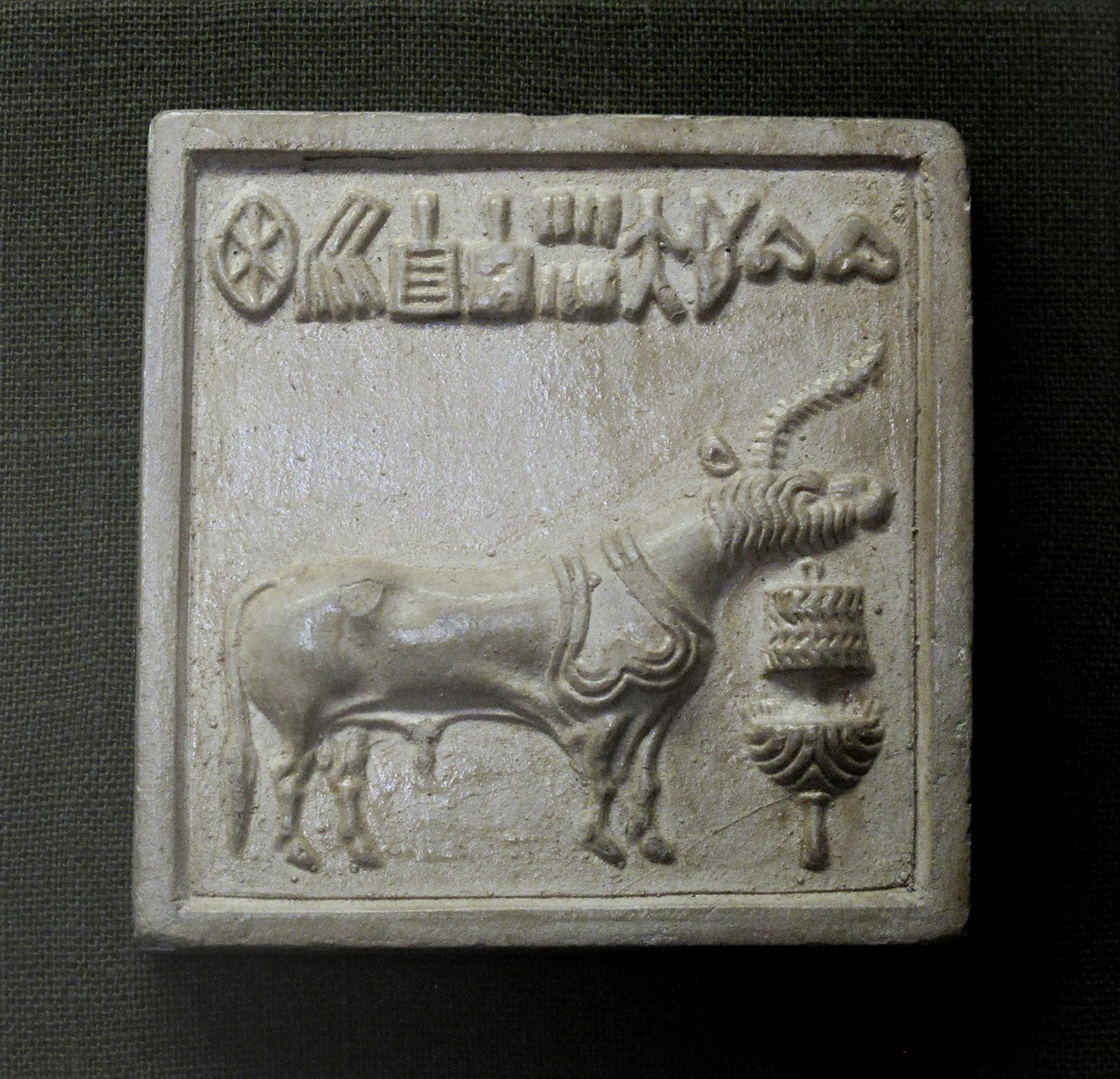
None of this is the oldest one-horned image on record. Seals from the Indus Valley Civilization, excavated at sites including Mohenjo-daro and Harappa in what is now Pakistan and northwest India and dated to roughly 2600 to 1900 BCE, feature a single-horned animal more often than any other motif the civilization left behind. Archaeologists usually call it the "Indus unicorn," and even at the low end of that dating range it predates Ctesias's Indica by more than a thousand years.
The leading explanation isn't a mythical beast at all. Archaeologist Ernest Mackay argued decades ago that the figure is a bull shown in profile, its two horns overlapping into what reads, in two dimensions, as one, a common stylistic shorthand in ancient seal-carving rather than a deliberate fantasy animal. The Indus script itself remains undeciphered, so nobody can say for certain what the seals meant to the people who carved them; most were probably used as trade markers, stamped into clay on bundles of goods. There is no evidence connecting this image to the Greek and Roman unicorn tradition that developed independently, more than a thousand years later and in an entirely different region. It's an older horn on an older continent, not an earlier chapter of the same myth.

Why the myth still flies on an official flag
The unicorn outlived every explorer who debunked it partly because it stopped needing to be biologically real to keep working as a symbol. Scotland adopted it as a royal emblem by the mid-1500s, and before 1603 its coat of arms was supported by two unicorns facing each other. When James VI of Scotland also became James I of England that year, he replaced one of the two unicorns with England's lion, a heraldic handshake marking the union of the crowns that is still visible on the United Kingdom's royal coat of arms today. Scotland's own government still designates the unicorn its national animal, chosen, by its own official framing, for representing power, purity, and an untameable spirit rather than for anyone believing an actual one grazed the Highlands.
The chain that shows up in the Scottish depiction, much like the one in the final Hunt of the Unicorn tapestry panel, isn't meant to signal captivity. It signals that only a legitimate, powerful sovereign could hold such a creature at all, an animal too strong to be tamed by anyone lesser. Ctesias's fever-dream travelogue, the Vikings' narwhal-tusk trade, and a Physiologus parable about virgins never converged on a real species. What they built instead, over two thousand years, was a creature durable enough to end up carved into a national coat of arms, the same kind of afterlife that turned a modest Egyptian solar bird into at least four unrelated "phoenix" myths sharing one convenient English name, or that let a feathered serpent worshipped across Mesoamerica outlast the empire that built temples to it.