
The staff on the ambulance belongs to the wrong god
Look closely at the logo on a lot of ambulances, pharmacy signs, and medical-corps insignia and you'll find a short staff with two snakes wound around it and a pair of wings sprouting near the top. That symbol is the caduceus, and it has nothing to do with healing. It's the herald's staff carried by Hermes, the Greek god of travelers, merchants, thieves, and messages, a peacetime symbol of trade and safe passage between hostile parties.
The actual symbol of medicine is different and simpler: the Rod of Asclepius, a plain wooden staff with a single serpent coiled around it and no wings at all, belonging to Asclepius, the Greek god of healing and medicine. Asclepius's rod shows up on the World Health Organization's emblem and plenty of medical associations that got the symbol right. But a large share of American hospitals, ambulance services, and the U.S. Army Medical Corps itself still fly Hermes's staff instead.
The mix-up has a specific origin point. Captain Frederick P. Reynolds, a U.S. Army assistant surgeon, repeatedly pitched the caduceus as the Medical Corps's new collar insignia, apparently unaware he was proposing a messenger god's staff rather than a healing god's rod, and possibly under the mistaken impression that other nations' medical services already used it. Surgeon General George M. Sternberg turned the idea down outright; Reynolds only got his symbol approved on July 17, 1902, after Sternberg's successor, Brigadier General William H. Forwood, agreed to it. The Medical Corps has carried Hermes's symbol ever since, and generations of hospitals and ambulance companies copied the Army's lead without anyone tracing the error back to its source. A confused, centuries-old trail connecting two separate things to one popular image isn't unique to this symbol either: the same pattern, a real creature repeatedly mistaken for a legendary one, runs through the story of real animals once mistaken for unicorns.
The god who committed grand larceny on the day he was born
The staff mix-up is a fitting legacy for a god whose signature myth is a story about getting away with something. The Homeric Hymn to Hermes, likely composed sometime in the sixth century BC, opens with Hermes as a newborn, son of Zeus and the mountain nymph Maia, and gives him an itinerary for his first day alive: "Born with the dawning, at mid-day he played on the lyre, and in the evening he stole the cattle of far-shooting Apollo."
By midday he had already invented an instrument. Climbing out of his cradle, the infant god found a tortoise at the mouth of Maia's cave, killed it, and stretched sheep-gut strings across the hollowed shell to build the first lyre. By evening, according to the same hymn, he had walked to Pieria, stolen fifty head of cattle belonging to his elder half-brother Apollo, and driven them backward to hide his tracks. When Apollo hauled him before Zeus to answer for it, Hermes brazenly denied everything to the king of the gods' own face, opening with, "Zeus, my father, indeed I will speak truth to you; for I am truthful and I cannot tell a lie," and swearing he had never crossed Apollo's threshold at all. Zeus, the hymn says, only laughed at watching his newborn son lie so smoothly. Hermes then talked his way out of the theft entirely by handing over the lyre he'd just invented. Apollo was so taken with the instrument that he let Hermes keep the cattle and, in most versions of the story, gave him the herald's staff, the same caduceus later borrowed by an army surgeon, in exchange.
A name modern linguists don't actually trust
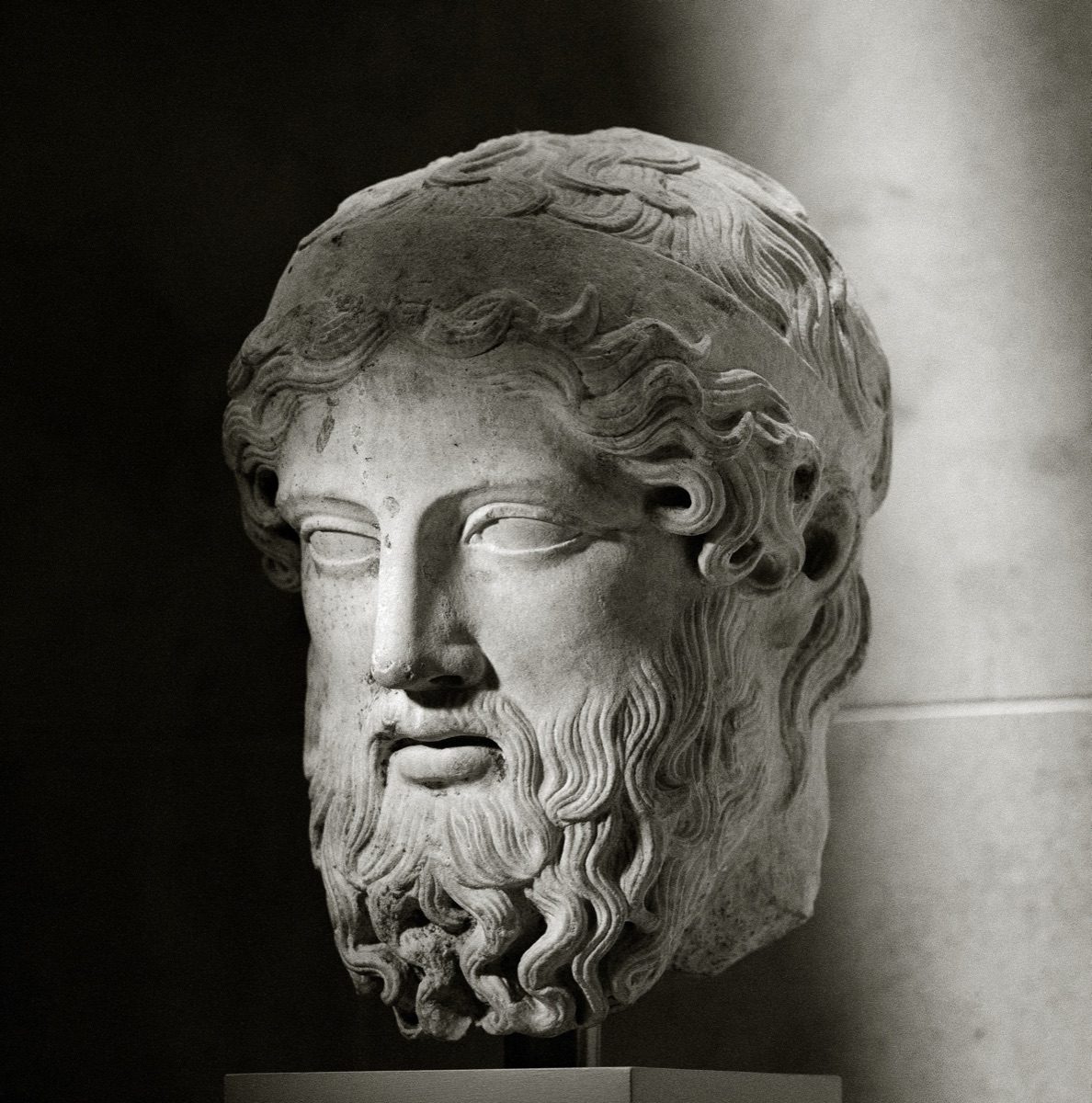
Ask where the name "Hermes" comes from and most popular sources will point to herma, the Greek word for a heap or pillar of stones used to mark boundaries and crossroads. It's a tidy story, since Hermes was worshipped as the god of exactly those boundary markers, called herms, bearded stone pillars topped with his head that stood at property lines, doorways, and crossroads across the Greek world.
The trouble is that the linguistics don't hold up. Dutch linguist Robert S. P. Beekes, in his 2010 Etymological Dictionary of Greek, judged the herma connection etymologically unlikely and concluded that Hermes's name is Pre-Greek, meaning it predates the arrival of Greek speakers in the region and comes from a substrate language linguists can no longer identify. The earliest surviving trace of the name isn't in myth at all: a Mycenaean Linear B tablet, written centuries before the Greek alphabet existed, records the form e-ma-a2, read as hermāhās, making Hermes one of the oldest attested names in the entire Greek pantheon even though its actual origin is lost.
Guardian of every threshold, guide of every departure
Hermes's job description reads like a list of everything that involves crossing a line: god of roads and travelers, of trade and merchants, of heralds and messages, of thieves and liars, and, less commonly remembered, of interpreters and language itself, since ancient audiences already associated him with the act of translation long before the word "hermeneutics" existed. That last connection gets overstated online today; historical linguists consider it a folk etymology rather than a proven derivation, since the actual Greek root behind "hermeneutics" has no confirmed link to Hermes's name.
The role that ties all of it together is psychopompos, "conductor of souls," his responsibility for guiding the newly dead from the world of the living to the underworld ruled by his uncle Hades. It's the same boundary-crossing function that made him god of roads and doorways in life, extended to the last boundary anyone crosses. Ancient Greek gravestones commonly carried his image for exactly that reason.
Homer put that role on the page directly. In Book 24 of the Odyssey, Hermes gathers the souls of the slain suitors with the same golden wand he uses to grant or lift sleep from mortal eyes, and leads them, squealing like bats in a hollow cave, past the rock of Leucas and the gate of the sun to the fields of asphodel, where the ghosts of Achilles and Ajax already wait. It's a strange, unglamorous errand for an Olympian, herding the newly dead like livestock, but it's consistent with everything else about him: whatever the boundary is, roads, doorways, negotiations, or the line between the living and the dead, Hermes is the one who crosses it and brings others across too. In the Odyssey that messenger work is his alone; Iris, the other messenger goddess, is never mentioned in the poem.
Family, Olympus, and his Roman name
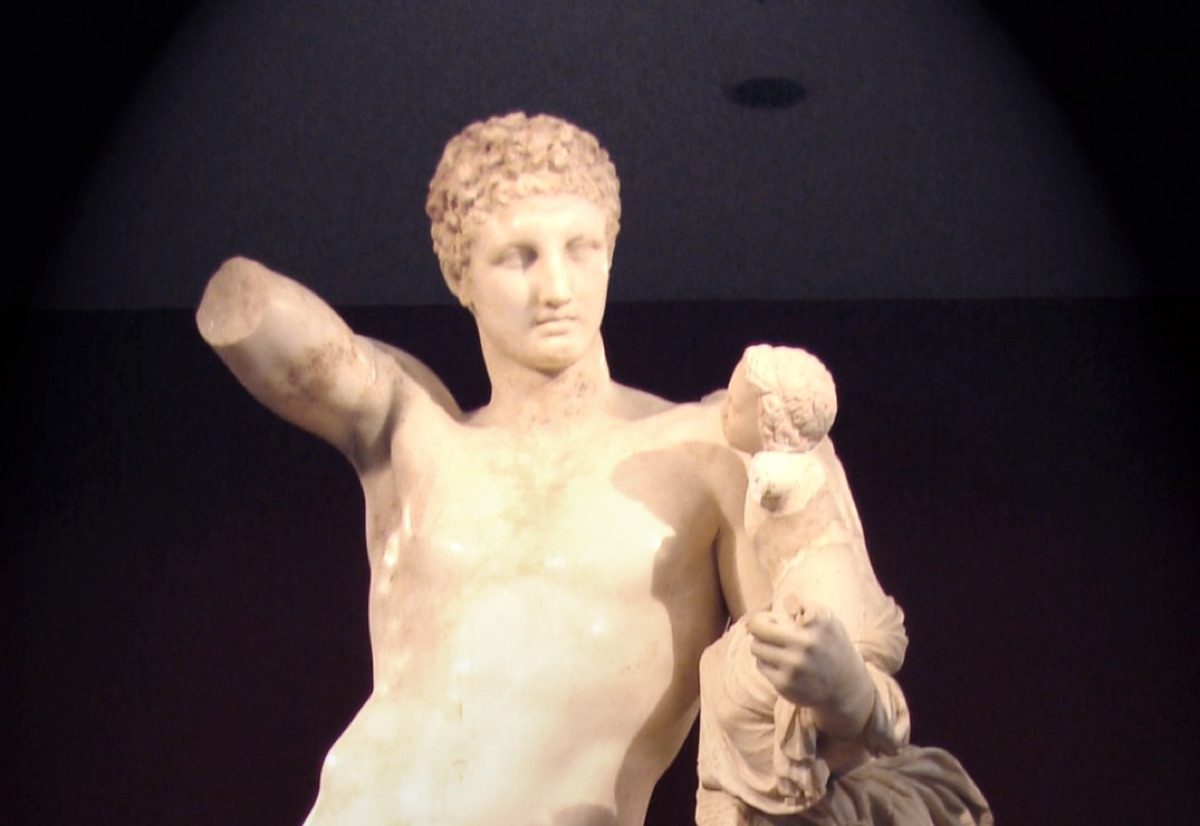
Hermes was the son of Zeus and Maia, a daughter of the Titan Atlas and eldest of the seven star-nymphs known as the Pleiades. As one of the Twelve Olympians, his most famous single appearance in surviving Greek sculpture shows him carrying his infant half-brother Dionysus to be raised by nymphs, a scene carved into the marble statue discovered in 1877 at the Temple of Hera in Olympia, the same sanctuary that gave the modern Olympics their name, and one of the best-preserved cult statues to survive from classical Greece. The statue is traditionally attributed to Praxiteles on the strength of a passing mention by the 2nd-century traveler Pausanias, but art historians have argued over that attribution for decades, since no ancient copies of the work have ever turned up to confirm it. By his own later myths, Hermes fathered the goat-legged god Pan with the nymph Dryope, making him grandfather to a satyr as well as messenger to a king, and his statues stood at the entrance of Greek gymnasiums alongside those of Heracles, since he was also patron of athletic contests and the wrestling ground.
To the Romans, he was Mercury, a name that still marks the fastest planet in the solar system and, appropriately enough for a god of trade, gives English the word "mercantile." The overlap wasn't a Roman invention grafted onto an unrelated god: Mercury absorbed Hermes's full portfolio, trade, travel, thievery, eloquence, and the psychopomp role alike, more completely than most Greek-to-Roman god pairings, which is part of why the caduceus, Mercury's staff as much as Hermes's, survived so easily into a 20th-century American army insignia with nobody noticing which god it belonged to.