_01.jpg)
What people mean by a "Western dragon" today
Ask for a mental picture of a Western dragon and most people describe the same animal: four thick legs, a pair of membranous wings doubling as forelimbs on some versions, a crocodile-like head, a barbed tail, fire pouring from the jaws, and a personality built around greed, hoarded treasure, and villainy that ends with a sword through its heart. Nobody learns that description as a single story, because it isn't one. Each piece has its own paper trail, and the trails don't meet until surprisingly late: a 7th-century Latin encyclopedia entry with no wings in it at all, an anonymous Old English poem that added fire centuries afterward, a saint's biography that supplied the villain-and-hero plot, a Welsh political banner that used the same animal for the opposite purpose, and a set of English heraldic rulebooks that finally pinned down the leg count. Europe's actual medieval dragon traditions, Norse, Welsh, Slavic, and Germanic, don't share a common monster either, and the second half of this page follows each of the four to its oldest source; the composite sketched above sits on top of all four without matching what any single one of those cultures actually told its own children. The word travels just as badly outside Europe: Korea's yong, Vietnam's rồng, and Southeast Asia's naga get folded into the same English label despite coming from two mythological lineages that never touched each other. This page stays on the assembly history of the Western image and the four medieval traditions underneath it; the separate question of whether any real animal sighting or fossil find ever fed dragon belief in the first place is covered elsewhere on this site.
The wingless original: Isidore of Seville, 7th century
The oldest systematic definition of "dragon" in Western writing comes from Isidore of Seville, a Hispano-Roman archbishop who died in 636 and spent his final decades compiling the Etymologiae, an encyclopedia that would remain a standard reference across medieval Europe for centuries. His entry, in Book 12, is specific and, by modern standards, almost unrecognizable: "The dragon is the largest of all the snakes, or of all the animals on earth." No wings. No fire. Isidore's dragon is crested, has a small mouth, and kills not with venom or teeth but by wrapping around its prey, most memorably elephants, and crushing the air out of them as they walk their usual paths. Its strength, he wrote, is in its tail.
Isidore was drawing on older Roman natural history, particularly Pliny the Elder's first-century Natural History, which already described a dragon locked in aerial combat with eagles over stolen eggs. The Christian moral overlay came from a separate, older text, the Physiologus, a Greek-language work that began circulating out of Alexandria somewhere in the 2nd to 4th centuries CE and reached Latin readers by the 4th and 5th centuries. Physiologus-derived bestiaries filed the dragon among the serpents and read it as a figure for the devil, a symbolic reading medieval scribes kept copying long after Isidore's zoological description had already fixed the animal's physical shape for their audience: wingless, earthbound apart from short flights, and dangerous through sheer size and muscle rather than any of the traits people now assume come standard.

Who added the fire: the Beowulf poet
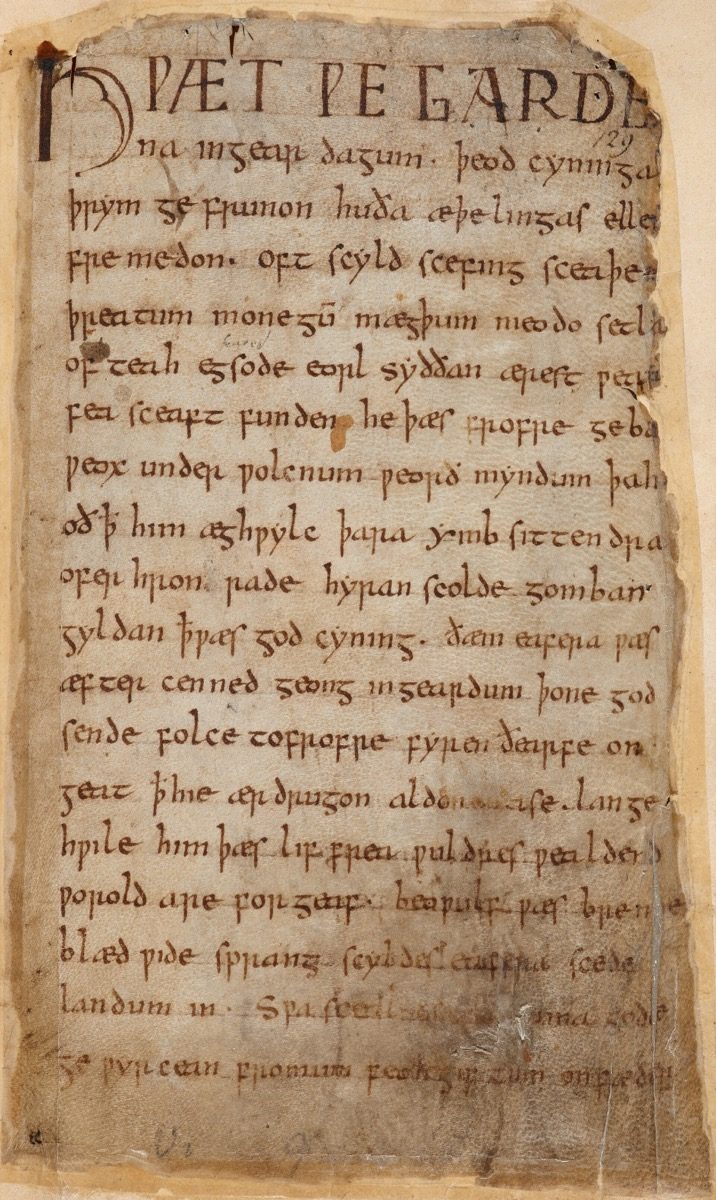
Fire breath is the single trait most associated with dragons today, and it doesn't come from Isidore, from Pliny, or from the Physiologus. It comes from a poem. The dragon in Beowulf, preserved in a single manuscript now known as the Nowell Codex and dated by recent scholarship to the decade after 1000 CE, guards a hoard buried centuries earlier by the last survivor of a vanished people, who sealed it away while mourning that he had no one left to leave it to. The treasure itself is described as tarnished, rusted, and corroding, sitting untouched until a fugitive steals a single gold cup. The dragon responds by hunting nightly, incinerating homes, and eventually burning down Beowulf's own hall. Scholars studying the poem credit its unnamed author as the first to combine a serpent's earlier traits into a distinctly fire-breathing treasure guardian, a synthesis that hadn't existed in any single earlier source. One honest caveat: that decade-after-1000 date is for the surviving copy, not necessarily the poem itself, which specialists still argue was composed anywhere from the 8th century to not long before the manuscript was written; nobody can currently pin the fire-breathing innovation to an exact year, only to that manuscript as its earliest proof.
The manuscript that preserves that invention almost didn't survive to pass it on. In 1731, a fire tore through Ashburnham House in London, where the antiquarian Robert Cotton's manuscript collection, including the only copy of Beowulf ever found, was being stored. The volume survived, but its page edges were scorched, and no serious restoration was attempted until the 19th century, by which point the margins had crumbled and parts of the text were already unreadable. The poem that gave the West's dragon its fire came within reach of being erased by an actual one.
The hero-slayer plot: Saint George
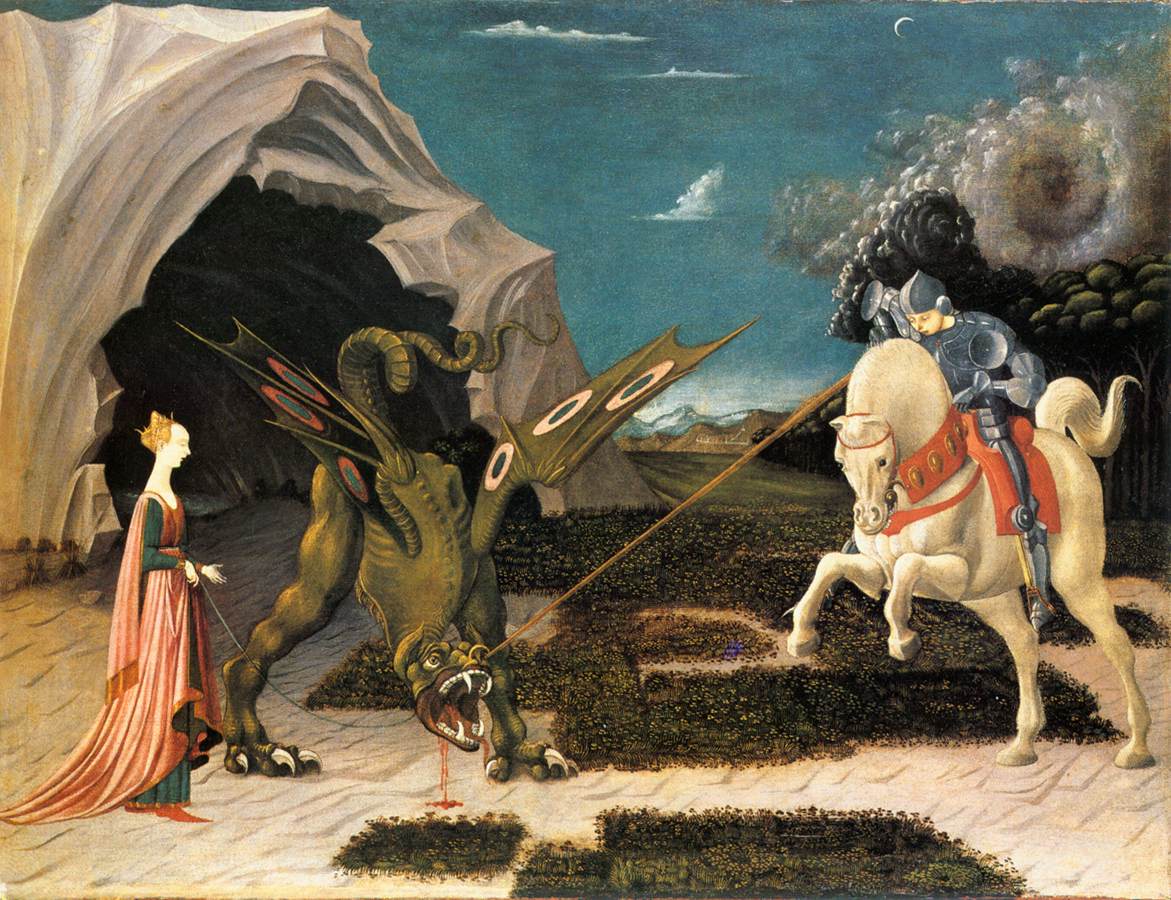
Neither Isidore's constrictor nor Beowulf's fire-breather gets killed by a righteous hero riding to a princess's rescue. That plot beat arrives from an entirely separate strand: hagiography, the writing of saints' lives. The earliest known versions of the Saint George legend, from the 11th and 12th centuries, set the story in Cappadocia, in what's now central Turkey. By the time Jacobus de Voragine, archbishop of Genoa, compiled his enormously popular Legenda aurea, the Golden Legend, in the 1260s, the setting had shifted to a city he called Silene in Libya, where a dragon fed on the town's children by lottery until the lot fell on the king's own daughter. The text has the king begging his people, "For the love of the gods take gold and silver and all that I have, but let me have my daughter," before George rides up, spears the dragon, and talks the town into baptism in exchange for finishing it off. Some scholars have traced an echo of an even older, pre-Christian story underneath George's: the Greek myth of Perseus rescuing Andromeda from a sea monster near Lydda, in roughly the same region.
The Golden Legend was first printed in Latin in 1470 and translated widely within a few years; William Caxton's English edition, commissioned by the Earl of Arundel, followed in 1483 and helped cement George as England's patron saint. What that legend contributes to the modern composite isn't a body shape or a power, it's a moral structure: a specific, evil dragon, opposed by a specific, virtuous human, resolved by a duel. Nothing in Isidore's entry or the Beowulf poem asks the reader to root for the dragon's death as a triumph of good over evil. George's story does, and that framing is now so default that most retellings of dragon-slaying stories assume it without crediting where it came from.
Four medieval traditions with no shared monster
English uses "dragon" for Fafnir, for the pair buried under a Welsh hillfort, for a fire-breathing raider in Russian epic, and for the serpent Siegfried kills in German legend, as though one monster just picked up local costumes on its way across the continent. It didn't. These four traditions come from four language families and four separate manuscript histories, and the same flattening problem shows up on the other side of the world, where English "dragon" also covers two mythologies, China's long and South Asia's naga, that never shared an ancestor either. What Europe's dragons actually share is a job, not a family tree: each one stands between a hero, or a kingdom, and something it wants.
Follow each tradition to its oldest source and the differences stop being cosmetic. The Norse dragon used to be a dwarf. The Welsh dragons aren't slain by anyone; the plot turns on which one wins a fight against the other. Nobody agrees how many heads the Slavic dragon has. And the German version hinges on a single unreachable patch of skin that decides how the whole story ends.
Fafnir used to be a dwarf, not a dragon
Fafnir starts the story as a dwarf, one of three sons of Hreidmar alongside his brothers Regin and Otr. According to the Poetic Edda's Reginsmal and the 13th-century Volsunga saga, which compiles older material into prose, Otr was killed while shapeshifted into an otter, and the gods Odin, Loki, and Hoenir owed Hreidmar compensation. Loki got the payment by robbing a dwarf named Andvari of his gold hoard, including a ring, Andvaranaut, that Andvari cursed on the way out. Hreidmar took the cursed gold as his son's blood-price. Fafnir killed his own father for it, kept the whole hoard for himself, and turned into a serpent, a lindworm in the Old Norse telling, to guard it on the plain of Gnitaheath.
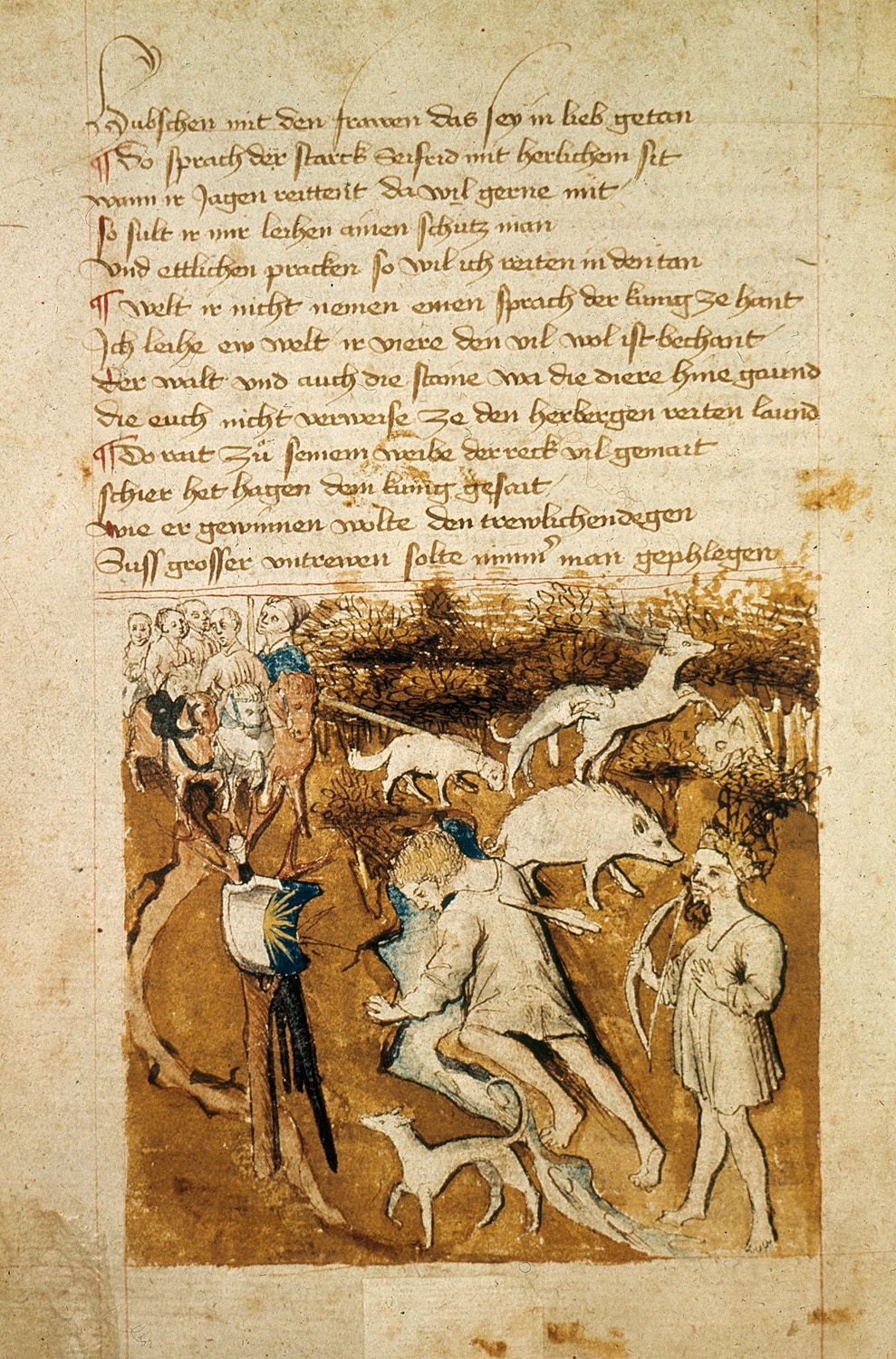
Sigurd, raised by Regin, is talked into killing his foster father's own brother for a share of the gold. Fafnismal has him dig a pit in Fafnir's path and stab upward into the dragon's underside as it crawls to drink, on Odin's disguised advice. As he dies, Fafnir warns Sigurd what the gold will cost him, in Henry Adams Bellows's 1936 translation of the poem: "The sounding gold, the glow-red wealth, and the rings thy bane shall be." Roasting the dragon's heart afterward for Regin, Sigurd burns his thumb, sucks it, and tastes the blood, which lets him understand the birds overhead warning him that Regin plans to murder him for the gold too. Sigurd kills Regin first, proving Fafnir right. The whole sequence, killing from the pit, tasting the blood, listening to the birds, loading the horse Grani with treasure, is carved into the Ramsund rock in Sodermanland, Sweden, dated to roughly 1030 CE. That is about two and a half centuries before the Codex Regius, the Poetic Edda's oldest surviving manuscript, was copied around 1270, and closer to four centuries before the earliest surviving manuscript of the Volsunga saga itself, made around 1400. The stone is the oldest surviving version of the story by a wide margin, not an illustration of a later text.


Wales flips the symbol
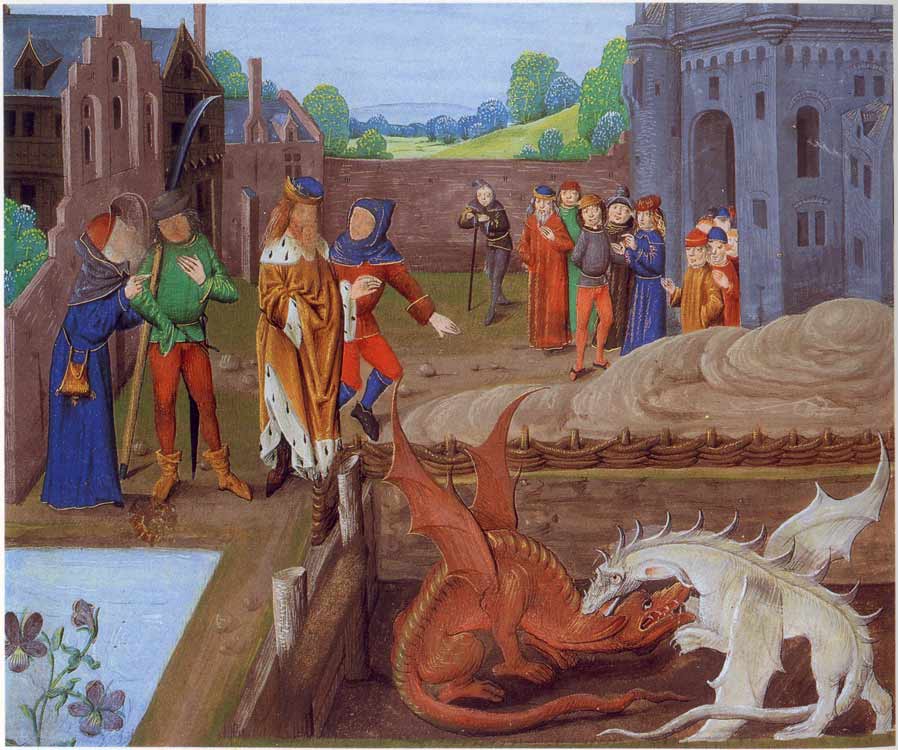
While hagiography was turning the dragon into a villain, a separate and much older tradition in Wales was doing the opposite. The earliest recorded link between a dragon and Wales appears in Nennius's Historia Brittonum, written around 829-830 CE, which tells of King Vortigern trying to raise a fortress at Dinas Emrys in Snowdonia, only to find its walls torn down every night by something underground. His advisers tell him the collapse can only be stopped by the blood of a boy born without a father. The boy Vortigern's men find, condemned to death for this purpose, talks his way out of it by naming the real cause: a pool holding two sleeping serpents, one red and one white. Vortigern's men dig up the pool and free them, and the two fight. In J.A. Giles's 1848 translation, the boy explains what the men have just watched: "The pool is the emblem of this world, and the tent that of your kingdom: the two serpents are two dragons; the red serpent is your dragon, but the white serpent is the dragon of the people who occupy several provinces and districts of Britain." The white dragon dominates for most of the fight before the red one finally drives it out, which the boy reads as a forecast: the Saxons would dominate Britain for a time, but the Britons would eventually push them back across the sea.
In Nennius's original text, that boy gives his own name as Ambrose, not Merlin. The identification with Merlin comes three centuries later, when Geoffrey of Monmouth, writing between 1120 and 1129, merged Ambrosius with Myrddin, a separate Welsh prophet figure with no connection to Vortigern's story in the earlier sources, into the composite character his Historia Regum Britanniae called Merlinus Ambrosius. Geoffrey also folded the dragon itself into the Arthurian legend, connecting it to Uther Pendragon, whose epithet translates roughly as "chief of warriors," and reading the struggle of the red and white dragons as a stand-in for the Welsh and the English. The prophecy's ending held up well enough as branding that the red dragon, Y Ddraig Goch, is still the emblem at the center of Wales's national flag today.
That symbolism became a literal battle flag centuries later. During his revolt against English rule, Owain Glyndŵr flew a golden dragon on a white field at the Battle of Tuthill, fought at Caernarfon on 2 November 1401, deliberately invoking Uther Pendragon and the Geoffrey of Monmouth tradition. Henry Tudor picked up the same symbol after his own rise to the throne, pairing the red dragon with the Tudor rose to claim descent from Arthur and Cadwaladr and shore up his legitimacy after the Wars of the Roses. None of this treats the dragon as something to be slain. It's a standard to rally behind, which is the exact opposite of what Saint George's legend was doing with the same creature at almost the same time in European history.

How many heads does Zmey Gorynych actually have?
Zmey Gorynych is the recurring dragon antagonist of the East Slavic byliny, the oral heroic epic poems of Russia and Ukraine, most often faced down by the bogatyr, or knight-hero, Dobrynya Nikitich. In one of the best-known cycles, Zmey Gorynych kidnaps Zabava Putyatichna, niece of Prince Vladimir, and Dobrynya rides out to fight the dragon and bring her back. The word zmey itself is just the Slavic word for serpent given a masculine form, and the byliny describe the creature as green, capable of flight and human speech, and breathing fire.
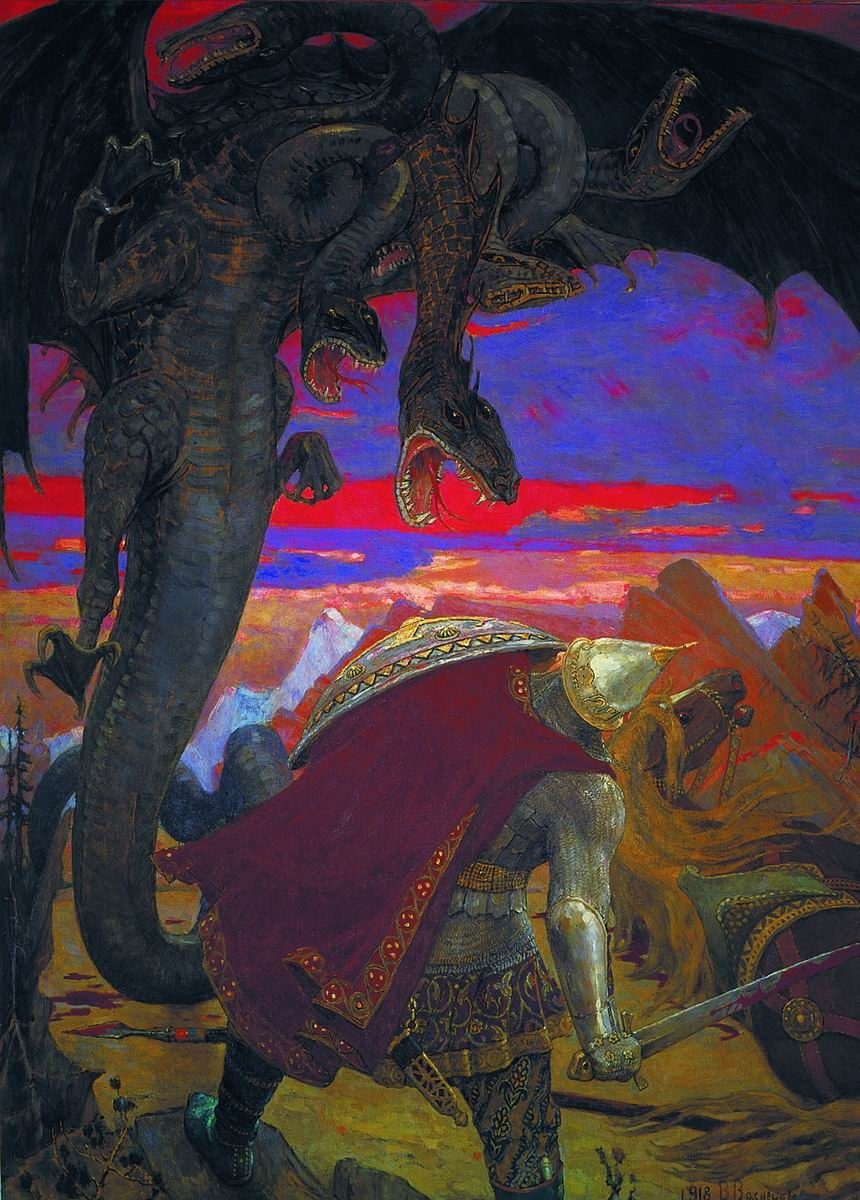
The most commonly cited folk description gives Zmey Gorynych three heads, but because byliny were passed down orally rather than fixed in a single canonical text the way the Poetic Edda was, the count isn't stable across tellings. Viktor Vasnetsov's 1918 painting of the story, Dobrynya Nikitich's Fight with the Seven-Headed Snake Gorynych, gives the dragon seven, reflecting a bylina variant with a larger creature than the standard three-headed version most retellings settle on. That kind of variation, a folk tradition where even the monster's basic anatomy shifts by region and performer, has no equivalent in the more textually fixed Norse or Welsh material above.
.jpg)
One inch of skin decides how the German epic ends
The Nibelungenlied, a Middle High German epic written down around 1200 CE, probably in Austria or southern Germany, tells the same underlying hero story as the Norse Sigurd material under a different name, Siegfried, and a different spelling for the dragon, Fafner. The two traditions diverge in a structural way beyond spelling: where the Poetic Edda and Volsunga saga stage the pit, the stabbing, and the burnt thumb as a scene the audience watches happen, the Nibelungenlied treats Siegfried's killing of the dragon as something that already happened before the poem opens, mentioned rather than dramatized.
The two traditions also diverge on what the dragon's blood is actually for. Norse tradition ties it to wisdom, tasting Fafnir's blood is what lets Sigurd understand birds. German tradition ties it to invulnerability: Siegfried bathes in Fafner's blood and comes out unable to be wounded by any weapon, with one exception. Kriemhild, married to Siegfried, is the one who explains why, confiding the secret to Hagen in George Henry Needler's 1904 translation: "When from the wounded dragon reeking flowed the blood, and therein did bathe him the valiant knight and good, fell down between his shoulders full broad a linden leaf. There may he be smitten." Hagen, one of the Burgundian retainers, gets Kriemhild to sew a marker onto Siegfried's tunic over the spot, claiming he needs it to protect him in battle, then stabs him there instead, killing him. The dragon's blood does more than set up the poem's backstory. The one place it never touched is what ends the story.

What actually separates these four
Line the four up and the differences run deeper than setting. Fafnir began as a person, a dwarf undone by his own father's cursed gold, which is a different kind of monster than something that was always a dwarf and never asked to be feared for it. The Welsh story isn't a monster-slaying at all; nobody kills either dragon, and the entire point is which one wins a fight underground. Zmey Gorynych is the only one of the four whose physical form isn't fixed, a side effect of surviving as oral performance rather than as a text anyone could check against. And Fafner's fight in German tradition matters less for the killing itself than for the one spot the blood never reached, a detail that would be trivia in the Norse version and is the whole plot in the German one. Nothing here got flattened by translation. It just never was one story to begin with.
Heraldry settles the body plan: dragon vs. wyvern
Even the number of legs wasn't fixed for most of this history. The formal split between a four-legged "dragon" and a two-legged "wyvern," the version where the forelimbs are replaced entirely by wings, only hardened into a rule inside English heraldic writing in the 16th and 17th centuries. The herald John Guillim put it plainly in his 1610 Display of Heraldrie: a wyvern, he wrote, "partake[s] of a Fowle in the Wings and Legs, ... and doth resemble a Serpent in the Taile." John Gibbon, writing in 1682, agreed that a wyvern has "but" two legs, treating the distinction as settled fact by then. That split was a peculiarly English bookkeeping habit. Heraldic traditions elsewhere on the continent never adopted it, and a two-legged, winged dragon-creature drawn in French or German heraldry of the same period is simply called a dragon, no separate name required.
Put together, none of the elements now treated as baseline, wingless in the 7th century, fire-breathing only from the 10th or 11th century onward, evil-and-slain only from the 12th and 13th centuries, four legs specifically only codified in the 16th and 17th, existed as a single package anywhere before the modern era. The heraldic rulebook is the closest thing to an official body plan the Western dragon ever got, and it arrived nearly a thousand years after Isidore's first attempt at a definition.
The 20th century locks it in: Tolkien and Dungeons & Dragons
The composite reached something close to its modern, stable form only in the 20th century, and largely through two specific, traceable sources. J.R.R. Tolkien's Smaug, introduced in The Hobbit in 1937, drew directly on Fafnir, the treasure-guarding serpent from Norse legend that Tolkien had loved since childhood, and just as directly on the Beowulf dragon: the plot device of a single stolen cup provoking the dragon's rampage is lifted from the Old English poem almost intact. Smaug is reptilian, winged, and fire-breathing, and the book's enormous and lasting popularity made that specific combination the reference point most later fantasy writers worked from, whether or not they'd read Isidore, the Physiologus, or Beowulf themselves.
The other major push toward standardization came from a tabletop game. The original 1974 Dungeons & Dragons "white box" set introduced five chaotic, evil-aligned chromatic dragons, white, black, green, blue, and red, plus a lawful-good gold dragon. The 1975 Greyhawk supplement added four more good-aligned, metallic types, copper, brass, bronze, and silver, and the 1977 Advanced Dungeons & Dragons Monster Manual folded that whole roster together into one official taxonomy alongside the god-like dragons Bahamut and Tiamat. That system, sorting an entire mythological category by scale color and moral alignment, has shaped a large share of fantasy fiction, art, and games made since, giving the composite creature assembled from Isidore, the Beowulf poet, Saint George's hagiographers, Welsh heraldry, and English wyvern rules its final, most widely recognized form.