.jpg)
A serpent wearing feathers
The name breaks into two Nahuatl parts: quetzalli, the long, iridescent tail feather of the resplendent quetzal bird, and coatl, serpent. Put together, Quetzalcoatl reads literally as "feathered serpent," and Aztec religious thought treated that combination as more than decoration. The serpent belonged to the earth, low and coiled; the bird belonged to the sky, the realm of the heavens. A deity built from both was a deity that fused opposites, earth and air folded into a single body.
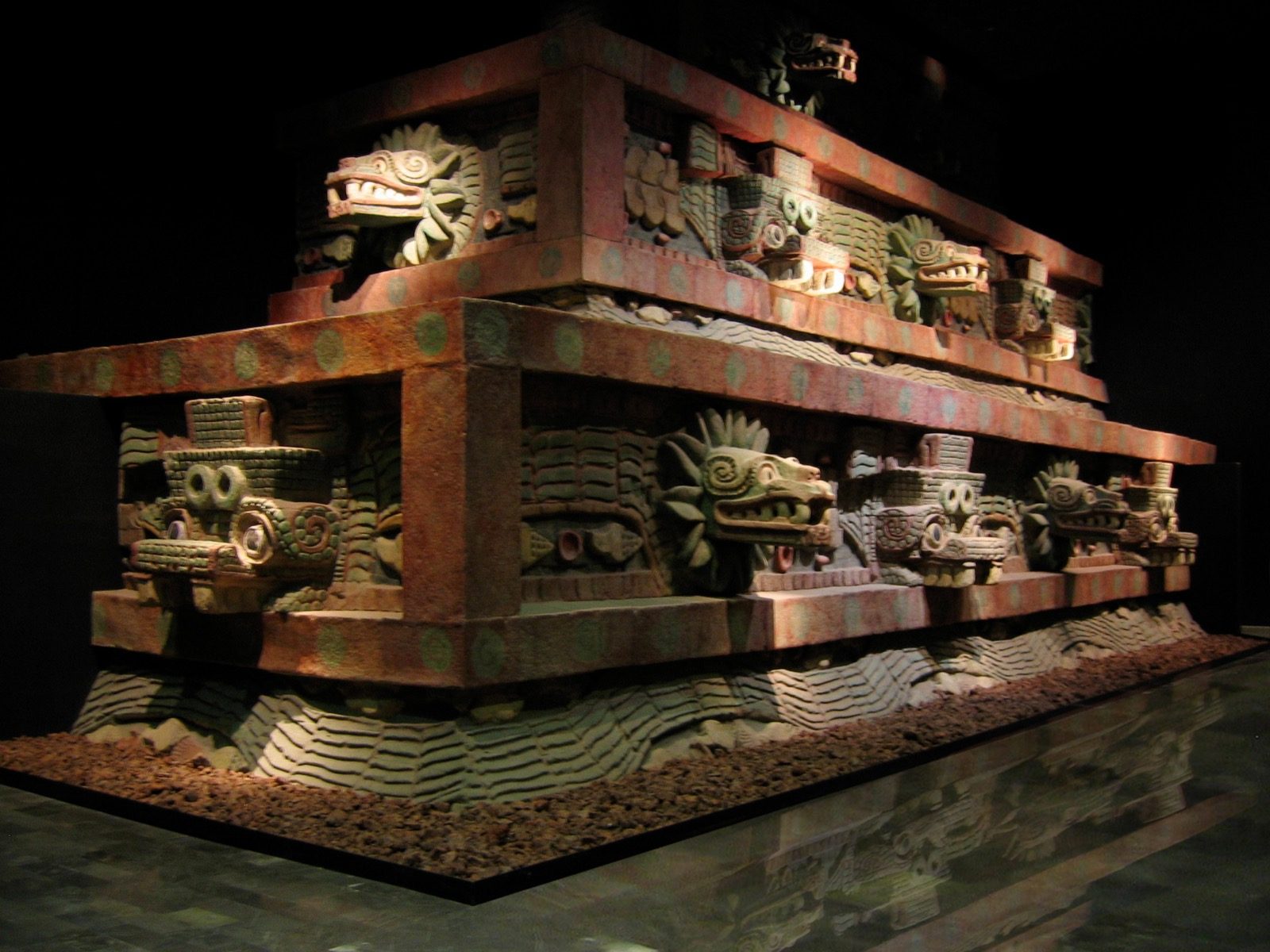
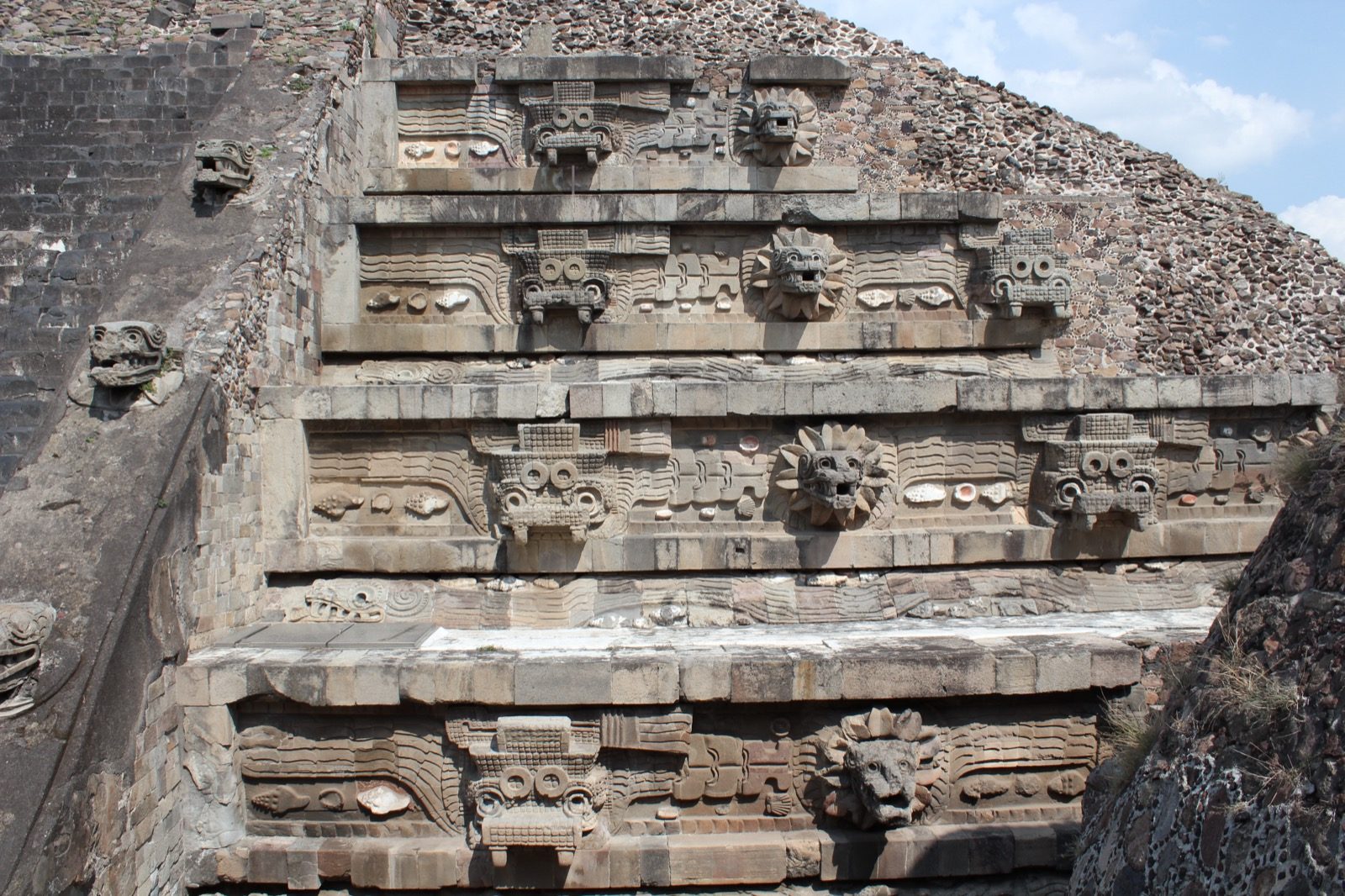
Among the Aztecs, Quetzalcoatl governed wind in his aspect as Ehecatl, along with the planet Venus, dawn, learning, and the priesthood, and he served as patron of merchants, goldsmiths, and craftworkers. He ranked among the three or four most consequential deities in the Aztec pantheon, just below the four creator gods who set the cosmos in motion. But the Aztecs were latecomers to this god. The earliest confirmed worship traces to the Teotihuacan civilization, whose Temple of the Feathered Serpent, its stepped facade still studded with carved serpent heads, was built around 150-200 CE, a thousand years before the Aztec empire existed at all. Veneration spread across Mesoamerica through the Late Classic period, and the Toltecs and other Nahua peoples worshipped the feathered serpent long before the Aztecs adopted him into their own religious system. The Maya gods are covered on their own page, where one letter still stands in for a name.
.jpg)
The bones that became humanity
Aztec cosmology holds that the world has been destroyed and remade across multiple ages, called suns, and Quetzalcoatl is credited with repopulating the current one, the Fifth Sun. According to the myth, he traveled down into Mictlan, the underworld ruled by the death god Mictlantecuhtli, to recover the bones of the peoples who had lived and died in earlier ages. He ground those bones on a jade dish and mixed the powder with blood drawn from his own body, and from that mixture the first humans of this era were formed. A separate but related tradition credits him with discovering maize, hidden inside a mountain, by transforming himself into an ant small enough to carry the kernels out one at a time and hand cultivation to humanity.
The underworld errand gives Quetzalcoatl a job description that shows up in unrelated mythologies an ocean away: a deity who crosses the boundary between the land of the dead and the land of the living to do something the dead cannot do for themselves. Anubis fills a comparable role in Egyptian religion, weighing hearts and guiding souls through the underworld, though the two traditions developed independently, with no historical contact and no shared source.
Two stars, one god
Quetzalcoatl's connection to Venus comes from a myth in which he is humiliated in a conflict with the rival god Tezcatlipoca and, in shame, sets himself on fire on the eastern shore. Out of that fire he rises into the sky as the planet Venus in its morning-star phase, worshipped separately as Tlahuizcalpantecuhtli, "Lord of the House of Dawn." His counterpart, sometimes described as his twin, appears as Xolotl, a dog-headed figure who represents Venus in its evening-star phase and is said to guide the planet back through the underworld each time it disappears from the night sky before its next dawn rising. The two names for one planet reflect a real astronomical fact ancient Mesoamerican observers had tracked with precision: Venus alternates between appearing before sunrise and after sunset, vanishing from view during the transitions, a cycle Aztec and earlier Mesoamerican calendars charted closely enough to structure entire ritual calendars around it.
The human king who borrowed the god's name
A separate strand of the tradition centers on a human being rather than a deity: Ce Acatl Topiltzin Quetzalcoatl, a legendary priest-king who ruled the Toltec capital of Tollan, generally placed in the 10th century CE, centuries before the Aztec empire rose. According to the legend, Topiltzin angered a rival faction, or a rival god depending on the version, and was driven from Tollan. He is said to have departed "in a wizard skiff made of serpent skins," heading east and promising to return one day.
Over the centuries between the fall of Tollan and the arrival of Spanish chroniclers who wrote the story down, the human priest-king and the deity whose name he carried blurred into each other. Later tellings sometimes treat Topiltzin's exile and the god Quetzalcoatl's own myths as a single continuous story, even though the earliest layers describe a mortal ruler with a political rival, not a god with a cosmic one. Greek myth built comparable composite figures out of centuries of retelling. Even the roster of the Twelve Olympians was never fixed in antiquity; competing lists from different cities and different centuries assigned the twelfth seat to different gods, the same way centuries of Mesoamerican retelling folded a human king into a deity's biography.
A prophecy that was written down thirty-two years late
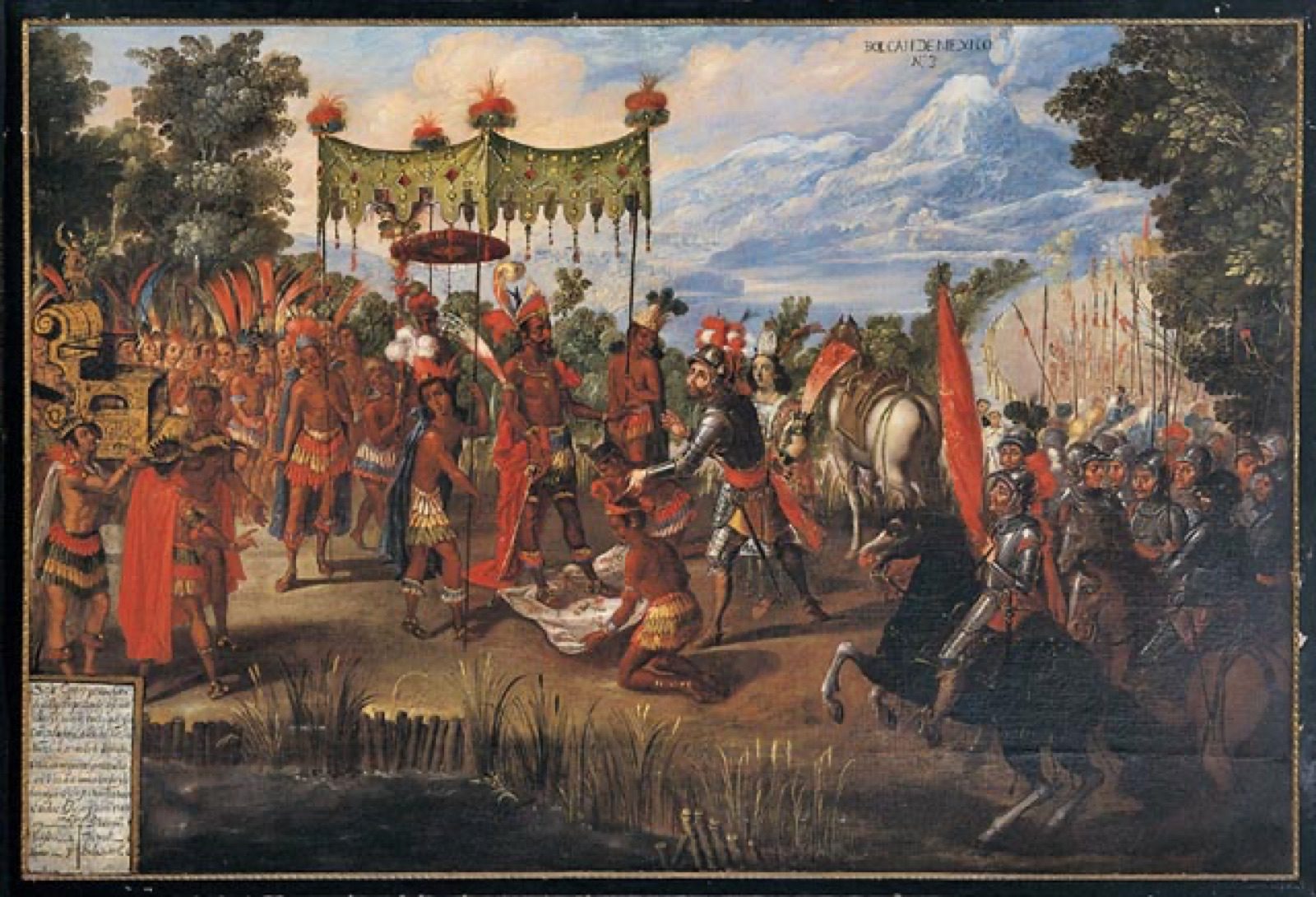
The story most people know goes like this: Quetzalcoatl had vowed to return from the east, the year of his prophesied arrival lined up with Hernán Cortés landing on the Gulf coast in 1519, and Moctezuma II, paralyzed by the belief that the pale, bearded stranger might be the returning god, let the Spanish walk into Tenochtitlan largely unopposed. Versions of this account still appear across general reference sources today, essentially unchanged from the form Spanish chroniclers gave it five centuries ago.
The documentary trail tells a more complicated story. The earliest primary source, Cortés's own second letter to King Charles V, written in 1520, records his version of Moctezuma's welcome speech: "For a long time we have known from the writings of our ancestors that neither I, nor any of those who dwell in this land, are natives of it, but foreigners who came from very distant parts." That passage, the closest thing to contemporaneous evidence for any return legend, describes ancestral foreigners and a departed chieftain, not a god, and it never mentions Quetzalcoatl by name. Restall and other historians treat the whole speech as self-serving on Cortés's part, written to justify a conquest to a distant king rather than to record what Moctezuma actually said. The specific claim that the Aztecs mistook the Spanish for the returning god first appears in print in 1552, in a history of the conquest written by Francisco López de Gómara, who had served as Cortés's chaplain and secretary but had never set foot in Mexico himself, writing three decades after the events he described. Franciscan missionaries working in Mexico through the 1540s to 1570s, compiling accounts like Bernardino de Sahagún's Historia General, were independently shaping a related narrative during the same window, overlaying a Christian framework of prophesied return onto Aztec religious material as part of their broader project of converting the Nahua population.
Historian Camilla Townsend examined this evidentiary trail in a 2003 article in the American Historical Review and concluded there is "little evidence that indigenous people ever seriously believed the newcomers were gods, and there is no meaningful evidence that any story about Quetzalcoatl's returning from the east ever existed before the conquest." She has described the myth as a kind of "political pornography," a narrative that flatters European technological superiority into a stand-in for moral and intellectual superiority, at the cost of erasing what the documentary record actually shows: a Mexica leadership that assessed the newcomers' weapons and numbers with practical calculation, not religious paralysis. Matthew Restall reached a closely related conclusion in his 2018 book on the same encounter, tracing the "returning lords" framing to Cortés's own reworking of Moctezuma's speech and to the Franciscans who built on it afterward. Neither historian claims Aztec religion lacked stories about the god's departure and eventual return in some form; the claim they dispute is narrower and more specific, that Aztec observers in 1519 actually identified Cortés with that prophecy in the moment, rather than Spanish and mestizo writers assembling that identification decades later.

Why the story keeps getting repeated
None of this makes Quetzalcoatl a minor or fictional figure. Iconography of the feathered serpent is genuinely older than the Aztec state, worship at Cholula was genuinely central to Aztec religious life, and rulers genuinely made pilgrimages there to legitimize their power. What the historical record does not support is the specific, cinematic version of the conquest story, an Aztec empire frozen by religious awe at the sight of a bearded Spaniard, that circulated for so long it became the default explanation in general reference works long after specialist historians had moved past it. The gap between what academic Mesoamericanist scholarship concludes and what still gets repeated in casual retellings is itself worth noticing, since it means the prophecy that supposedly determined the outcome of the conquest may be less a piece of Aztec religion than a piece of the conquest's own aftermath, written by the people who benefited most from telling it that way.