
The short answer skips a real complication
Type "god of water" into a search engine and the answer changes depending on which mythology wrote it. Poseidon covers it in the Greek pantheon, though his oldest recorded titles in the clay tablets from Bronze Age Pylos, dated to around 1200 BC, were about earthquakes and horses rather than the sea, a case laid out in more detail in the site's separate look at Poseidon. Varuna covers it in the Rigveda, but only after starting his career as ruler of the sky. Enki covers it in Mesopotamia, bundled in with wisdom and magic. Several mythologies never gave the job to one deity at all.
The pattern that actually holds up across cultures has little to do with one water god wearing different names. It comes down to a habit of splitting water into separate jobs before anyone gets around to naming a god for it. Salt water and fresh water were routinely treated as different departments. The flood that fed a river and the river itself could answer to two different gods. Rain falling from the sky belonged to someone else again. What follows is not a top-ten list of water deities. It is a look at how six mythologies drew those internal lines, and at how differently they drew them.
Egypt split the job three ways, with almost no overlap
Ancient Egyptian religion did not treat "water" as one portfolio. Hapi was the god of the Nile's annual flood specifically, not of the river as a permanent feature of the landscape. He was depicted as an androgynous figure with a rounded belly and pendulous breasts, symbols of nourishment, not markers of a fixed gender, and villagers threw amulets into the Nile during flood season while priests tracked the river's rising level to forecast how good the harvest would be. Hapi's entire religious function was tied to that one annual event.
Sobek, worshipped from the Old Kingdom (roughly 2686-2181 BC) through the Roman period some 2,700 years later, had a different and more dangerous portfolio. Depicted as a crocodile or as a man with a crocodile's head, he was known as "Lord of the Waters" and was invoked as a protective deity against the real hazards the Nile presented: crocodile attacks and drowning. Sobek's cult also attached him to fertility and to pharaonic military power, none of which had anything to do with Hapi's flood-specific role.
A third figure, Nun, covered water that predated both of them. Nun personified the shapeless primeval ocean that Egyptian cosmology placed before creation itself, the waters out of which the first mound of land and the creator god Atum were said to have emerged. Because Nun was older than any created god, Egyptian texts sometimes call him the father of the gods, and he was paired with a consort, Naunet, as part of the Hermopolitan Ogdoad, a group of eight primordial deities. Egypt did not have a water god. It had a flood god, a river-danger god, and a pre-creation-chaos god, and none of the three did the others' work. Egyptian religion split plenty of other jobs this narrowly too. The ibis-headed god Thoth gets credited online with judging the dead, a role that actually belonged to Anubis and Osiris; his real job in that same ceremony was just keeping the record.

Norse mythology needed three beings, and one of them was not a god
Norse tradition split the sea among three figures with different standings entirely. Njord belonged to the Vanir, the second family of Norse gods, and governed seafaring luck, fishing, and the wealth that came from the sea, rather than the ocean as a physical thing. His marriage to the giantess Skadi is the clearest illustration of how narrow that job description was: the two of them could not agree on where to live, since Njord wanted to stay at Noatun by the shore and Skadi preferred her father's mountains. Snorri Sturluson wrote the story down around 1220-23 in the Prose Edda, roughly two centuries after Iceland's conversion to Christianity around 999-1000 CE, and records the marriage failing over exactly that disagreement.
The sea itself belonged to someone outside the pantheon altogether. Aegir was a jotunn, one of the giants, not a member of either the Aesir or Vanir families of gods, and Norse poetry used his name as a straightforward stand-in word for "sea" the way English poetry might use "Neptune." Snorri's Skaldskaparmal, a section of that same Prose Edda built as a handbook of poetic kennings, lists gold pulled from the seabed as "Aegir's fire," treating his name as a building block for other words rather than a personality anyone worshipped directly. His wife Ran, whose name has been translated as "robber," covered the sea's more sinister side in Old Norse poetry: she is the one associated with pulling sailors down and drowning them, a separate and darker function from her husband's role as personification of the water itself. These three sit inside a wider Norse pantheon that survives mainly through the same 13th-century Christian retelling, which is its own separate complication for how reliably any of these portfolios can be traced back to what pre-Christian Scandinavians actually believed.
Mesopotamia and India folded water into a bigger portfolio instead
Not every culture split water into narrower and narrower slices. Mesopotamian religion did close to the opposite: it folded freshwater into a much larger job. Enki, called Ea by the Akkadians and worshipped from Sumerian city-states in the 3rd millennium BC onward, ruled the Abzu, the vast underground freshwater ocean that Sumerians believed fed every spring, well, and river on the surface. But water was a secondary attribute of a god whose primary domain was wisdom, magic, and craft; Enki's iconography, a horned headdress with water and fish streaming from his shoulders, ties the water directly to knowledge rather than isolating it as its own department the way Egypt or Norse tradition did.
Vedic India shows the same folding-in pattern from a different angle. Varuna is a single deity who covers water, unlike the split figures above, but water was not originally his job description at all. In the Rigveda, composed roughly 1500-1200 BC, Varuna's earliest hymns cast him as the sovereign ruler of the sky and the guardian of rita, the cosmic and moral order the universe runs on. One of them, addressing Varuna alongside the god Mitra, calls the pair those "who by Law uphold the Law, Lords of the shining light of Law" (Rigveda 1.23.5, trans. Ralph T. H. Griffith), a role he shared with a wider group of gods called the Adityas. Later Hinduism narrowed him into a guardian of the western direction associated specifically with oceans, attended by river goddesses and riding a crocodile-like creature called a makara. The oceans came second. The cosmic law came first.
Aztec religion drew the line between sky water and ground water
Aztec cosmology split water along a different axis: not salt versus fresh, but sky versus ground. Tlaloc, whose name has been translated as "He Who Makes Things Sprout," controlled rain, storms, lightning, and hail falling from above. He was feared as much as he was worshipped, since the same god who could send life-giving rain could just as easily send drought or a devastating hurricane, and his iconography, large round eyes and long fangs, dates back to the Teotihuacan culture of the 3rd to 8th centuries AD, centuries before the Aztec empire itself formed around 1428.
Chalchiuhtlicue, described in different myths as Tlaloc's wife or his sister, governed the water that had already reached the ground: rivers, lakes, and streams. In Aztec cosmology she ruled over the fourth of the world's successive suns, the cosmic era in which maize was first cultivated, giving her a creation-myth role that Tlaloc's rain-focused portfolio does not share. Aztec mythology more broadly has its own history of gods gaining and losing standing depending on which state or ruler was doing the telling, a separate wrinkle from the rain-versus-standing-water split covered here.
Japan's word for water god is a category, not a name
Japanese tradition complicates the question differently: Suijin works more like a category label than a proper name the way Poseidon or Varuna are. The term covers the whole range of Shinto water kami, mostly associated with freshwater sources like lakes, ponds, springs, and wells, and it stretches to include serpent and dragon spirits and even the mischievous kappa. It names a category of being, closer to forest spirit than to a personal name, and Suijin alone is not the answer to who a specific water god is.
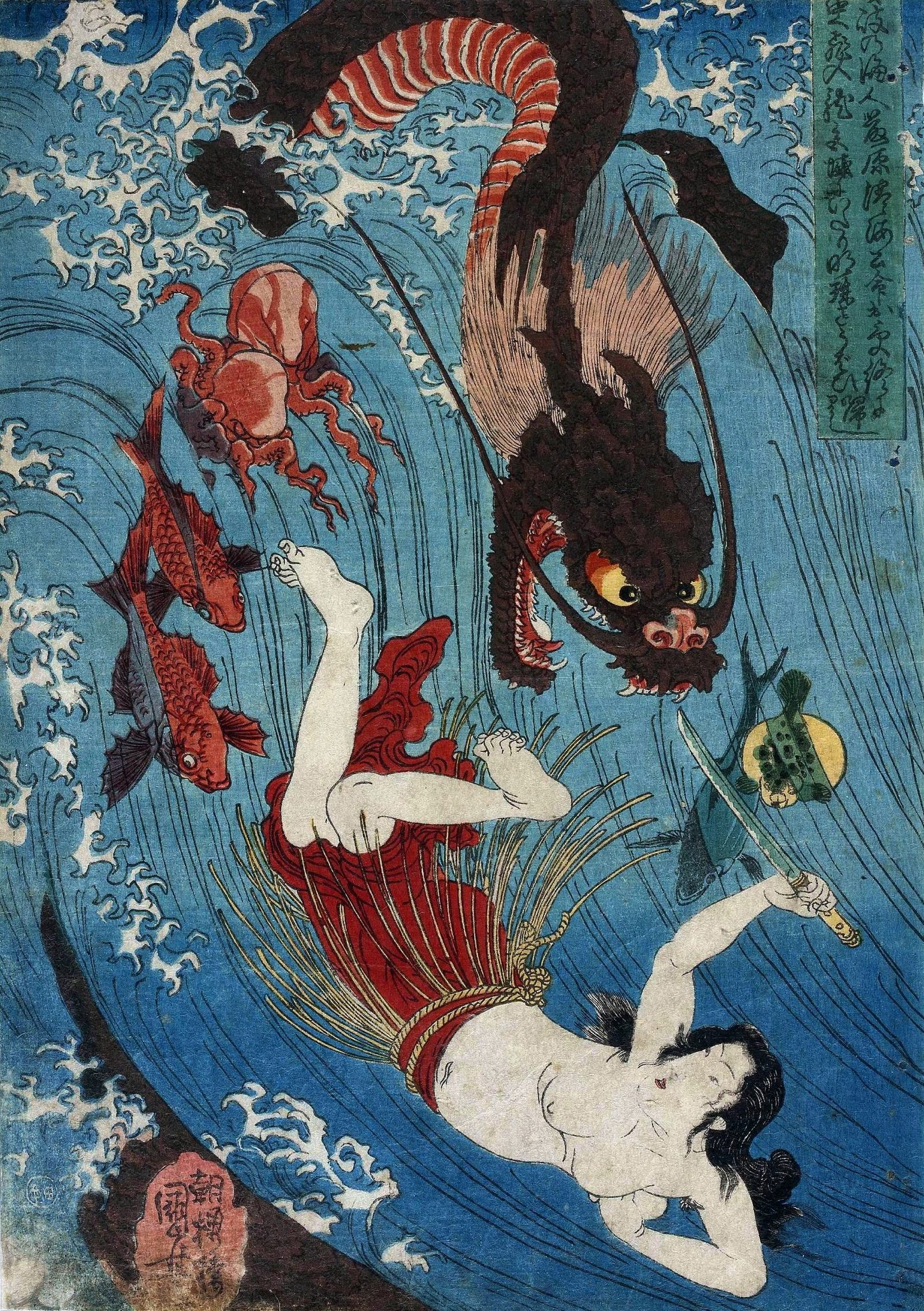
Ryujin, the dragon god pictured above, is one specific being nested within that broader Suijin category; he is not a rival term standing outside it. He is the tutelary deity of the sea specifically, said to be able to transform into human shape, and he is the antagonist of one of Japan's most frequently illustrated maritime legends: a pearl diver named Tamatori, sent to recover a stolen jewel from his undersea palace, who has to outrun Ryujin's sea creatures on the way back to shore after taking it. The print above shows exactly that chase. Even within a single mythology, a water god can mean an entire category on one hand and one specific dragon inside that category on the other, which is a fair summary of the confusion the phrase causes everywhere else too.