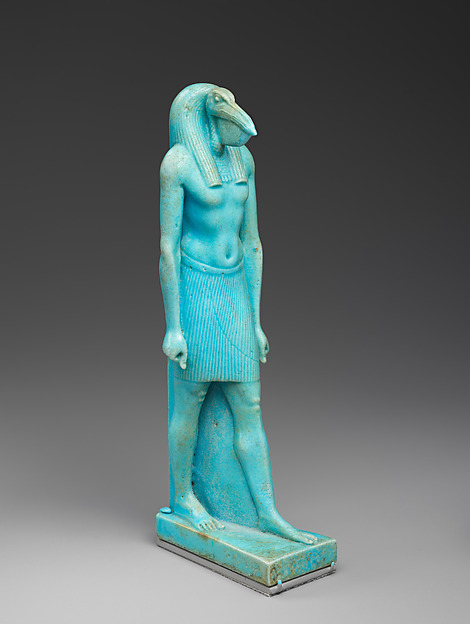
The job everyone assumes he had
Ask who judges the dead in Egyptian mythology and Thoth is a common guess. He is the wisdom god, the one holding the scribe's palette in half the museum reliefs, so it feels right to hand him the verdict too. The clearest surviving picture of what he actually does comes from the Papyrus of Ani, a Book of the Dead manuscript made for a Theban scribe named Ani around 1250 BC, during Egypt's Nineteenth Dynasty, and now held at the British Museum. It splits the ceremony into distinct jobs, and none of the top ones belongs to Thoth.
Anubis operates the scale, weighing the deceased's heart against the feather of Ma'at, goddess of truth and order, while the monster Ammit, part crocodile, part lion, part hippopotamus, waits beside the balance to devour any heart too heavy with wrongdoing. Thoth stands at the scale in his ibis-headed form, sometimes shown instead as a baboon perched on top of it, holding a scribe's palette and reed pen, and writes down what the balance finds. Osiris, enthroned at the far end of the hall, is the one the verdict is actually reported to. Anubis runs the test. Osiris receives the ruling. Thoth's part is the paperwork.
A Greek name on an Egyptian face
The name most people use, Thoth, is itself a Greek import. The Egyptian original, written Ḏḥwtj, is rendered by Egyptological convention as Djehuti, though the Hellenized "Thoth" has been the more common label for so long that even Egyptologists default to it. In art he appears as a man with the head of an ibis, or occasionally a baboon shown holding up a crescent moon, both animals treated as sacred to him. The ibis connection has a specific proposed reason behind it: ancient Egyptians may have read the curved shape of the bird's beak as an echo of the crescent moon, tying his image directly to the lunar half of his portfolio.
His formal title, scribe of the gods, undersells the actual job description. Later Egyptian religion credited him with the invention of writing, music, and hieroglyphs, and pulled him into the arbitration of disputes among the other gods, less a court stenographer than a divine mediator with a very good memory for who said what. The claim that he invented writing gets its most vivid telling not from an Egyptian temple wall but from a Greek philosophical dialogue: Plato's Phaedrus, written around 370 BC, has Socrates retell a story in which the Egyptian god Theuth presents his inventions, numbers, arithmetic, geometry, astronomy, and above all writing, to King Thamus, calling the new invention "an elixir of memory and wisdom." Thamus is not convinced, warning that "this invention will produce forgetfulness in the minds of those who learn to use it, because they will not practice their memory," in Harold N. Fowler's Loeb Classical Library translation. It is a Greek fable using an Egyptian god to make a philosophical point about literacy, not a native Egyptian account of the invention.
The city of eight gods that was never officially his
Thoth's chief temple stood in the city the Egyptians called Khemenu, meaning roughly "City of Eight." The name has nothing to do with Thoth himself. It refers to the Ogdoad, eight primordial deities worshipped there in four male-female pairs: Nun and Naunet, the formless waters that preceded creation; Heh and Hauhet, boundlessness; Kek and Kauket, darkness; and Amun and Amunet, hiddenness. Together they represented the raw qualities of the universe before anything had taken shape, the same kind of unresolved creation question this site's overview of Egyptian gods covers across Heliopolis, Hermopolis, and Memphis's three competing accounts of who actually built the world.
Thoth ran the temple in a city named for somebody else's pantheon. The Ogdoad's own roster stops at eight, four pairs and nothing more, with no seat reserved for the ibis-headed god whose priesthood maintained their cult. It is an easy detail to lose if a source only lists Egypt's dozen or so best-known deities and assumes each city's chief god must also star in that city's headline myth. Greek visitors later smoothed the mismatch over by renaming the city entirely: once they had decided Thoth was their own god Hermes wearing a different head, Khemenu became Hermopolis, City of Hermes, dropping the Ogdoad's number from its name altogether.
The eye he probably fixed, in the version most people tell
Thoth also shows up in the myth behind the Eye of Horus, though which version you read changes his role in it. After Horus and Set fight over the throne Set stole from Horus's father Osiris, Set damages or tears out one of Horus's eyes. In most surviving accounts, another god restores it, and that god is usually Thoth, who is described either as brokering peace between Horus and Set or as physically reassembling the eye after Set tore it apart. Temple texts from the Greco-Roman period go further, describing Thoth working alongside fourteen other deities to fill the wound using specific plants and minerals.
Not every version agrees, and the disagreement is worth keeping rather than smoothing over. In The Contendings of Horus and Set, a narrative text from the late New Kingdom, Set instead tears out both of Horus's eyes and buries them, and by the next morning they have grown into lotus flowers. The god who restores them in that telling is not Thoth at all but Hathor, who anoints the empty sockets with gazelle's milk. Ancient Egyptian myth rarely settled on one canonical script, and the eye Thoth is usually credited with fixing is also the symbol whose fractional geometry scribes reused as a real system for measuring grain.
How a Greek word game turned one scribe into three
By the time Herodotus was writing in the fifth century BC, Greeks visiting Egypt had already decided Thoth was their own messenger god under a different name, and the identification was fully in place by the third century BC. That is why Khemenu became Hermopolis rather than keeping some transliteration of its own name, and why the honorific Egyptians used for Thoth was carried into Greek as the epithet Trismegistus, thrice-great, attached to the merged figure of Hermes Trismegistus.
That composite god had a longer afterlife than either of his source deities. Hermes Trismegistus was credited as the pseudonymous author of the Hermetica, a collection of roughly seventeen Greek philosophical treatises written between about AD 100 and 300, while temples to Thoth under Roman rule were still functioning, if increasingly squeezed by imperial tax and land policy rather than shut down outright. It took until AD 391 and 392, when the emperor Theodosius I ordered pagan temples across the empire closed, for Egypt's old priesthoods to lose their legal footing at all, a shutdown some holdout shrines elsewhere in Egypt outlasted by a century or more. Those Hermetic texts became the foundation of Hermeticism, an esoteric tradition that later shaped Renaissance occult philosophy and, further downstream, modern tarot and astrology, none of which has much connection to what New Kingdom priests actually believed about the ibis-headed scribe who wrote down the verdicts he did not hand down. It is also a different god from the Hermes profiled elsewhere on this site: two unrelated deities from two separate pantheons, merged by Greek visitors making sense of a foreign religion, not gods who share a myth of their own.