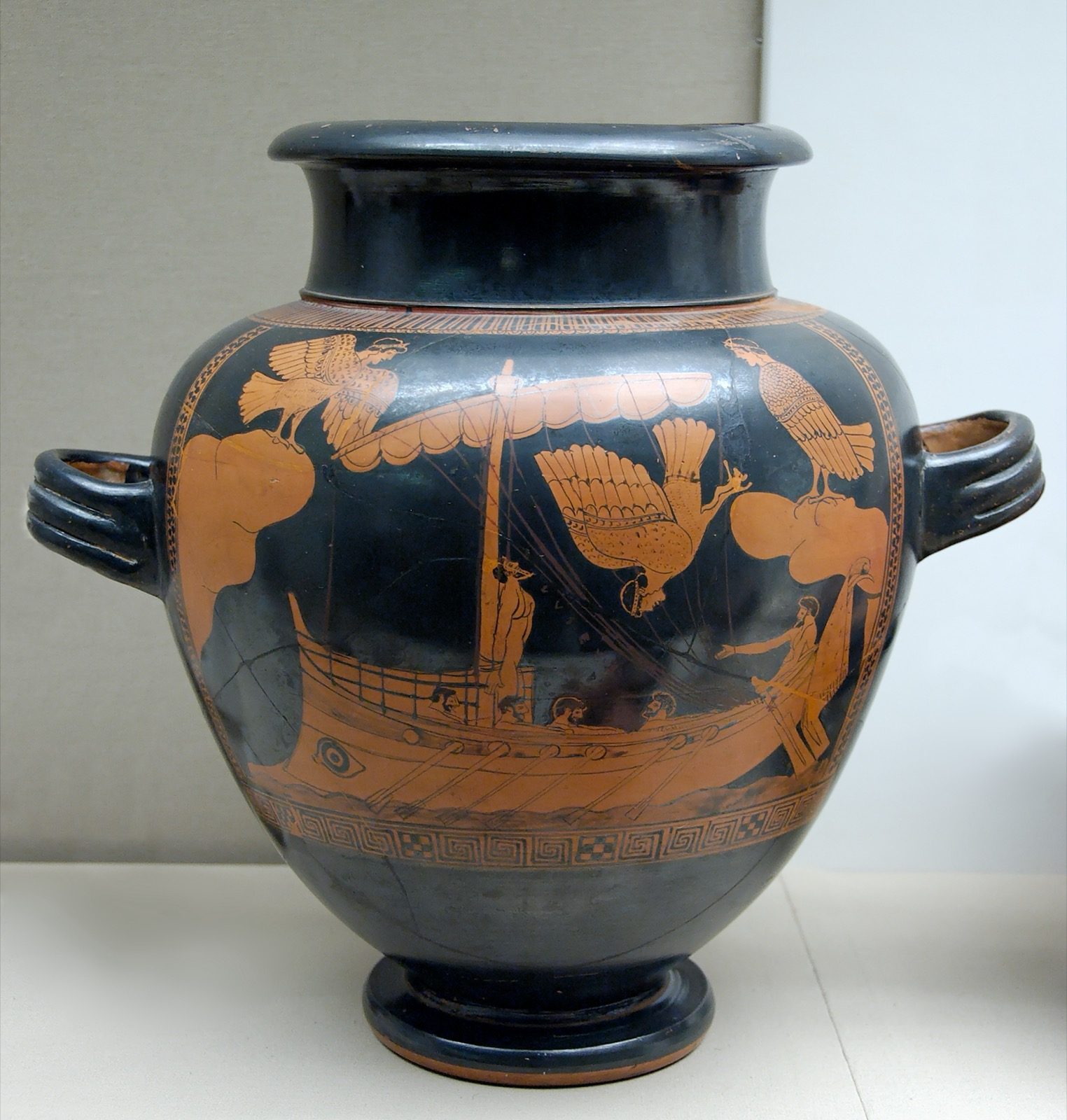

Homer never says what a Siren looks like
The warning comes from Circe, not from the Sirens themselves. Before Odysseus's ship reaches their island, Circe tells him exactly what is coming: a meadow ringed with "a great heap of bones of mouldering men," a song no sailor has ever survived hearing, and a fix, plug his crew's ears with wax and have himself bound to the mast if he wants to listen and live (Odyssey 12.39-54, A.T. Murray's translation). She calls them "the two Sirens." Not three, not a named trio, just two, and that number matters, because most of what circulates online as the "full" story of the Sirens (three named sisters, daughters of the river god Achelous and a Muse) comes from centuries-later sources like Apollodorus's Bibliotheca, not from Homer.
What Circe's warning never does, in the entire passage, is describe how the Sirens look. No feathers, no fish tail, no mention of beauty. The silence continues when the Sirens sing to Odysseus in person a few hundred lines later. Classicist Gerald K. Gresseth, writing on the folkloric background of the Homeric Sirens, put the gap bluntly: "Homer doesn't say that they had bird forms of any kind. Actually Homer doesn't say anything on this matter either way." Every visual detail readers now take for granted, the wings, the talons, the human face, was supplied later by artists and mythographers filling in a blank Homer left open.
What the song is actually selling
When the Sirens do speak, in Book 12, their pitch is not about themselves at all. "For never yet has any man rowed past this isle in his black ship until he has heard the sweet voice from our lips. Nay, he has joy of it, and goes his way a wiser man. For we know all the toils that in wide Troy the Argives and Trojans endured through the will of the gods, and we know all things that come to pass upon the fruitful earth" (Odyssey 12.184-191, A.T. Murray's translation). The offer is complete knowledge of the Trojan War and of everything that happens on earth. Nothing about appearance, nothing about love.
Emily Wilson, the classicist who published the first English translation of the Odyssey by a woman in 2017, made the same point in a 2018 Twitter thread dissecting five major English translations line by line: "we learn nothing even about their hair, in contrast to other divine temptresses. The seduction they offer is cognitive." She singled out one recurring translation choice: the Greek word for what the song pours from, stomatōn, means "mouths," not "lips," yet Lattimore, Fagles, Lombardo, and the standard Loeb edition all render it "lips" anyway. Fitzgerald skips the word swap and goes further still, inventing throats, honey, and a "purling note" that aren't in Homer's Greek at all. Wilson called the lips substitution a pattern with no textual justification "unless you want to make sure the Sirens sound sexy." The changes are small, a word here, an image there, but they show how much of the Sirens' modern sex appeal was added by translators working millennia after Homer composed the poem, not by Homer himself.
Ancient artists filled the gap with a bird body of no fixed sex
Vase painters and sculptors started filling in Homer's silence almost as soon as it existed. Surviving Sirens in Greek art go back to the 7th century BCE, rendered as birds with human heads and, eventually, human arms grafted onto a bird's body and legs. A 2024 study in the classics journal Pallas, surveying Sirens across Archaic and Classical Attic vase-painting, traces this iconography through the 6th and 5th centuries BCE and ties it directly to Greek religion's treatment of the Sirens as afterlife and burial figures, not erotic ones. By the middle of the 6th century BCE, the form that dominates the surviving record has a woman's head, torso, and arms on a bird's wings and legs.
That dominant form was not the only one. Classical pottery from the same broad period also shows Sirens as male, sometimes bearded, alongside the female examples, a detail Audubon magazine's coverage of siren scholarship confirms and that a handful of surviving vases bear out directly. The gender split never became a real controversy in antiquity because ancient sources never agreed on much else about the Sirens either: Apollodorus names three, Peisinoe, Aglaope, and Thelxiepeia, daughters of Achelous and the Muse Melpomene; a separate tradition names them Parthenope, Ligeia, and Leucosia; the Roman mythographer Hyginus counts four. A creature nobody could agree on the number, names, or parentage of was never likely to get a fixed sex in its art, either. Selene gets a similar flattening treatment in Greek myth: modern references usually merge her with Artemis and Hecate into one interchangeable lunar figure, even though she alone was ever treated as the literal Moon in the earliest surviving sources.
On Greek tombs, the Siren is a mourner
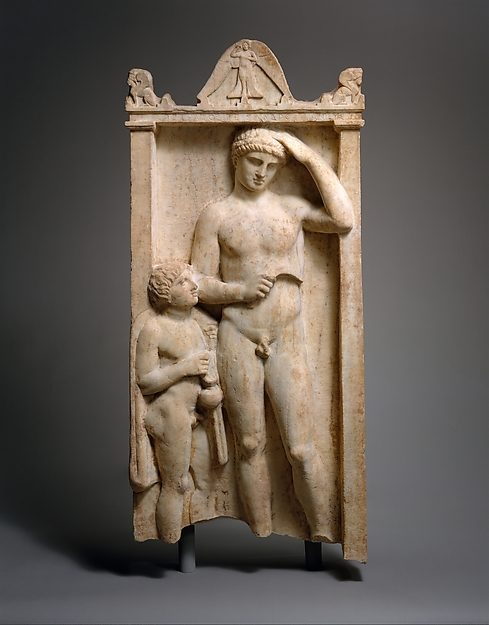
The clearest evidence that ancient Greeks didn't read Sirens as seductresses sits in their cemeteries. Sirens appear regularly on Attic grave stelai and funerary vases from the Classical period, carved in the pose of a mourner rather than a temptress. The Metropolitan Museum's marble grave stele of Sostratos, carved in Athens around 375-350 BCE for a young athlete shown holding a strigil, places a Siren in the pediment above him tearing her hair and beating her breast, the standard ancient gestures of grief, while sphinxes stand guard at either end of the monument as protectors of the tomb.
That funerary role is not incidental. The Pallas study on Siren iconography frames it as central: in ancient Greek religion, the Sirens carried a genuine connection to death, the afterlife, and burial ritual, which is presumably why grieving families put them on their children's and relatives' gravestones in the first place. A creature commissioned to sing a dead man's mourning song is not doing the same cultural work as a mermaid luring a ship onto the rocks, even though modern retellings collapse the two into one image.
The fish tail is a medieval invention, not a Greek one
Nothing in Homer, in Apollodorus, or on any Archaic or Classical Greek vase gives a Siren a fish's tail, and the bird body held on for far longer than most retellings assume. Apollonius of Rhodes, writing the Argonautica in the 3rd century BCE, still describes them as "fashioned in part like birds and in part like maidens to behold," daughters, in his telling, of the river Achelous and the Muse Terpsichore, yet another parentage tradition on top of the ones Apollodorus and Hyginus give. Roughly nine hundred years later, Isidore of Seville was still describing three Sirens as "part maidens, part birds, having wings and talons," each assigned her own instrument, voice, flute, or lyre, in his 7th-century Etymologies.
The fish-tailed version enters the written record only with the Liber Monstrorum, an Anglo-Latin bestiary from the late 7th or early 8th century that some scholars connect to the same manuscript culture that produced Beowulf, which describes the creature as a scale-tailed "sea girl" below a woman's head and torso. Even then the older image didn't disappear overnight: writers kept describing a bird-bodied Siren for centuries afterward, Jacques de Vitry still gave the lower half feathers around 1220 CE, roughly half a millennium after the fish-tailed version had already entered the written tradition. Roman literature, meanwhile, had moved the Sirens further from Homer while still keeping them bird-bodied and explicitly female. In Ovid's Metamorphoses, written around 8 CE, the Sirens are Persephone's own companions, gathering flowers with her when Hades seizes her; after searching for her across the land in vain, they ask the gods for wings to search the sea as well, and are granted "golden plumage" while their "virgin face and human voice" stay intact, so the singing that made them famous survives the transformation, an origin story with no counterpart in the oldest surviving account of that same abduction, composed centuries earlier. The two body types, bird and fish, ran alongside each other in medieval art and text for hundreds of years before the fish-tailed version won out completely, a shift classicist Wilfred P. Mustard traced to the classical Siren merging with an unrelated "Teutonic and Northern superstition of the mermaid." That merger, not anything in Greek myth, is where today's exclusively female, exclusively fish-tailed Siren comes from. The drift hasn't stopped: in 2022, a beauty trend called "siren eyes" turned the name into a TikTok makeup look built entirely around seduction and glamour, the furthest possible point from a bird that sang a dead man's mourning song or offered a shipwrecked sailor a lecture on the Trojan War instead of a kiss.