A protective symbol that came before the story
Long before anyone bothers to explain why it works, the gorgoneion is already doing its job. The image, a frontal face with bulging eyes, bared teeth, and a lolling tongue, shows up on temple pediments, hoplite shields, coins, and doorway lintels across the Greek world from the Archaic period onward, and it functions as an apotropaic device: something meant to frighten danger away, not illustrate a myth. Homer's Iliad already assumes its audience recognizes what the image means. Agamemnon's shield carries "the Gorgon, grim of aspect, glaring terribly, and about her were Terror and Rout" (Iliad 11.36-37, A.T. Murray's translation), and the poem never pauses to explain who Medusa is or how she died. The protective use came first. The biography got attached later.
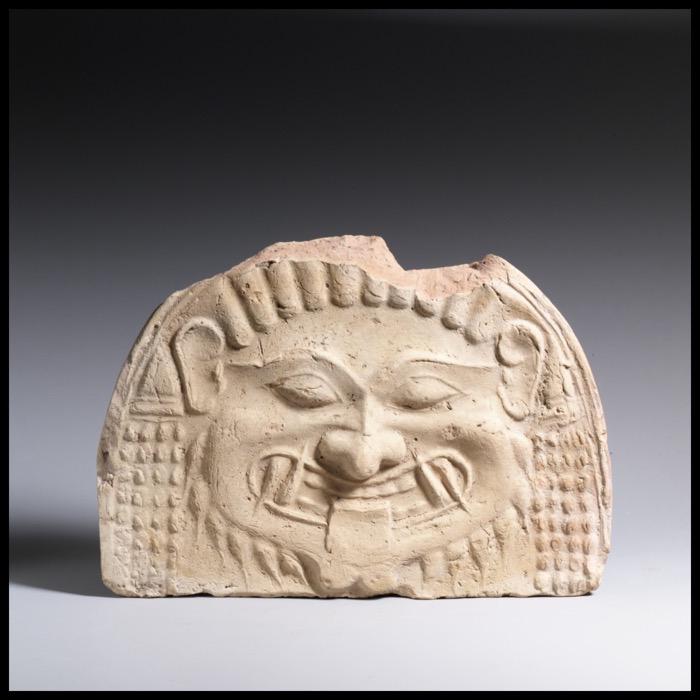
That order shows up in the objects themselves. A terracotta antefix made for a Greek temple roof around 570 BCE, now in the Metropolitan Museum, is just the face: no body, no Perseus, no sword, only the wide-mouthed stare mounted where it could watch over the building. According to the Metropolitan Museum's research into Medusa's appearances in Greek art, Archaic-period artists had already combined bulging eyes, fangs, snakes, and a gaping, tongue-out mouth into this fear-inducing package well before Medusa had anything resembling a sympathetic backstory.
Two Medusas who cannot both be true
The oldest surviving account gives Medusa no origin story to feel sorry for. Hesiod's Theogony, composed around 700 BCE, lists her as one of three Gorgon sisters, daughters of the primordial sea deities Phorcys and Ceto, two names that rarely make it onto simplified family trees of the Greek pantheon: "Sthenno, and Euryale, and Medusa who suffered a woeful fate: she was mortal, but the two were undying and grew not old" (Theogony 276-277, Evelyn-White's translation). She is not a beautiful woman who fell from grace. She is born into a family of monsters, the only mortal one of the three, and that single detail is the whole reason Perseus can kill her. Hesiod even accounts for her connection to Poseidon in the same passage, saying only that the sea god lay with her "in a soft meadow amid spring flowers," with no palace, no temple, and no violence attached to the line.
The story most people know today is not this one. It comes from Ovid's Metamorphoses, written in Latin roughly seven centuries after Hesiod. Ovid's Medusa starts out mortal and famous for her beauty, admired above all for her hair, until Neptune, the Roman name for the sea god Poseidon, assaults her inside the temple of Minerva, the Roman Athena. Minerva's response, in the poem, lands on the victim, not the god responsible: she "changed the Gorgon's locks to ugly snakes," turning Medusa's face into the very thing that now defines her. Two authors, seven hundred years apart, describing an encounter with the same god, and only one of them treats it as a crime that needs someone to blame.
Athena wears the result, she does not bury it
Whichever version a given household believed, both end at the same image: Perseus beheads Medusa, and Athena, the goddess who arrived already grown and armored, mounts the severed head on her own aegis, the goatskin shield she carries into battle. The gorgoneion becomes the goddess's personal emblem, not a monster kept at a distance but a face she wears. In Ovid's telling, that is a strange choice for the trophy of a punishment she herself is credited with inflicting on the victim, not the man responsible for the assault. In Hesiod's telling, it reads more simply: a powerful goddess claiming the head of a dangerous creature, the way any hero claims a trophy. Either way, the culture that told this story chose to keep the image working, not retire it.
Same face, opposite arguments, centuries later
Designer Gianni Versace founded his fashion house in 1978 and later chose the same image as its emblem. According to his sister Donatella, his reasoning stayed close to Ovid's fatal-attraction framing over Hesiod's. She has said he told her that "whoever falls in love with Medusa can't flee from her," building the entire brand identity around beauty framed as danger. The logo keeps the myth's threat intact and drops everything about victimhood or punishment.
Sculptor Luciano Garbati went the opposite direction. His 2008 bronze, "Medusa with the Head of Perseus," reverses the pose of a 16th-century Cellini statue in Florence and shows Medusa holding Perseus's severed head instead of the other way around. The piece went viral online in 2020 after an Italian scholar reposted it, and it was installed in a park facing the New York courthouse where Harvey Weinstein stood trial, adopted as an unofficial symbol of the #MeToo movement. Garbati has said the point was that a victim should not have to lose in order to be admired: "How can a triumph be possible if you are defeating a victim."
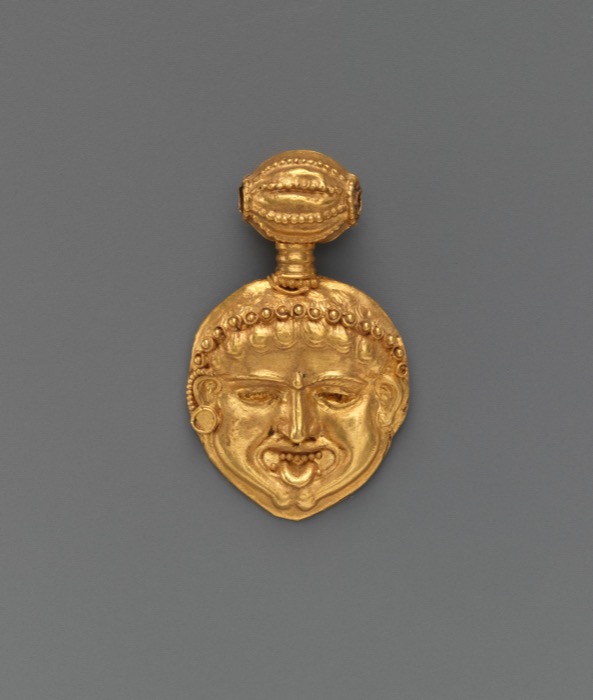
Neither of those readings needs the ancient gorgoneion to make its point, but the oldest use of the image has not disappeared either. Contemporary discussion of Medusa tattoos and jewelry commonly frames the image in protective terms, guarding the person who wears it rather than warning enemies off someone else's shield. Wikipedia's overview of Gorgon symbolism traces that split meaning back to the snakes themselves, which cultures around the ancient Mediterranean associated with both danger and the chthonic, regenerative underworld, threatening in one context and protective in another. The specific vocabulary people use today is new. A solid gold pendant in the Metropolitan Museum, made around 450 BCE, shows the idea itself is not: Greeks were already wearing this face against their own skin for exactly this reason more than two thousand years before anyone called it a tattoo.