
Search "Norse goddesses" and the results agree on a list. Philologists don't agree on the count.
Type "Norse goddesses" into a search engine and the results settle into a familiar pattern: a numbered list, Frigg first as queen of Asgard and wife of Odin, Freyja second as goddess of love, war, and magic, each with her own tidy portfolio and no overlap implied. That framing treats the two as obviously separate figures who happen to share a similar-sounding name. The etymology behind that name is where the tidiness breaks down.
Frigg's name has close relatives across the old Germanic-speaking world: Old English sources call the same figure Frig, Old High German sources call her Frija, and all three forms trace back to a reconstructed Proto-Germanic root, Frijjo. Freyja's name has no such company. Neither her name nor the Vanir, the family of gods she belongs to, show up anywhere outside Scandinavia in the surviving record. In his 1835 treatise Deutsche Mythologie, the philologist Jacob Grimm treated that gap as real evidence, not mere coincidence, arguing that Frigg and Freyja both trace back to a single earlier goddess, Frijjo, whose worship split into two figures once Norse tradition diverged from the rest of the Germanic-speaking world.
The hypothesis still divides specialists more than a century and a half later. Scholars including Britt-Mari Nasstrom read Frigg and Freyja as originally the same figure, pointing to how often the two overlap in later sources: both are linked with falcon-feather cloaks used for shape-shifting, both ride in chariots pulled by animals, and Old Norse poets occasionally use their names in ways that blur which goddess is meant. Other researchers hold back from that conclusion, since almost nothing survives from the pre-Viking Age period when a shared origin would have to be settled, which leaves the case built mostly on linguistics and later coincidence rather than direct evidence. Nobody disputes that Frigg and Freyja are two separate figures by the time medieval Icelandic sources start describing them in detail; the argument is only about what came before those sources existed.
Freyja: the Vanir goddess who takes half of the war-dead
In the medieval sources that do survive, Freyja is unambiguously Vanir, not Aesir, a member of the rival family of gods who joined the Aesir's ranks as part of the hostage exchange that ended the Aesir-Vanir War described in MythCairn's piece on where the Norse gods come from. Her father Njord and brother Freyr came with her. That outsider origin sits oddly with how central she becomes to Norse mythology's picture of the afterlife: according to the Eddic poem Grimnismal, in which the disguised Odin lectures a captive prince on the geography of the nine worlds, Freyja takes half of all warriors who die in battle to her own hall, Sessrumnir, in a field called Folkvangr, while Odin keeps the other half for Valhalla. The poem gives no reason for the split, only the fact of it, one more detail that makes Freyja look less like a junior goddess of romance and more like a second, independent power running her own corner of the afterlife.
Freyja's other attributes point the same direction. She owns a cloak of falcon feathers that lets its wearer fly in bird form, later lent to Loki twice, once to search for Thor's stolen hammer and once to rescue the kidnapped Idunn. She travels by a chariot drawn by two cats. Snorri Sturluson's Prose Edda names her the foremost practitioner of seidr, a form of magic tied to fate and prophecy that the sources say she taught to the Aesir themselves, including Odin. And Sorla thattr, a later Icelandic tale, has her obtaining the golden necklace Brisingamen by spending a night with each of four dwarven smiths who forged it, a story artists have returned to repeatedly since.
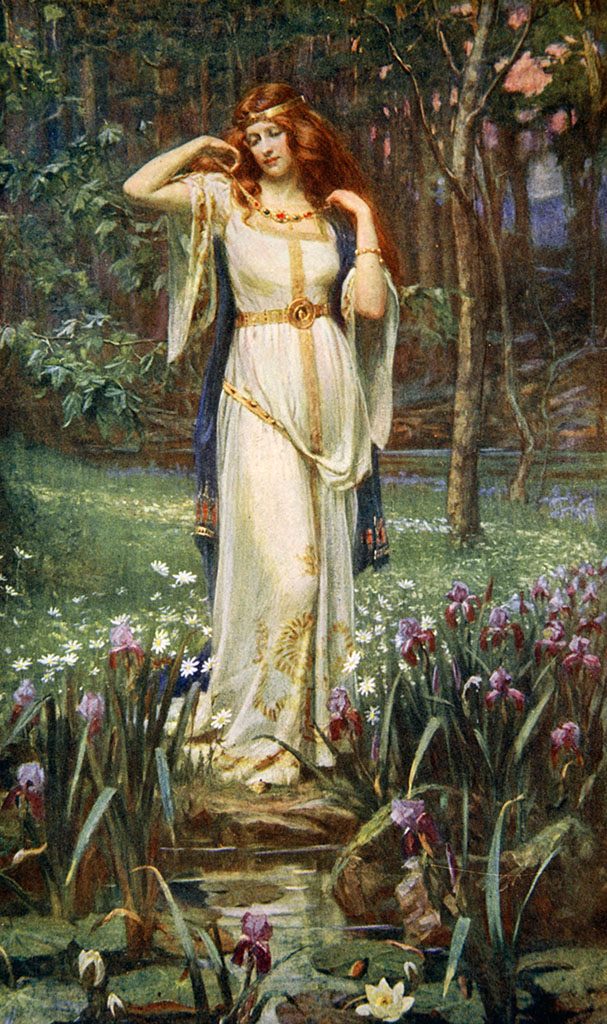
Frigg: the queen who knows every fate and repeats none of them
Frigg's role in the surviving sources reads as more settled and less adventurous than Freyja's, which is part of why the two are usually kept apart on modern lists despite the etymological question above. She is Odin's wife and, by most tellings, the highest-ranking goddess among the Aesir, associated with marriage, motherhood, and the running of the household, a domestic portfolio distinct from war or magic practiced for its own sake. Her clearest individual trait shows up in the poem Lokasenna, where Loki works his way around a hall insulting nearly every god and goddess present. When he turns on Frigg, Freyja intervenes and warns him that Frigg knows the fate, or orlog, of every being that exists, even though she never says what she knows out loud.
That single detail, foreknowledge permanently withheld, has done a lot of work in keeping Frigg and Freyja distinct in the popular imagination even while philologists keep arguing about their shared name: Frigg is the goddess who sees everything and says nothing, bound to Odin and to Asgard's ruling house, while Freyja moves independently between worlds, keeps her own hall, and teaches magic rather than simply possessing foreknowledge of it. The overlap Grimm and later scholars point to is real, but so is the distance between a queen who withholds what she knows and a goddess who actively practices the craft of knowing it.
Idunn's apples, and the one afternoon Asgard nearly grew old
Idunn keeps the apples that the Aesir depend on to stay young, and the Prose Edda's account of what happens when she goes missing is one of the few Norse myths where a goddess drives the entire plot instead of appearing as a supporting figure in a god's story. Loki, coerced by the giant Thiazi after a botched attempt to steal an ox, lures Idunn out of Asgard's walls by claiming to have found apples even more interesting than her own, then stands by while Thiazi, disguised as an eagle, snatches her and carries her off to his home. Idunn's apples leave Asgard along with her.
The consequence is immediate and physical rather than symbolic: without the apples, the Aesir begin aging rapidly, and the Prose Edda describes them turning gray and stooped within what reads as a single stretch of time, not years. Once the gods work out that Loki is responsible, they force him to fix it. He borrows Freyja's falcon-feather cloak, flies to Thiazi's home, transforms Idunn into a nut to carry her, and races back to Asgard with the giant close behind in eagle form. The Aesir kill Thiazi at Asgard's wall as he closes in, and the apples, and the gods' youth along with them, are restored. Skadi, Thiazi's daughter, does not let the matter end there.
Skadi picked a husband by his feet, and got the wrong god
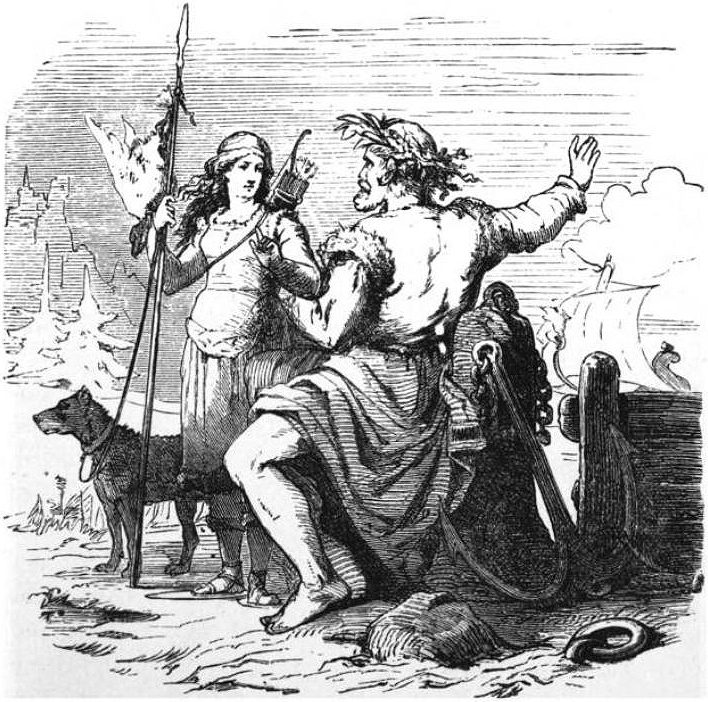
Skadi arms herself and marches on Asgard once she learns her father Thiazi is dead, and the Aesir, unwilling to fight her outright, offer a settlement instead: she may choose a husband from among the gods to make up for her loss, on the condition that she choose by looking at nothing but their feet. Skadi picks the pair she judges most beautiful, expecting them to belong to Baldr. They belong instead to Njord, the Vanir god of the sea and Freyja's own father.
The marriage does not survive contact with either god's home. Njord's hall, Noatun, sits on the coast; Skadi's home, Thrymheim, sits high in the mountains where her father used to hunt. According to Snorri's account in the Prose Edda, the couple agree on a compromise: nine nights at Thrymheim first, then nine nights at Noatun. The arrangement fails on sensory grounds, not any dramatic betrayal: Njord cannot stand the howling of wolves that fills Skadi's mountains at night, and Skadi cannot stand the cries of seabirds that never stop along Njord's coast. Neither one adjusts. The two separate, and Skadi returns to Thrymheim alone, an ending the source treats as a plain fact of the myth, not a tragedy to be mourned, which is part of why modern retellings that end the story at the wedding are leaving out how it actually finishes.

Two goddesses this piece leaves out, because they already have their own
A complete list of Norse goddesses would also include Hel, who governs the realm that receives most of the ordinary dead, and Sif, Thor's wife, best known for the myth explaining how she got her golden hair. Neither gets full treatment here because MythCairn already covers both in depth: Hel's actual role in the Prose Edda has little to do with the villain later adaptations turned her into, and what the medieval sources do and don't say about Sif's marriage to Thor turns out to be a lot less than most retellings claim.