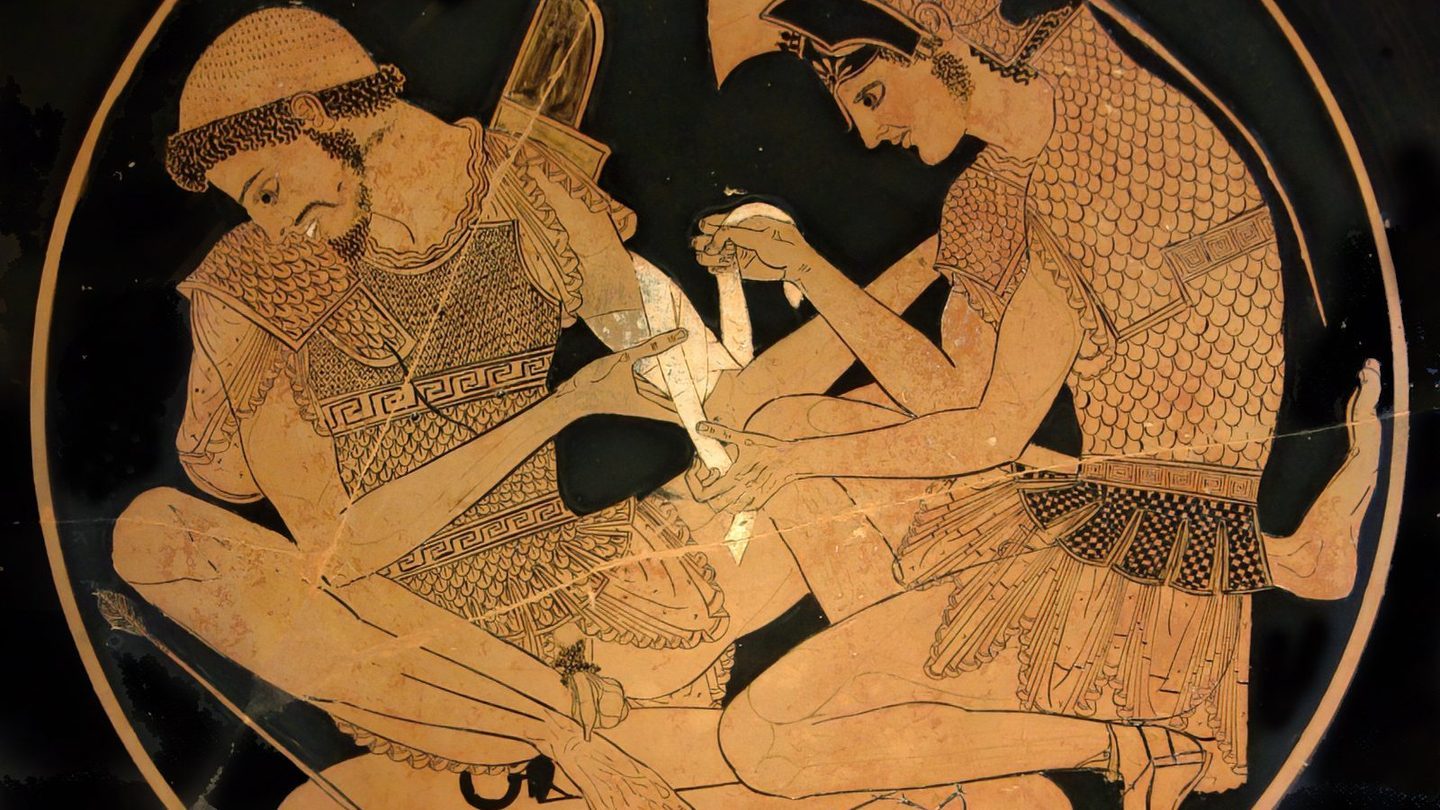

Why does Patroclus wear Achilles' armor?
The request comes during a crisis at the ships, not before an ordinary day of fighting. At the opening of Book 16, Patroclus reports that several Greek leaders are wounded. Achilles is still refusing to fight after his quarrel with Agamemnon. Patroclus asks him to send the Myrmidons under a substitute commander and to lend the armor that the Trojans associate with Achilles. The intended mistake is stated openly: the enemy might think Achilles has returned and pull back. That would give the tired Greeks time to recover.
There are two parts to the proposal: fresh troops can drive back weary attackers, and recognizable equipment can lend those troops Achilles' reputation. Calling it a disguise explains the second part. It does not mean Patroclus sneaks into Achilles' tent or takes the armor without permission. Achilles agrees and helps arrange the force. The request and response are in Iliad 16.20-100.
This military question is separate from the long debate about Achilles and Patroclus's relationship. Their closeness matters to the episode, and the poem gives an explicit battlefield reason for the loan. A summary that says only that Achilles wants to protect his friend misses Patroclus's stated proposal and the danger facing the ships.
Achilles permits a rescue, with a stopping point
Achilles has not reconciled with Agamemnon when he gives permission. He explains his anger over the seizure of Briseis and the insult to his standing among the Greeks. The armor loan allows his troops to intervene while he stays out of the fighting himself. His speech also connects a successful rescue with recognition of his value: he expects the Greeks to honor him and restore what was taken from him.
The instruction has a clear limit. In A. T. Murray's translation, Achilles says, "When thou hast driven them from the ships, come back" (16.87-88). He warns Patroclus against continuing the battle on his own and against leading the Greeks toward Troy. Apollo favors the Trojans, he says. Read the warning in the same speech, 16.83-100; it makes the later pursuit an expansion of the mission rather than its original goal.
Achilles subsequently prays for success and a safe return with the armor and companions. The narrator says Zeus grants the rescue of the ships but denies the return. These are different levels of knowledge within the story. The narrator's announcement tells the audience what will happen; it does not show Achilles knowingly sending Patroclus to die. His order and prayer ask for the opposite outcome.
The borrowed equipment and the spear left behind
The arming passage lists greaves with silver ankle fastenings, a decorated breastplate, a bronze sword with silver studs, a strong shield, and a helmet with a horsehair crest. Patroclus takes two spears. He cannot wield Achilles' heavy ash spear from Mount Pelion, so that weapon remains behind. These details are in 16.130-144. The passage identifies a conspicuous exception to the borrowed equipment rather than a complete transfer of Achilles' fighting power.
Thomas Van Nortwick and Geoffrey Steadman's Dickinson College commentary discusses the borrowed armor as part of the poem's distinction between appearance and reality. Their reading gives particular attention to the spear Patroclus cannot use. That is an interpretation of the arming scene; the equipment list and the stated deception can also be checked directly against Book 16.
The armor's later history can cause another mix-up. The shield with the extended scenes of cities, farming, dancing, and the surrounding Ocean belongs to the new set forged in Book 18. It is not the shield Patroclus borrows in Book 16. After Patroclus's death, Antilochus reports that Hector has the old armor. Thetis then asks Hephaestus for replacement equipment for Achilles. Book 18 presents that manufacture after the loss.
A plan-versus-events reading table
The following comparison keeps an order, an observed result, and a later consequence in separate columns. Line numbers refer to the Greek verse numbering used by the Murray edition linked below. Some English verse translations have their own line counts, so use the book and Greek reference when comparing editions.
| Stage | Intended action | What the poem reports | Greek verse reference |
|---|---|---|---|
| Borrow the armor | Make the Trojans think Achilles has returned | The Trojans recognize the equipment and their ranks are shaken | 16.20-45; 16.278-283 |
| Rescue the fleet | Drive the attackers away from the ships | Patroclus breaks the attack and the fire is put out | 16.83-100; 16.284-302 |
| End the mission | Return after the rescue | Patroclus keeps pursuing the Trojans toward the city | 16.684-711 |
| Return safely | Bring back the armor and companions | Apollo disarms him; Euphorbus wounds him; Hector kills him | 16.777-863 |
A downloadable reading worksheet contains these stages, the source links, and space for notes. It is a comparison compiled from the poem, not an archaeological reconstruction or a record of a battle verified to have happened. The stages also help distinguish why the armor is lent from why Patroclus later dies.
The disguise succeeds before the mission goes wrong
When the Trojans see Patroclus and his troops, they think Achilles has set aside his anger. Homer describes their formations as shaken by that recognition. Patroclus's attack then drives men away from the ships and the fire is extinguished. On those immediate terms, the proposed rescue succeeds. The confusion does not make Patroclus unbeatable or prevent the gods from recognizing him; 16.278-302 describes a response by the Trojan troops at this moment.
The stopping point is where events part from Achilles' instructions. Patroclus pursues the Trojans and Lycians. At 16.684-691, the narrator says he could have escaped death had he obeyed Achilles, but also describes Zeus stirring his desire to fight. Both statements belong in an account of the episode. Reducing the explanation to personal arrogance alone leaves out the divine action that the poem supplies.
Near Troy's wall, Apollo repels three attempts by Patroclus to advance. On the next approach, the god tells him that taking Troy is not his allotted task, nor Achilles'. Patroclus draws back. Later, Apollo strikes him from behind and strips away his protection: the helmet falls, the spear breaks, the shield drops, and the breastplate is loosened. Euphorbus then wounds him. Hector delivers the fatal thrust while Patroclus is retreating without his armor. The armor has ceased to protect him before that final blow.
Hector's imagined order is not Achilles' instruction
After striking Patroclus, Hector boasts about what his opponent supposedly hoped to do. He imagines that Achilles sent Patroclus out with an order not to return until he had bloodied Hector's tunic. That is Hector's reconstruction of his enemy's intentions, not the earlier instruction readers heard from Achilles. Compare the speeches at 16.83-100 and 16.830-842: Achilles ordered a return after the ships were saved.
Readers tracing the wider genealogy can compare Alcmene's contested family tree and the Greek gods' family tree chart. The distinction matters in a short answer to this question. Patroclus goes into battle wearing borrowed armor to help save the fleet through force and misidentification. He is not given a mission to kill Hector. The pursuit carries him beyond the agreed limit, and the poem shows divine intervention as well as human attacks in his defeat.
Book 18 opens with news of the death and the loss of the armor. Achilles' grief then brings him back into the war, and Thetis obtains the replacement set from Hephaestus. See 18.15-21, 18.428-461, and 18.478-617. Achilles' own death is a separate question: the sources for how Achilles dies extend beyond the Iliad's narrated ending.