.jpg)
Selene, Artemis, and Hecate get filed under one search result. The Greeks kept them apart.
Look up "Selene greek mythology" today and the reference sites that come back tend to treat her as one point on a triangle with Artemis and Hecate, three moon goddesses standing in for the same idea. That triangle is real, but it is not where the story starts. Selene is a Titan by birth, daughter of Hyperion and Theia in Hesiod's Theogony, and Wikipedia's summary of the scholarship is direct about what set her apart from the other two: she alone was regarded as the personification of the Moon itself, not merely a goddess associated with it. Artemis began as an Olympian goddess of the hunt and wild places, with no lunar portfolio in the earliest sources at all, and Hecate started out further still, a goddess tied to crossroads, doorways, and the restless dead.
The merger happened later, and it happened for practical reasons rather than theological ones. Wikipedia's entry on Hecate traces the syncretism to the Greek Magical Papyri and other ritual texts, where invoking Selene, Hecate, and Artemis together was thought to make a spell more effective, a convention that hardened into Roman religious practice as the triple form of Diana, Luna, and Hecate worshipped together in sacred groves and at crossroad shrines. By the time that convention was established, Artemis herself had already absorbed at least one older identity of her own, an Anatolian mother goddess folded into her cult at Ephesus. Layering a second, later merger with Selene on top of that only makes the modern one-goddess picture harder to untangle from what any single century of Greek religion actually believed.
Even her own parents change depending which ancient source you read.
The genealogy that gets repeated most often comes from Hesiod's Theogony: the sun-titan Hyperion marries his sister Theia, and the couple produce Helios, Selene, and Eos. The Homeric Hymn to Helios repeats the same family, naming Theia under the epithet Euryphaessa, "widely shining." That much looks settled.
It isn't. The Homeric Hymn to Hermes gives Selene an entirely different father, Pallas, a shadowy figure identified with the son of the Titan Crius, which would make Selene her own cousin under the Hesiodic version. Euripides drops the sibling relationship altogether and makes her Helios's daughter rather than his sister. A fragment attributed to Aeschylus, and a scholium on Euripides's play The Phoenician Women, go further still and name Leto and Zeus as her parents instead, the same couple that produced Apollo and Artemis in the standard tradition. Four separate ancient authors, four different family trees, for a goddess who barely appears in the two poets, Homer and Hesiod, usually treated as Greek myth's most authoritative sources.
Homer never calls her a goddess. The horned crown and golden chariot come from a much later hymn.
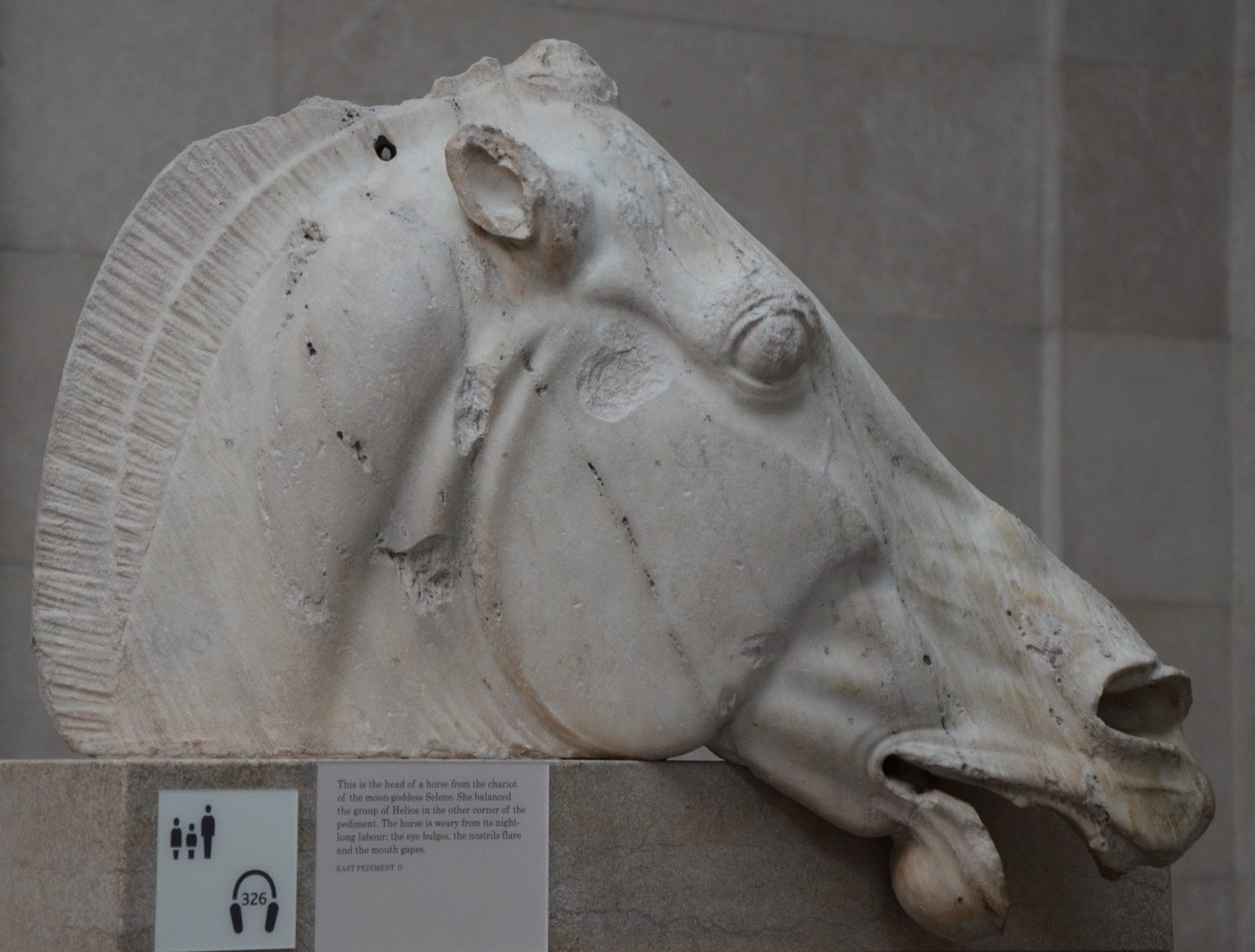
Selene is absent as a goddess from both the Iliad and the Odyssey. Her only appearance in Hesiod's Theogony is the single line naming her parents and siblings; the poem gives her no chariot, no myths, no physical description at all. The vivid imagery most people picture when they think of a moon goddess, the golden crown, the team of shining horses, the ritual bath in the waters of Ocean before each night's ride, comes from the Homeric Hymn to Selene, one of thirty-three Homeric Hymns that despite the name were not written by Homer and are generally dated centuries after the Iliad and Odyssey.
The horns now attached to her, the detail that makes her instantly recognizable in later art, arrive later still. The Orphic Hymn to Selene addresses her as "bull-horned Moon," a text that belongs to a still later layer of Greek religious poetry. Strip away the hymn tradition and go back to Hesiod alone, and Selene has no crown, no horns, and no chariot on record at all, only a name and a family line. Selene isn't the only Greek goddess whose basic facts keep shifting between ancient sources: ancient vase painters couldn't even agree on how many Sirens there were, or whether they were male or female.
Ancient writers can't agree on why Endymion never wakes up.
The myth most people associate with Selene is her love for Endymion, a mortal shepherd she visits nightly while he sleeps in a cave on Mount Latmus, a story already old enough that the poet Sappho apparently referenced it in the 7th or 6th century BC. What almost never survives into modern retellings is that ancient authors could not settle on why Endymion sleeps forever in the first place, and the versions they offer put the blame on three different people.
Apollodorus says the choice was Endymion's own: Zeus let him pick anything he wanted, and he chose an eternal, ageless sleep over death. A scholiast commenting on Apollonius of Rhodes, citing the much earlier poet Epimenides, tells a harsher version, that Zeus imposed the sleep as punishment after Endymion fell in love with Hera. A third account, the one later writers including Cicero and Theocritus treat as the default, removes Zeus from the story entirely and has Selene herself lull Endymion to sleep, not as a punishment but so she can visit him undisturbed, forever, without losing him to old age. Self-chosen boon, divine punishment, a goddess's own doing: three ancient explanations that assign the same outcome to three different actors, none of which quite fits together into one myth.
The strangest version of Heracles' first labor has the Nemean Lion falling out of the sky, from the Moon.
The standard genealogy of the Nemean Lion, the beast Heracles strangles in the first of his Twelve Labors, comes from Hesiod: it is the offspring of the monsters Typhon and Echidna, raised in secret by Hera and set loose on the countryside around Nemea to torment the local farmers. That is the version most retellings still use.
It is not the only one on record. Aelian, writing in the 2nd century AD in his natural history On Animals, preserves a very different account and attributes it to Epimenides, a poet traditionally dated to around 600 BC, roughly seven to eight centuries earlier: "They say that the Lion of Nemea fell from the moon. At any rate Epimenides also has these words: 'For I am sprung from fair-tressed Selene the Moon, who in a fearful shudder shook off the savage lion in Nemea, and brought him forth at the bidding of Queen Hera.'" The philosopher Anaxagoras is separately reported to have repeated the same claim, that the lion fell from the Moon rather than being born on earth at all. Later writers add their own variations on top of it: the pseudo-Plutarch treatise On Rivers has Hera and Selene jointly conjuring the lion out of sea foam using magical incantations, and the Roman mythographer Hyginus says instead that Selene "nourished" the already-formed lion in a cave with two mouths. None of these details made it into the version of the story that gets repeated in modern lion-and-Heracles retellings, where the lunar origin, and Selene's role in producing the first monster the greatest of the Greek heroes ever fought, has simply been dropped.