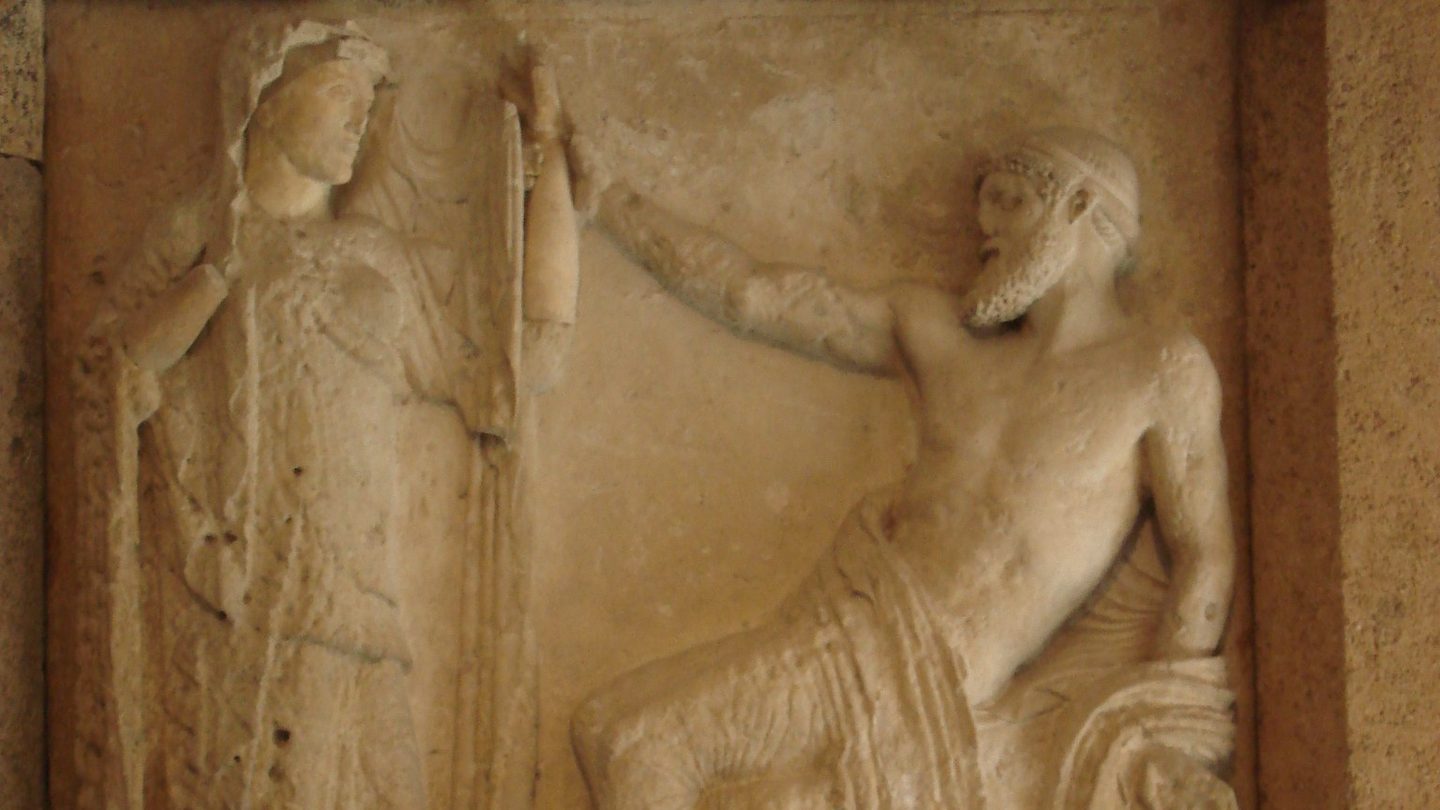

Hera really is his full sister, and the poets never explain why he married her
Yes, Hera was Zeus's sister, and not a half-sister. Hesiod's Theogony lists the children Rhea bore to Cronus as Hestia, Demeter, Hera, Hades, Poseidon and Zeus, which makes Hera and Zeus children of the same two parents. The Twelve Olympians page and the Greek gods family tree show where each sibling sits.
If you open Hesiod hoping for the reason Zeus wed her, you get one line. After the list of his earlier loves, the poem says "Lastly, he made Hera his blooming wife," and names their children as Hebe, Ares and Eileithyia (Theogony 921-923). No motive, no apology, no comment on the family tree. The Iliad is just as quiet. When Hera bargains with Zeus in Book 4, she says she is Cronus's eldest daughter and honored on two grounds, by her birth and because she is Zeus's wife. The sibling bond is offered as a credential there, part of her rank. Nobody in the scene treats it as a problem to be solved.
The question "why did Zeus marry his sister" is a modern one. The earliest Greek poets were busy with a different question, which was how Hera ended up as queen.
Zeus's wives and partners in Hesiod's order, and where the sisters fall
Read in Hesiod's order, the unions look less like a king marrying the only woman available and more like a long series in which Hera is the last wife. This table is compiled from Theogony lines 886 to 923, using the poem's own verbs.
| Order in Hesiod | Partner | How Hesiod puts it | Children he names | Zeus's sister? |
|---|---|---|---|---|
| 1 | Metis | "made Metis his wife first" | Athena, born from Zeus's head | No |
| 2 | Themis | "Next he married" | The Horae and the Moirai | No |
| 3 | Eurynome | She "bare him" | The three Graces | No |
| 4 | Demeter | "came to the bed of" | Persephone | Yes |
| 5 | Mnemosyne | "he loved" | The nine Muses | No |
| 6 | Leto | "joined in love with" | Apollo and Artemis | No |
| 7 | Hera | "Lastly, he made Hera his blooming wife" | Hebe, Ares, Eileithyia | Yes |
Zeus's first two partners are not his sisters, so the idea that he had nobody else to marry does not match the poem. Hera is the last wife on the list. After her, Hesiod adds Maia, Semele and Alcmene (lines 938 to 944) as mothers of Hermes, Dionysus and Heracles, without calling them wives. And Demeter, the other sister on the list, is not a wife in Hesiod's wording. She receives Zeus in her bed and bears Persephone, a story told at more length on the Demeter page. Among the sisters, only Hera is made a wife.
Homer's version is a secret that the parents never knew about
The Iliad does give a glimpse of how the couple's first union was remembered. In Book 14, Hera tricks Zeus on Mount Ida, and the narrator says his desire was as strong as when they first enjoyed each other's embraces and slept together "without their dear parents knowing anything about it" (Samuel Butler's prose translation). That is an affair hidden from Cronus and Rhea.
Later storytellers added courtship. Pausanias, walking through the Argive Heraion in the 2nd century AD, describes a huge gold-and-ivory statue of Hera by Polycleitus with a cuckoo on her sceptre. The locals explained the bird by saying that when Zeus was in love with Hera as a maiden, he changed himself into a cuckoo and she caught it to be her pet. Pausanias adds that he reports such tales without believing them. A scholion on Theocritus, as summarized on Wikipedia, checked 13 October 2026, sets the scene on Mount Thornax instead. Zeus raises a storm, lands on her lap as a cuckoo, she covers the bird with her cloak, and he turns back and takes hold of her. In that version she had been refusing him, and he promised to marry her.
A wedding Greeks re-enacted in cult
The other way the ancient world handled the marriage was to act it out. Wikipedia (checked 13 October 2026) calls the wedding of Zeus and Hera at the Heraion of Samos the classic Greek instance of a hieros gamos, a sacred marriage rite, and notes that most scholars extend the term to real or simulated unions performed to promote fertility. At Plataea in Boeotia, the Daedala was a festival of reconciliation in Hera's honor. Pausanias describes a lesser version held about every four years and a greater one for all Boeotians at much longer intervals, and the festival is linked to an account of a quarrel between Zeus and Hera and their making up.
A marriage that cities re-enacted on a calendar had the standing of an institution, which may be why the texts never pause to justify it. The pairing of Zeus and Hera was already the frame other stories hung from. The peacock article traces her cults at Samos and Argos.
What mortal Greeks thought of marrying a sibling
Mortal Greeks did not treat a brother-sister marriage as ordinary. Wikipedia's (checked 13 October 2026) summary of Greek practice says the law allowed a man to marry a half-sister if they had different mothers, and gives the story that Cimon and his half-sister Elpinice were married for a time as an example of how some accounts describe it. By that rule a full sibling, with both parents in common, would fall outside the allowance, and Zeus and Hera share both parents.
The best evidence for how shocking it looked comes from Alexandria. In the mid-270s BC, Ptolemy II married his full sister Arsinoe II, and the pair took the epithet Philadelphoi, "sibling-lovers." Wikipedia's (checked 13 October 2026) entry on Ptolemy II says that while this matched old pharaonic practice, it shocked Greeks, who considered it incestuous, and that the poet Sotades mocked the marriage and was exiled and assassinated.
An early text that uses Zeus and Hera as an excuse
Theocritus comes closest to giving a reason. In Idyll 17, written in praise of Ptolemy II around 274 BC, he describes Arsinoe as a wife who loves "brother and husband in one." He goes on, in J. M. Edmonds's translation, "So too in heaven was the holy wedlock accomplished of those whom august Rhea bare to be rulers of Olympus," and then pictures Iris laying one couch for the sleeping Zeus and Hera. Wikipedia's (checked 13 October 2026) Ptolemy II article reads this as Theocritus defending the marriage by comparing it to the marriage of the gods.
A court poet needed a precedent to calm Greek readers, and the nearest one was Olympus. The myth is used as a license for humans, which is the reverse of the modern habit of treating the divine marriage as the thing that needs defending. If you want a documented "why" attached to Zeus's marriage to his sister, this is an early one, and it was written to justify someone else's wedding. Ovid later has Byblis, in Metamorphoses 9, argue for her own love of her brother by pointing to Saturn and Ops and to Jupiter and Juno, so the appeal outlived Theocritus.
For Zeus himself, see the Zeus article. Hesiod and Homer record the marriage without a reason. Cult made it a rite, and a court poet in the 270s BC put it to work as an argument.