
The question treats two labels as rivals
Search "is Helios a god or a Titan" and most answers pick a side. Reference pages label him the Titan god of the sun, forum threads argue the point, and the framing assumes that calling him one rules out the other. In Greek sources, though, the two words describe different things. "Titan" is a genealogical and political label, inherited from Hesiod's account of how the cosmos changed hands. "God" is what a being is in worship and in epic, where the word used is theos and where it is applied to Olympians, Titans and river spirits alike. Helios sits on both sides of that line at once, which is why the flat answers keep failing to survive contact with the sources.
Hesiod gives him Titan parents
The genealogical half of the answer is not in dispute. Hesiod's Theogony lists the children of two Titans: "And Theia was subject in love to Hyperion and bare great Helios (Sun) and clear Selene (Moon) and Eos (Dawn) who shine upon all that are on earth and upon the deathless Gods who live in the wide heaven" (Theogony 371-374).
Pseudo-Apollodorus's Bibliotheca gives the same three children to the same parents, and the Homeric Hymn to Helios gives his mother the epithet Euryphaessa, "widely shining," the same goddess under a second name. Helios is the child of Titans and the brother of the Moon and the Dawn. Zeus, Hera and Hestia also have Titan parents, Cronus and Rhea, so that ancestry does not place Helios a generation before every Olympian. If "Titan" meant only "enemy of Zeus," that would settle the question. It does not.
He is the Titan who was never locked up
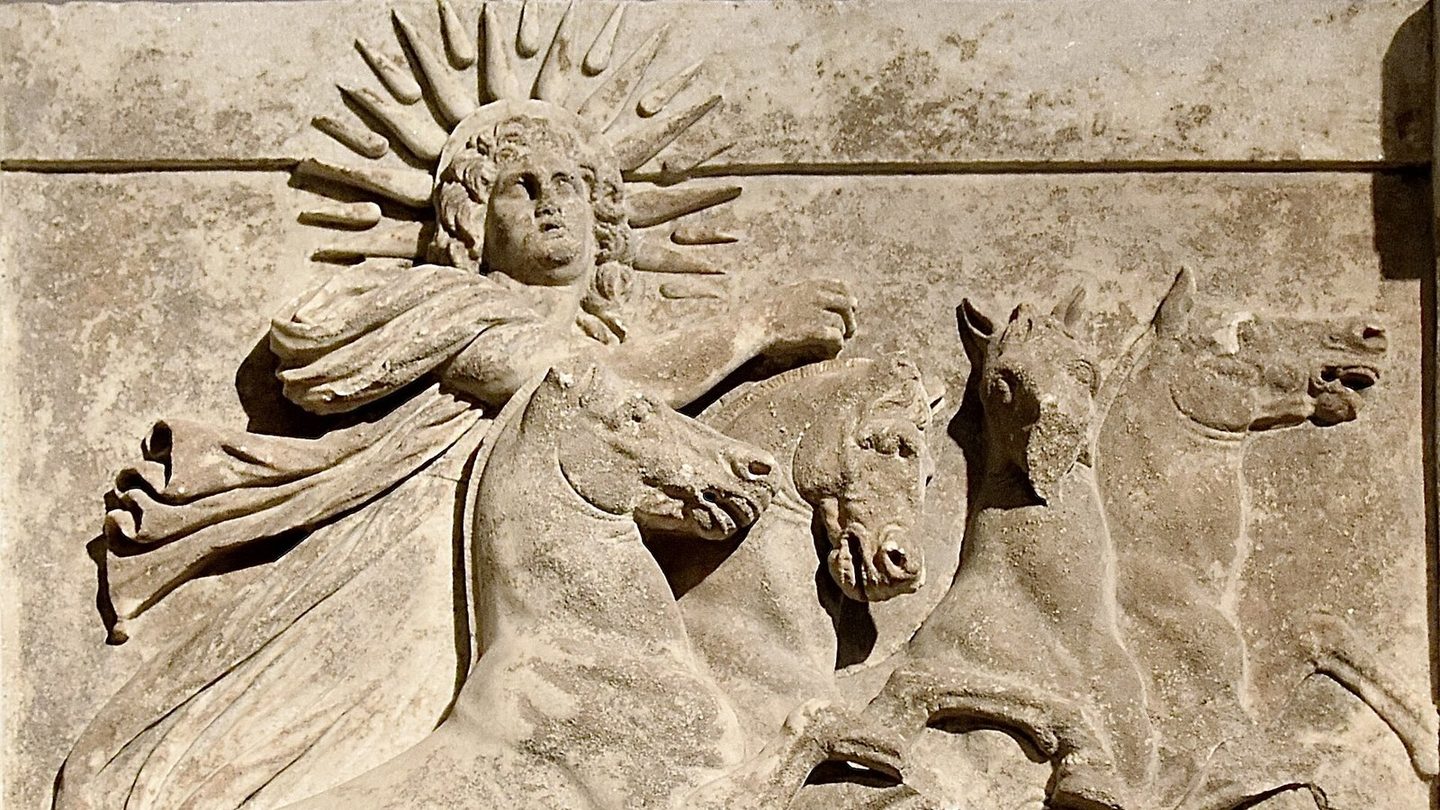
After the war against the Titans, the losing generation was confined. Hesiod sends most of them down to Tartarus, the pit beneath the underworld. Helios was not among them. He kept his chariot, his four horses and his daily route from the eastern Ocean to the west, and no surviving source describes him serving a sentence or losing his office.
The reason is structural. The sun has to rise. A deity whose function cannot be interrupted is a poor candidate for imprisonment, and Helios's power in the poems runs on exactly that logic: he wins by withdrawing. In the Odyssey he threatens to abandon the sky and shine among the dead unless Zeus punishes the men who killed his cattle, and Zeus complies. A being who can withhold the sun holds a standing the political settlement never touched.
Homer gives him a god's job and a god's authority
The oldest Greek poetry treats Helios as a god without hesitation. In the Iliad, when Agamemnon seals the truce before the duel between Menelaus and Paris, he calls on Zeus, the rivers and "Helios, who sees all things and hears all things" (Iliad 3.276-277) to witness the oath. That formula reflects practice. Oaths in the Greek world were sworn before witnesses who could not be deceived, and the sun, which passes over everything, was the witness who missed nothing.
The same all-seeing quality drives plots elsewhere. Helios is the one who tells the grieving Demeter who took her daughter, since he alone saw the abduction from above, which is why he stands in the background of the Persephone and Hades story. He is also the god who catches Ares and Aphrodite together and reports it to Hephaestus. When the Odyssey's crew slaughters his sacred herd on Thrinacia, he goes to Zeus and demands justice, and Zeus destroys the ship with a thunderbolt. Throughout, Helios acts with the standing of a god.
He had his own temples, which is not something you build for a category
Cult is the clearest evidence, because worship is a practical act. Rhodes was Helios's main centre: his sanctuary there was called the Haleion, his festival the Halieia, and the Colossus of Rhodes was raised in his honour. Pausanias, traveling in the second century AD, records more of the same across the Greek mainland.
| Place | What Pausanias records | Reference |
|---|---|---|
| Corinth | Gilded chariot groups of Helios and his son Phaethon over the north entrance to the forum | 2.3.2 |
| Troezen | An altar to Helios the Liberator, for deliverance from the Persians | 2.31.6 |
| Hermione | A temple to the Sun | 2.34.10 |
| Megalopolis | A herm of Helios the Savior in the precinct of the Great Goddesses (Demeter and Kore) | 8.31.7 |
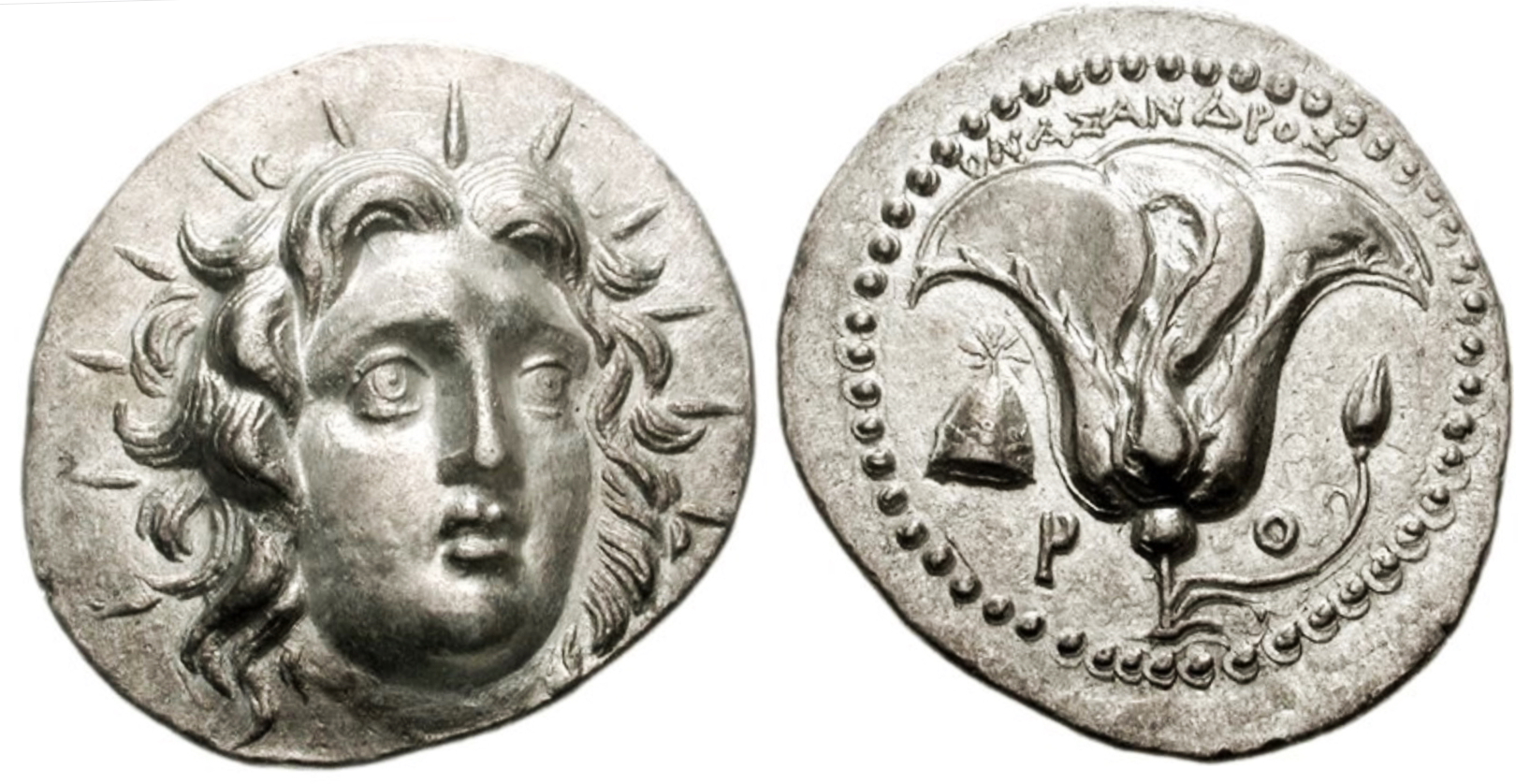
Temples, festivals and a city's coinage are what a patron deity receives. The Rhodians gave Helios all three, treating him as the patron of their island rather than a footnote to a succession myth.

Where the confusion comes from: Apollo
Ask a modern reader who the Greek sun god is and the answer is often Apollo. That answer is late, and it is the reason the question exists. In Homer, Apollo is a plague-god with a silver bow and no solar role at all; the sun is Helios, and the two are never merged. The earliest certain identification of Apollo with the sun comes from a fragment of Euripides' lost play Phaethon, from around 420-410 BC, in which Clymene laments that the god who destroyed her son is Helios, "whom men rightly call Apollo" (fr. 781).
From there the fusion spread. By the Hellenistic period Apollo was tied to the sun in cult and poetry, and Rome inherited the merger as Sol. Once Apollo has been promoted into "the sun god," Helios has to become something else, and the nearest available label is the one his parents gave him. That is how a genealogical fact turned into an answer to a question the sources were not asking. The same kind of late merger reshaped Selene, who was folded together with Artemis and Hecate.
So which is it?
Titan by descent, god by everything else. His parents were Titans, he belongs to that lineage, and he is absent from the usual lists of the twelve Olympians. But he was never punished and never stripped of his function, and the people who swore oaths in his name and built him temples treated him as a god throughout.
The mistake is to read "Titan" as a species. In the Greek texts it is closer to a generation, and generations overlap with godhood rather than excluding it. Helios is both at once, and the sources are comfortable with that in a way the question is not. His daughter Circe shows the same pattern: Homer calls her a goddess even though her father is a Titan.