
The love story most pages promise, and the plot Sif never gets a line in
Search "Thor and Sif" and the results mostly agree on a shape: devoted husband, beautiful golden-haired wife, a prank against her that Thor avenges. Lesson pages and mythology roundups tend to frame the whole episode as proof of Thor's love, a domestic aside before he gets back to fighting giants. What the actual 13th-century source describes is narrower and stranger than that summary suggests, and Sif herself does not say or do anything in it.
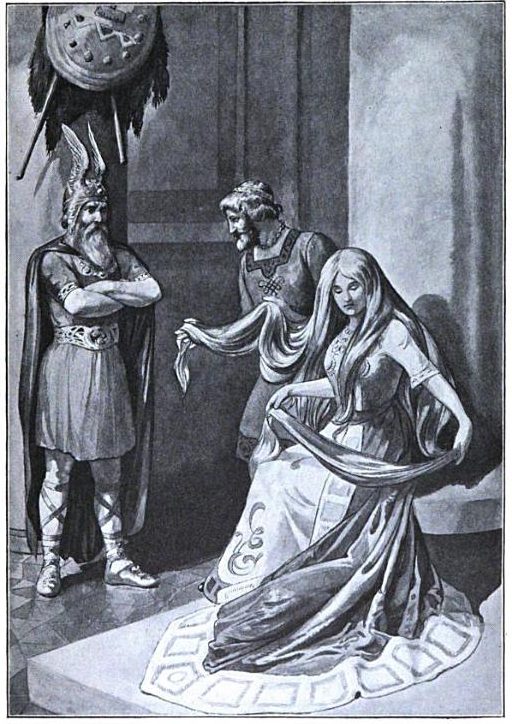
The text is Skaldskaparmal, the second part of Snorri Sturluson's Prose Edda, a handbook for poets that explains the kennings, the compressed metaphors, Norse verse ran on. One entry in it exists specifically to explain why gold is sometimes called "Sif's hair." Arthur Gilchrist Brodeur's standard 1916 translation gives the opening in eight words: "Loki Laufeyarson, for mischief's sake, cut off all Sif's hair." No motive beyond mischief is offered. No prior conflict is described. It is simply what Loki does.
Thor's reaction is immediate and almost fatal for Loki: he seizes him and, in Brodeur's phrasing, "would have broken every bone in him," until Loki swears an oath to get the dwarves called the Black Elves to forge Sif hair of gold that will take root and grow like the hair it replaces. That oath is the whole of Sif's role in her own most-cited story. The passage exists in Snorri's handbook to explain a poetic metaphor for gold, and, further down the same chapter, an epithet for Loki himself: "Harmer of Sif's Hair." It is not built to be a portrait of a marriage.
One prank, five legendary objects, and a wager Loki nearly loses his head over
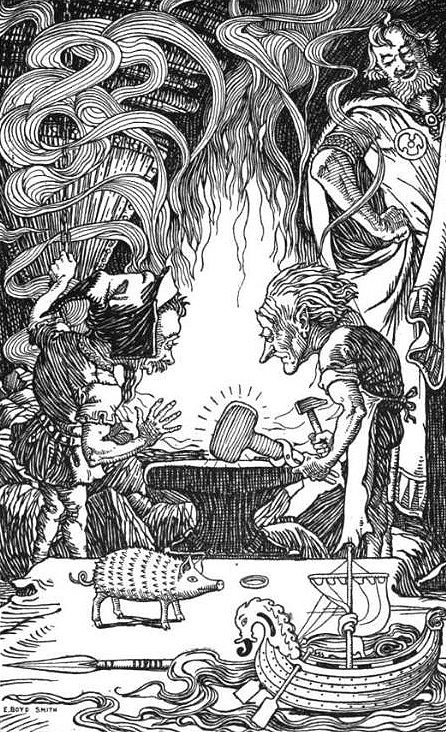
Loki carries out his oath by going to the dwarves Snorri calls Ivaldi's Sons, who forge three things at once: the golden hair for Sif, the ship Skidbladnir that folds up small enough to fit in a pouch, and the spear Gungnir that Odin will carry ever after. Flush with those results, Loki makes a bet he does not need to make. He wagers his own head with a dwarf named Brokkr that Brokkr's brother Sindri cannot forge three objects to match them.
Sindri and Brokkr work at a forge under active sabotage. A fly, never named outright but understood by every retelling since as Loki in disguise, stings Brokkr on the hand, then the neck, then between the eyes hard enough to draw blood into them, trying to break his bellows-work at each stage. He keeps working anyway. Out of that forge come a golden-bristled boar that can outrun any horse and light its own way through darkness, a ring called Draupnir that drips eight more rings of equal weight every ninth night, and a hammer. Brodeur's translation notes the hammer's one flaw plainly: "the fore-haft was somewhat short," the direct result of the fly's final sting interrupting the smith mid-strike.
Odin, Thor, and Freyr sit as judges over both sets of gifts, and the verdict goes entirely to Brokkr's hammer, on the grounds that "in it there was the greatest defence against the Rime-Giants." Sif's restored hair, the item that started the entire chain of events, does not even get mentioned in the ruling. Having lost, Loki tries to talk his way out of the wager, offering to "redeem his head" with a payment instead, and when that fails, protests that Brokkr can take the head but was never promised the neck, a technicality the dwarves answer by sewing his mouth shut rather than beheading him. By the story's own accounting, its real subject is Mjolnir's origin and Loki's punishment. Sif supplies the opening incident and then exits the narrative entirely.

The accusation two different poems raise, and neither one ever settles
Sif appears independently of the hair story exactly twice more in the surviving Eddic poems, and both appearances involve the same unresolved claim. In Lokasenna, the poem built around Loki insulting every god at a feast in turn, Sif steps forward and offers Loki a cup of mead, declaring herself the one member of the Aesir's children beyond reproach. Loki drinks, then accuses her of having betrayed Thor with him. Sif does not answer. The poem simply moves on to its next target.
In Harbardsljod, a separate poem built around Thor arguing with a ferryman who is secretly Odin in disguise, the ferryman needles Thor by claiming Sif has a lover waiting at home. Thor calls it a lie and presses on toward the crossing he wants. Neither accusation is ever confirmed, denied with evidence, or explained anywhere else in the surviving corpus. The scholar Carolyne Larrington has proposed a possible link between the two loose threads, suggesting the hair-cutting scene may be the source of Loki's claimed intimacy with Sif, close enough contact to make the boast plausible within the poem's own logic. That is an inference from later scholarship, not something either poem states. What the primary texts actually leave behind is two separate insults about the same subject, raised in two unrelated confrontations, that no myth in the corpus ever resolves one way or the other.
Snorri's other Sif: a human prophetess, not a goddess at all
The Prose Edda opens with a Prologue, written by the same Snorri Sturluson who tells the hair story later on, and it describes an entirely different Sif. The Prologue reframes the Norse gods as historical men and women, Trojan migrants later mistaken for deities by people who forgot their human origins, a strategy scholars generally read as Snorri's way of making pre-Christian material safe to write down for a 13th-century Christian audience. In that account, Thor does not marry a fertility goddess. Anthony Faulkes's translation of the passage has it plainly: Thor comes across "a prophetess called Sibyl, whom we call Sif, and married her." She is a gifted seer, not a divine figure with a domain to preside over.
That version rarely survives into modern retellings, which jump straight to Skaldskaparmal's hair-cutting episode and treat "goddess" as settled fact. It is worth noting that scholars have proposed her golden hair stands for ripening wheat, tying her to fertility and the harvest, but that reading is an interpretation built on the hair's color and Sif's brief kenning-based appearances elsewhere, not a claim any surviving source makes outright about her in so many words. Between the Prologue's human prophetess and Skaldskaparmal's silent goddess, Snorri's own book cannot even settle what kind of being Sif is supposed to be, and nothing like a central clergy existed to reconcile the two accounts into one official version the way a church council might have.
What the sources actually add up to
Strip away the modern gloss and what remains is three disconnected fragments: an origin story for other gods' treasures in which Sif is acted upon rather than acting, two accusations of infidelity that arrive from different directions and are never adjudicated, and a Prologue that quietly demotes her from goddess to human seer. None of the three describes the marriage itself, how it began, what it was like, or how Thor and Sif related to each other day to day. Snorri's kennings do supply one concrete fact outside all three fragments: Ullr is listed as "Son of Sif, Stepson of Thor," meaning Sif already had a son by another father before this marriage, a life and family history the sources otherwise skip past entirely. Loki, the trickster whose mischief drives the hair-cutting story, goes on to father Hel, whom Odin later puts in charge of an entire realm of the dead, a considerably fuller afterlife than anything the sources bother to give Sif. What passes for "the story of Thor and Sif" online is mostly modern paraphrase filling gaps the medieval material left open, not a fuller myth someone forgot to mention.